There is a city in northeast China that only exists for about two months a year. Then it melts. Every winter, workers cut thousands of blocks of ice out of the frozen Songhua River, haul them across to a patch of land in Harbin, and build a full-scale city out of them. Palaces, cathedrals, castles, a high-speed train, slides you can actually ride, all of it made of ice and lit from the inside with coloured lights. When spring comes, the whole thing turns back into water.
That is the Harbin Ice and Snow Festival, and the 2027 edition is set to be the biggest one ever built. The main park, Harbin Ice and Snow World, is expanding to 1.25 million square metres. That is about 175 football fields of frozen buildings, carved from roughly 400,000 cubic metres of ice and snow. If you have ever wanted to walk through a fairy tale at minus 25 degrees, this is the place to do it.
I have spent weeks digging through the announcements, the ticket details and the survival guides so you do not have to. Here is everything that is confirmed for the 2026-27 season, what is new, what it costs, when to go, and how to enjoy it without freezing solid.
What Is the Harbin Ice Festival, Exactly?
First, a bit of clearing up, because the name confuses almost everyone. The “Harbin Ice Festival” is not one attraction. It is a whole winter season across the city of Harbin, the capital of Heilongjiang province, about 1,200 kilometres north of Beijing.
The star of the show is Harbin Ice and Snow World, a ticketed theme park built fresh every winter since 1999. This coming winter is its 28th edition. It sits on the north bank of the Songhua River in the Songbei district, and it holds the Guinness World Record as the largest ice and snow theme park on the planet. Over its 27 seasons it has welcomed more than 40 million visits. On a single day in February 2026, more than 120,000 people walked through its gates. That was a record, and it tells you everything about how popular this place has become.
Then there is the wider festival itself, the China Harbin International Ice and Snow Festival, which officially opens on 5 January 2027 for its 42nd edition. It covers the whole city: the snow sculpture expo on Sun Island, the ice lantern fair at Zhaolin Park, the frozen river carnival, the Russian-flavoured streets of the old town. The park usually opens a couple of weeks before the official ceremony, and it closes whenever the ice starts to soften, normally in late February.
Put simply, Ice and Snow World is the main event, and the festival is everything else around it. You want at least two full days in Harbin to do both properly, three if you like taking things slow.
What Is New for 2027: The Biggest Park Ever Built
The 28th edition was confirmed on 12 October 2026 at a winter tourism event in Guangzhou, and the numbers are genuinely hard to picture. The park will cover 1.25 million square metres, making it the largest Ice and Snow World ever built. Builders will use around 400,000 cubic metres of ice and snow, and the site will hold more than 1,000 ice and snow buildings across six themed zones. Ice harvesting for this edition began on 15 January 2026, while the previous season was still running.
Here is what is new this winter:
A Disney Frozen zone, for the first time
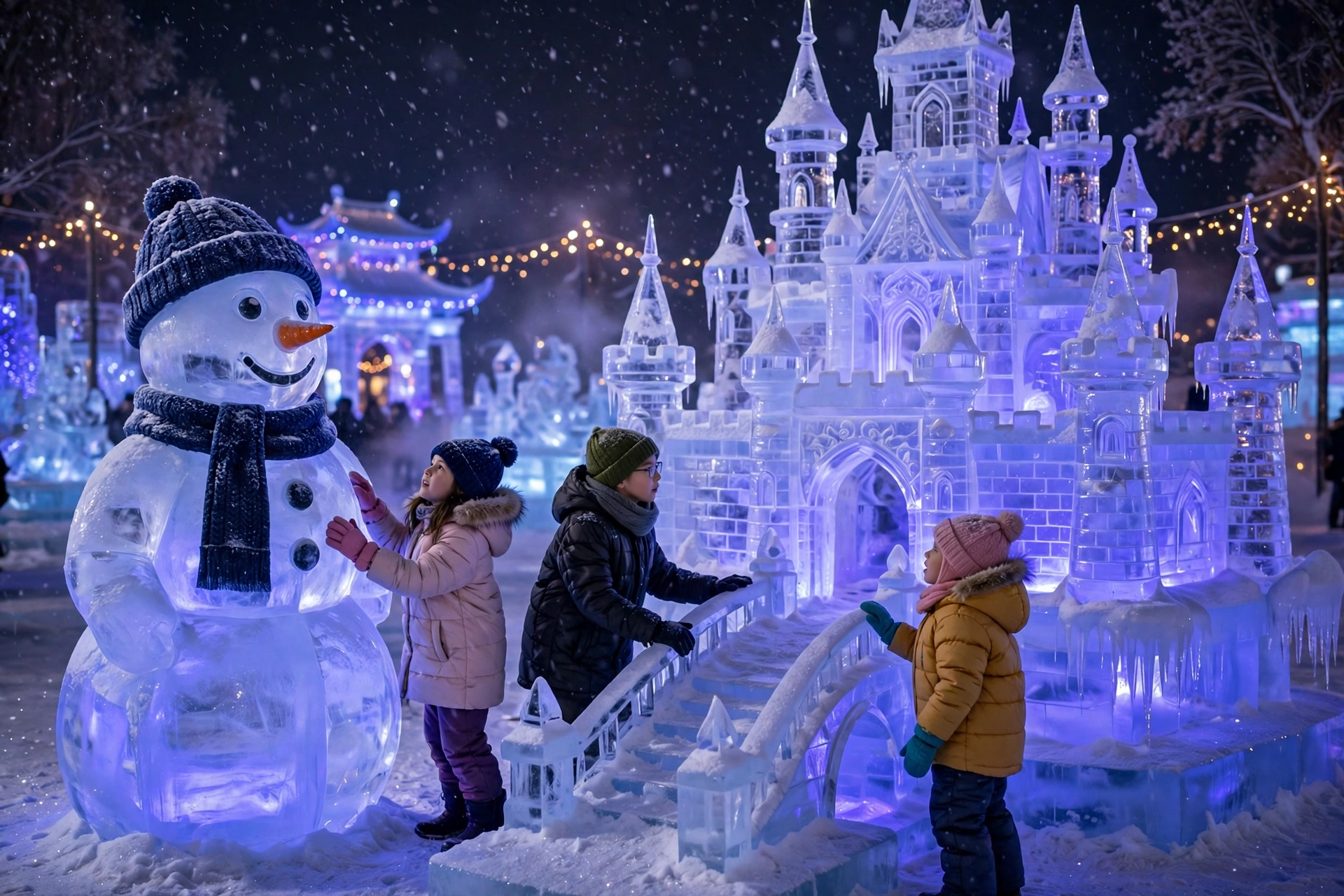
Yes, really. For the first time, Ice and Snow World will have a themed Disney Frozen area of almost 20,000 square metres, with Elsa, Anna and Olaf carved in ice, plus a pop-up shop. If you are travelling with kids, this is the part they will talk about for the rest of the year. If you are travelling without kids, go anyway. A twenty-metre Olaf glowing blue at night is worth seeing at any age.
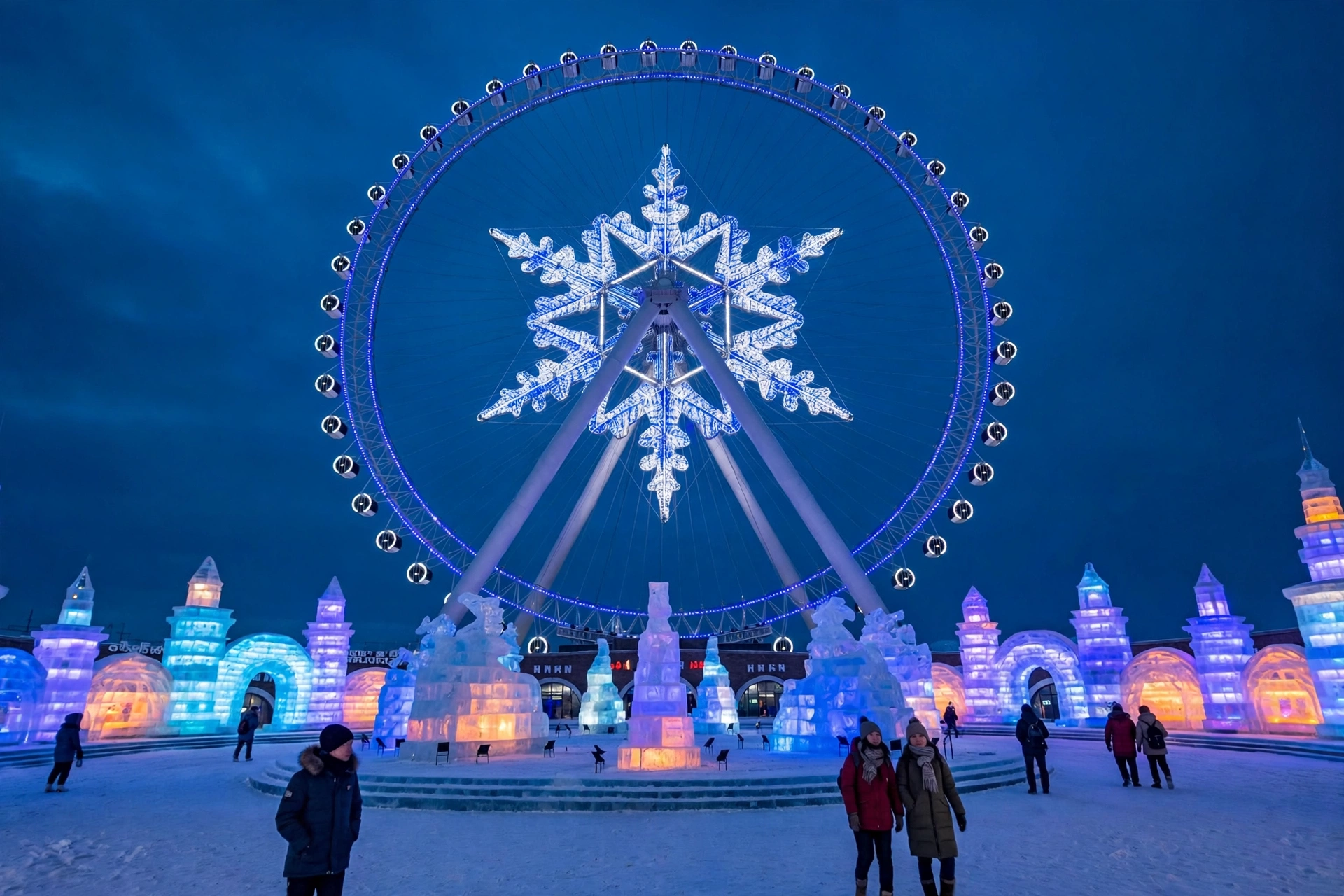
A 120-metre snowflake Ferris wheel
The new snowflake-shaped Ferris wheel stands 120 metres tall and gives you a view over the entire glowing park. Go at dusk, when the sky is turning indigo and the lights are coming on below you. It is the single best photograph in Harbin, and it is brand new for this season.
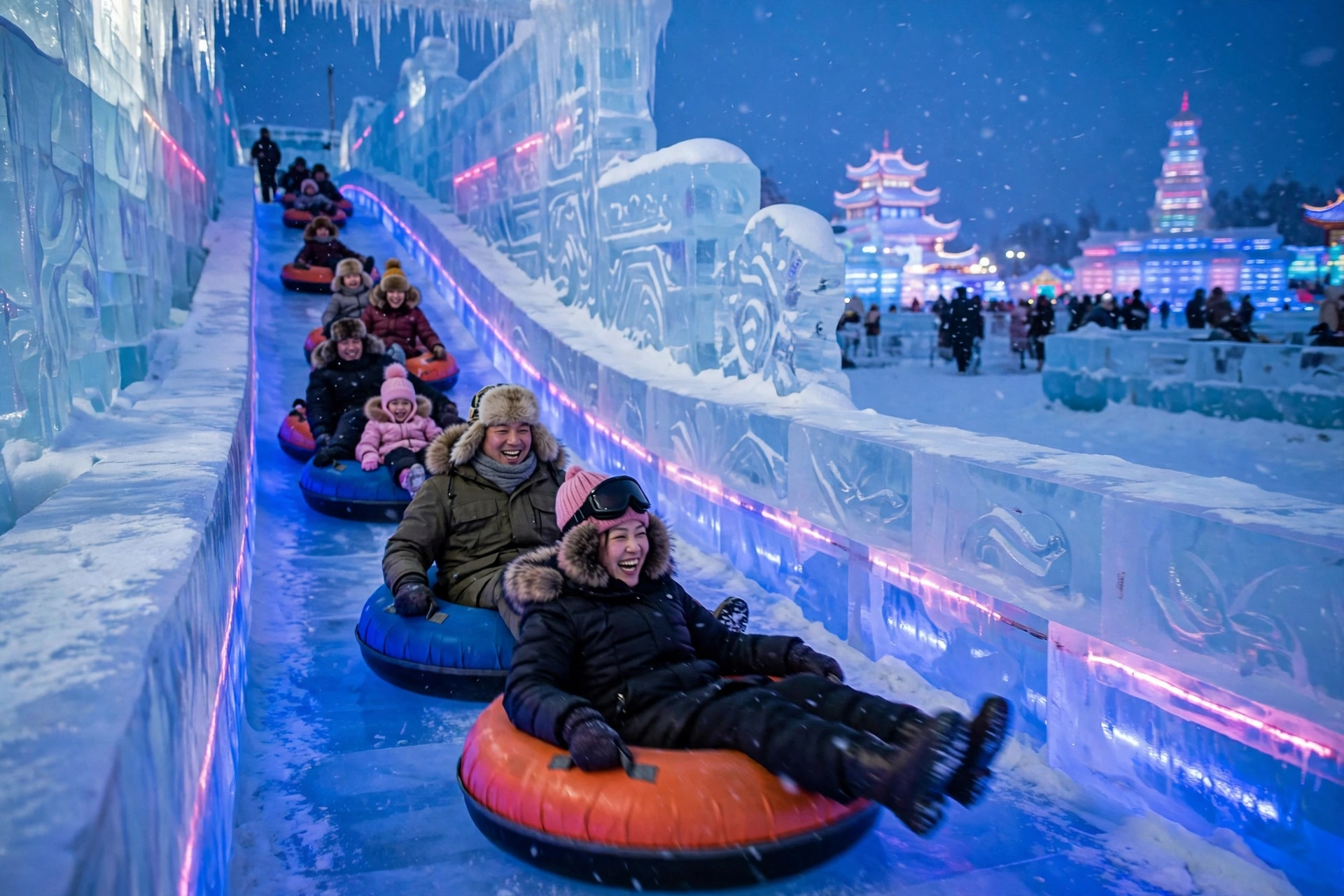
Around 100 ice slides
The park is keeping its 24 large slides and adding new ones in the west area, bringing the total to around 100. The famous Super Ice Slide is back, bigger than before, along with a new extra-long slide. Ride them early in your visit, before the evening crowds build up, because the queues are the one thing everyone complains about.
More shows, and a hot spring pool
This season adds a Dream Stage, an ice show, an ice car ballet and themed parades, plus the international ice and snow sculpture competitions. There is also a new hot-spring pool and an ice and snow RV camp expanded to 60 units. The theme for the 28th edition is “Chasing Dreams in Ice and Snow, a Romantic Date”, which sounds like a line from a wedding invitation and honestly fits the place.
When to Go: Dates, and the One Timing Decision That Matters
The exact opening day for the 2026-27 season has not been announced yet at the time of writing, and that is normal. The last two seasons opened on 21 December 2024 and 17 December 2025, and officials have said to expect mid-December 2026, with some guides pointing at around 21 December. The official festival opening ceremony is on 5 January 2027, and the park normally runs until late February.
Here is the timing advice that actually matters. Aim for 10 to 25 January. By then the construction is fully finished, every zone is open, and the lighting is at its best. You will be there before the Spring Festival crowds arrive. Spring Festival falls on 6 February in 2027, and the week around it is the busiest and most expensive of the whole season. Hotel prices can triple in January at the peak, so book early.
The other date to keep in mind is the end of the season. In February 2026, a record warm spell started melting the sculptures, and Ice and Snow World closed early on 21 February, eleven days before the planned finish. Ticket holders for the cancelled days were refunded in full. The lesson is simple: do not plan a trip for the last week of February and expect the full park. Go in January and you get the best version of it with the least risk.
Within a single day, the sweet spot is from about 3pm to 7pm. Arrive in daylight to see the ice architecture in natural light, then stay as the sun sets around 4 to 4.30pm and the coloured lights come on. The best ninety minutes are 5 to 7pm: fully dark, every light on, and the whole park glowing. It is also the coldest part of the day, so dress for it.
Tickets and Costs: What You Will Actually Pay
The 2026-27 ticket price had not been announced when the season details were released in October and November 2026, and it usually drops with the opening date. Last season’s price is the best guide you have. A standard adult ticket to Ice and Snow World cost 328 yuan, about 46 US dollars, with a cheaper 298 yuan ticket in the opening week. That ticket covers the slides, the ice skating, the ice bicycles and the ice cinema inside the park, so once you are in, the rides are free.
The other two venues are cheaper. Sun Island’s snow sculpture expo cost around 200 yuan last season, and Zhaolin Park’s ice lantern fair is free to enter, which makes it the best value evening in Harbin. You can book through the park’s official WeChat mini-program or through Trip.com, which carried the park through the last season at roughly 37 to 39 dollars. Foreign visitors can book with a passport, and the park has supported overseas payment methods in recent seasons.
A realistic daily budget looks like this. The Ice and Snow World ticket is your big spend at around 46 dollars. Add Sun Island at about 30 dollars, a metro or taxi ride for a few dollars, and food. Harbin is not an expensive city by Chinese standards. A bowl of noodles or a plate of dumplings costs a few dollars, and even a proper sit-down dinner with the local iron pot stew will rarely pass 15 dollars a person. Budget about 80 to 100 dollars a day per person and you will be comfortable.
Getting There: The Train Beats the Plane
Most international visitors come through Beijing, and from there you have two good options. The high-speed train is the one I would pick. The fastest G trains run from Beijing Chaoyang station to Harbin West in 4 hours and 33 minutes, with around 19 pairs of trains a day. Second class fares run about 598 to 665 yuan, roughly 90 to 100 dollars one way. The train runs city centre to city centre, you watch the snowy plains of the northeast roll past the window, and snow delays trains far less than it delays flights.
Flying takes about two hours in the air from Beijing Capital or Daxing to Harbin Taiping International Airport, and there are around twenty flights a day. The airport sits 33 to 40 kilometres southwest of the city centre, about 45 minutes by car. Airport bus Line 4 runs straight to the Ice and Snow World area, and Line 1 goes to Harbin Railway Station. A taxi into the city costs roughly 80 to 100 yuan.
Once you are in Harbin, getting to the park is easy. Metro Line 2 has a station called Ice and Snow World, right at the park, and the airport bus Line 4 serves the area too. Stay in Songbei, the district north of the river where the park sits, if you want to be close to the ice, or in Daoli around Central Street on the south bank if you want the restaurants, the Russian architecture and the nightlife. Metro Line 2 links the two.
The Three Venues, and How to Do Each One
1. Harbin Ice and Snow World: the main event
Allow four to six hours here, minimum. The site is enormous, and walking between zones in minus 25 degrees takes longer than you think. Go in the afternoon, ride the slides first while the queues are short, then walk the zones slowly as the light fades. The full-size ice buildings are the show: castles, pagodas, towers, even a full-size high-speed train, all lit from within. The ice bar serves drinks in glasses made of ice. There are drone light shows on some nights, and the new Ferris wheel is the place to end your visit.
One practical tip: your phone battery will die fast in this cold. Keep it in an inside pocket against your body, and bring a power bank that you also keep warm. The same goes for camera batteries. The cold is not a joke at these temperatures, and it kills electronics before it bothers you.
2. Sun Island Snow Sculpture Expo: go in the morning
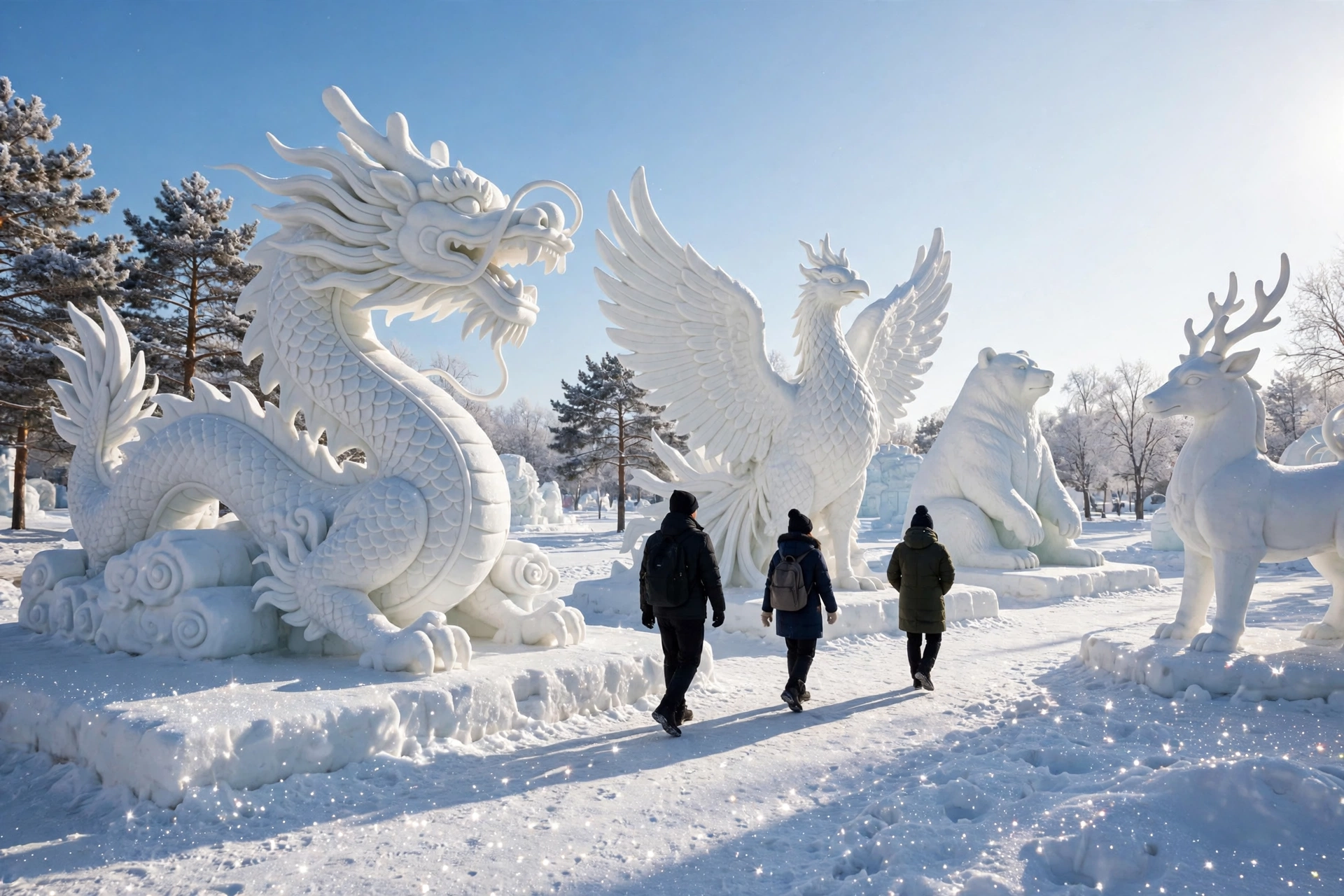
Sun Island sits across the frozen Songhua River, and it is a completely different experience. Where Ice and Snow World is about coloured light at night, Sun Island is about pure white snow in daylight. Sculptors carve colossal snow figures, some of them tens of metres tall, out of packed snow. Go in the morning, when the sun is low and the snow looks its whitest, and get there by 10am to beat the tour groups. Allow two to three hours. You can cross the frozen river on foot or by cable car, which is an experience in itself.
3. Zhaolin Park: the lanterns, and the cheapest night out
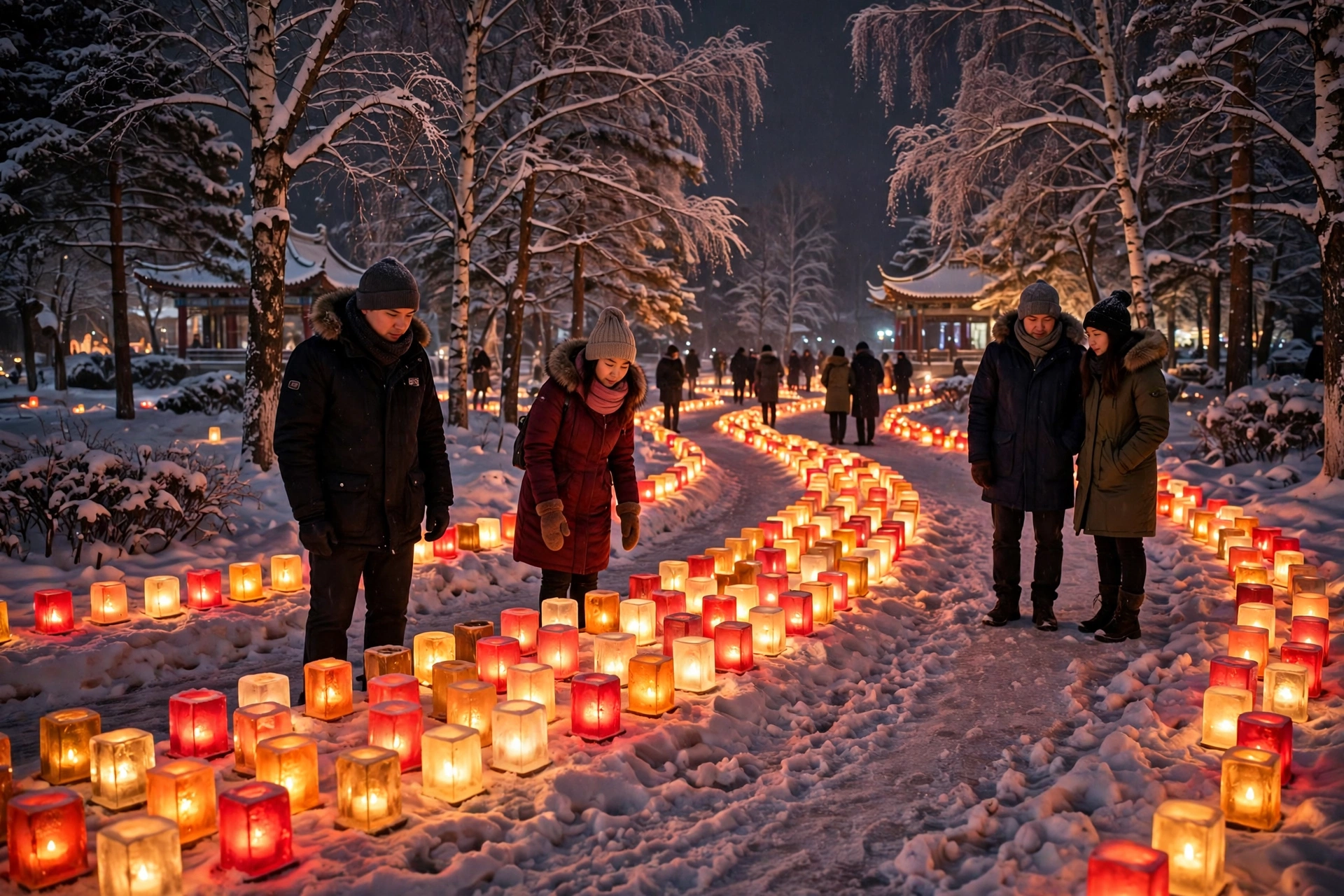
Zhaolin Park is where Harbin’s ice art began, and its ice lantern fair is the oldest part of the festival. Hundreds of small ice lanterns in red, orange and gold line the snowy paths between the trees, and the whole park glows warm instead of electric blue. It is smaller and quieter than Ice and Snow World, it is free to enter, and it is the most romantic of the three venues. Go after dinner, walk slowly, and let it be the gentle end to a long cold day.
Harbin Beyond the Ice: A City Worth a Day on Its Own
Most visitors make the mistake of treating Harbin as a one-park trip. The city itself is half the reason to come. Harbin was built up in the late 1800s as a Russian railway town, and the old centre still looks like a piece of Europe dropped into northeast China.
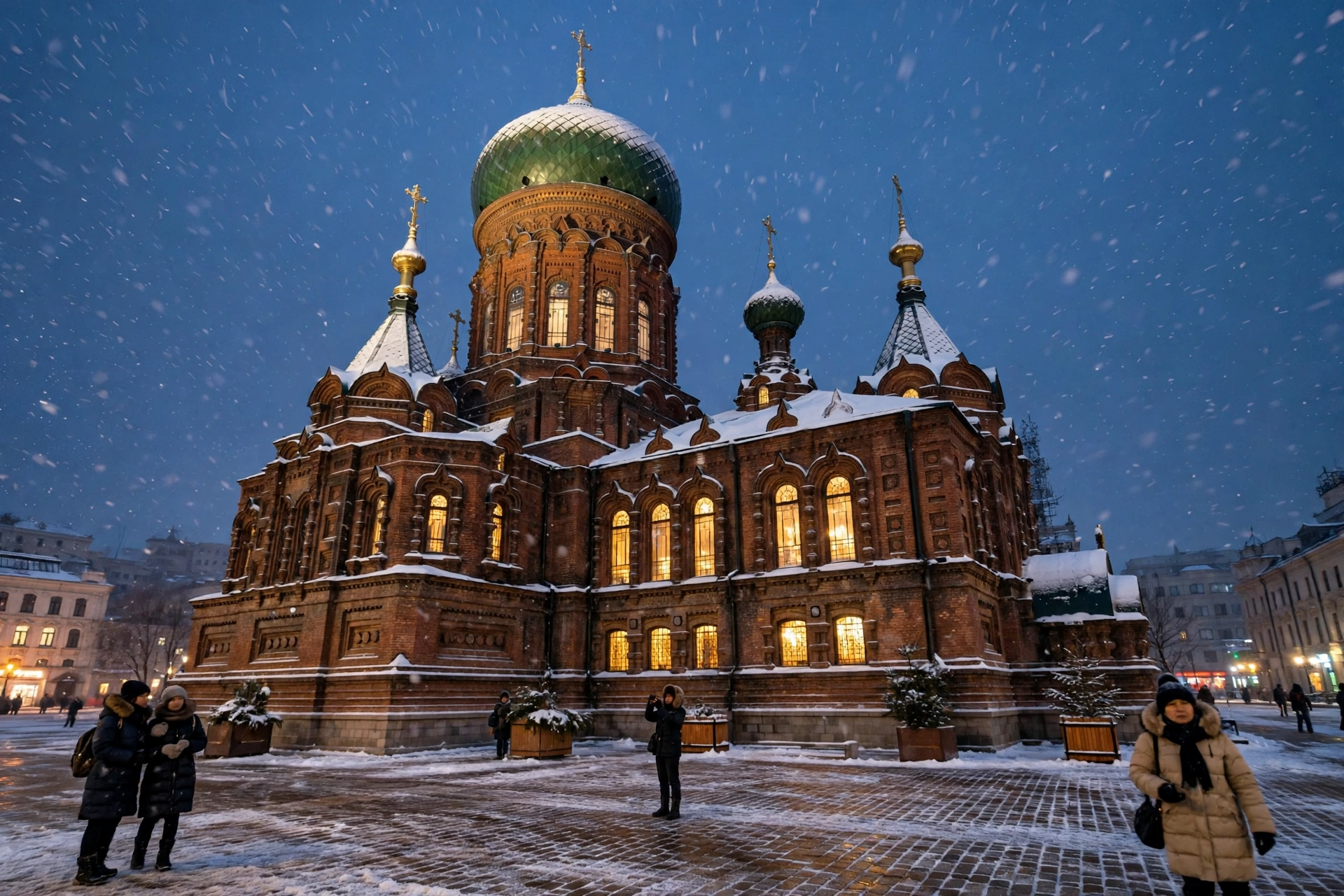
Start at Saint Sophia Cathedral, the red-brick Russian Orthodox church with green onion domes, finished in 1932 and now the largest Orthodox church in the Far East. Go early in the morning, when the courtyard is empty and the snow is fresh, and it photographs like a postcard. Then walk Central Street, the cobbled pedestrian street lined with Baroque and Russian facades, and eat your way along it. The local rituals are worth knowing: Madieer ice cream, eaten outdoors in minus 20 degrees because that is how Harbiners do it, and Qiulin sausage from a street vendor. For dinner, order tie guo dun, iron pot stew, which is basically a hot pot built to warm you from the inside out.
If you have a third day, the classic add-on is China Snow Town, about five hours away, a village of snow-covered wooden houses that looks like a film set. Or go the other way and visit the Siberian Tiger Park, where the big cats are far more active in the cold than they ever are in summer. Either way, do not fly home after one night at the ice park. You will have seen the postcard and missed the city.
Surviving -30C: The Cold Is the Real Adventure
Let us be honest about the part nobody puts on the postcards. Harbin in January runs from about minus 15 to minus 30 degrees Celsius. That is cold enough to hurt, and cold enough to ruin your trip if you get it wrong. The good news is that it is a dry cold, and with the right layers it is completely manageable. People live here all winter. You can handle a few days.
The layering system that works is simple. Start with thermal underwear, top and bottom, against your skin. Add a fleece or wool mid-layer. Finish with a long down jacket that covers your hips, plus snow pants or at least windproof trousers. Insulated boots with thick wool socks are non-negotiable. Your feet will be the first thing to go numb, and once they do, the whole day goes with them.
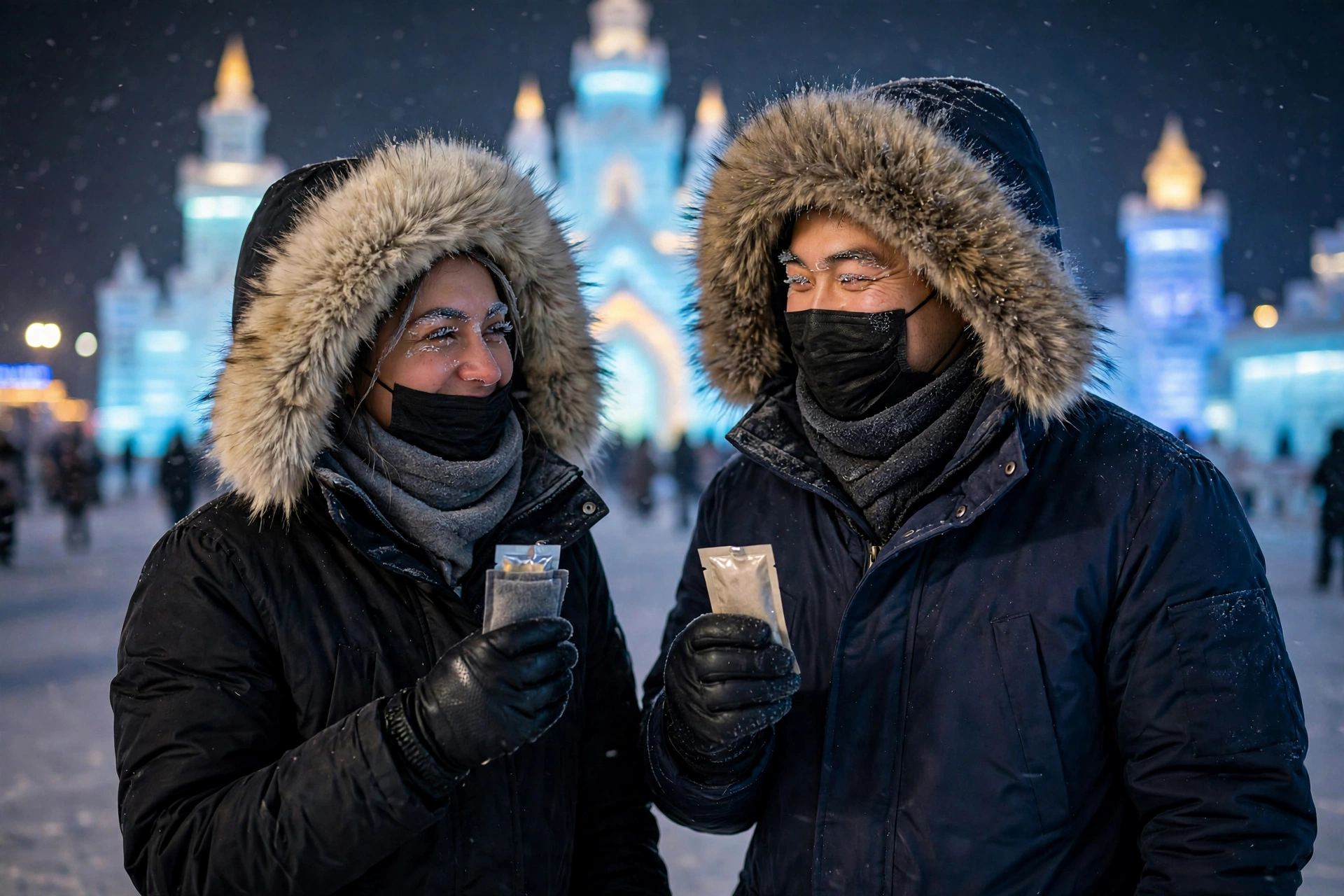
Cover everything else. A hat that covers your ears, a scarf or face mask, and proper gloves, not the thin touchscreen kind. Bring hand warmers, the disposable kind you crack open and slip into your gloves and boots. They are cheap, they are sold everywhere in Harbin, and they are the difference between a magical evening and a miserable one. Keep your phone and power bank warm in an inside pocket, and do not take your gloves off for photos for longer than a few seconds. Frostnip on fingertips can happen faster than you expect at minus 30.
One more thing that surprises first-timers: you will sweat. Walking between zones, climbing ice slides, queuing in a crowd, all of it warms you up. Then you stop, and the sweat turns cold against your skin. The fix is to unzip your jacket when you are moving and zip it back up when you stop. It sounds fussy, but it is what the locals do, and it works.
Where to Stay and How Long to Spend
Two to three days is the sweet spot. Day one: arrive, settle in around Central Street, walk the street in the evening, eat well, sleep early. Day two: Sun Island in the morning, rest at the hotel in the afternoon, then Ice and Snow World from 3pm until the lights and the cold chase you home. Day three: Saint Sophia Cathedral in the morning, Zhaolin Park lanterns in the evening, and a slow last dinner.
For hotels, Songbei puts you closest to the park, and Daoli puts you closest to the food and the old town. Both work, because Metro Line 2 connects them. Book as early as you can, especially for January. The festival drew more than 3 million visits in the first 52 days of the 2024-25 season, and hotel prices in the peak weeks can triple. If the big international hotels are full, the local mid-range hotels around Central Street are good value and the staff are used to foreign guests.
On money, bring your cards but also have some cash and a working mobile payment option if you can set one up before you travel. The park’s ticketing runs through a Chinese-language mini-program, though Trip.com sells tickets to foreign visitors and the park has accepted passport bookings and overseas payments in recent seasons. Book the ticket before you travel rather than sorting it out at the gate in minus 25 degrees.
On visas, check the rules for your nationality before you book anything. China runs a 240-hour transit visa-free scheme that many travellers use for a Beijing plus Harbin trip, but the details and the eligible zones change, so confirm the current rules for Harbin specifically rather than assuming the Beijing rules apply.
Is Harbin Worth It?
Here is the honest answer. Harbin is cold, it is crowded at the peak, the queues for the slides can be long, and the exact opening date is never confirmed until the last minute. If you want a smooth, predictable winter holiday, go to a ski resort.
But if you want to see something that exists nowhere else on earth, a city built out of a frozen river and lit up like a dream, then lit up again bigger than ever in 2027, Harbin is worth every frozen fingertip. The 28th edition is the largest Ice and Snow World ever attempted, with a Disney Frozen zone, a 120-metre snowflake Ferris wheel and around 100 slides. It is the kind of trip you will still be talking about in ten years, long after you have forgotten the cold.
Book the train from Beijing, pack your warmest layers, aim for mid-January, and go and see a city made of ice before it melts.
Planning Your Harbin Trip? Start Here
If this guide helped you picture the trip, save it and share it with whoever you would drag along to minus 30 degrees. For more winter adventure ideas, read our guide to Iceland’s ice cave season, where the caves glow blue from the inside, and our Zhangjiajie adventure guide for another side of China entirely. And if you want the slow, high-altitude version of adventure, our Upper Mustang guide covers the Himalayan kingdom that just opened up to solo travellers.
For the latest confirmed dates and ticket details as the season approaches, check the detailed Harbin guides at Baba Goes China and Jusha Travel, which track the official announcements as they drop. Then follow The Cavee on Pinterest for more winter adventure guides, and start packing. The ice is waiting.