You’ll Rappel 60 Meters Straight Down Into the Earth. What Waits at the Bottom Is Unreal.
There’s a hole in the ground in the jungles of Java that people fly across the planet to fall into. On purpose.
Not walk into. Fall into. Strapped to a rope, leaning back over the edge of a 60-meter pit, while the jungle floor disappears above you and the whole world goes dark for about four minutes.
Then your boots touch something soft. The rope goes slack. A guide unclips your harness. And when your eyes adjust, you see it: a shaft of sunlight so thick and white it looks solid, dropping from the sky through the hole you just came down, lighting up a patch of ancient forest that should not exist underground.
The locals call it the Light of Heaven. And honestly? After standing under it, I’ve stopped arguing.
This is Jomblang Cave in Gunung Kidul, Yogyakarta, Indonesia. It is the only cave I’ve ever covered where the adventure starts with being lowered into the earth like cargo. If you’ve ever wanted to feel what it’s like to rappel into another world and come back with the photo that makes everyone on your feed ask “where IS that,” this is your cave. Let’s get into everything: what it costs in 2026, how the day actually runs, and the mistakes that turn this trip from magical to miserable.
What Makes Jomblang Different From Every Other Cave on This List
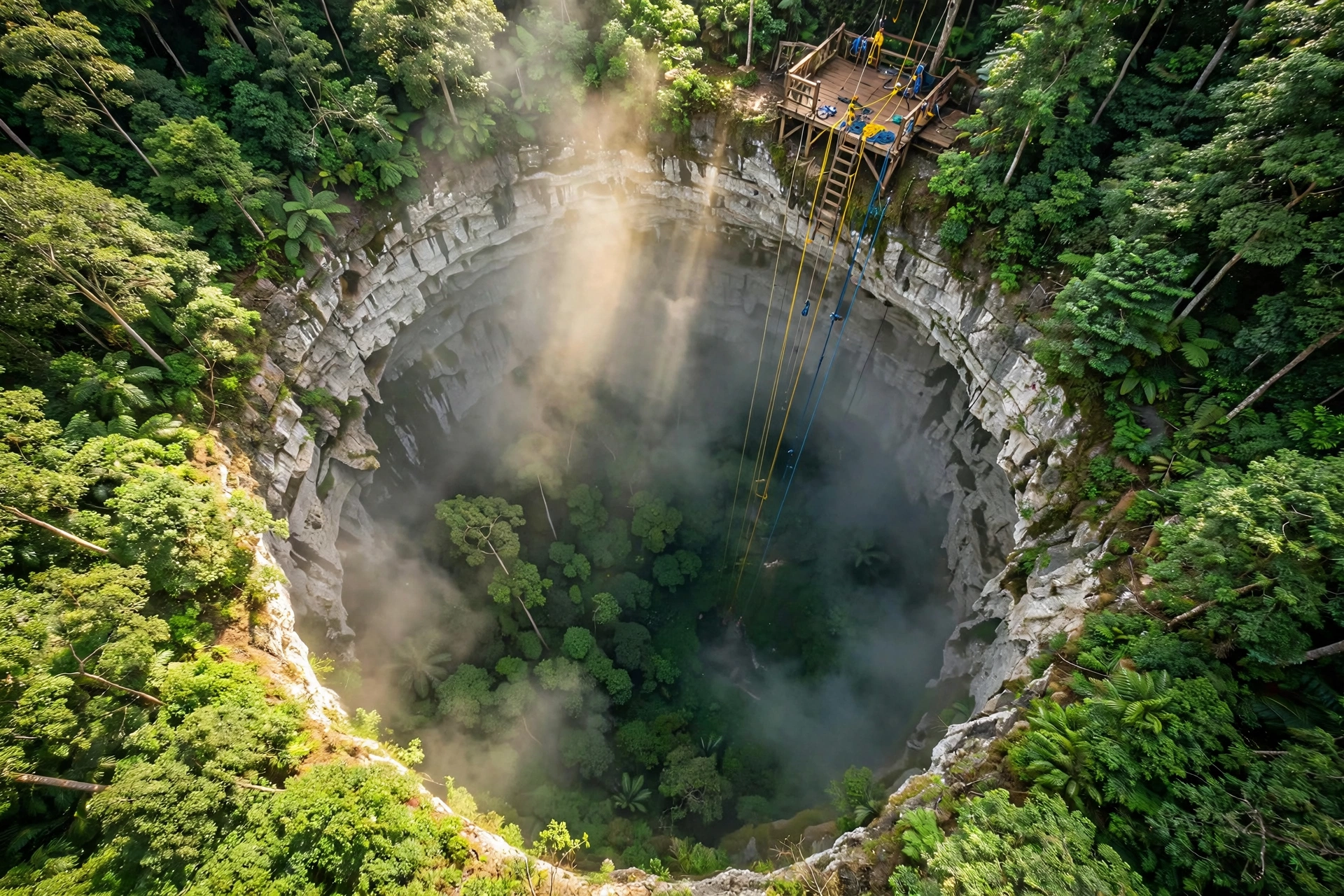
Most caves you walk into. Jomblang, you sink into.
The cave is a vertical pit, a collapsed sinkhole that dropped roughly 90 meters into the ground thousands of years ago, taking a chunk of ancient rainforest down with it. That forest never left. It kept growing in the dark, in a chamber that’s part cave, part lost world, fed by the daylight pouring through the hole in the ceiling.
From the surface, the rim looks unremarkable: jungle, some rocks, a wooden platform, a metal pulley rig. Ten minutes later you’re 60 meters down, standing in mud, breathing cool air, while green light filters through ferns the size of small cars.
Jomblang is actually two caves connected underground. The first pit drops you into Jomblang itself. Then a long, dark, gloriously muddy tunnel connects it to Grubug Cave, where the Light of Heaven beam lands. Most visitors experience both in one go, which is why the tour takes half a day, not an hour.
There is nothing else quite like it in Southeast Asia. Indonesia has plenty of horizontal caves you float through on tubes (Pindul Cave, just down the road, is exactly that). Jomblang is the one where gravity does the work, and your camera roll will never look the same.
The Light of Heaven: The Moment You’re Really Paying For
Let me be honest about something, because this matters for your trip planning.
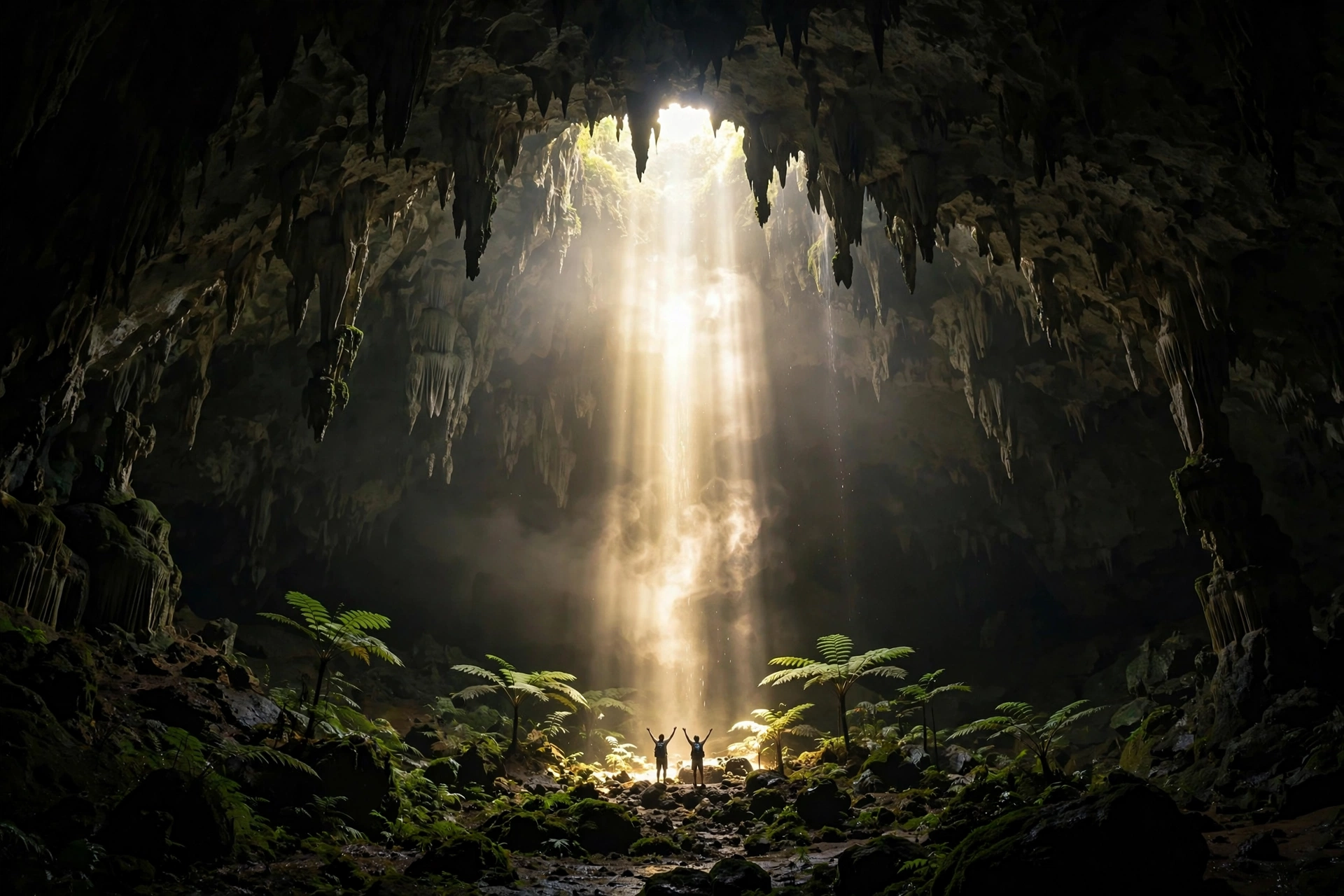
The famous beam of light that every Jomblang photo shows? It only looks like THAT for a short window around midday, roughly 11 a.m. to 1 p.m., when the sun is directly overhead. Earlier in the morning, the beam is weaker or lands at a different angle. On an overcast day, it’s muted entirely. The light is real physics, not Photoshop, but it is a sunbeam, and sunbeams answer to the weather.
When it’s on, though, it’s absurd. The shaft drops through the hole in Grubug’s ceiling and hits a small clearing in the cave’s interior forest. Dust and mist hang in it. Ancient fern trees frame it. If you time it right and your guide knows the spot (they all do), you stand in the beam while someone photographs you from the dark. The contrast is so strong your phone will struggle, which is why the guides are pros at this exact shot.
Here’s the good news: the standard daily tour runs from about 10 a.m. to 1 p.m. at the cave itself, which puts you at the light right in the sweet spot. The whole operation is timed around it. You just need to be there on a clear day, and the dry season is your best bet.
What the Day Actually Looks Like, Step by Step
The 2026 tour itinerary is nearly identical across operators, because there’s only one tour per day and one way down. Here’s how a typical day runs:
7:00 to 9:00 a.m.: The drive from Yogyakarta
Jomblang sits in the Gunung Kidul regency, about 1.5 to 2 hours southeast of Yogyakarta. Most 2026 tour packages include hotel pickup and an air-conditioned car. If you’re going DIY, a private car from Yogyakarta runs about 550,000 IDR total, which is easy to split with friends. Scooter rentals work too if you’re confident on Indonesian roads.
9:00 to 10:00 a.m.: Registration, briefing, gear-up
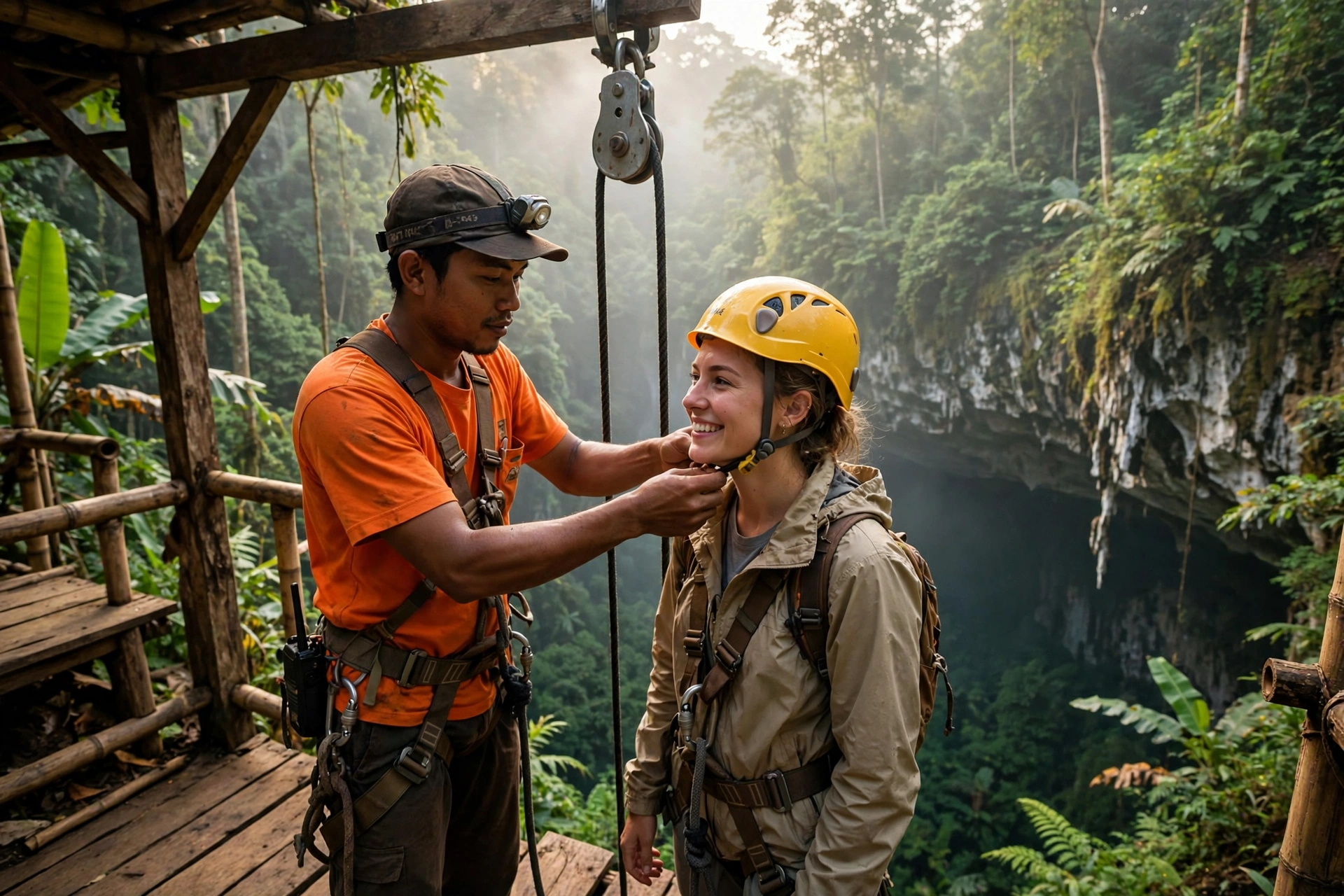
You’ll sign in, pay the entrance fee, and get kitted out: harness, helmet, gloves. The staff runs a safety briefing. This is also when the smell of the shared helmets becomes a topic of conversation among travelers, which brings me to a pro tip: bring a shower cap from your hotel to wear under the helmet. Every seasoned visitor mentions this. It’s not a hygiene scandal, it’s a humid tropical cave and hundreds of heads have worn that helmet. A thin cap solves it completely.
10:00 a.m. to 1:00 p.m.: The descent and the caves
You lean back over the edge, and a pulley system lowers you 60 meters down. It takes a few minutes. It’s controlled, the staff manages the rope, and you don’t do any of the rappelling work yourself, you just enjoy the controlled fall and try not to scream into the void.
On the cave floor, your group hikes through Jomblang’s chamber, past the ancient forest, into the muddy connecting tunnel toward Grubug. The tunnel is the part nobody warns you about: it’s dark, slippery, and genuinely muddy. You’ll be glad you wore the right shoes (more on that below). At the end of it, the tunnel opens into Grubug, and there it is: the Light of Heaven.
You’ll spend time at the beam, take photos, maybe just stand there quietly for a bit. Then you walk back, and the staff winches you back up to the surface, one or two at a time, on the same rope system.
1:00 p.m. onward: Lunch and the drive back
A simple local lunch is included in most 2026 packages, eaten at the site. You’ll be back in Yogyakarta between 2 and 4 p.m., depending on the operator. Total time at the cave: 4 to 5 hours. Total day: about 10 hours door to door.
The Muddy Tunnel Nobody Warns You About (And Why You’ll Love It)
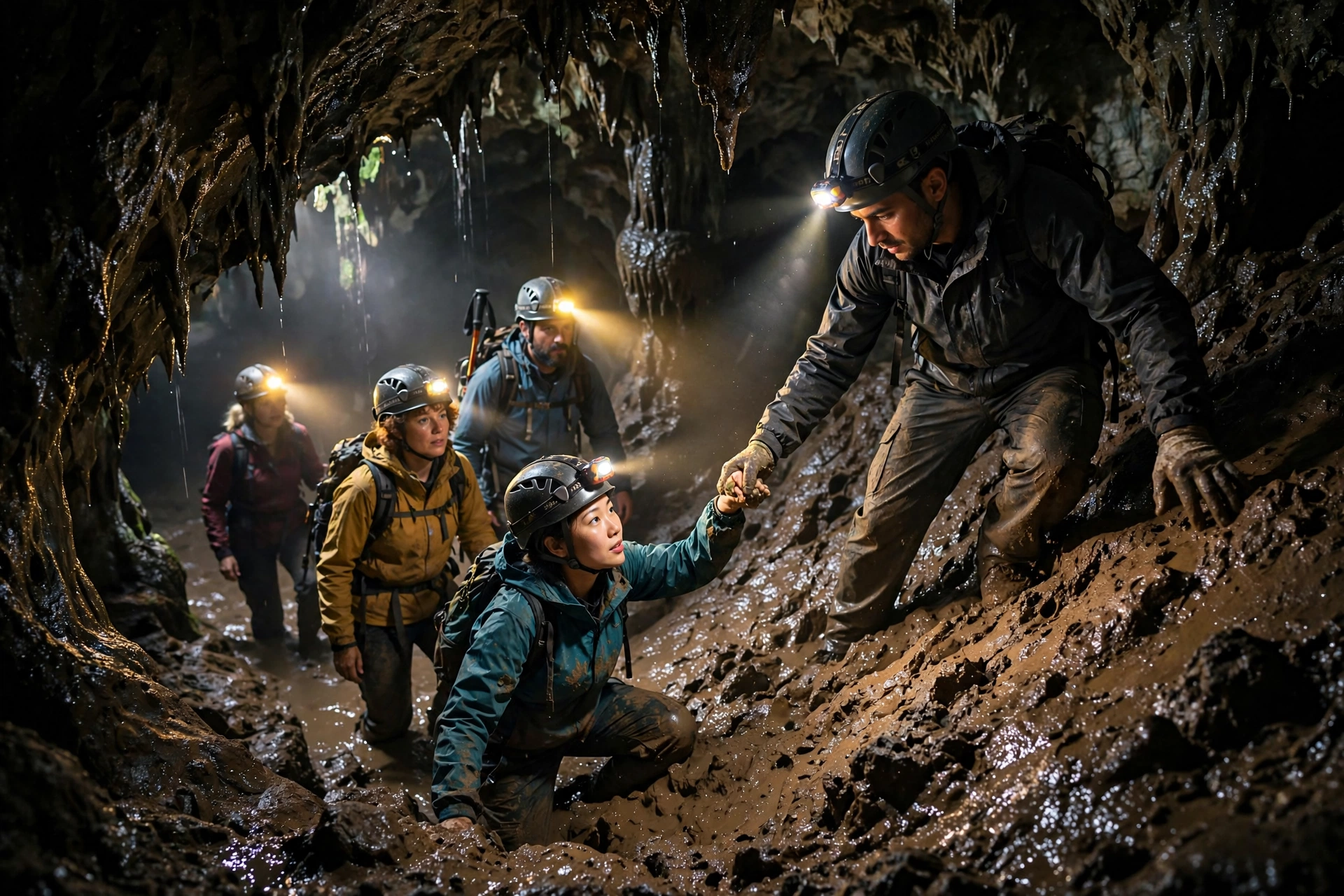
If Jomblang’s descent is the thrill, the tunnel to Grubug is the adventure. It’s a few hundred meters of wet, dark, slippery passage linking the two caves, and after rain it can be genuinely sloppy.
Here’s what I want you to understand: this is a feature, not a bug. The mud is what makes the walk memorable. Your group moves single file, headlamps on, laughing, slipping, grabbing hands. It feels like actual exploration, not a theme park ride. The tunnel is safe, the guides have walked it thousands of times, and the footing is manageable if you move deliberately.
The one thing that will ruin it: wrong shoes. Wear something with grip that you don’t mind getting destroyed. Sturdy sandals with straps or old sneakers. The site provides boots, but only down to a certain small size, so if you have small feet, bring your own. Flip-flops are a recipe for a lost shoe and a bruised ego.
Bring a full change of clothes, a towel, and a dry bag or waterproof pouch for your phone. You’ll thank yourself at the end.
2026 Prices: What It Actually Costs
There are two ways to pay for Jomblang: the raw entrance fee if you arrive yourself, and the all-in tour packages that most visitors book. Here’s the real 2026 picture:
Gate price (DIY): 500,000 IDR per person, cash only, paid at the site. That’s roughly $30 USD at current rates. It covers the descent, guides, and equipment. No guide-free option exists, this is a guided-only experience and the staff handles all the rope work. (The site’s 2026 visitor FAQ confirms the cash-only rule and the one-tour-per-day limit.)
Full-day tour packages from Yogyakarta (2026 rates): these bundle pickup, transport, entrance, equipment, lunch, and the return drive. One established local operator’s 2026 special rates run IDR 1,300,000 for a solo traveler, dropping to 1,000,000 per person for two, 900,000 for three, 850,000 for four to five, 800,000 for six to nine, and 750,000 per person for groups of ten or more. An optional English or Japanese-speaking guide adds 550,000 IDR per day.
International booking platforms: combo tours pairing Jomblang with Pindul Cave tubing run from around $30 to $52 per person on the major platforms, with private day trips from about $50 per group. A standalone Jomblang tour with hotel pickup lists around $81. Prices vary by group size and season, so check live Jomblang tour listings when you book.
What’s included in the better packages: air-conditioned transport, professional caving guide, all descent equipment, entrance tickets, one packed local lunch, and mineral water. What’s not: personal expenses and gratuities, which the guides genuinely appreciate given they’re the ones lowering you into the earth.
When to Go and How to Book (Read This Before You Plan)
Season: May to October is the dry season and the best window. The light beam is strongest on clear days, the tunnel is less of a swamp, and the drive is smoother. October, right now, is the tail end of the sweet spot. The rainy season (November to April) doesn’t close the cave, but it makes everything muddier and the light moodier.
The one thing you must know about booking: only one descent runs per day, and spots are limited. Weekends sell out first. The entrance fee is cash only, so if you’re going DIY, bring rupiah. Book tour packages a few days ahead in high season, and confirm pickup time the night before.
Timing: the tour is fixed around the midday light. You don’t get to choose a sunset slot. The operation exists to put you under the beam at the right hour, so lean into it.
What to Bring: The Practical List
This is the problem-solving section, because almost every bad Jomblang review comes down to packing, not the cave itself:
- Sturdy shoes with grip that can get filthy. Not flip-flops. Not your good sneakers.
- A complete change of clothes in a dry bag. You’ll be muddy. Everywhere.
- A shower cap to wear under the shared helmet. Trust the internet on this one.
- A waterproof phone pouch and a camera that handles low light. The beam photos work best with exposure compensation and a steady hand, or just hand your phone to the guide, they’ve shot this scene thousands of times.
- Insect repellent and a towel. The jungle around the rim is buggy and humid.
- Cash in rupiah if going DIY: entrance is cash only, and there are small warungs nearby.
- A headlamp or phone flashlight helps in the tunnel, though the guides carry lights.
Who Should Skip This One: Honest Talk
I’m a fan of this cave, but not everyone should go down it. Be honest with yourself:
- Fear of heights: you’re being lowered 60 meters into a dark pit. There is no gentle ramp. If heights genuinely terrify you, this will not be fun, it will be an ordeal.
- Claustrophobia: the connecting tunnel is narrow, dark, and crowded in spots. If enclosed spaces bother you, skip it.
- Back or joint issues: the descent is controlled but the posture is awkward, and the tunnel walk is uneven. Moderate fitness is enough, but serious mobility limitations are a no.
- Kids: operators generally welcome children with an accompanying adult, but use your judgment. The descent alone is intense for a nervous child.
For everyone else with moderate fitness and a sense of adventure, no caving experience is needed. The staff does the technical work. You just have to lean back and let go.
Make It a Full Day: What to Pair With Jomblang
You’re already 2 hours from Yogyakarta, so don’t drive back empty. Two classic pairings:
Pindul Cave tubing: the yin to Jomblang’s yang. Instead of descending vertically, you float horizontally through an underground river on an inner tube, past stalactites, in the dark. It’s relaxed, fun, and the standard combo tour runs both in one day. Many of the $30 to $52 platform packages are exactly this combo.
Timang Beach: famous for its wooden gondola that carries you over crashing waves between cliffs, plus some of the best lobster on the Gunungkidul coast. The adrenaline-to-dinner pipeline is strong with this one.
Quick Answers Before You Go
How deep is the descent? About 60 meters to the cave floor, on a controlled rope system managed by the staff.
Is it safe? It’s a guided-only operation with professional equipment and experienced staff who run the descent daily. Thousands of visitors do it every year. The risk profile is closer to a zipline than to wild caving, but it is still an adventure activity at height, so follow the briefing.
Can I go without a guide? No. It’s guided only, and the rope system requires the staff.
How long does it take? 4 to 5 hours at the cave, about 10 hours round trip from Yogyakarta.
Is the light guaranteed? No, it’s sunlight. Clear dry-season days around midday are your best shot. Overcast days mute it.
Why Jomblang Belongs on Your Cave List
There are bigger caves. There are prettier caves. I’ve covered caves with their own weather systems (see our Son Doong guide), caves you dive into through Mayan sinkholes (our cenotes piece), and sea caves with skylight beams you can only reach by kayak (hello, Benagil).
But there’s no other cave where the ticket is a 60-meter fall into the earth, and the reward is a beam of heaven landing in a forest that shouldn’t exist. Jomblang isn’t just a sight. It’s a story you’ll tell for years, and it starts the second you lean back over that edge.
Loved this? We pin every cave adventure we cover. Follow The Cavee on Pinterest for daily cave discoveries, and read the full story here whenever you need the details.