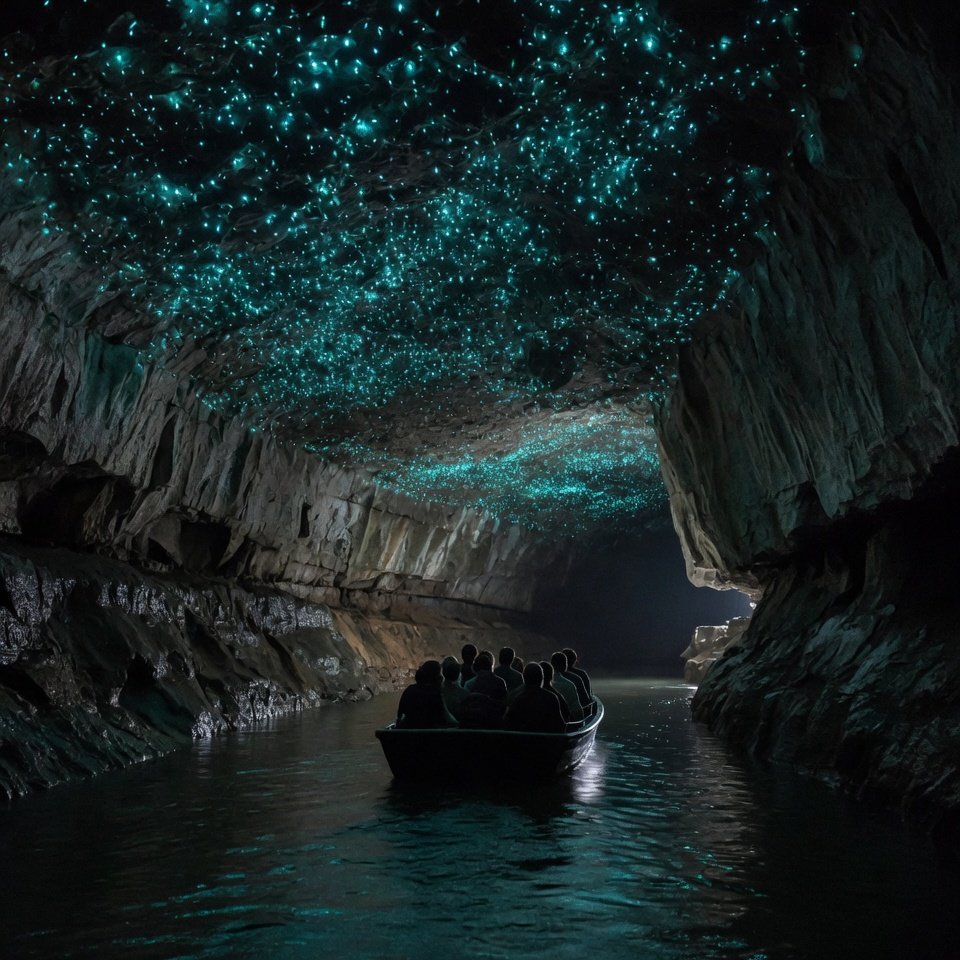
Inside Waitomo: New Zealand’s Glowing Underground World That Feels Like Another Planet
There is a small village in the Waikato region of New Zealand’s North Island where the real attraction is not on the surface at all. It is underground, deep inside ancient limestone caves, where thousands of tiny blue green lights cling to the ceiling and turn the darkness into something that looks like a galaxy. This is Waitomo, and every year around half a million travelers come here to look at worms. Once you understand what those worms actually do, the appeal makes a lot more sense.
Waitomo is not a single cave. It is a network of limestone caverns carved out over millions of years by underground rivers, and three of them stand out for visitors: the Waitomo Glowworm Cave, Ruakuri Cave, and Aranui Cave. The word Waitomo comes from the Maori language, where wai means water and tomo means hole or shaft. That name says almost everything you need to know about the terrain here. Rivers still run through these caves today, and that constant moisture is exactly what keeps the glowworms alive.
The Problem Most Travelers Run Into
If you search for things to do in Waitomo, you will quickly run into a common problem. There are multiple caves, multiple tour operators, and multiple experience levels, and it is genuinely confusing to figure out which one actually fits your trip. Some travelers want a calm, quiet, family friendly boat ride. Others want to abseil into darkness and jump off waterfalls. Booking the wrong one wastes time and money, and in peak season, tours sell out fast, so there is little room for a do over. This guide breaks down exactly what each experience involves so you can choose with confidence before you arrive.
What Are Glowworms, Really
The glowworms of Waitomo are not worms at all. They are the larvae of a fungus gnat called Arachnocampa luminosa, a species found only in New Zealand. During their larval stage, which can last six to nine months depending on how much food they get, they hang dozens to hundreds of sticky silk threads from the cave ceiling. Each larva glows to attract small flying insects, which get trapped in those threads much like prey caught in a spider’s web. The hungrier the glowworm, the brighter it shines. It is a survival strategy, not a performance, but the visual effect is stunning regardless of the biology behind it.
Because the light is a hunting tool, cave operators enforce strict rules. Photography is banned inside the main glowworm viewing areas, touching the silk threads is not allowed, and loud noises are discouraged because they cause the worms to dim. These rules exist for a good reason. Respecting them keeps the ecosystem intact for the next visitor and the one after that.
Option One: The Classic Glowworm Boat Tour
For travelers who want the glowworm experience without any physical exertion, the original Waitomo Glowworm Cave tour is the answer. Guided tours have been running here since 1880, making this one of the oldest tourism operations in the country. The walking portion takes you past limestone formations, stalactites and stalagmites, before ending with a completely silent boat ride through the Cathedral Cave chamber. No motors, no paddles, just a guide gently pulling the boat along a cable while everyone looks straight up at what feels like a night sky underground. The full tour runs about forty five minutes to an hour and works well for families, older travelers, or anyone short on time.
Option Two: Black Water Rafting for the Adrenaline Seekers
If a quiet boat ride sounds too tame, Ruakuri Cave offers something entirely different through an activity called black water rafting. Despite the name, it has nothing to do with traditional white water rafting. Instead, visitors wear a wetsuit, helmet and headlamp, and float through the cave on an inner tube rather than a raft. There are two versions of this tour, and choosing between them is where most first time visitors get stuck.
The Black Labyrinth is the original and more accessible option, running about three hours. It involves floating through semi dark passages lit by glowworms, jumping backward off small waterfalls into your tube, and occasionally forming a human chain by hooking your feet onto the tube in front of you as your group drifts along together. Water temperature sits around ten to fifteen degrees Celsius, so it is genuinely cold, but wetsuits are provided and a hot shower with soup or snacks waits at the end.
The Black Abyss steps things up considerably. This five hour adventure adds a thirty five meter abseil straight down into the cave, a zipline through a gallery of glowing worms, and sections where you climb up underground waterfalls instead of just jumping off them. It is physically demanding and requires a reasonable fitness level, since participants must be able to step up fifty centimeters, climb a ladder, and walk uphill for ten minutes, all unaided. Minimum age is sixteen for the Black Abyss and twelve for the Black Labyrinth, with a weight range of forty five to one hundred thirty kilograms for both.
Solving the choice problem comes down to this. If you want maximum thrill and don’t mind spending most of a day underground, the Black Abyss delivers an unforgettable, borderline extreme experience. If you want adventure without pushing your limits too hard, the Black Labyrinth gives you waterfalls, tubing and glowworms in a shorter, slightly gentler package.
Option Three: Aranui Cave for Formation Lovers
Aranui Cave does not have glowworms, since it is a dry cave rather than a wet one, but it makes up for that with some of the most delicate limestone formations in the region. Towering chambers, fine stalactites, and quiet corridors make this the calmest of the three main caves. It suits travelers who are more interested in geology and photography than adrenaline, and it pairs well as an add on to either of the other two tours.
Planning Your Visit the Smart Way
Waitomo sits about two and a half hours south of Auckland, roughly two hours from Rotorua, and just one hour from Hobbiton, which makes it easy to combine with a North Island road trip. Many travelers pair a morning at Hobbiton with an afternoon underground in Waitomo, since both destinations are close together and both require advance booking.
Speaking of booking, this is the single most important tip for visiting Waitomo without stress. Tours here operate on a fixed schedule, the visitor centre is a cashless site, and if you arrive late your ticket may be forfeited with no refund. Aim to check in at least thirty minutes before your scheduled time. During peak travel months, popular tours can sell out days or even weeks in advance, so booking online ahead of your trip rather than showing up and hoping for a spot will save you a wasted afternoon.
For black water rafting specifically, you do not need to bring caving gear. Wetsuits, boots, helmets, headlamps and tubes are all provided by the operator. What you should bring is swimwear to wear underneath the wetsuit, a towel, and a change of clothes for afterward. Photography is not permitted during the underground portion of black water rafting tours, but guides typically take photos throughout that are available to purchase once you are back on the surface, so you still walk away with proof of the adventure.
Why Waitomo Belongs on Your List
What makes Waitomo genuinely special is the contrast it offers within a single small area. You can have a peaceful, almost spiritual boat ride under a ceiling of living light, and just a short walk away, you can be abseiling into total darkness and jumping off underground waterfalls with a group of strangers who become instant friends by the time the hot soup arrives. Few destinations manage to offer both a calm, family friendly option and a genuinely extreme adventure experience within the same cave system.
The caves themselves are ancient, shaped over millions of years by rivers that still run beneath the Waikato countryside today. The glowworms are found nowhere else on Earth in this exact form. And the sense of stepping into complete silence and darkness, only to look up and see what appears to be a starlit sky glowing on solid rock, is not something photographs or videos fully capture. It has to be experienced in person, ideally with a plan already in place so you spend your time enjoying the cave rather than figuring out logistics on the fly.
If Waitomo has made it onto your travel bucket list, now is the time to start planning the details, from choosing between the Black Labyrinth and Black Abyss to deciding how to pair it with nearby attractions like Hobbiton and Rotorua. For the complete breakdown of tour prices, booking tips and the best time of year to visit, read the full story on thecavee.com.
Pingback: The World’s Largest Cave Has Its Own Weather System (And You’ve Never Seen It) – thecavee
Pingback: The Maya Called These Sinkholes “Gateways to the Underworld” — Now Divers Swim Through Them – thecavee