Down 70 Metres Into a Stone Cathedral: France’s Jura Caves Are the Cheapest Thrill in Europe Right Now
There is a moment, about halfway down into the Gouffre de Poudrey, when the staircase seems to go on forever and the air turns cool enough to raise goosebumps on your arms. Then the chamber opens up beneath you, and you understand why France’s official tourism site compares this place to Notre-Dame Cathedral in Paris. Only this cathedral took millions of years to build, nobody carved a single stone, and the ticket costs 12 euros.
I have a soft spot for places that overdeliver for very little money, and the Jura caves in eastern France might be the best example I have found all year. For the price of a sandwich in Paris, you can descend into a cavern the size of a cathedral, walk past the bones of prehistoric cave bears, follow an underground river, and finish the day watching a sound-and-light show bounce off stalactites. October 2026 is a particularly good time to go: operators have just refreshed their autumn schedules, one cave is running a torchlit Halloween visit on October 31, and the summer crowds have gone home.
Here is the honest guide: which caves are worth it, what each one actually costs, what to wear, and the seasonal traps to avoid.
Why the Jura, and why now
The Jura mountains run along France’s eastern edge, a rumpled limestone landscape that water has been quietly hollowing out for millions of years. The result is one of the densest clusters of show caves in Europe, all within easy reach of Besancon, Lyon, and Geneva. Unlike the famous caves of the south, which can feel like theme parks in summer, the Jura caves are still the kind of places where a guide knows your name by the end of the tour.
The timing matters. Autumn is when these caves make the most sense. The temperature underground barely moves all year, so a cave is the perfect rainy day plan, and in October the tour groups shrink to a handful of people. Just check the calendar before you travel, because not every cave runs year round. One of the prettiest stops on this list, Baume-les-Messieurs, closes its season at the end of September, and October visitors who assume it is open will be disappointed. That kind of detail is exactly why this guide exists.
If you only have one problem with your France trip, it is probably this: the famous sights are expensive and crowded, and the weather in autumn is a gamble. The Jura caves solve all three at once. They are cheap, they are indoors, and they are genuinely spectacular. A family of four can do a full cave day here for less than a single adult ticket at some Paris attractions.
Gouffre de Poudrey: the one that drops your jaw
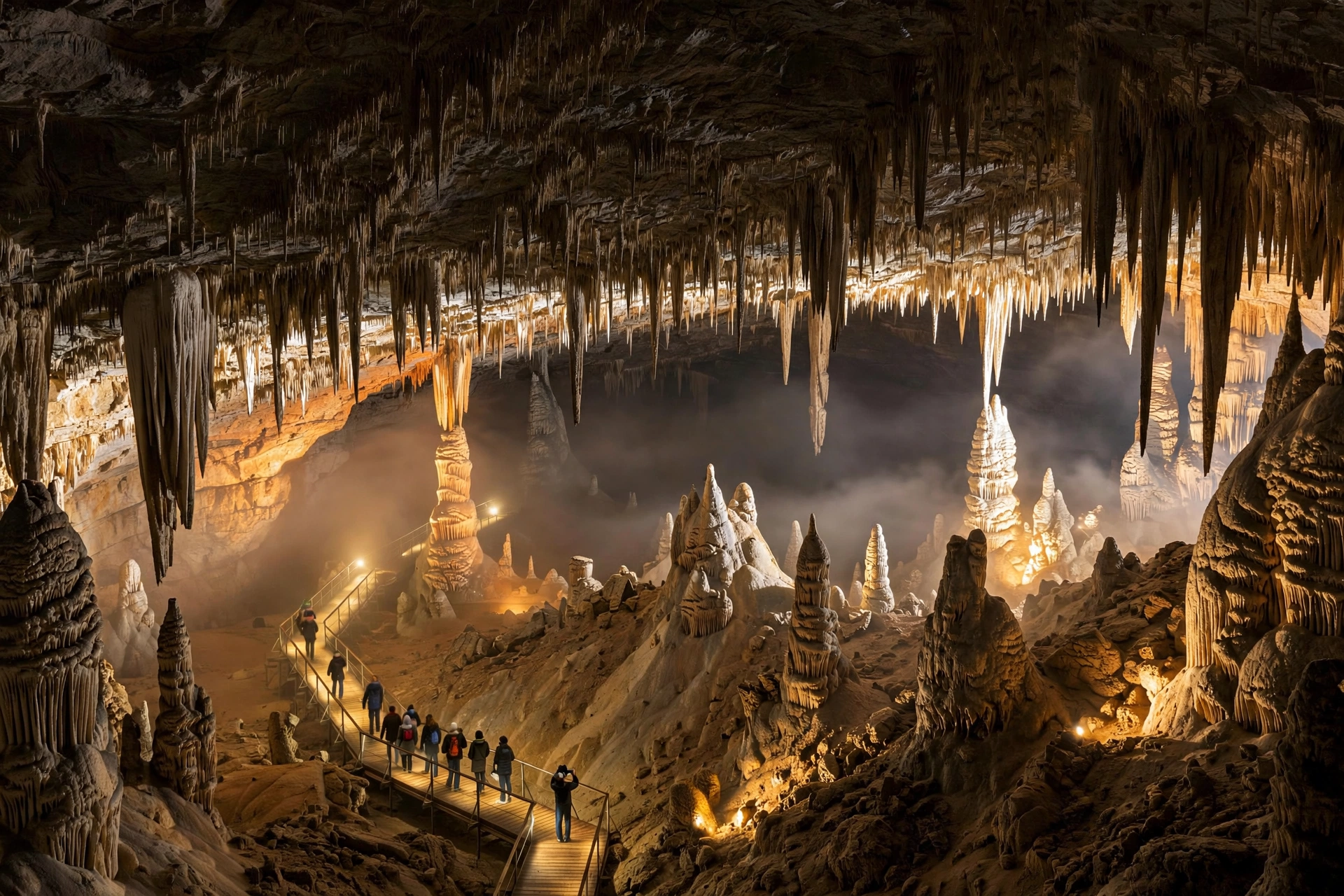
Start here. The Gouffre de Poudrey sits about 20 kilometres from Besancon, and it is the most dramatic cave in the region by a clear margin. You descend roughly 70 metres into a single enormous chamber, and the scale is hard to describe until you are standing in it. The official comparison to Notre-Dame is not marketing fluff. You feel small in the best possible way.
The tour pairs the geology with a sound-and-light presentation that picks out limestone formations in sequence, so you are not just staring at rocks in the dark. Guides explain how water carved the chamber over geological time, and the lighting makes the whole place feel like a concert hall that happens to be underground.
The practical facts for 2026: adult admission is 12 euros, children aged five to 14 pay 10 euros, and younger children enter free. Guided tours run at set times through October, and advance reservations are strongly recommended, especially on weekends. Bring warm clothing. The temperature inside sits around 7 degrees Celsius all year, and after twenty minutes in a T-shirt you will regret every life choice that led you there. Wear shoes with grip too, because cave floors are damp by nature.
This is the cave to pick if you only have time for one. It is the closest thing in France to the feeling of standing inside Son Doong, the world’s largest cave in Vietnam, except you do not need a multi-day expedition or a waiting list to get in. You just need a car, a jumper, and 12 euros.
Grotte d’Osselle: where cave bears once slept
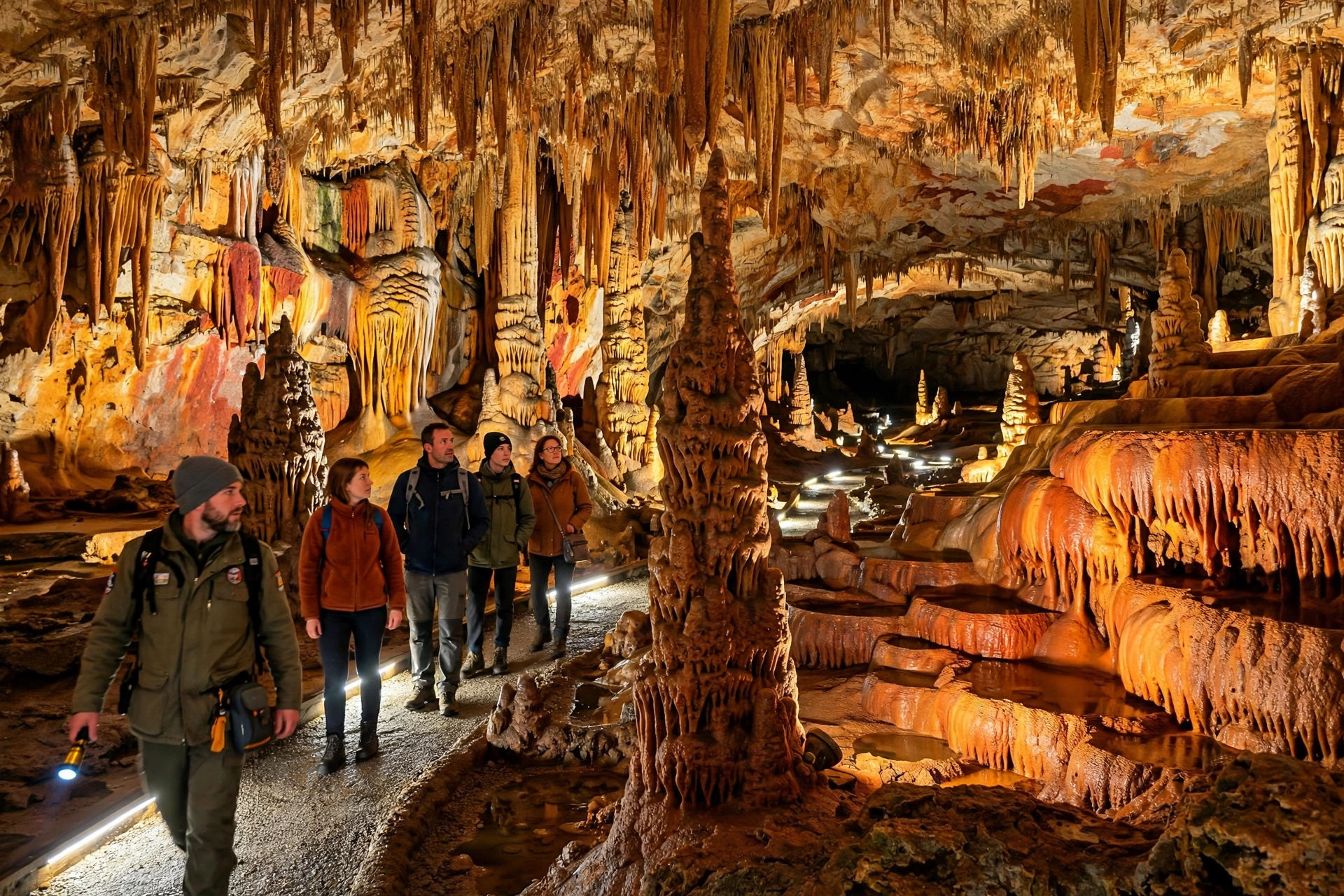
A short drive from Poudrey, the Grotte d’Osselle trades sheer size for deep history. France’s national tourism authority flags it as an important prehistoric site, and the reason is wonderfully eerie: ancient cave-bear skeletons were discovered here. These were Ice Age animals, bigger than any bear alive today, and they used caves like this one to hibernate through winters that lasted months.
Walking the galleries now, you see colourful mineral deposits, spacious chambers, and formations shaped by water over thousands of years. It is less of a spectacle than Poudrey and more of a slow burn. You start noticing details: the way flowstone drapes a wall like frozen cloth, the rust-red staining where minerals seeped through cracks, the sheer patience of geology.
Admission in 2026 is 11 euros for adults, 9 euros for students, and 7 euros for children aged four to 12. Group rates start at 8 euros for adults. Two quirks to know before you go: in October, weekday opening starts at 2 pm, while Sundays and public holidays open earlier, and the operator accepts cash and cheques only. That last one catches people out. Bring cash.
If you love the archaeology side of caves, pair this with our story about 15,000-year-old cave art discovered in Ireland. The Jura bears and the Irish artists were living in the same Ice Age world, just at opposite ends of Europe.
Baume-les-Messieurs: the village above the cave
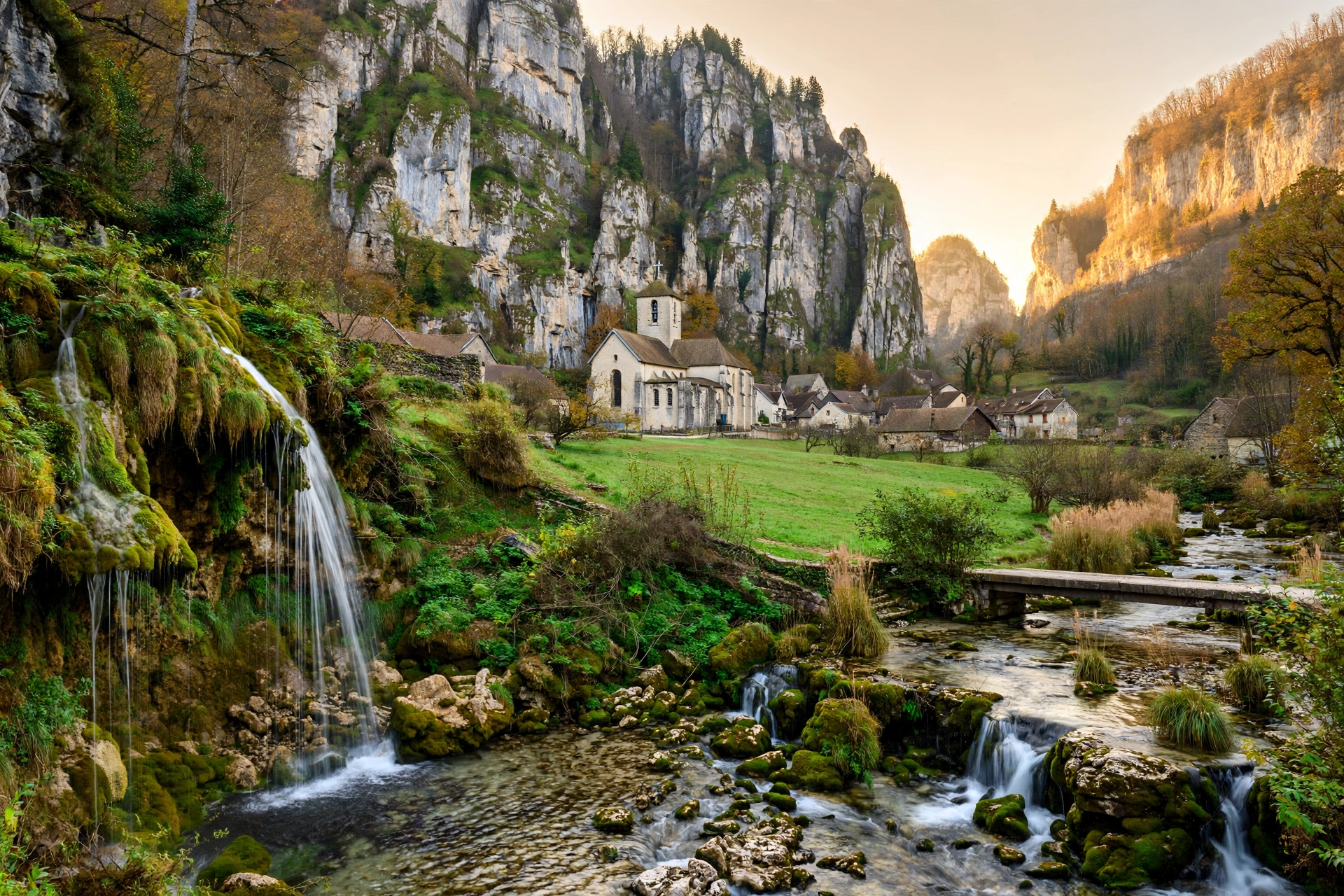
Some caves are worth visiting for what sits above them, and Baume-les-Messieurs is the best example in the Jura. The cave itself is a guided route of about one kilometre, including 500 metres of developed galleries, connected to the Dard river system and the waterfalls that tumble through the valley. Underground, the limestone formations are spectacular. Above ground, you get one of France’s officially recognised most beautiful villages: a historic abbey, dramatic cliffs, and a valley that looks like it was designed for a postcard.
The tour takes about one hour, the temperature averages 11 degrees Celsius, and tickets cost 10.50 euros for adults and 7 euros for children aged six to 12. Here is the catch, and it matters: the published visiting season runs from April through September. If you are reading this in October, do not assume you can walk in. Check the official site first, or save Baume for a spring trip and spend your October day at Poudrey, Osselle, and Cerdon instead. I would rather tell you this now than have you drive to a closed gate.
Grottes des Moidons: the light show cave
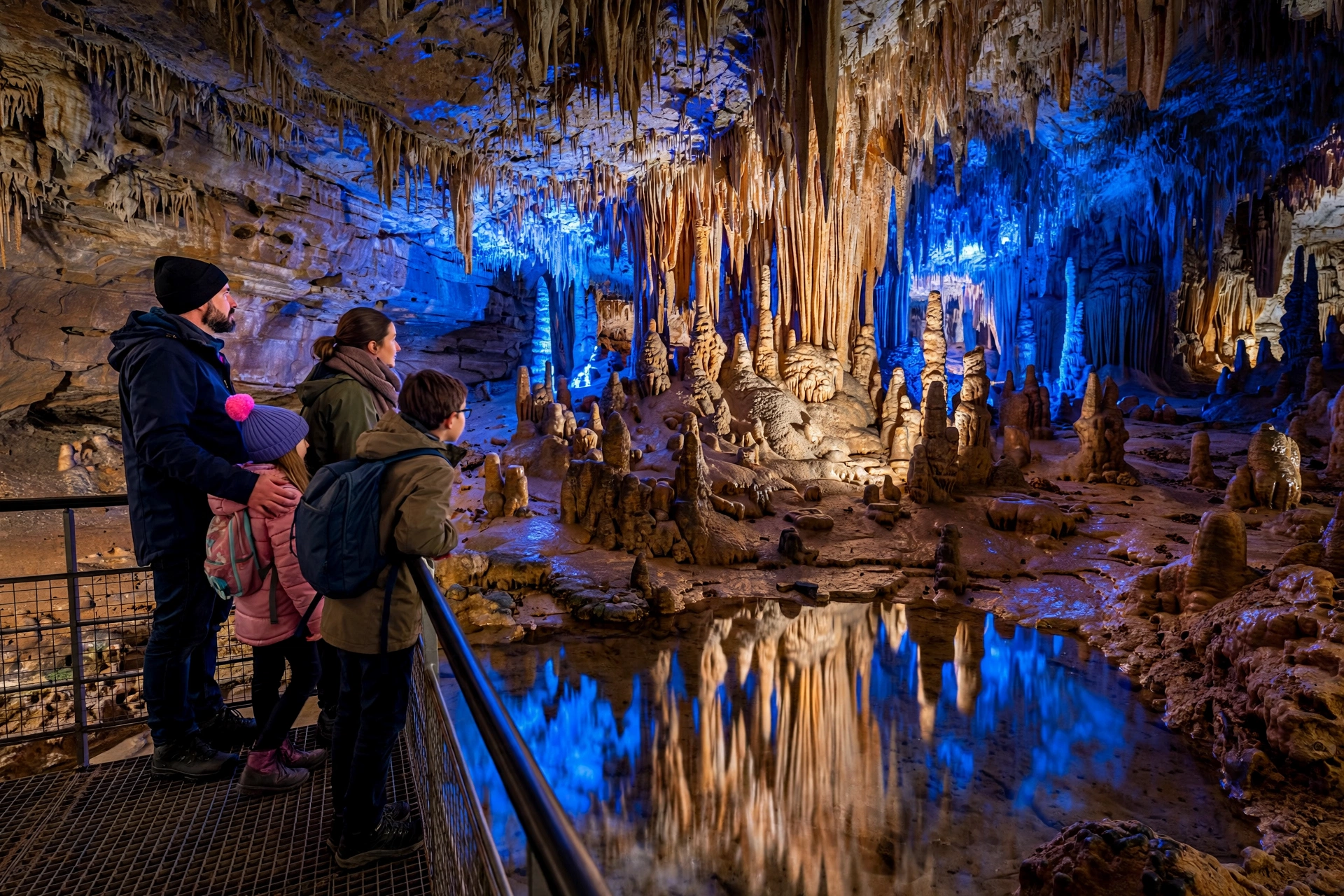
If you are travelling with kids, or you just like your geology with a bit of theatre, head to the Grottes des Moidons near Arbois. Discovered in 1966 and opened to visitors in 1989, this cave leans into the spectacle: a sound-and-light presentation highlights the stalactites, stalagmites, and mineral formations as you move through the chambers.
The guided visit takes 50 to 55 minutes and includes an introductory film, the cave exploration, and a bat discovery area with a children’s maze. Outside there are picnic facilities, woodland discovery paths, and a souvenir shop, so it works as a half-day outing rather than a quick stop. The temperature is around 10 degrees Celsius, so yes, bring that jumper again. The operator notes that pushchairs are permitted but wheelchair users should verify accessibility restrictions before visiting.
Moidons is also the best answer to a common family problem: what do you do with children on a rainy day in the Jura when the hiking trails are mud and the villages are quiet? You go underground, where the weather does not matter and the lights do the entertaining.
Grottes du Cerdon: the underground river and the Halloween torchlight
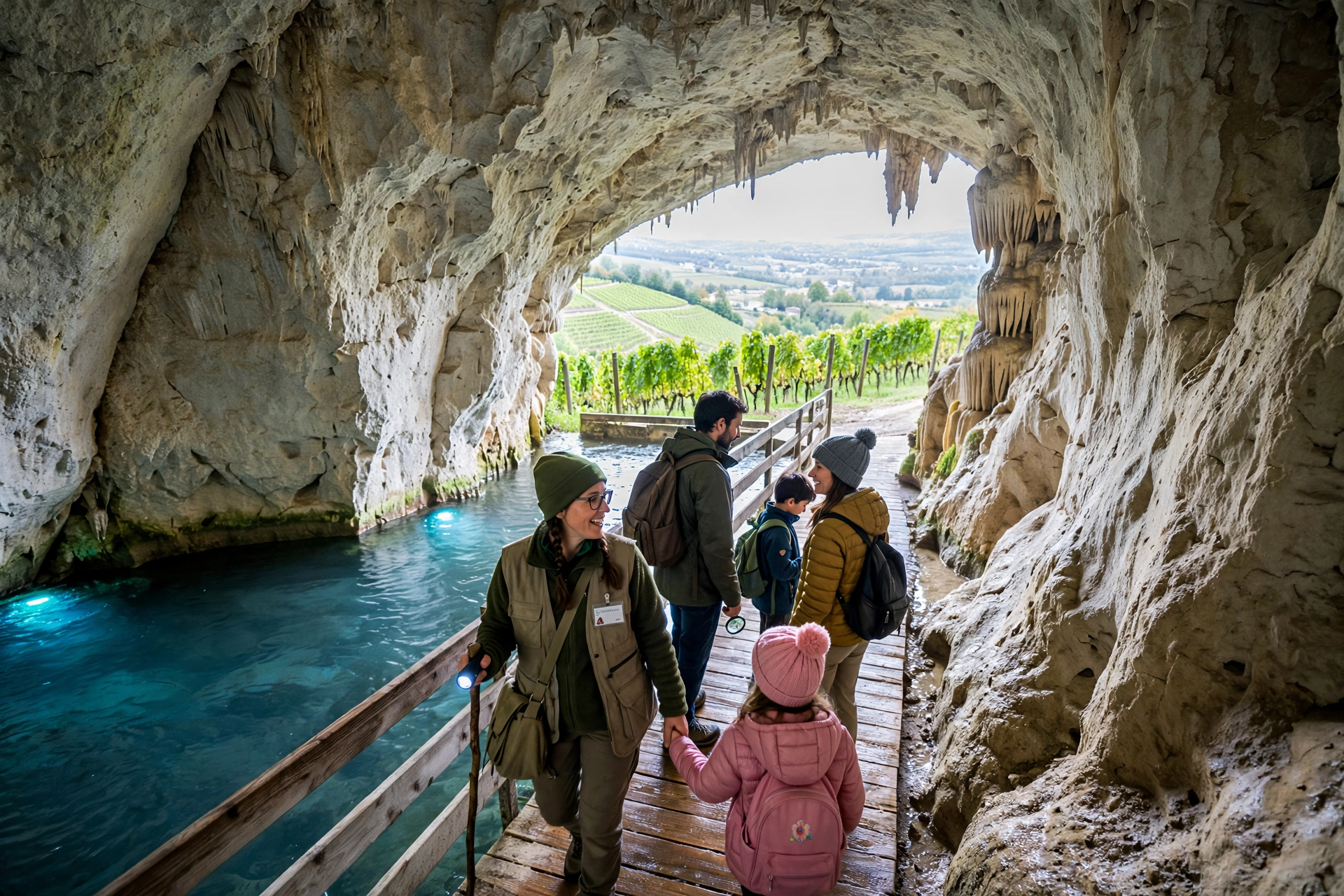
The Grottes du Cerdon, in the Ain department about an hour from Lyon, Geneva, and Annecy, is the most complete day out on this list. You follow the former course of an underground river through the caves, then emerge to viewpoints overlooking the Cerdon vineyards. The site combines the caves with a prehistoric leisure park, so families can choose guided or self-guided visits and join prehistoric workshops.
For 2026 the site added a Mineral River experience: a 20-minute supervised stone-discovery workshop for children at 8 euros per participant. Standard cave admission is 11.50 euros for visitors aged 12 and above and 8 euros for children aged four to 11. The combined ticket, cave plus six prehistoric workshops, costs 17 euros, which is genuinely good value if you have kids who want to do everything.
And here is the timely bit. The operator has announced a vineyard-themed experience for October 18, 2026, followed by a special torchlit cave visit on October 31. A torchlit cave on Halloween night is the kind of thing that sounds gimmicky until you are actually standing in a dark limestone gallery with a flame in your hand, listening to water drip somewhere you cannot see. If you can get tickets, get them.
One road note for drivers: the D1084 near the Col de Cerdon was scheduled to stay closed until October 12, 2026, with a recommended motorway diversion toward Geneva, exiting at Exit 8, Hauteville/Saint-Martin-du-Fresne, from where the caves are about ten minutes away. Roadworks end, but it is worth checking the route before you set off.
Planning your Jura cave trip: prices, packing, and base camps
Here is the whole list at a glance, with 2026 prices checked on October 8, 2026. Prices and access can change, so treat this as your starting point, not gospel, and confirm on the official operator sites before booking.
Gouffre de Poudrey: 12 euros adults, 10 euros children aged five to 14, under-fives free. Around 7 degrees inside, 70-metre descent, October tours at set times, book ahead.
Grotte d’Osselle: 11 euros adults, 9 euros students, 7 euros children aged four to 12. Cash and cheques only. October weekdays from 2 pm.
Grottes de Baume: 10.50 euros adults, 7 euros children aged six to 12. Season April to September, so October visitors should verify before travelling.
Grottes du Cerdon: 11.50 euros for ages 12 and up, 8 euros children aged four to 11, 17 euros combined cave plus workshops ticket.
Base yourself in Besancon for Poudrey and Osselle. It is a handsome, underrated city in its own right, with a UNESCO citadel designed by Vauban and far fewer tourists than Dijon or Lyon. For Cerdon, base in Lyon, Geneva, or Annecy, all about an hour away. A car makes everything easier. Public transport reaches the towns, but the caves themselves are rural, and buses are infrequent.
Pack like this: warm layer, waterproof jacket for the walk from the car park, shoes with real grip, a small torch (your phone works, but a headlamp is better), cash for Osselle, and water. Skip the tripod unless you have checked the photography rules, because several caves restrict them. And if you are claustrophobic, know this: these are show caves with lit walkways and high chambers, not crawl-through squeezes. Poudrey’s chamber is enormous. If any cave is going to convert a nervous first-timer, it is this one.
For a different kind of cold underground world, compare the Jura with Iceland’s ice cave season for 2026-2027, where the caves themselves melt and reform every year. The Jura’s limestone has been there for millions of years. Iceland’s ice might not survive the winter. Both are worth seeing, and the contrast is half the fun.
The bottom line
The Jura caves are not the biggest caves in the world, and they are not trying to be. Their charm is the opposite: modest prices, real geology, genuine prehistory, and guides who care about the place. You can stand in a chamber the size of a cathedral, walk where cave bears slept, follow a river that no longer flows, and be back in Besancon in time for dinner, all for about the price of a cinema ticket.
If you go, go soon. The torchlit Halloween visit at Cerdon is October 31, the autumn tour schedules are live now, and the caves will still be there in spring, but the quiet October version of them, with small groups and cold air and empty walkways, is the one worth catching.
Found this guide useful? Save it on Pinterest and share it with the one friend who always says France is too expensive. The Jura caves are the proof that it is not. Read the full story and more underground adventures on thecavee.com.