Sealed for 16,500 Years: Inside La Garma, the Spanish Cave With a Stone Age Home Still Standing
Picture this. You crawl through a narrow passage in a green hillside in northern Spain, drop down two steep chasms, and step into a gallery nobody has walked through for sixteen and a half thousand years. Your headlamp sweeps across a floor covered in deer bones, seashells, stone tools and needles. In the middle of it all sits a small oval of stones, about the size of a garden shed, with a fire pit in the centre. It is a home. Somebody built it, cooked in it, slept in it, and then left it, and a rockfall sealed the door behind them while mammoths still roamed Europe.
That place is real. It is called La Garma, and it sits on a low limestone hill near the village of Omoño, in Cantabria, about 25 kilometres west of Santander. Archaeologists found its Lower Gallery in November 1995, and what they found inside has quietly become one of the most important discoveries in European prehistory. The floor is the best preserved Palaeolithic living floor ever found. The cave is on UNESCO’s World Heritage List. And almost nobody is ever allowed inside.
This is the story of the cave that time forgot, the family who lived in it, and why you will probably never see it with your own eyes.
A rockfall locked the door while the Ice Age was ending
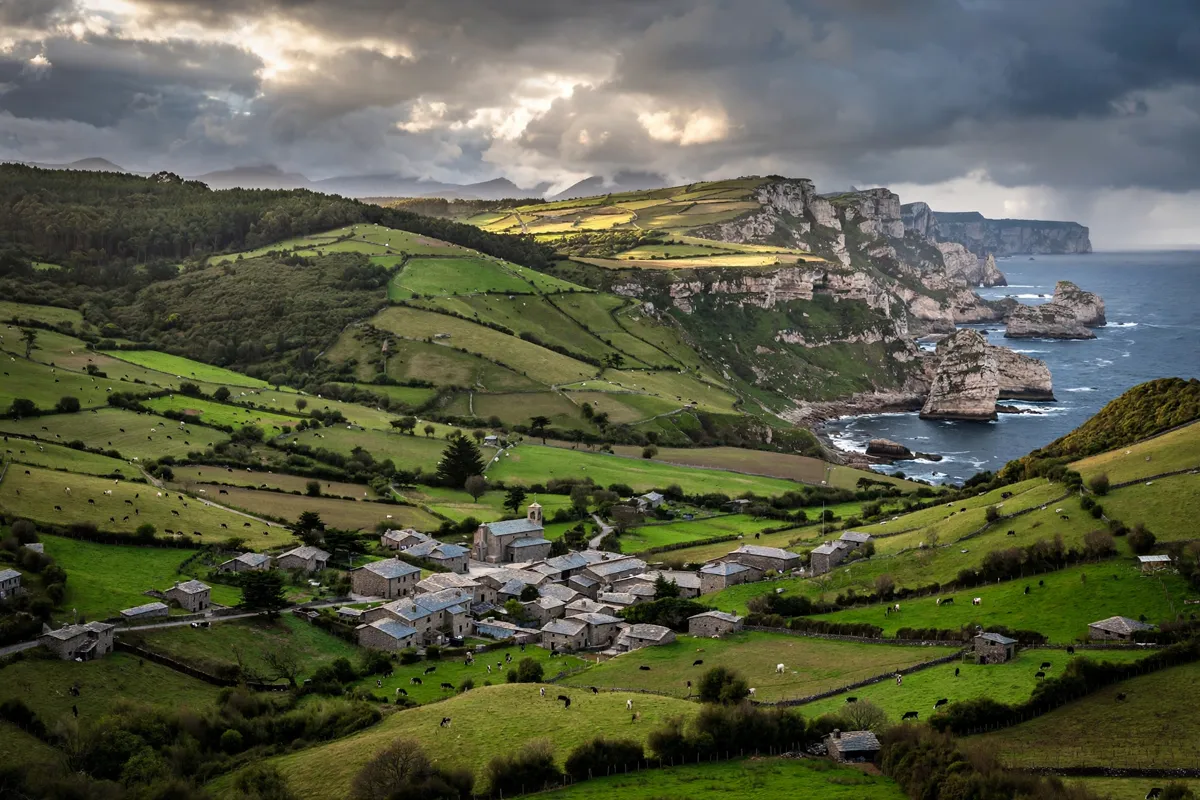
La Garma is not one cave. It is a whole hill full of them. The hill rises just 185 metres above sea level, a short drive from the Bay of Santander and about five kilometres from the present coastline, near the mouth of the River Miera. Water spent millions of years hollowing out the limestone, and today the complex holds ten archaeological sites: La Garma A, B, C and D, the Lower Gallery, Cueva del Mar, El Truchiro, Peredo, Valladar and a hillfort called Castro de La Garma.
The star of the show is the Lower Gallery, or Galería Inferior. It runs about 300 metres long and sits 59 metres above sea level. Its original entrance collapsed during the Pleistocene, roughly 16,500 years ago, in about 14,500 BC. The rockfall did something extraordinary by accident. It turned the gallery into a sealed box. No wind, no rain, no animals, no later visitors. Everything inside stayed exactly where the last occupants left it.
Archaeologists did not reach it until November 1995, when they found a way in through La Garma A, the only entrance used today. What they stepped into was not an empty tunnel. It was a living space, frozen mid-use.
The hut that time forgot
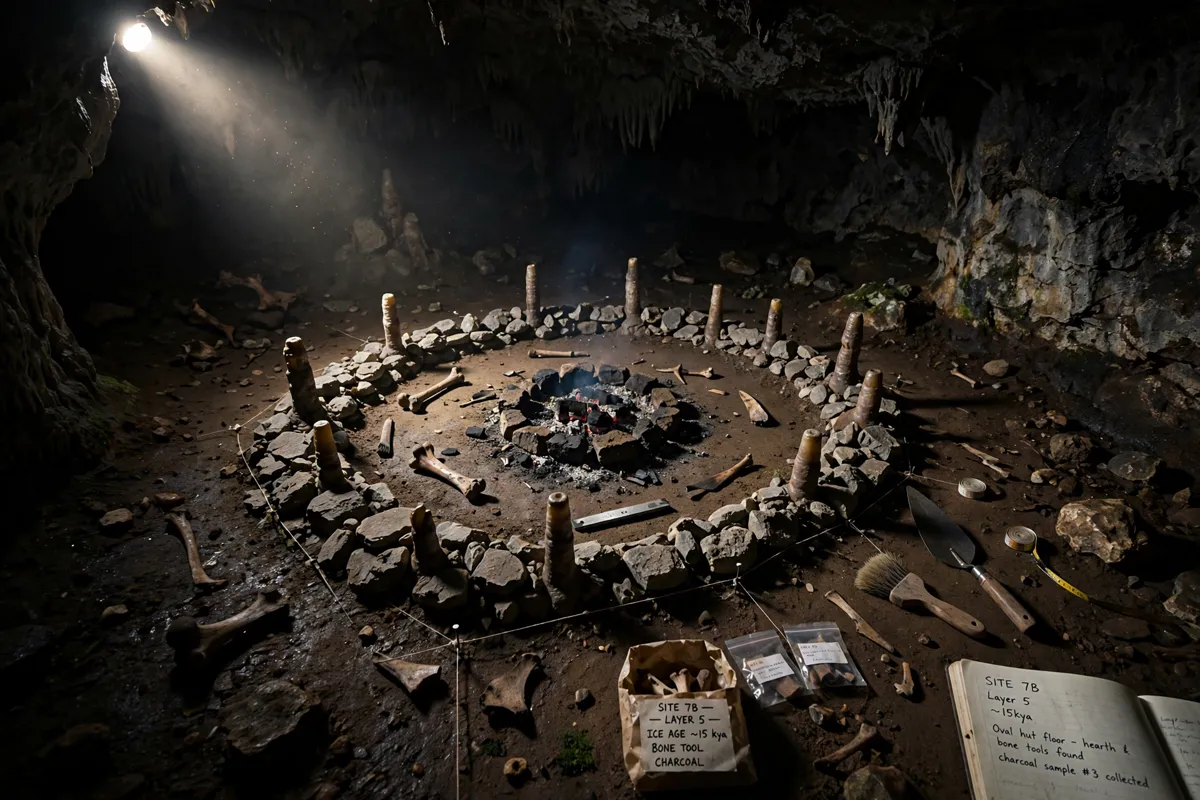
About forty metres from the old entrance, the team found the remains of a dwelling. It is small, roughly five square metres, about the size of a tiny bedroom. A ring of stone blocks and stalagmites traces an oval on the floor. The stones once pinned down a frame of sticks and animal skins. The roof would have stood just 1.6 to 1.7 metres high, so the people who lived there could not have stood upright inside. They would have crouched, or sat, or lain down.
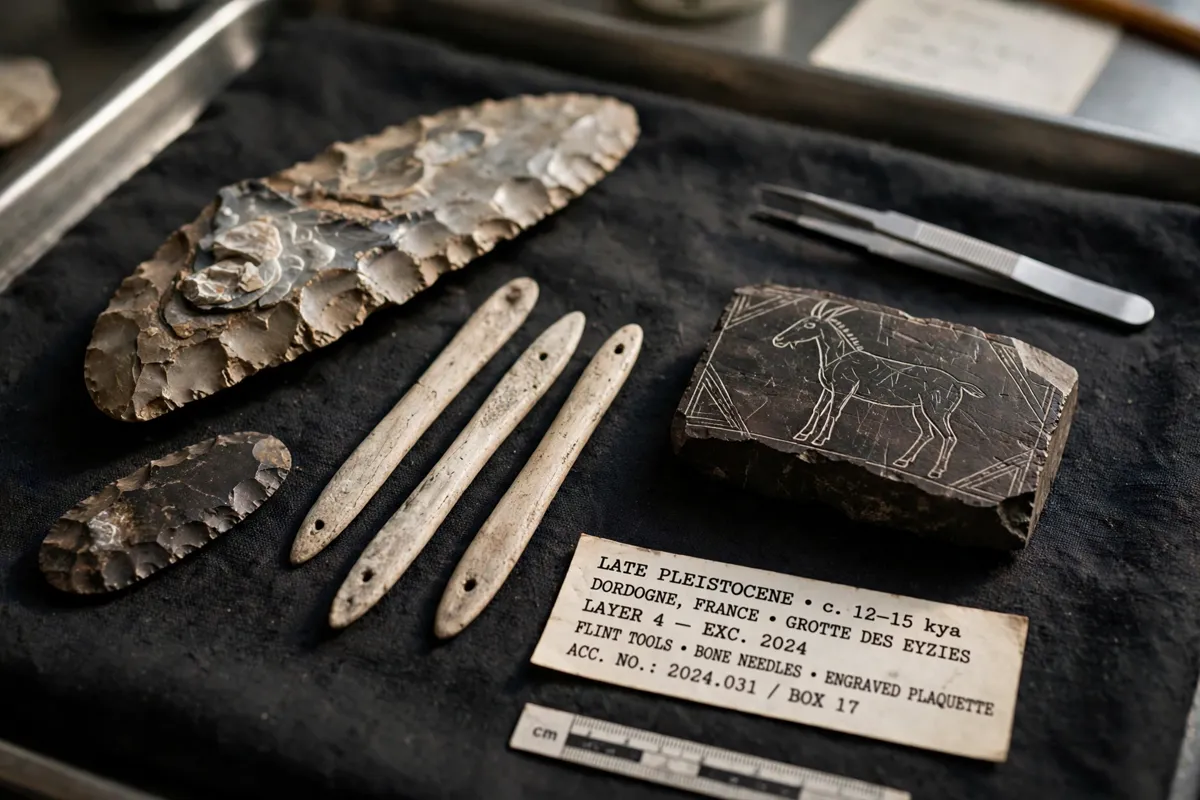
In the centre sat a small bonfire. Around it lay the debris of a working household: tools shaped from stone, antler and bone, needles, pendants, and the bones of the deer they had hunted. The occupants belonged to the Magdalenian culture, late Ice Age hunter gatherers who lived across Europe as the glaciers were retreating. They processed game here, worked hides, and made tools. Then one day they walked out, and the hill closed behind them.
The University of Cantabria calls the hut one of the best preserved Palaeolithic dwellings in the world. That is not hype. Most prehistoric homes survive only as a scatter of postholes or a stain in the soil. This one still has its walls, its floor and its fire, arranged the way its owners left them. Researchers have logged 4,614 objects from the hut area alone, from deer bones to needles and pendants. Across the whole site, the inventory passed 213,000 pieces by September 2026.
Think about that for a second. Two hundred and thirteen thousand objects, and most of them have never been touched by a modern hand. They are still lying on the floor where they were dropped.
How archaeologists walk on air
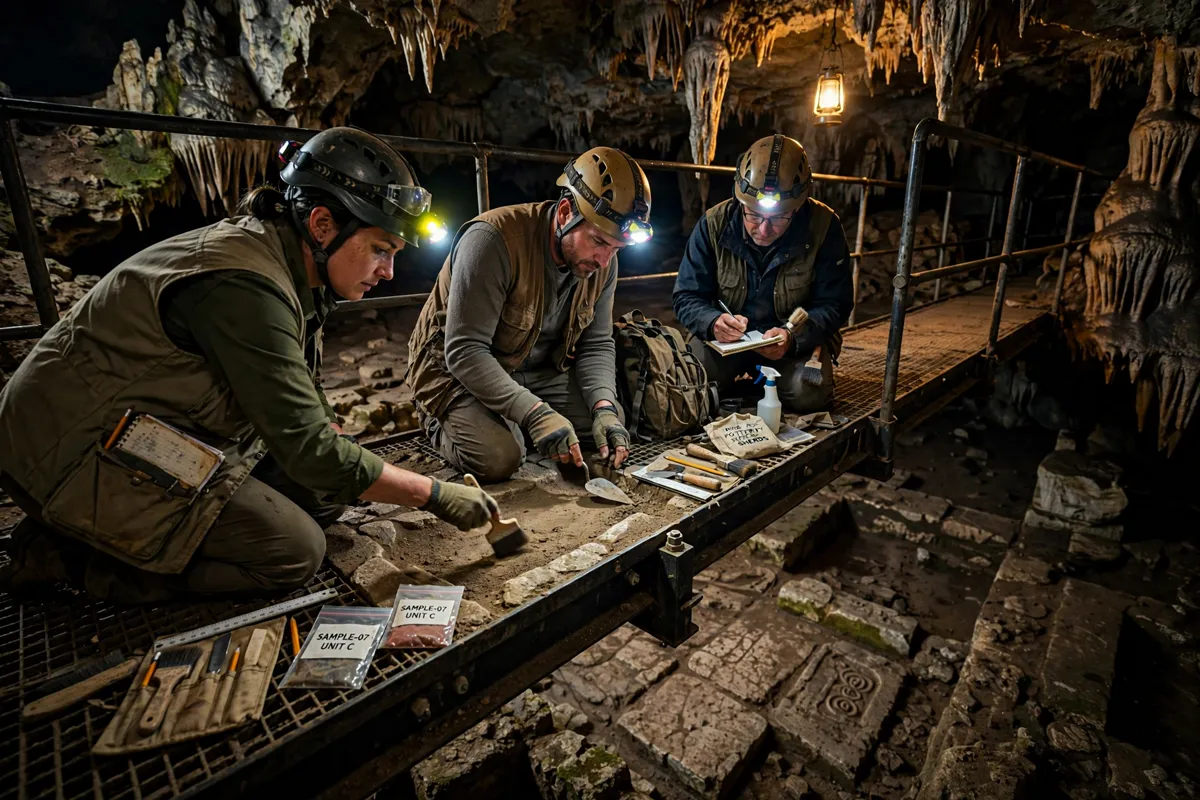
Here is the problem with a floor this perfect: you cannot walk on it. One careless footstep would crush sixteen thousand years of evidence. So the team at La Garma does something that looks almost absurd from the outside. They cross the gallery on a retractable aluminium walkway just 35 centimetres wide, about the width of a ruler. The walkway has padded feet so it does not mark the ground. Before anyone steps onto it, they change their footwear and pull on nitrile gloves.
The project is led by Pablo Arias, a professor of prehistory at the University of Cantabria, together with Roberto Ontañón, director of Cantabria’s Museum of Prehistory and Archaeology. They have worked the site since 1995, and their full study of the dwelling was published in the journal Advances in Archaeological Practice. The Government of Cantabria calls the gallery a prehistoric time capsule, and that is exactly what it is. The remains can be seen without any digging, because they were never buried. They are just lying there.
It is slow work. Every object has to be recorded exactly where it sits before it is moved, because its position is part of the story. A needle next to a hearth means something different from a needle next to a wall. A pile of deer bones by the door tells a different tale from the same bones by the fire. The team has spent three decades reading that floor like a crime scene, and they are still finding things.
Art on the walls, hands on the rock
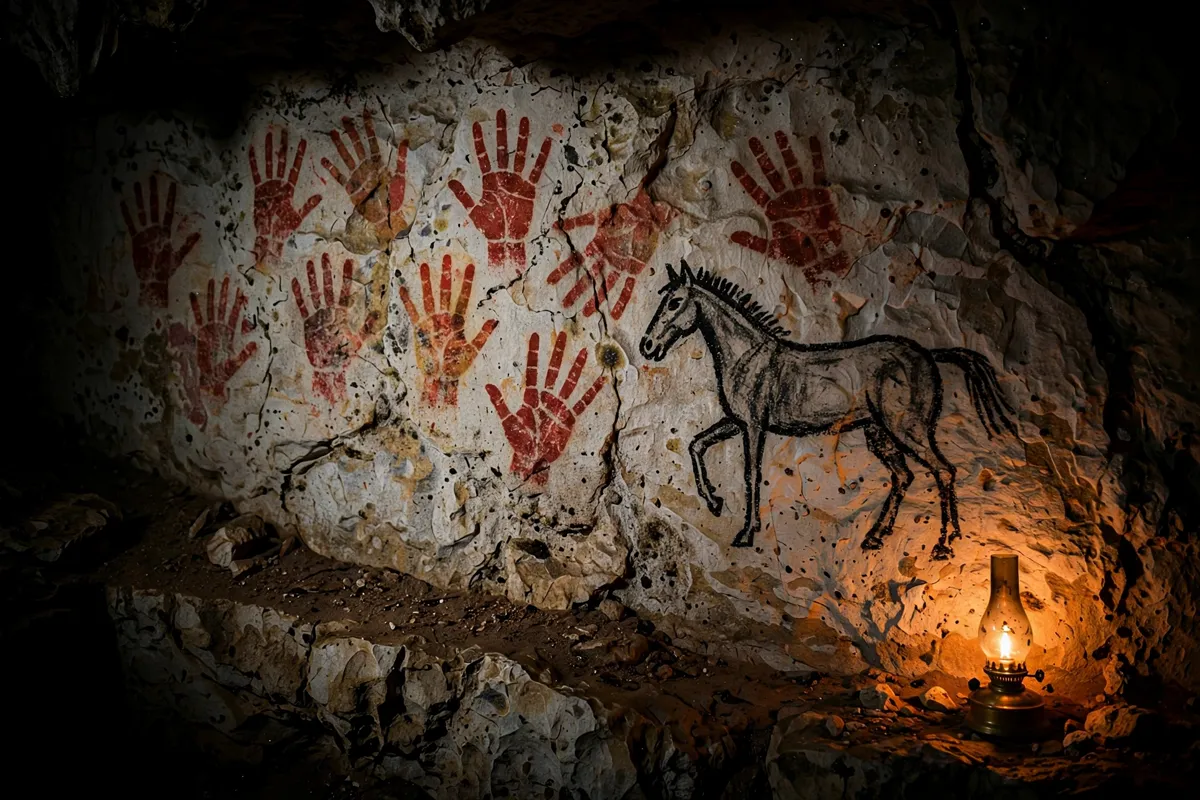
The floor is not the only treasure in La Garma. The walls carry more than 500 graphic units: 92 animal figures, 109 signs and 40 hand stencils, painted and engraved by people who lived here between roughly 28,000 and 13,000 years ago. There is a strikingly realistic black horse. There are goats, bison and panels of red symbols. One vertical bison has been directly dated to between 16,512 and 17,238 years before the present, which makes it a contemporary of the hut below.
The hand stencils are the ones that stop you in your tracks. Somebody pressed a hand against the rock, blew red pigment around it, and lifted the hand away. Sixteen thousand years later, the shape of that hand is still there. You can see the fingers. You can almost feel the person standing where you are standing. It is the closest thing archaeology has to a handshake across time.
La Garma also holds one of the most important collections of portable art from the period: seventeen engraved stone plaquettes found in one zone alone, plus tools and ornaments made from bone and antler. The floors hold thousands of potential surfaces for portable art, so the count keeps growing. The cave was added to UNESCO’s World Heritage List in July 2008, as part of the Cave of Altamira and Palaeolithic Cave Art of Northern Spain listing, and for good reason. The art here is not a footnote. It is one of the great galleries of the Ice Age.
A hill with 400,000 years of history
What makes La Garma truly special is not one moment in time. It is the sheer depth of the record. The cave system shows evidence of human use from 175,000 years ago through to the Middle Ages, and the hill’s layers reach back further still, toward 400,000 years. La Garma A, the current entrance, holds an extraordinary sequence of its own: Aurignacian, Gravettian, Solutrean and Magdalenian layers, then Mesolithic, Neolithic, Chalcolithic, Bronze Age and medieval levels, stacked one on top of another like the floors of a very old house.
That is why researchers describe La Garma as an archive of European prehistory. Most sites give you one chapter. This one gives you the whole book. You can trace how people lived, hunted, painted and buried their dead across hundreds of thousands of years, all on a single hillside.
It is also why the site is so fiercely protected. The hill is listed as an Archaeological Zone with the maximum level of protection under Spanish heritage law. The cave is closed to the public, and it stays closed. Only researchers go in, and even they go in carefully. According to the team behind the VR documentary Memoria: Stories of La Garma, only around fifty visitors have ever been granted access to the Lower Gallery.
Why you will probably never go inside (and what to do instead)
Let us be honest about this. If you are planning a trip to Cantabria hoping to walk into La Garma, you will be disappointed. The cave is not open, there are no tickets, and there is no tour. The environment inside is so fragile that daylight, breath and body heat can damage it. That is the price of keeping a 16,500 year old home intact.
But you are not shut out completely. Here is how to get close.
Watch it in virtual reality
Memoria: Stories of La Garma is an interactive VR documentary narrated by Geraldine Chaplin that takes you inside the cave without touching a single stone. It was nominated for Best Documentary Experience at Raindance Immersive, and it is the closest most of us will ever get to standing on that floor. If you get the chance to see it at a festival or a museum screening, take it.
Visit the neighbours
Cantabria is the richest cave art region in Europe, and the caves you can visit are extraordinary. The Museum of Altamira, about 30 kilometres west of Santander, holds a precise replica of the famous Altamira ceiling, painted around 36,000 years ago. The caves of Monte Castillo, near Puente Viesgo, hold some of the oldest art in the world, including hand stencils dated to more than 40,000 years ago. El Castillo, Las Monedas, La Pasiega and Las Chimeneas are all visitable, and they sit within a short drive of La Garma hill.
See the objects in Santander
The Museum of Prehistory and Archaeology of Cantabria, in Santander, is where much of the region’s story is told. It is the home institution of Roberto Ontañón, La Garma’s co-director, and it is the best place to understand what the caves mean before you go and look at the hills they sit in.
What La Garma teaches us about the people who lived there
There is a temptation to look at a site like La Garma and see only old stones. That misses the point. The hut is a solution to a problem, and the problem is one we still recognise: how do you keep a family warm, fed and safe when the world outside is freezing?
The Magdalenians who built that hut were not primitive in the way we sometimes imagine. They chose their spot carefully, forty metres inside a cave, far enough from the entrance to escape the wind, close enough to the daylight to work by it. They built a low, oval shelter that held body heat. They kept a fire in the centre. They stored tools within arm’s reach. They hunted deer, worked hides, sewed with bone needles, and wore pendants. They painted horses and bison on the walls, and they pressed their hands into the rock so that someone, someday, would know they had been there.
That last part is worth sitting with. Those hand stencils were not decoration. They were a message, left by people who had no writing, no photographs and no way of knowing whether anyone would ever see their work. They left their hands anyway. Sixteen thousand years later, we are still looking at them.
La Garma also rewrites a lazy assumption about Ice Age life. These people were not wandering aimlessly. They returned to the same places, built the same kinds of homes, and kept the same traditions for thousands of years. The cave’s record stretches from the deep past to the Middle Ages, but it is the Magdalenian floor that tells the clearest story: a family, a fire, a home, and a door that closed behind them for sixteen and a half millennia.
Planning your own Cantabria cave trip
If La Garma has put northern Spain on your list, here is the practical version. Base yourself in Santander, which has an airport, a train station and good roads in every direction. Rent a car, because the caves are scattered across valleys that buses do not reach well. Book Monte Castillo and Altamira in advance, especially in summer, because visitor numbers are capped to protect the art. Wear warm layers: the caves sit at a steady cool temperature all year, and the walkways can be damp. And leave time for the coast. The same limestone that made these caves also made the cliffs, beaches and green valleys of Cantabria, and the region is far quieter than the usual Spanish tourist trail.
One more thing. When you stand in front of a hand stencil at El Castillo or a bison at Altamira, remember the people of La Garma. They lived in a cave with a fire in the middle of the floor, they made beautiful things, and they left their mark on the wall. Then the hill closed over them, and the world forgot they were there. It took a rockfall, sixteen thousand years, and a team of patient archaeologists to bring them back. That is what a cave can hold: not just stone, but a whole life, waiting to be found.
Keep exploring the underground world
La Garma is not the only cave that has rewritten what we know about our ancestors. Just a few months ago, a team working in a cave 2,235 metres up in the Pyrenees found a high altitude mining camp full of hearths, a child’s bones and a bear tooth pendant. In Ireland, AI helped find 15,000 year old cave art that may rewrite who reached the island first. And in County Waterford, giant deer bones in Ballynamintra Cave just pushed Ireland’s human history back by a thousand years. The ground beneath our feet is still giving up secrets, and the caves are where most of them are hiding.
If this story sparked your curiosity, save it to your Pinterest board and share it with someone who loves a good mystery. The Cavee is full of places like La Garma: sealed, strange and waiting. Read Full Story on thecavee.com, and come back for the next one.
Sources: Wikipedia, La Garma cave complex; Spain’s official tourism portal, La Garma Cave; University of Cantabria coverage via ecoticias.