Avatar’s Floating Mountains Are Real: Your 2026 Adventure Guide to Zhangjiajie, China
You remember the scene. Towering stone mountains hanging in the sky, waterfalls pouring off their edges into nothing, mist curling around peaks that have no business existing. When James Cameron’s Avatar came out in 2009, everyone assumed those floating Hallelujah Mountains were pure Hollywood imagination. They weren’t. Cameron’s team looked at photographs of a real place in China’s Hunan province and built Pandora’s most iconic landscape around it.
That place is Zhangjiajie. And honestly, standing there in person is weirder than the movie.
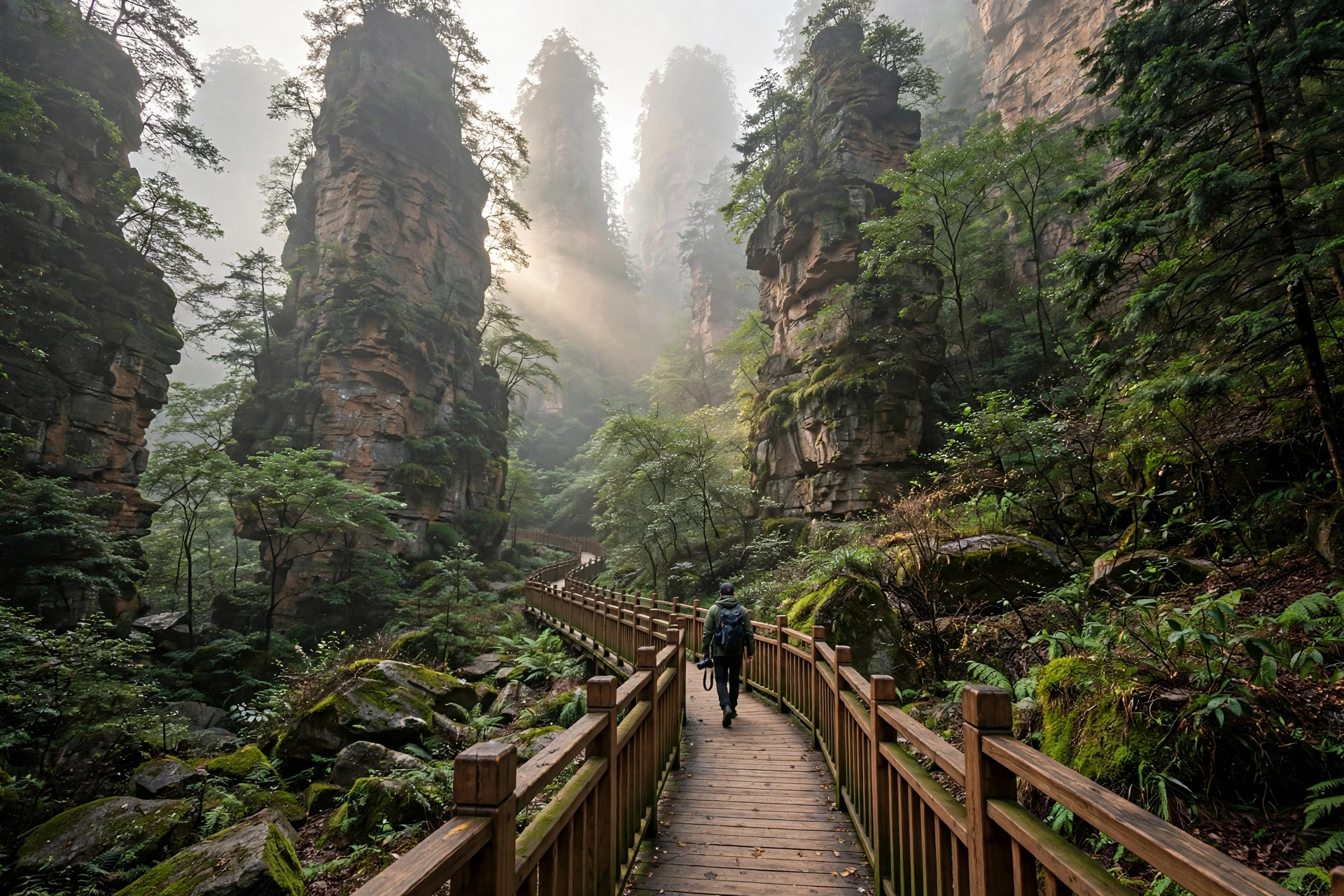
I’ve read a lot of travel writing that oversells things. “Breathtaking” gets thrown around so much it means nothing anymore. But Zhangjiajie does something to your brain that photos genuinely cannot prepare you for. More than 3,000 quartz-sandstone pillars rise straight out of the forest floor, some over 200 meters tall, packed so tightly they look like a stone army frozen mid-march. On misty mornings, and there are many, the forest floor disappears entirely. You stand on a cliff edge and watch mountaintops float on clouds. You will check twice. Everyone does.
This guide covers everything you need for a 2026 trip: the five experiences worth your time, real ticket prices, how the confusing multi-park system actually works, and the mistakes that ruin most first visits. Let’s get into it.
What Makes Zhangjiajie Unlike Anywhere Else on Earth
The short version: these pillars shouldn’t exist, and geologists spent decades arguing about exactly how they formed. The long version is more interesting. Roughly 380 million years ago, this whole region was under an ancient ocean. Layers of sand and sediment settled, compressed into quartz-sandstone, and then tectonic forces lifted the entire plateau thousands of meters into the air. Rain, wind, and plant roots did the rest, carving the plateau into a forest of isolated towers over millions of years.
The result is the world’s largest concentration of these pillar formations. Zhangjiajie National Forest Park became China’s first national forest park in 1982, and the wider Wulingyuan scenic area earned UNESCO World Heritage status in 1992. The park covers about 48 square kilometers, and the pillar forest is so dense that some valleys have never been fully explored on foot.
Then came the Avatar effect. After the film’s release, local officials renamed one of the most photographed towers, the 1,080-meter Southern Sky Column, to “Avatar Hallelujah Mountain.” Purists grumbled about the marketing gimmick. The tourists came anyway, in the millions. Love it or hate it, the name stuck, because once you see the place, the comparison stops feeling like a stretch.
The 5 Adventures You Can’t Miss in Zhangjiajie
Zhangjiajie is really three separate scenic areas with three separate tickets, and this is where most visitors get confused. The National Forest Park (the Avatar pillars), the Grand Canyon (the glass bridge), and Tianmen Mountain (Heaven’s Gate) are different parks in different locations. You cannot see all three properly in one day. Two full days is the sweet spot. Three is comfortable.
1. Stand Among the Avatar Hallelujah Mountains (Yuanjiajie)
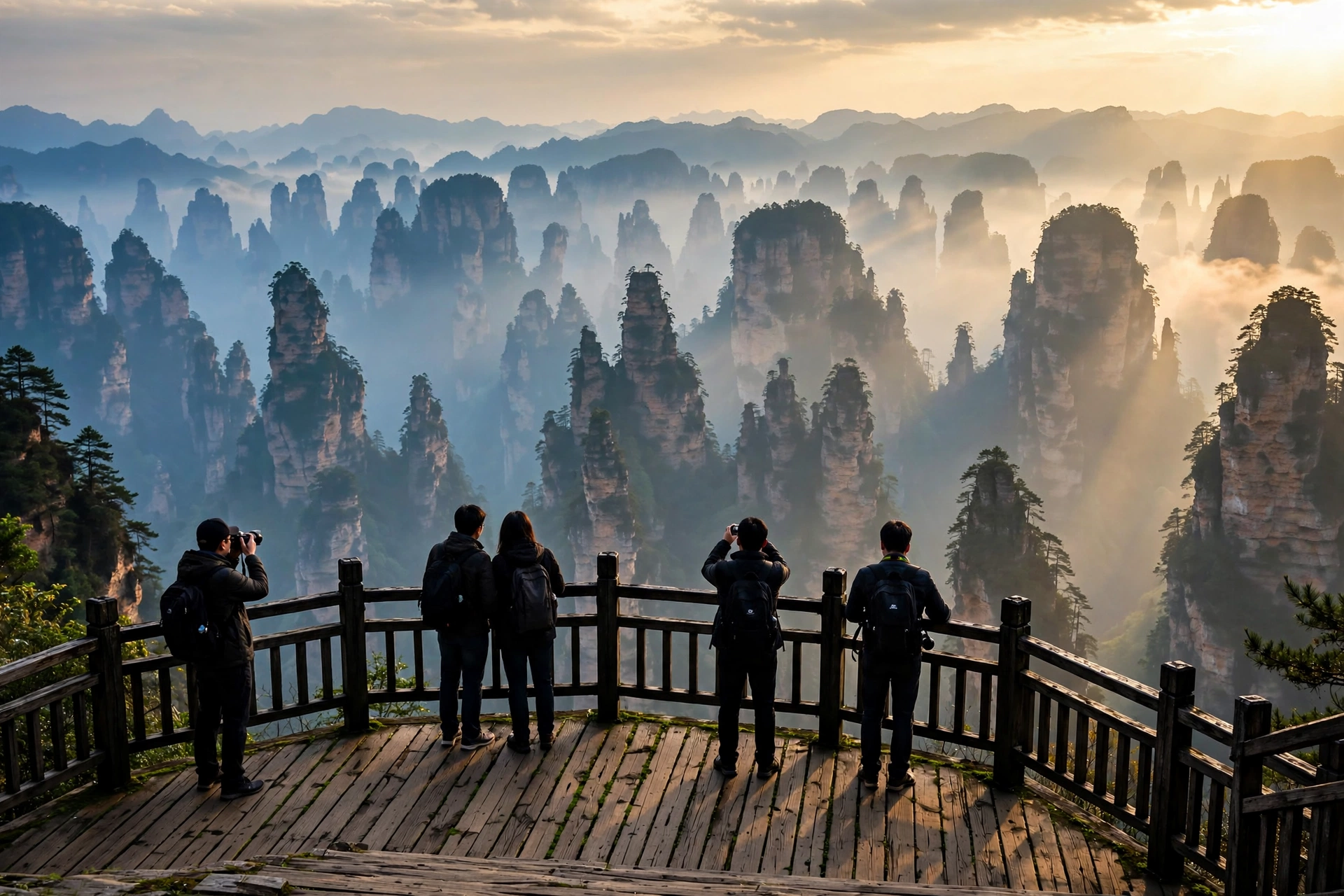
This is the main event. The Yuanjiajie scenic area holds the densest cluster of pillars and all the famous viewpoints: the First Bridge Under Heaven (a natural stone arch connecting two peaks), the Lost Souls Platform (a glass-floored overhang that empties your stomach nicely), and the Avatar Hallelujah Mountain itself.
Here’s what surprised me reading trip reports: the pillars look completely different depending on the weather. On clear days they’re dramatic but almost clinical, sharp stone towers against blue sky. After rain, when mist fills the valleys, the bases vanish and you get the floating mountain effect. Locals and guides actually prefer the “bad” weather days. If you wake up to fog, don’t be disappointed. That’s the day the place earns its nickname.
Yuanjiajie sits on a plateau, and getting up there is half the fun, which brings us to the next item.
2. Walk the World’s Longest Glass Bridge (Zhangjiajie Grand Canyon)
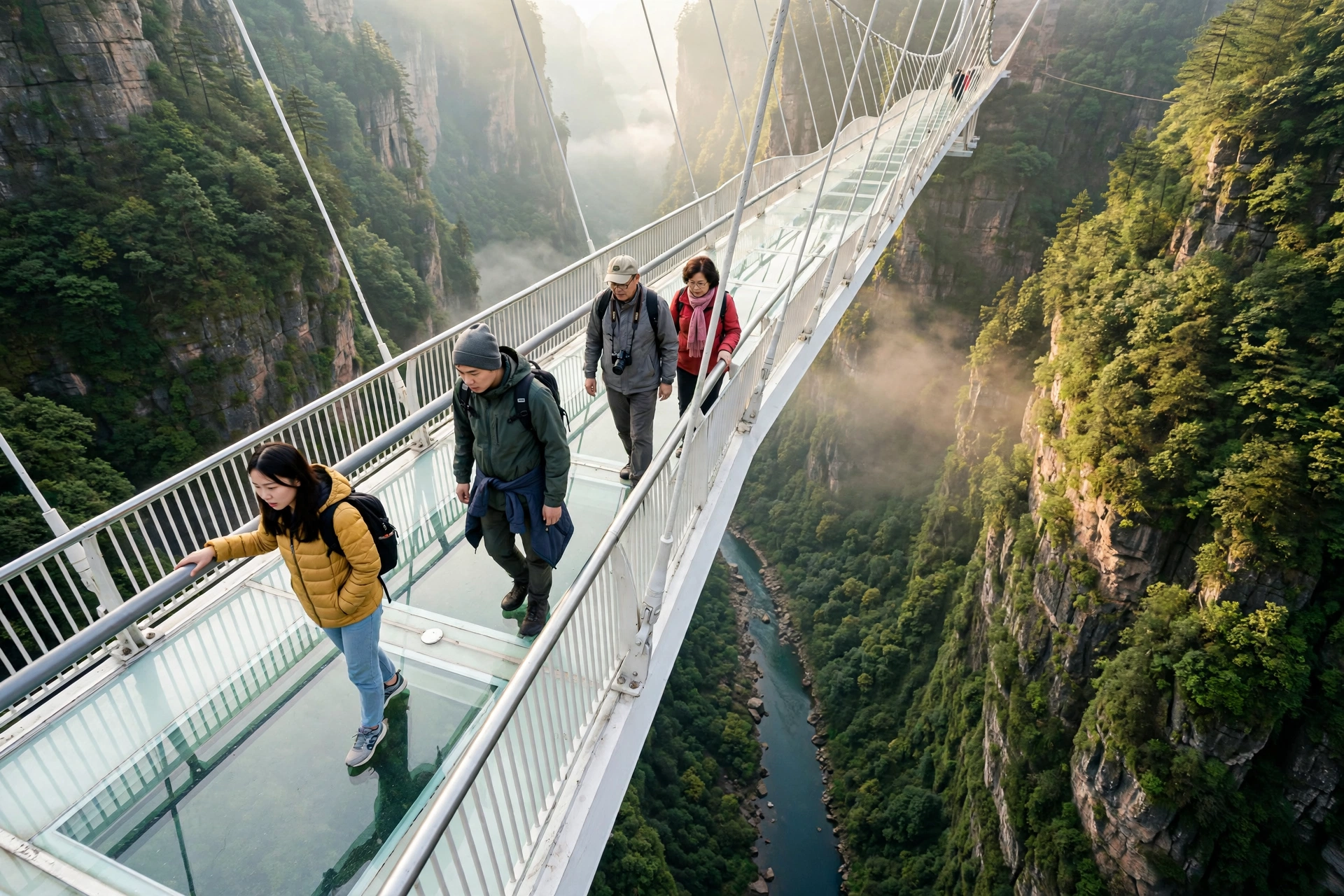
The Zhangjiajie Grand Canyon Glass Bridge stretches 430 meters long and 6 meters wide, suspended 300 meters above the canyon floor. When it opened in 2016, it was the longest and highest glass-bottomed bridge in the world, designed by Israeli architect Haim Dotan. It can hold 800 people at once, though standing on transparent glass with a 300-meter drop under your shoes makes 800 feel like a crowd you don’t want to join.
The bridge is in the Grand Canyon Scenic Area, a completely separate park from the National Forest Park, with its own ticket (around CNY 178 to 219) and its own booking system. Entry is time-slotted with a strict daily visitor cap, and during peak season the walk-up tickets sell out by mid-morning. Book through Trip.com or Klook before you go. This is not a place to wing it.
For the genuinely brave, a 260-meter bungee platform hangs off the bridge, one of the highest commercial bungee jumps on the planet. I’ll be honest: the bridge walk alone was enough adrenaline for most people I read about. The bungee is for the small subset of humans whose fear response appears to be broken.
3. Ride the Bailong Elevator Up a Cliff Face
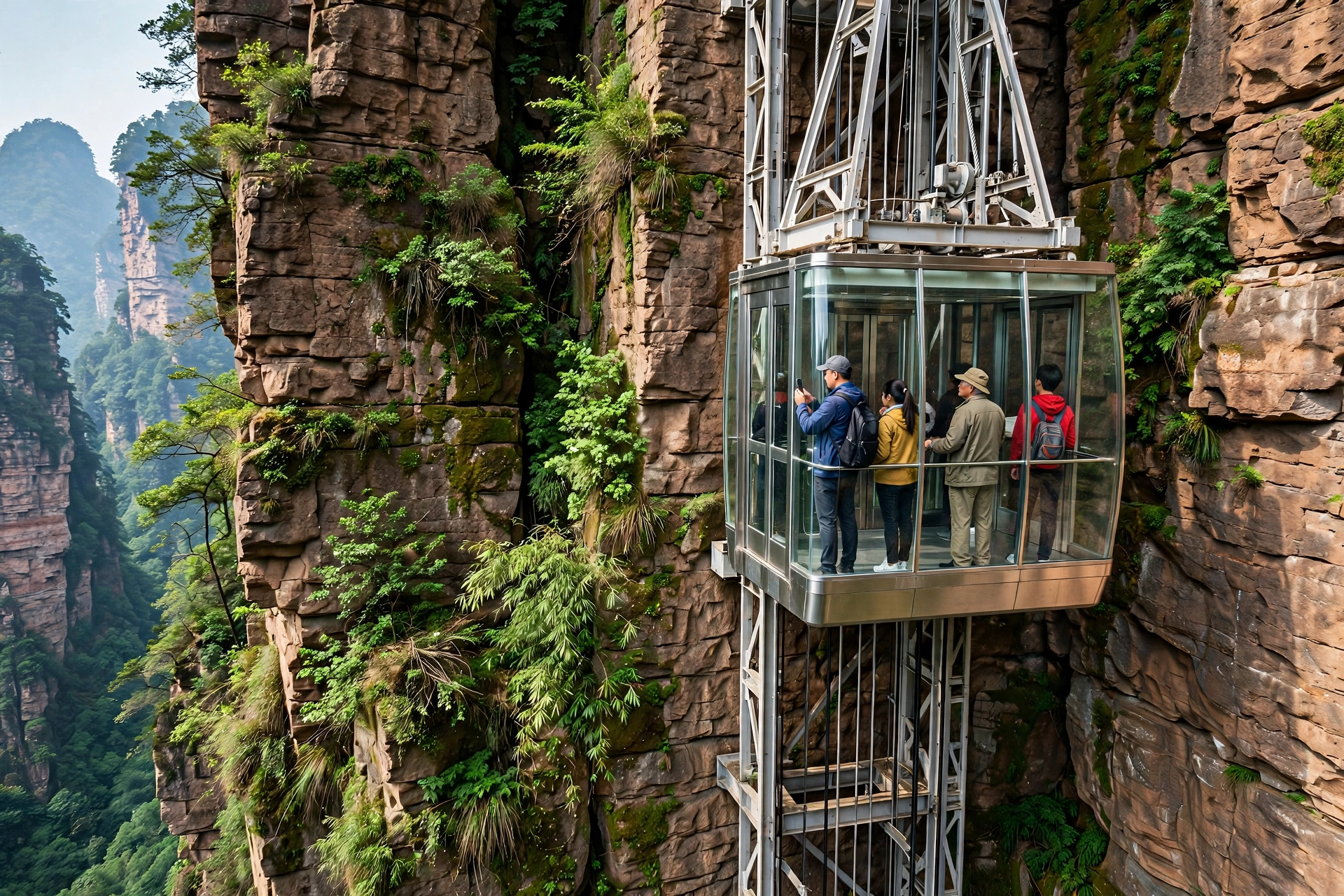
The Bailong Elevator, also called the Hundred Dragons Elevator, is a glass outdoor lift bolted to the side of a sandstone cliff. It rises 326 meters in about 88 seconds and holds the Guinness World Record as the world’s tallest outdoor elevator. Three transparent cars move up to 3,000 people per hour, and the ride up is genuinely spectacular: the pillar forest drops away beneath you through the glass walls.
It costs CNY 65 one way, separate from the park ticket, and it’s the fastest route from the valley floor to the Yuanjiajie plateau. The catch is the queue. Everyone has the same idea, so arrive at the elevator base by 8 am or prepare to stand in line watching other people’s vacation time evaporate. Environmentalists criticized the elevator when it was built, calling it a scar on a World Heritage landscape. Two decades on, it’s one of the park’s defining experiences, and the debate has mostly settled into a shrug.
4. Climb the 999 Steps to Heaven’s Gate (Tianmen Mountain)
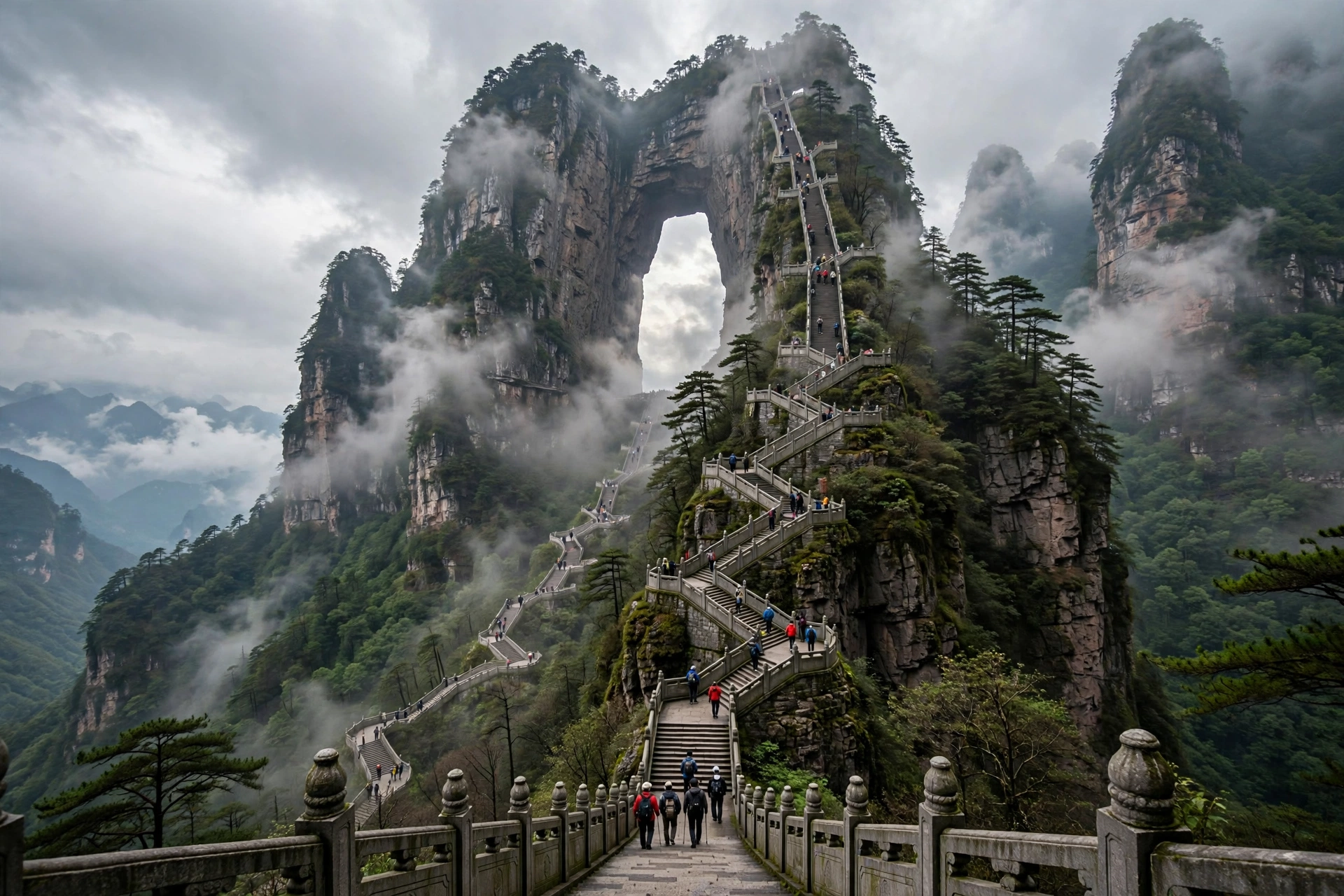
Tianmen Mountain is the third park, and it’s the odd one out in the best way. Its centerpiece is Heaven’s Gate, a massive natural arch eroded through the mountainside, one of the highest natural arches in the world. A staircase of 999 steps climbs to it. Nine is a lucky number in Chinese culture, and the symbolism isn’t subtle: you’re literally climbing a stairway to heaven.
Getting there is an adventure in itself. The Tianmen Mountain cableway runs about 7.5 kilometers from downtown Zhangjiajie up the mountain, one of the longest passenger cableways anywhere, with a famously stomach-dropping final ascent. At the top, cliff-hanging walkways (including glass skywalk sections bolted to vertical rock) loop around the summit with views that make the elevator ride feel tame.
Tianmen Mountain charges its own admission, around CNY 288 including the cable car. It’s a half to full day on its own, so plan accordingly.
5. Hike Tianzi Mountain’s Sea of Peaks
If Yuanjiajie is the blockbuster, Tianzi Mountain is the art film. The views here are wider and moodier: layer upon layer of misty spires fading into blue distance, the classic Chinese ink-painting landscape. Helong Park and the Clouds-Dispelling Platform are the headline viewpoints, and on mornings when the clouds sit below the platform level, you get that floating-on-air sensation that no photograph quite captures.
A cable car (CNY 72) connects the area, or you can hike the trails for a quieter experience. Tianzi sees fewer tour groups than Yuanjiajie, which makes it the connoisseur’s pick. Go at sunrise if you can manage it. The light does things to the mist that feel staged, except nobody staged them.
How to Plan Your 2026 Trip (The Practical Stuff)
Best time to visit
September through November is the sweet spot: clear skies, comfortable temperatures, and the autumn colors add a layer the summer crowds miss. April and May bring lush green and dramatic mist, though rain is more likely. Winter is underrated and empty, with occasional snow turning the pillars into something out of a fantasy novel, but some cableways close in bad weather.
The honest warning: avoid Chinese public holidays like your trip depends on it, because it does. National Day Golden Week (early October) and Labor Day (early May) turn the park into a slow-moving river of people. If you must travel during a holiday, book every ticket and time slot the moment bookings open.
Tickets and how the system works
This is the part that trips everyone up, so read it twice. The National Forest Park entry ticket costs around CNY 228 to 240, valid for four consecutive days, and includes the eco-shuttle bus network inside the park. It does not include the Bailong Elevator (CNY 65), the Tianzi Mountain cable car (CNY 72), or any of the other lifts. Budget roughly CNY 850 to 900 total if you want the full suite of main experiences across all the parks.
Entry runs on booked time slots tied to your passport, so bring it. The Grand Canyon Glass Bridge (around CNY 178 to 219) and Tianmen Mountain (around CNY 288) are separate parks with separate tickets, booked separately. A guided day tour covering the forest park runs from about $59 with entry included, and two-day packages adding Tianmen Mountain or the Glass Bridge run $185 to $205. Going guided removes most of the logistics headache, and for a first visit in China, that’s worth real money.
Getting there and where to stay
Fly into Zhangjiajie Hehua Airport (DYG), which has connections from major Chinese cities, or take the high-speed rail from Changsha in about two to three hours. Stay in Wulingyuan town near the park’s east gate for the National Forest Park days, it’s a purpose-built tourist town with everything you need, and move to downtown Zhangjiajie for Tianmen Mountain day, since the cableway starts right in the city.
What Most Guides Won’t Tell You
A few things I wish someone had told me before my first deep dive into planning this trip. First, the mist is the attraction. Travelers who visit on crystal-clear days sometimes leave underwhelmed, which sounds absurd until you realize the “floating” effect needs clouds below the peaks. A little rain the night before your visit is genuinely good news.
Second, go early or go late. The big tour groups arrive between 9 and 10 am and leave around 4 pm. If you’re at the Bailong Elevator base by 8 am, or still on the mountaintop viewpoints at golden hour, you’ll share the views with a fraction of the crowd. The light is better then anyway.
Third, the park is bigger than your legs think. Distances between scenic areas look short on the map and feel very long after six hours of stairs. Use the shuttle buses and lifts strategically. Nobody will think less of you for riding the elevator instead of hiking 3,000 steps. The elevator is an attraction, not a shortcut.
Fourth, food inside the park is basic and overpriced. Eat a big breakfast, carry snacks and water, and save your appetite for Hunan cuisine in town at night. Hunan food is famously spicy, numbingly spicy, the kind of spicy that rearranges your priorities. Try it anyway.
Is Zhangjiajie Worth the Hype? (Honest Answer)
Here’s my honest take after digging through hundreds of trip reports and reviews. Zhangjiajie is not a hidden gem. It’s one of China’s most visited natural attractions, and on a bad day it can feel like it: queues, crowds, selfie sticks, the works. If your idea of adventure is untouched wilderness with no one else around, this isn’t that, and no article should pretend otherwise.
But the landscape itself? It delivers. There’s a reason this place shows up on “world’s most surreal landscapes” lists year after year, and a reason it made the cut on 2026’s trending adventure destination roundups. The scale of the pillar forest does something that crowded or not, commercial or not, most travelers describe as genuinely moving. People who were skeptical going in, and there are many, tend to come out converted.
The trick is managing the experience rather than just showing up. Go in shoulder season, start early, book the time-slotted tickets in advance, and give it two full days instead of rushing. Do that, and Zhangjiajie earns every bit of its reputation.
More Adventures Worth Your Bucket List
If sky-high landscapes are your thing, you’ll want to read our guide to Iceland’s ice cave season, where you can walk inside glaciers of solid blue crystal. For underground wonders on the opposite end of the vertical spectrum, our Cappadocia underground cities guide takes you 85 meters beneath Turkey into cities that hid 20,000 people. And if 2026 is your year of big thrills, check out why Brazil was ranked the world’s top thrill-seeker destination.
For the record books side of these wonders, the UNESCO listing for Wulingyuan documents the site’s protected status and geological significance, and Guinness World Records certifies the Bailong Elevator as the tallest outdoor lift on Earth.
Pin It for Later
Planning a China adventure? Save this guide on Pinterest and follow The Cavee for daily adventure travel inspiration, from the world’s deepest caves to its highest glass bridges. Your 2026 bucket list will thank you.