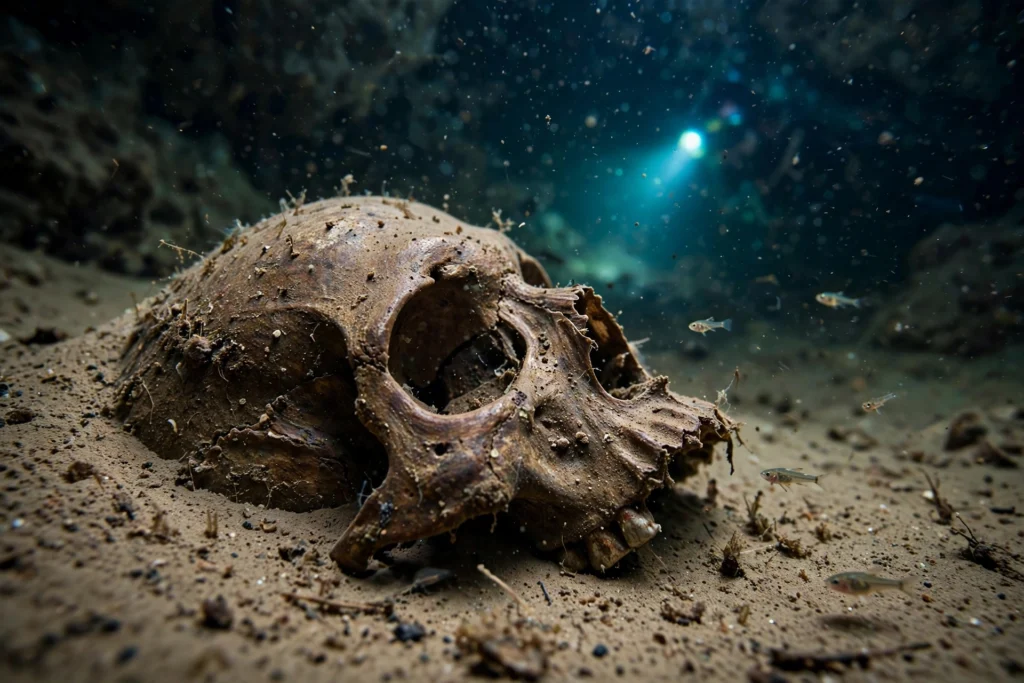
Picture this. You’re floating in water so still it barely ripples. Above you, a rock ceiling your headlamp can’t reach. Below you, sediment that hasn’t been disturbed in eleven thousand years. And resting on that sediment, half-buried and ghostly white in your light beam: a human skull.
That’s not a scene from an adventure movie. It’s what happened in September 2025, when a team of cave divers descended into a remote flooded cave in Brazil and started pulling one of the most important archaeological discoveries of the decade out of the dark.
They call it the Cave of Bones. And the story of how they mapped it is almost as incredible as what’s inside.
What They Found Down There
Let’s get to the numbers first, because they’re wild.
The team recovered around 400 bones. Not fragments. Four hundred individual bones, pulled one by one from the cave floor using weighted mesh bags and crates so small they could handle the tiniest shards without breaking them.
Among them: several human skulls and skeletons. A tapir. A giant rodent skull (imagine a guinea pig the size of a small dog, because that’s basically what prehistoric Brazil was working with).
Carbon dating told the rest of the story. The human remains clocked in at about 11,000 years old. The animal bones ranged from 8,000 to a staggering 100,000 years old. So this single cave floor is a timeline spanning nearly a hundred millennia.
But here’s the part that made archaeologists sit up straight. Some of the human skeletons weren’t just lying there randomly. Their positioning suggested deliberate burial rituals. People didn’t just die in this cave, which is what you’d assume. Somebody put them there. On purpose. Which means organized ritual behavior in Brazil over eleven thousand years ago, thousands of years before anyone built the first pyramid in Egypt.
Think about that for a second. The people who buried their dead in this cave were doing it when mammoths were still… well, not quite around, but close. When the last ice age was barely over. When writing didn’t exist, wheels didn’t exist, and agriculture was a brand-new experiment.
The Expedition: 26 People, 6 Divers, One Rule
Here’s what I love about this story: the team didn’t just grab the bones and swim out. They treated the site like a crime scene, which in a way it is. An eleven-thousand-year-old one.
The project brought together 26 people: archaeologists, geologists, dry cavers, and a documentary crew. The underwater work fell to a dive team of just six cave divers. And their first objective wasn’t recovery at all. It was documentation.
Over three days, each diver logged 18 hours underwater. They captured 10,000 photographs. Not for fun. For photogrammetry, which is a fancy word for turning thousands of overlapping photos into a precise 3D model of the cave’s main chamber.
Only after the 3D model was complete did anyone touch a bone.
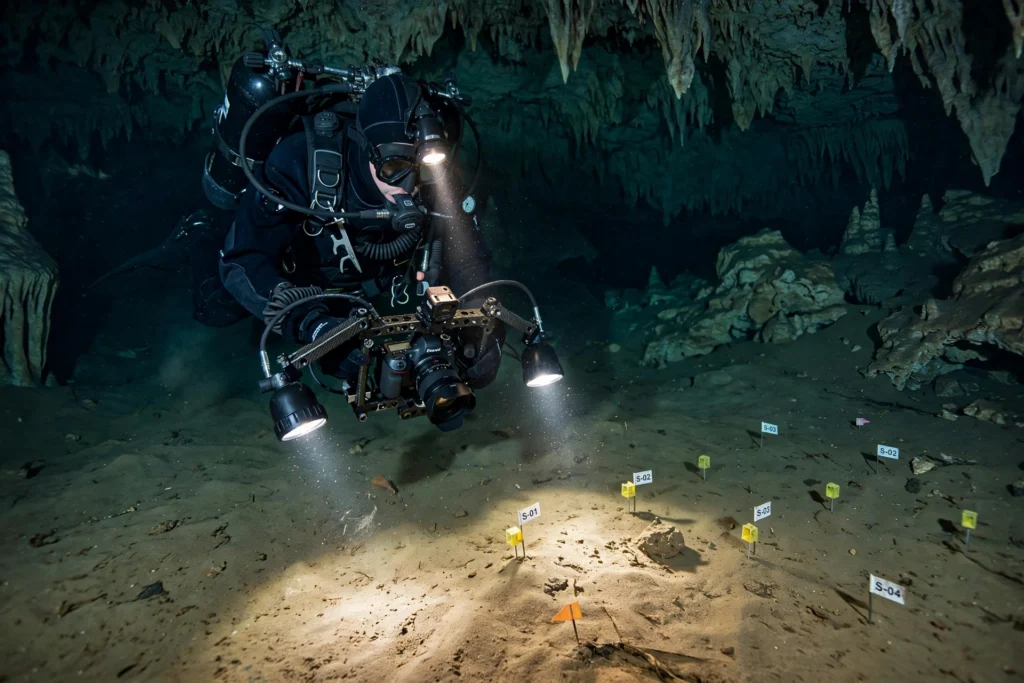
This matters more than you’d think. When you’re dealing with something this old and this fragile, the context is everything. A bone sitting alone on sediment tells you almost nothing. A bone sitting exactly where it was found, with its position mapped to the millimeter in a 3D model, tells you a whole story. It tells you whether the body was laid there deliberately. Whether other bones were arranged around it. Whether it moved over time or stayed exactly where it was placed.
Why Cave Divers Swear by Rebreathers
Here’s a detail that stuck with me. The dive team used closed-circuit rebreathers, or CCRs. These are not your normal scuba tanks.
A regular scuba diver exhales bubbles that rise to the surface. In a cave that has sat undisturbed for millennia, those bubbles are a disaster. They stir up sediment. They cloud the water. They can literally destroy an archaeological site in minutes by lifting thousands of years of settled dust off everything.
Closed-circuit rebreathers recycle the diver’s exhaled breath, scrubbing out carbon dioxide and topping up oxygen. No bubbles. Almost no disturbance. The cave floor stays pristine. The water stays clear enough to photograph.
There’s also a logistical advantage: CCRs let divers stay underwater far longer than open-circuit tanks would allow. When each diver needs to log 18 hours underwater across three days, efficiency matters.
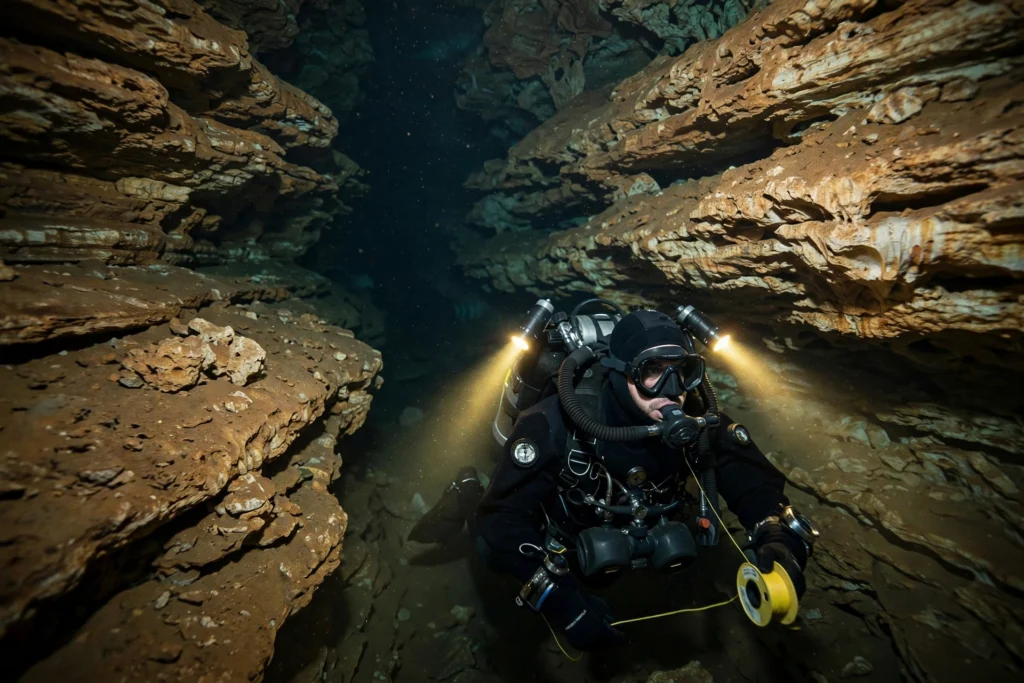
Cave diving is already one of the most dangerous recreational activities on the planet. Add a remote Brazilian cave, 18-hour dive days, zero-bubble equipment, and millimeter-precision archaeological work, and you’ve got an expedition that most people wouldn’t attempt in their wildest dreams.
Why Did the Bones Survive at All?
This is the question that gets me. Eleven thousand years. In water. How is any of this still there?
The answer is the cave itself. When the cave flooded (at some point after those burials happened, the water table rose or the entrance collapsed, or both), the environment inside became almost perfectly stable. No sunlight. No weather. No scavengers, because almost nothing lives down there. The water is so still and so undisturbed that sediment settles like a protective blanket over everything.
It’s the same reason ancient shipwrecks survive in the Black Sea’s oxygen-depleted depths, or why cenotes in Mexico preserve artifacts for thousands of years. Still water is nature’s best vault. The chemistry is gentler than air exposure, and once something sinks into that fine sediment, it basically gets laminated in place.
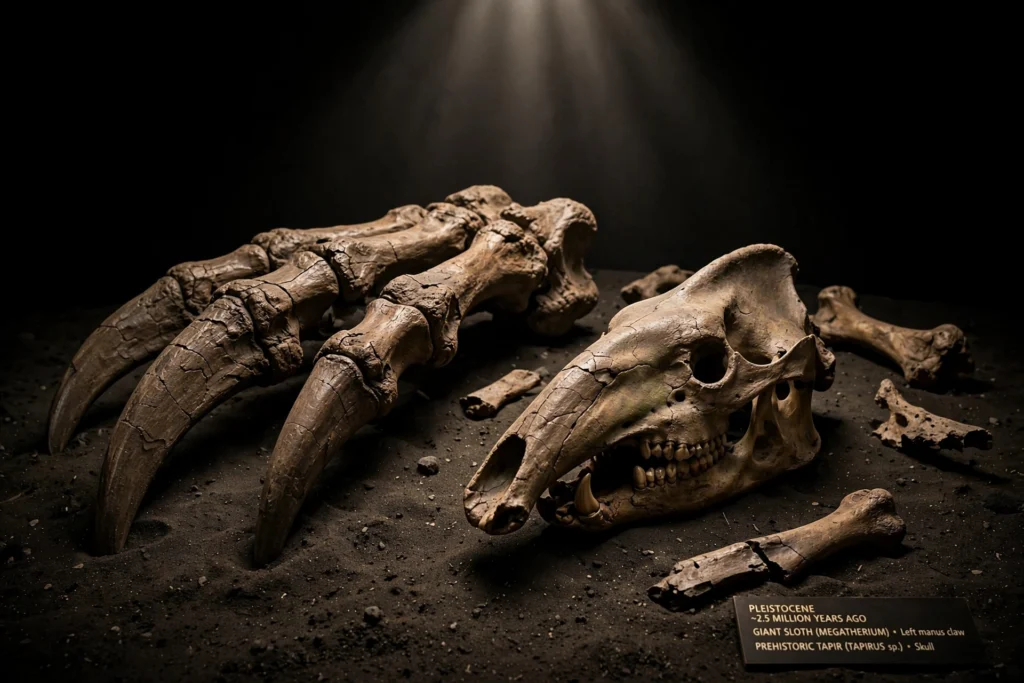
The bone preservation is so good, in fact, that researchers could read positioning details that would have vanished long ago in a dry cave exposed to bats, insects, and temperature swings. The water saved the story.
What 11,000-Year-Old Burials Tell Us About Ourselves
I want to pause here because the science matters, and it’s easy to get lost in the adventure and miss it.
Eleven thousand years ago puts these burials among the oldest evidence of organized human ritual in the Americas. The deliberate positioning of bodies suggests these weren’t accidents or casual disposals. Someone cared enough to arrange the dead. To perform rites we can barely guess at.
This joins a growing body of evidence that early American cultures were more sophisticated, more organized, and more spiritually complex than the old textbooks suggested. At sites like Lapa do Santo in east-central Brazil, researchers have found that burial rituals evolved over thousands of years: bodies buried intact 10,600 years ago, then dismembered and defleshed before burial a thousand years later, then simpler disarticulated burials 8,000 years ago. Each change tells us something about how those people’s beliefs shifted.
The Cave of Bones adds a whole new chapter to that story, written in water and sediment.
Could You Visit This Cave?
Honestly? Probably not, and that’s okay.
The cave is in a remote part of Brazil, its exact location kept quiet for obvious reasons. This is a working archaeological site, not a tourist attraction. Flooding it with visitors would destroy exactly the conditions that preserved it.
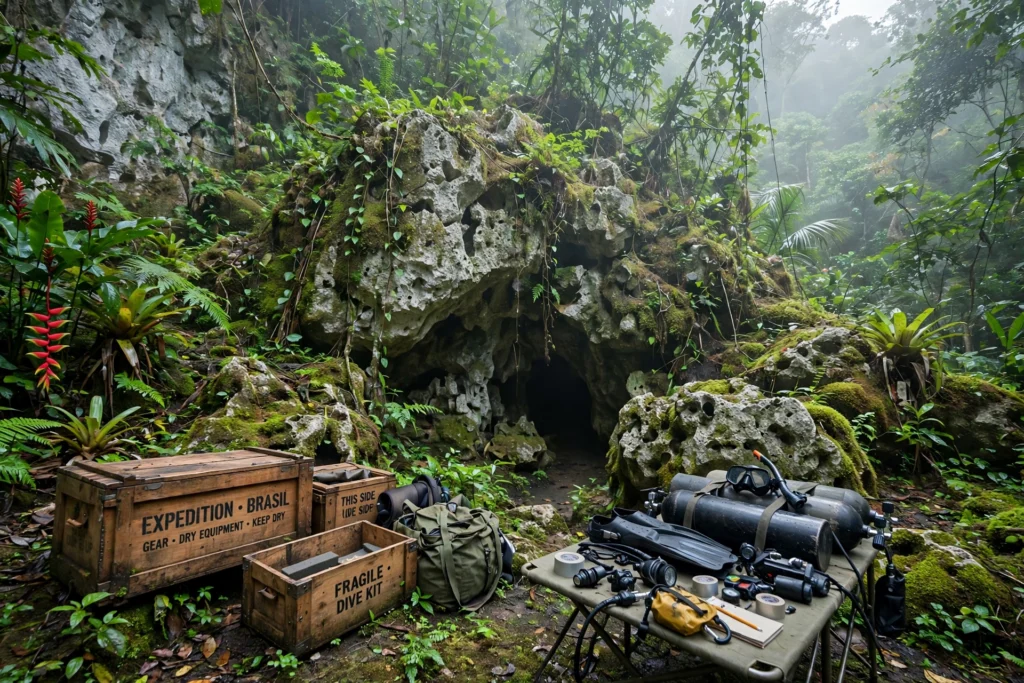
But here’s the good news: you don’t need to be one of those six divers to experience flooded caves. Mexico’s cenotes offer guided cave dives through crystal-clear underground rivers lined with stalactites. Thailand’s Sra Keow is considered one of the world’s most beautiful flooded caves. And if you want to see what cave exploration looks like without getting wet, learning how to photograph a cave properly will change the way you see every underground space you ever walk into.
The Cave of Bones reminds us that the world’s most important discoveries aren’t always in museums or dig sites. Sometimes they’re at the bottom of a flooded hole in the jungle, waiting for someone brave enough to go down with a camera instead of a shovel.
What Happens Next
The documentary crew that accompanied the expedition means we’ll eventually see footage of this place, which I honestly can’t wait for. The bones themselves will go through years of analysis: more precise dating, isotope analysis to figure out what these people ate, DNA extraction attempts (the cold, stable water is actually good for DNA preservation).
And the 3D model? That’s the real legacy of this expedition. Even if the physical bones eventually degrade, the digital cave will preserve their exact positions forever. Future researchers who aren’t even born yet will be able to “walk” through that chamber and study arrangements we haven’t even noticed yet.
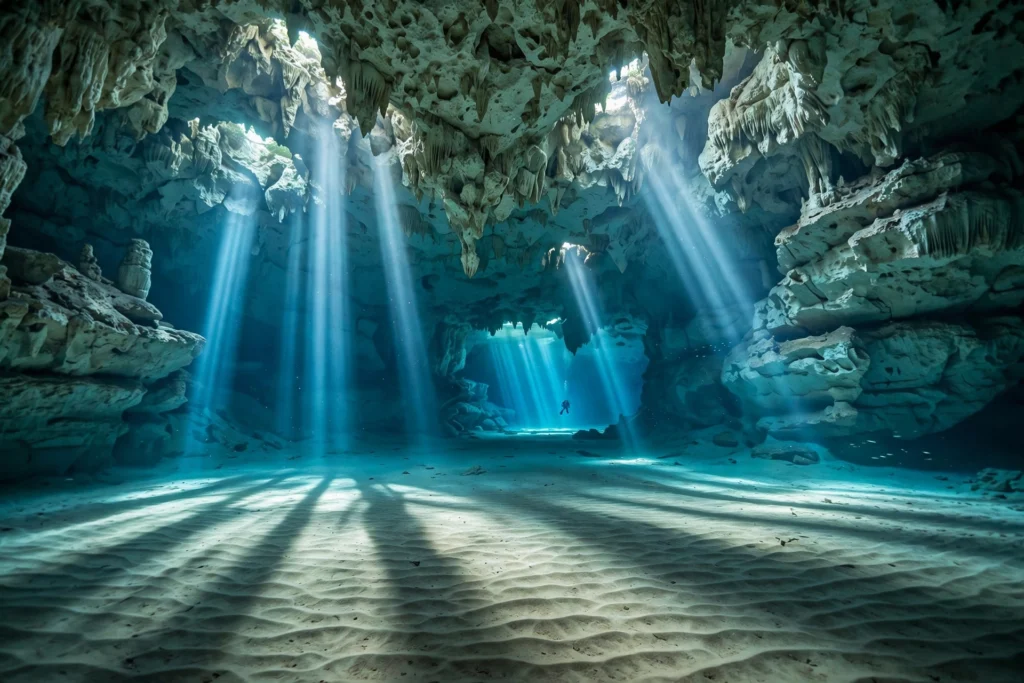
That’s the part that gives me chills. A cave sealed in darkness for thousands of years, mapped to the millimeter in three days, now living forever as a digital twin. Somewhere in Brazil, under the jungle, the bones are still down there in the dark. But their story is out now, and it’s never going back.
Want more cave stories like this? Follow our Pinterest page for daily cave discoveries, glowworm caves, underwater expeditions, and cave photography tips. Read Full Story on thecavee.com.