Saudi Arabia Just Opened a 1,200 KM Northern Trail (And Nobody Is Talking About It Yet)
Most people who plan a Saudi Arabia trip end up with the same three names: Riyadh, Jeddah, and AlUla. Maybe the Red Sea if they have been reading travel news. That is a fine trip, but it misses most of the country. On November 2, 2026, Saudi Arabia quietly fixed that problem. Tourism minister Ahmed Al-Khateeb announced a brand new Northern Trail: a 1,200 kilometre route from Riyadh through Qassim to Hail, with 16 stops and more than 130 experiences.
It is part of Saudi Winter 2026, and it might be the most interesting thing Saudi tourism has launched all year. Not because it is flashy. Because it is the opposite of flashy. Mud-brick villages. Date markets. A UNESCO rock art site where people carved camels into stone ten thousand years ago. Desert camps where the sky does the entertaining. This is the Saudi Arabia that most visitors never see, and now it comes with a map, a name, and 335 tour guides ready to show you around.
Here is the honest truth, though. The trail is brand new, which means you can be one of the first travellers to drive it, before the crowds arrive. It also means you cannot just show up and wing it the way you would in a city with a metro and a hundred hotels. The villages are small, the distances are real, and the details matter. This guide covers all of it: every stop, what each one is actually worth, how long to drive, what it costs, and the mistakes to avoid.
What the Northern Trail Actually Is
The Northern Trail is not one road and it is not one attraction. It is a coordinated tourism corridor: 16 destinations across three regions tied into a single journey, with shared branding, guides, and booking through local operators. The slogan is “A Journey at Every Stop”, and the visual identity, inspired by heritage landmarks and Najdi architecture, was unveiled on October 31, 2026.
The route covers 1,200 kilometres: eight stops in the Riyadh Region, six in Qassim, and two in Hail. There are more than 130 experiences on offer, from heritage walks and desert adventures to food tastings and craft workshops. Behind the scenes, 21 destination management companies and more than 335 tour guides are involved. That last number matters. You can self-drive the trail, and plenty of people will, but half of these places have no signs in English and no ticket office. A guide is the difference between driving past a mud-brick wall and understanding why it was built that way.
The trail also fits a bigger picture. It is part of Saudi Vision 2030, the plan to diversify the economy beyond oil, and it is aimed squarely at winter. Saudi summers are brutal in the interior, but from October to March the desert is genuinely pleasant. If you have ever wondered when to visit Saudi Arabia, this is the answer. Winter.
The 16 Stops, Region by Region
Here is the full list, so you can plan properly. The trail starts in Riyadh and ends in Jubbah, in the Hail Region.
Riyadh Region (8 stops): Riyadh, Thadiq, Shaqra, Ushaiqer, Al-Qasab, Al-Majma’ah, Al-Ghat, and Al-Zulfi.
Qassim Region (6 stops): Al-Mithnab, Unaizah, Al-Rass, Al-Bukayriyah, Buraidah, and Uyun Al-Jiwa.
Hail Region (2 stops): Hail and Jubbah.
Do not try to do all 16 in a weekend. The fastest road from Riyadh to Hail alone is about 620 kilometres, roughly six hours of driving through Al-Zulfi, Buraidah, and Al-Shanan, according to the Saudi Roads General Authority. A second, more scenic route runs about 731 kilometres and takes around eight hours. Add stops, meals, and the sunsets you will want to photograph, and you are looking at four to six days to do the trail properly. Three days if you are ruthless. Seven if you want to do it slowly, which is honestly the right way.
Riyadh Region: Where the Trail Begins
Every good road trip needs a strong opening, and the Riyadh Region delivers one about two hours out of the capital. Ushaiqer Heritage Village sits roughly 200 kilometres northwest of Riyadh, and it is the single most photogenic stop on the whole trail.
Ushaiqer is a walled oasis town settled by Bedouins more than 1,500 years ago. It grew up as a stopping point for pilgrims and trading caravans heading to Mecca, thanks to its underground water and fertile soil. What you see today is a dense maze of golden mud-brick walls, narrow lanes, and heavy timber doors carved with geometric folk art. The builders used sun-dried clay, straw, and palm trunks, and they built cleverly: thick walls keep the heat out, and overhead bridges connect second-story rooms across the narrow streets so families could move between houses without stepping into the sun.
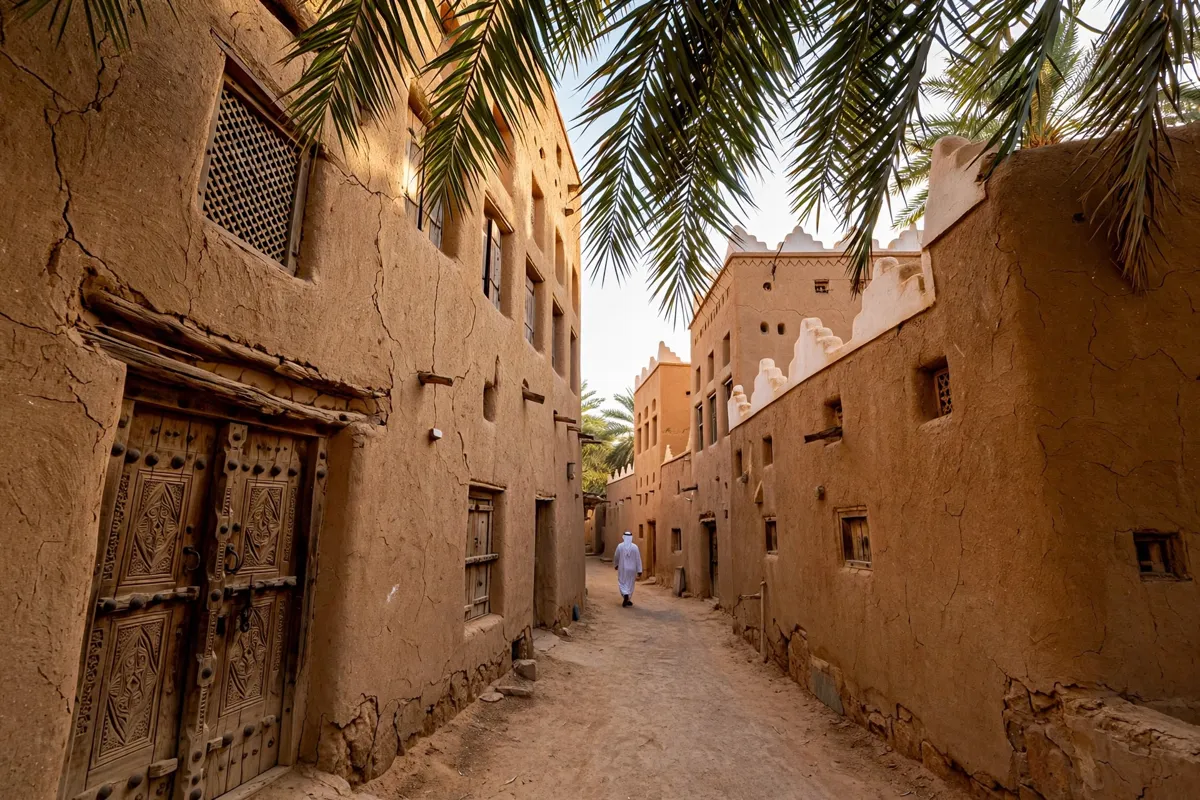
Give yourself two to three hours here. The highlights are the Al-Shenajer House Museum, a big family residence packed with historic Najdi artifacts, the restored Subai’i Mosque, and the Al-Musalla overlook tower, the best viewpoint in the village. Entry to the streets is free, and the small house museums usually accept a donation of 10 to 20 riyals. There is no public transport from Riyadh, so rent a car and drive Route 546. Go in the morning or late afternoon, when the light turns the mud walls gold.
The other Riyadh Region stops are quieter, and that is the point. Shaqra is another old Najdi town with its own heritage quarter, and it pairs naturally with Ushaiqer on the same day. Al-Ghat, Al-Zulfi, Al-Majma’ah, and Thadiq are small towns where the trail is less about ticking off sights and more about driving through a part of Saudi Arabia that guidebooks usually skip. If you like places before they are polished for tourists, this stretch is the reward.
Qassim: Dates, Markets, and Slow Mornings
Qassim is the middle of the trail, and it is the region most travellers will underestimate. That would be a mistake. Qassim is the agricultural heart of central Saudi Arabia, and its capital, Buraidah, hosts one of the most extraordinary food markets in the country. Go early in the morning, when the market is at its busiest.
The Buraidah date market, known locally as Dates City, is a working wholesale market where trucks arrive loaded with dates and buyers haggle over sacks of them. Row after row of golden, amber, and dark brown dates sit in woven baskets, vendors weigh them on old brass scales, and the air smells of fresh dates and cardamom. Buy a small bag of sukari dates, the soft, caramel-sweet variety Qassim is famous for. You will understand why people drive hours for this.
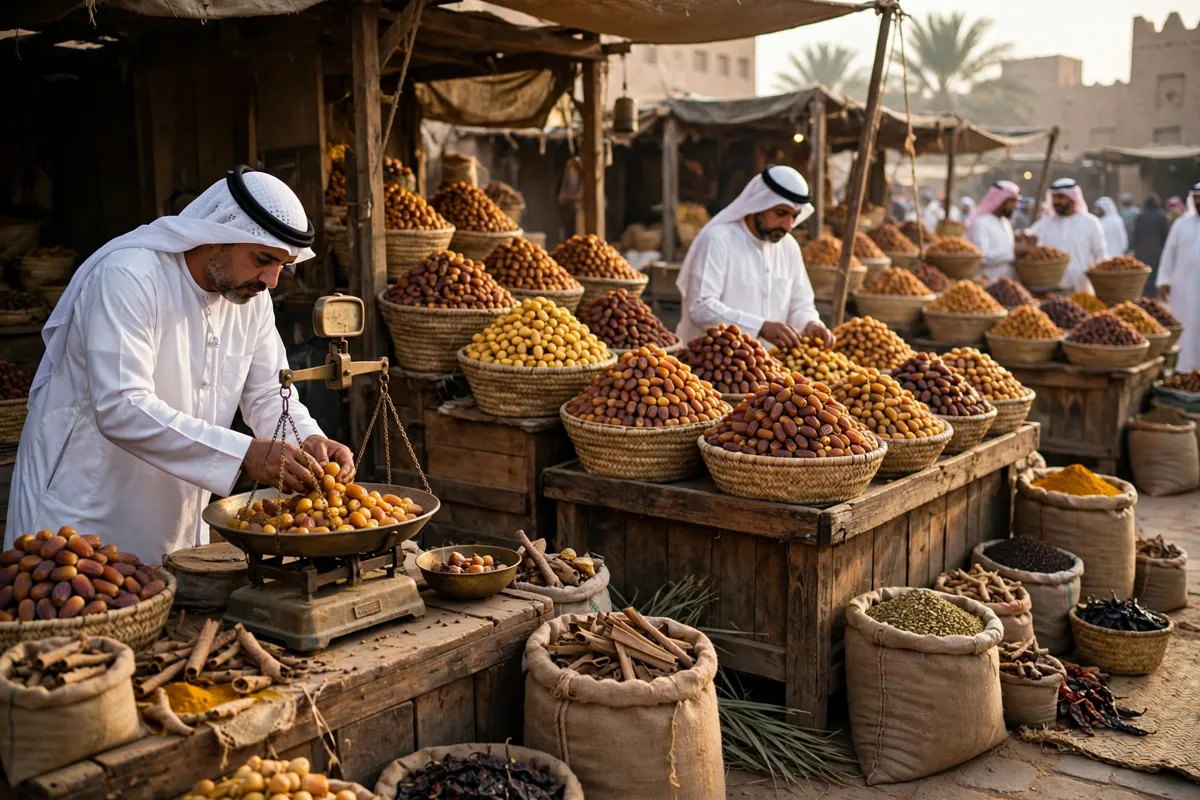
Beyond the market, Qassim’s contribution to the trail is food and craft. Unaizah is known for its old town and food culture, and the region’s towns are where the trail’s culinary experiences live: traditional dishes, bread baked in clay ovens, and coffee served the old way. Spend a night in Buraidah or Unaizah, eat well, and sleep properly. The trail is not a race, and Qassim is where you remember that.
Hail and Jubbah: The Part That Will Blow Your Mind
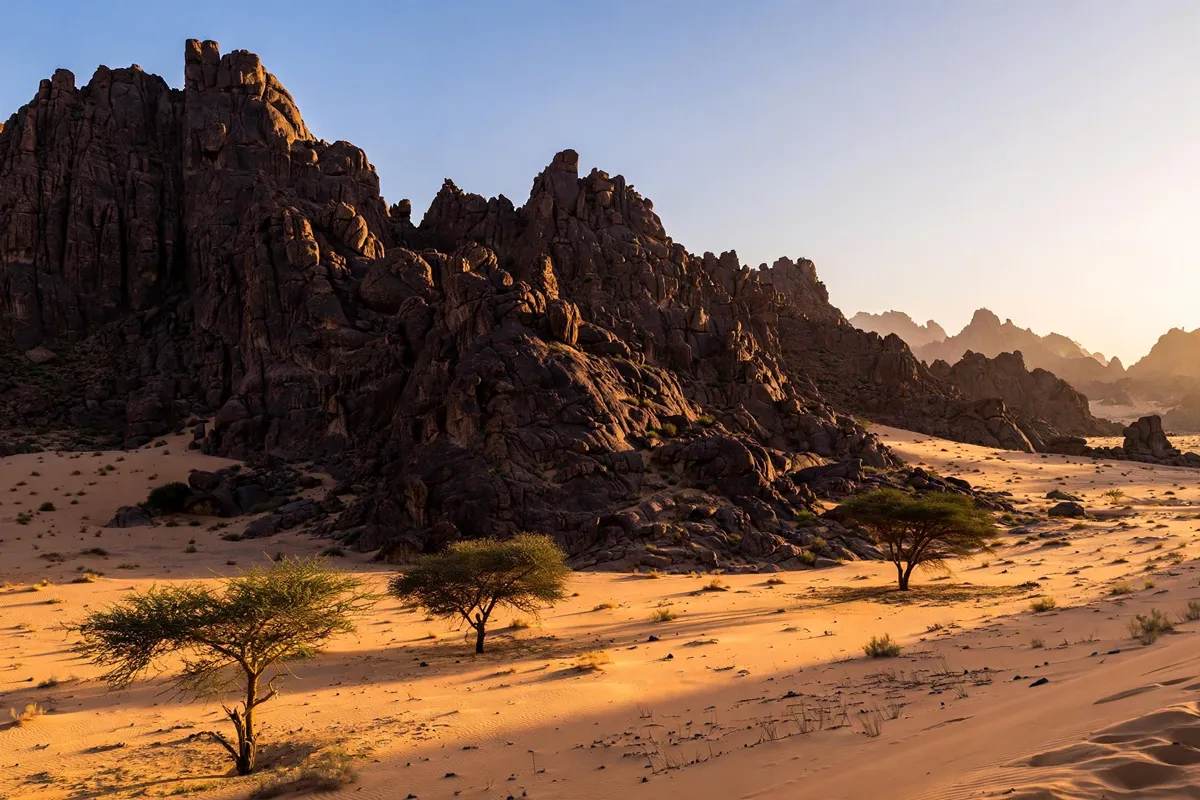
If Ushaiqer is the prettiest stop and Qassim is the tastiest, Hail is the one that will stay with you longest. The city sits between two mountain ranges, Aja and Salma, and the landscape around it is the most dramatic on the whole trail. Dark granite peaks rise straight out of golden sand, and the contrast is the kind of thing that makes you pull the car over for no reason at all. But the real reason to come to Hail is 90 kilometres northwest of the city, in a small town called Jubbah.
There, at a sandstone hill called Jabal Umm Sinman, people carved pictures into rock for thousands of years: camels, ibex, hunters, cattle, human figures. The carvings span from the Neolithic period seven to nine thousand years ago through the Bronze Age and into early Islamic times. UNESCO inscribed the Rock Art in the Hail Region as a World Heritage Site in 2015, calling it one of the biggest and richest rock art complexes in the wider region.
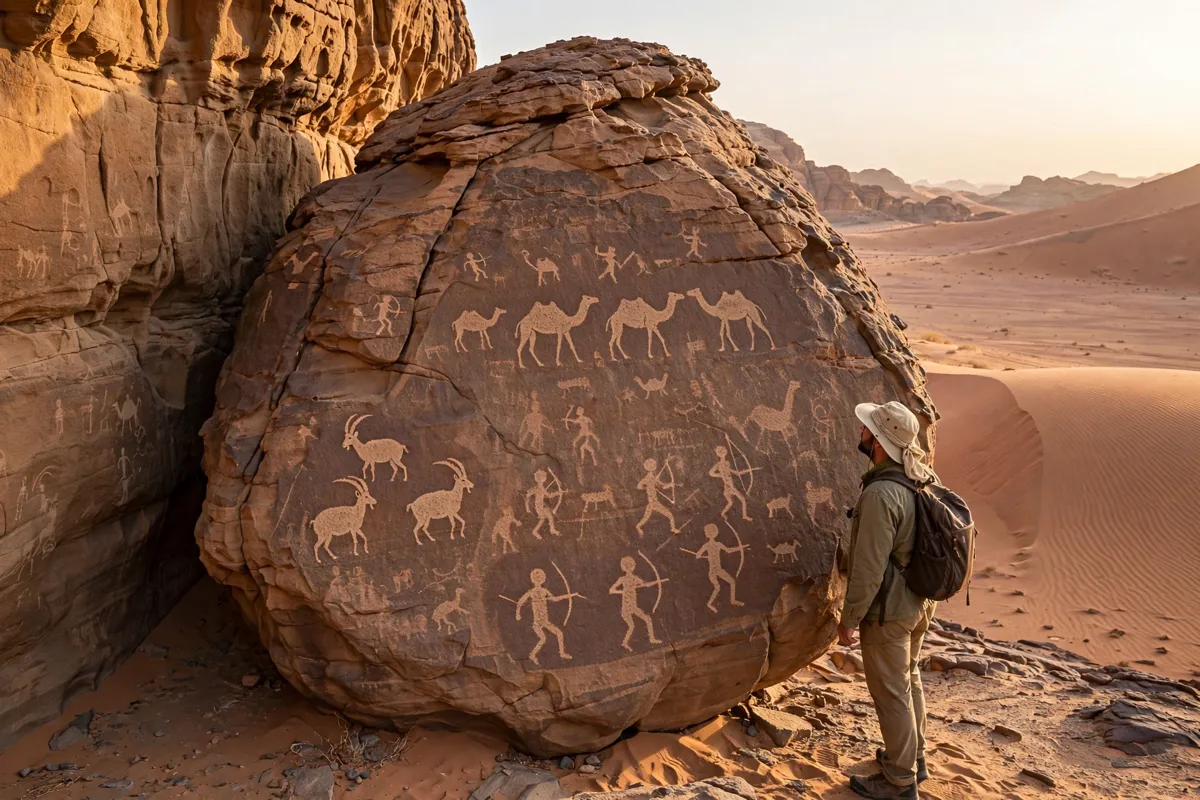
Here is what makes Jubbah special, and what most visitors miss. The rock art is not decoration. It is a record of a landscape that used to be completely different. Thousands of years ago, a freshwater lake sat at the foot of Jabal Umm Sinman, up to 20 kilometres long. The carvings show cattle and swimming figures, evidence of a green, watered world. Then the climate shifted, the lake dried up, and the desert took over. Standing in front of those carvings, looking out at dry sand in every direction, you are looking at ten thousand years of climate change written on a rock wall.
Practical advice: Jubbah has a visitor centre at the northwestern edge of town, right beside the petroglyph field. Go in the late afternoon, when the low sun brings the carvings out of the stone. Bring water, wear a hat, and do not touch the carvings. They survived ten thousand years. They do not need your help to survive the next ten.
Desert Nights: Camping the Nafud
The Northern Trail runs along the edge of the Nafud desert, a vast stretch of red sand dunes that most people only see from a car window. Do not make that mistake. At least one night on this trip should be spent out in the desert itself.
A proper Nafud camp is simple: white tents, a fire, food cooked over coals, and a sky full of stars. There is almost no light pollution out here, and on a clear winter night the Milky Way is bright enough to see with your naked eye. Bring a warm layer, because the temperature drops fast after sunset.
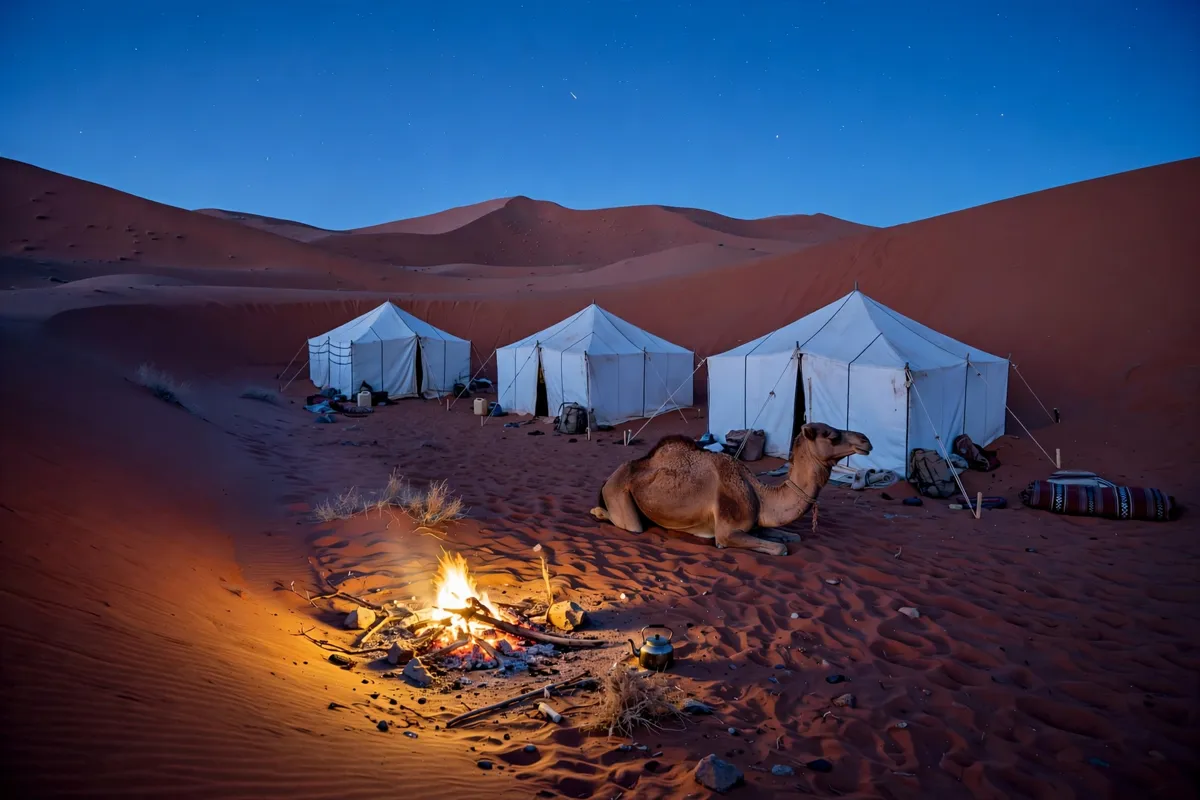
Book your camp through one of the trail’s operators or a local guide, not a random listing. The 21 destination management companies and 335 guides behind the trail exist so that desert nights are safe and properly run, with real equipment, real food, and someone who knows where the nearest help is. Spend the money, get the guide, and enjoy the stars without worrying.
The Food and the Coffee
Saudi hospitality runs on two things: dates and coffee. You will be offered both everywhere on this trail, often within minutes of arriving. The coffee is Arabic coffee, light and golden, flavoured with cardamom and sometimes saffron, served from a brass dallah pot into small handleless cups. It is poured in small amounts and refilled often. The rule is simple: keep accepting until you wiggle the cup gently to say you have had enough.
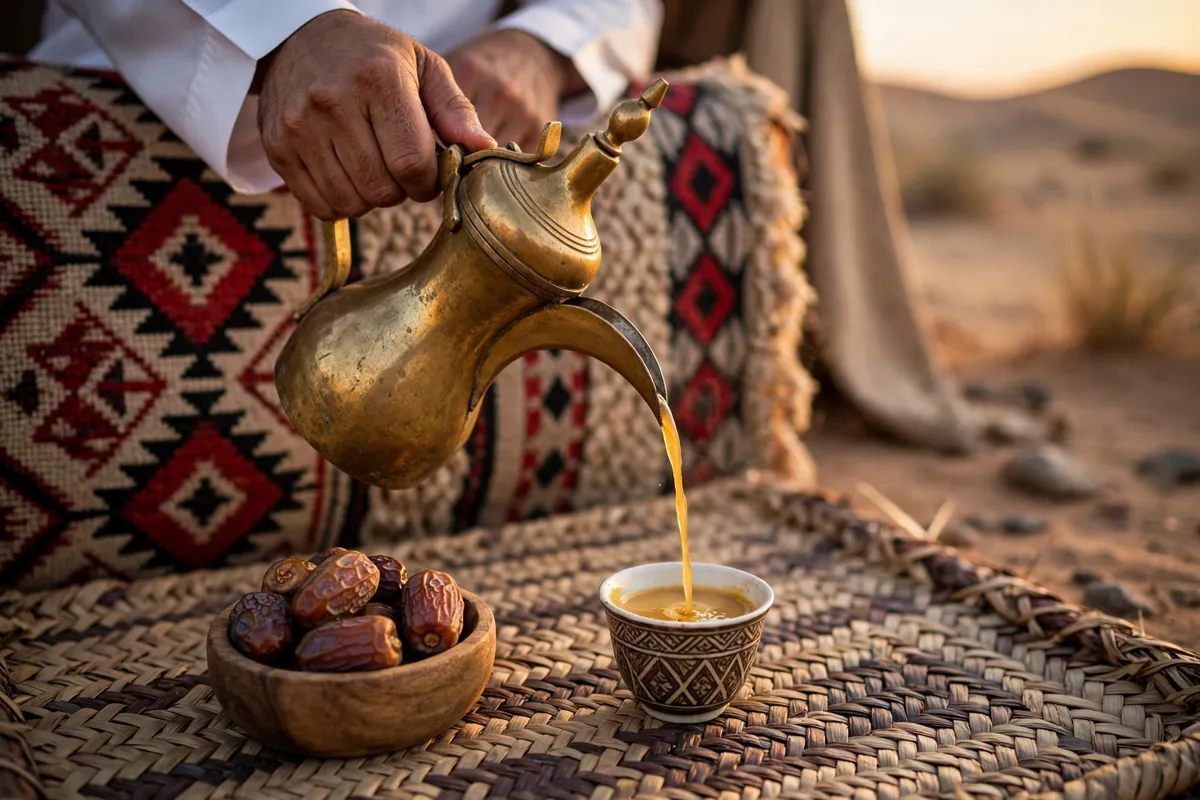
The food along the trail is the food of the Najd: slow-cooked lamb, rice dishes, flatbread from clay ovens, and dates with everything. Qassim’s markets are the place to eat well and cheaply, so ask your guide where the locals eat. The answer is almost always better than anything you will find on a review app.
How to Plan It: The Practical Stuff
Here is what decides whether your trip is great or miserable.
When to go
October to March. Full stop. Winter is the season the trail was built for, and summer in the interior desert is genuinely dangerous for outdoor travel. November is an ideal month: the heat has broken, the skies are clear, and the trail has just launched.
How long
Four to six days for the full route. Two days if you only want Riyadh, Ushaiqer, and Buraidah. One very long day gets you to Hail and back, but you will see nothing but highway.
How to get around
Rent a car in Riyadh. There is no public transport to the villages, and the trail is a driving route by design. A normal sedan handles the main roads fine, but an SUV is worth it if you plan to go off the highway to camps or viewpoints. Fuel is cheap, and the highways are good. Download offline maps before you leave Riyadh, because phone signal gets patchy between towns.
Guides or self-drive
Both work, and the honest answer is to mix them. Self-drive the main route, and hire a local guide for Ushaiqer, Jubbah, and any desert camp. The trail has more than 335 guides for a reason. They know which house museum is open, which road is washed out, and which family serves the best lunch. Book guides through the trail’s operators or your hotel.
What to pack
Layers. Desert days are warm and desert nights are cold, and the difference can be 20 degrees. Sunscreen, a hat, and more water than you think you need. Comfortable walking shoes with grip, because mud-brick lanes are uneven and sandstone is slippery. A power bank, and cash in small notes, because the village museums and market stalls do not take cards.
What it costs
The trail itself has no single ticket price, because it is a route, not an attraction. Your costs are car rental, fuel, hotels, food, and guides. Entry to most heritage sites is free or a small donation. A guided day tour from Riyadh to Ushaiqer runs around 799 riyals per person with transport included. Budget travellers can do the trail cheaply by self-driving and staying in simple hotels.
Who Should Go (And Who Should Skip It)
This trail is perfect for travellers who like road trips, history, photography, and places that are not crowded yet. If you enjoy the slow, curious side of travel, the part where a mud-brick lane is more interesting than a shopping mall, you will love it. It is also ideal for anyone who has already done AlUla and the Red Sea and wants to see what else Saudi Arabia has.
It is not for everyone, though. If you need nightlife, luxury hotels at every stop, and a full schedule of famous sights, you will be bored by the second day. The villages are small and quiet. Some have one restaurant. Some have none. If that sounds like a problem, stay in Riyadh and take a day trip to Ushaiqer instead. You will still get the best single stop on the trail.
How This Fits With the Rest of Saudi Arabia
The Northern Trail does not replace the famous destinations. It completes them. If you have a week in Saudi Arabia, the smart trip is now obvious: two days in Riyadh, four days on the Northern Trail, and a day or two at the Red Sea or in AlUla. The Red Sea coast, which we covered in our Saudi Arabia Red Sea adventure guide, gives you diving and coral reefs. The Northern Trail gives you history, desert, and villages.
And if you like hidden places, our guide to Cappadocia’s underground cities covers another ancient world built below the surface, and our Upper Mustang guide is the closest thing to this kind of remote, high-desert road trip anywhere in Asia. Different continents, same feeling: the best places are the ones you have to drive to find.
Frequently Asked Questions
Is the Northern Trail open now?
Yes. It was officially launched on November 2, 2026, as part of Saudi Winter 2026, with 21 destination management companies and more than 335 tour guides involved.
Do I need a guide, or can I drive it myself?
You can drive it yourself. The highways are good and the route is straightforward. But hire a local guide for Ushaiqer, Jubbah, and any desert camp. The guides know the places in a way no map can match.
How many days do I need?
Four to six days for the full 1,200 kilometre route. Two days covers Riyadh, Ushaiqer, and Buraidah.
What is the single best stop?
Jubbah, for the rock art. Ushaiqer, for the photography. Buraidah, for the food. If you forced me to pick one, it would be Jubbah, because ten thousand years of history on a rock wall is not something you see every day.
The Bottom Line
Saudi Arabia has spent years building famous destinations, and they are worth visiting. But the Northern Trail is something different. It is the country showing you its quiet side: the villages, the markets, the mountains, and the art on the rocks. Go this winter, while it is still new.
Drive slowly, stop often, drink the coffee, and look at the carvings at Jubbah in the late afternoon light. You will come home with a story nobody else at the dinner table has, because almost nobody has driven this road yet. In a year or two, that will not be true anymore.
Loved this guide? Save it to Pinterest and follow The Cavee on Pinterest for more adventure travel guides and hidden destinations. Read the full story on thecavee.com and start planning your Northern Trail drive today.