226 Human Teeth in a Belize Cave Just Rewrote What We Know About the Maya Elite
Some discoveries arrive quietly. A team of archaeologists publishes a paper, a few specialists nod, and the rest of the world moves on. This one did not arrive quietly, because the evidence is the kind of thing that stops you cold. In a cave high in the Maya Mountains of southern Belize, researchers found the grave of a woman buried around 1,700 years ago. Her head had been removed. In its place sat half a clay vessel holding a single jade bead. And scattered around her body were 226 human teeth.
That alone would be a strange story. What ancient DNA revealed next turned it into something much bigger. Many of those teeth belonged to people who were also buried somewhere else entirely, in elite tombs more than 26 kilometres away, on the opposite side of the mountains. The same people, buried in two places at once. It looks like the Maya elite had a burial custom nobody had ever proved before, and a remote cave in Belize just gave it away.
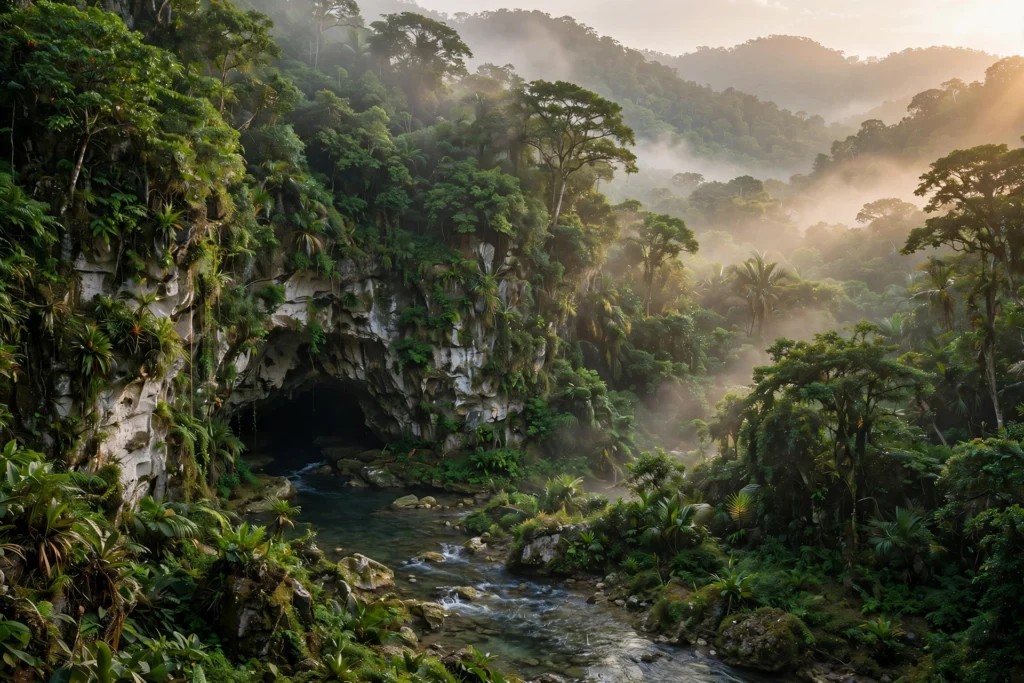
The mouth of a limestone cave in the Maya Mountains of Belize, where Bats’ub Cave hides its 1,700-year-old secret.
The cave that kept a secret for 1,700 years
Bats’ub Cave sits in the rugged Maya Mountains of southern Belize, inside the Bladen Nature Reserve. It is not a show cave. There are no walkways, no lights, no ticket booth. Getting there means rough jungle terrain, and the cave itself was excavated under permits from the Belize Institute of Archaeology and the Belize Forest Department, with the Ya’axche Conservation Trust as a local partner. The research team held public consultations with Indigenous leaders and residents from nearby villages in 2016, 2018, 2020, 2022 and 2024, and promised the results in English with translations into Mopan and Q’eqchi’.
The central burial dates to somewhere between AD 250 and 402. Radiocarbon dating of the woman’s tibia gives a median date of AD 331, right in the middle of the Maya Classic period, when the great cities of the lowlands were rising and the elite families who ran them were building the tombs we still dig up today.
What makes the find remarkable is not its age. Maya burials from this period are well known. It is what happened after the burial. Over the following centuries, people kept coming back to this grave, and each time they left something behind: human teeth. Not whole skeletons, not skulls, just teeth. Two hundred and twenty-six of them.
A woman, a missing head, and a single jade bead
The primary burial is strange in ways that go beyond the teeth. The woman was an adult, laid in a shallow pit only 20 to 25 centimetres deep. Her head had been removed, and in its place the mourners set the lower half of an undecorated vessel holding a single jade bead. Fragments of a poorly preserved cranium were found near her pelvis, and the researchers say it was possibly her own skull, set aside rather than buried with the rest of her.
Above her pelvis, someone had placed a bowl upside down. Inside it were five cacao seeds. Cacao was not a snack in the Maya world. It was currency, it was ritual drink, it was the stuff of ceremonies. Five seeds in a burial bowl is a deliberate, meaningful gesture, and nobody puts that in a grave by accident.
The other grave goods read like a list from a royal burial. There was a bowl painted with a corpse whose detached head rests on its abdomen. There was a vessel decorated with a feathered hummingbird-serpent. And there was a small rosewood stool, which the team describes as the first of its kind ever found in a mortuary context. The researchers argue the goods are, in their words, appropriate for a royal individual in an underworld setting.
That phrase matters. The ancient Maya saw caves as entrances to the underworld, places where the living could communicate with ancestors and deities. Other Belize caves held Maya ritual deposits too, most famously Actun Tunichil Muknal, and in the north the Maya linked sacred cenotes with the underworld. If you want to understand why a royal woman would be buried in a cave instead of a city tomb, that belief is the starting point. You can read about the sacred sinkholes of the Yucatan in our guide to the cenotes of Mexico, where the same underworld belief shaped an entire ritual landscape.
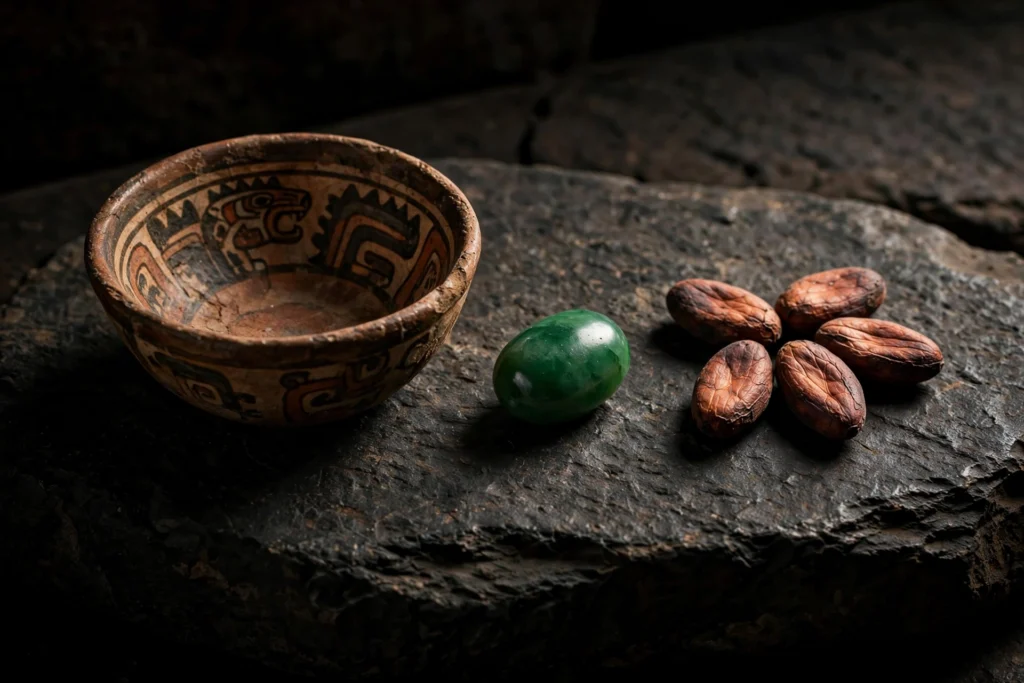
A painted Maya bowl, a single jade bead and cacao seeds, the kind of grave goods found with the woman in Bats’ub Cave.
226 teeth, 30 people, one impossible match
The teeth are where this story stops being archaeology and starts being a detective case. At least 144 teeth lay in a tight cluster around the woman’s pelvis. A smaller group sat near her upper spine, and others were scattered through the burial. The total count was 226.
The team, led by Esther Brielle and David Reich of Harvard University and Keith Prufer of the University of New Mexico, screened 487 tooth and bone samples and managed to get genome-wide DNA data from 430 of them. That is an enormous sample for ancient DNA work, and it is what makes the conclusions hard to dismiss.
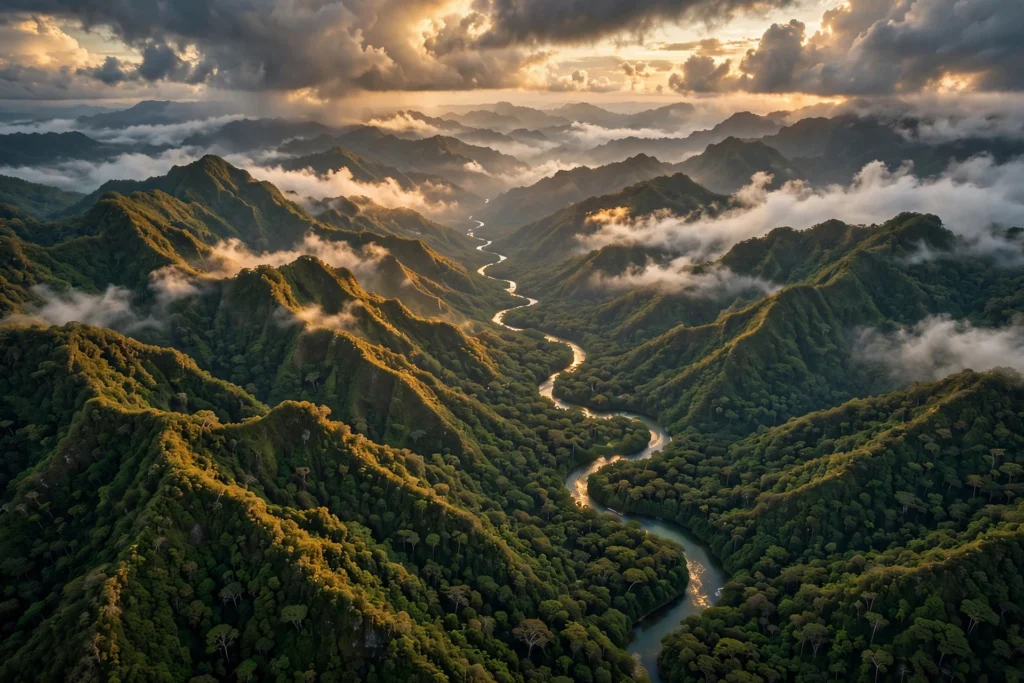
The Maya Mountains of southern Belize, seen from above. Bats’ub Cave and the elite tombs at Muklebal Tzul sit on opposite sides of this range.
Of the samples, 341 came from 107 individuals buried in elite and non-elite tombs at Muklebal Tzul, a Classic period centre in the Maya Mountains. And here is the result that made the news. The teeth in Bats’ub Cave came from at least 30 people. Of those 30, no fewer than 24 also had remains in the Plaza Tomb at Muklebal Tzul.
Think about what that means. Nearly four out of five people whose teeth were left in this cave were also buried in an elite tomb somewhere else. The authors call this far more overlap than expected by chance, and they back it with statistics. A one-sided Fisher exact test gives a probability of 4.9 in 10 million. A second simulation test gives a weaker result of 0.04, which is still significant, though the difference between the two tests is one of the things peer reviewers will want to look at.
The two sites are 26.5 kilometres apart, about 16.5 miles, on opposite sides of the Maya Mountains. The preprint’s route model gives a walking time of six to seven hours, but the authors add that given the mountainous terrain, the journey would take more than one day. This was not a casual stroll. Somebody carried human remains across a mountain range, on foot, more than once, over centuries.
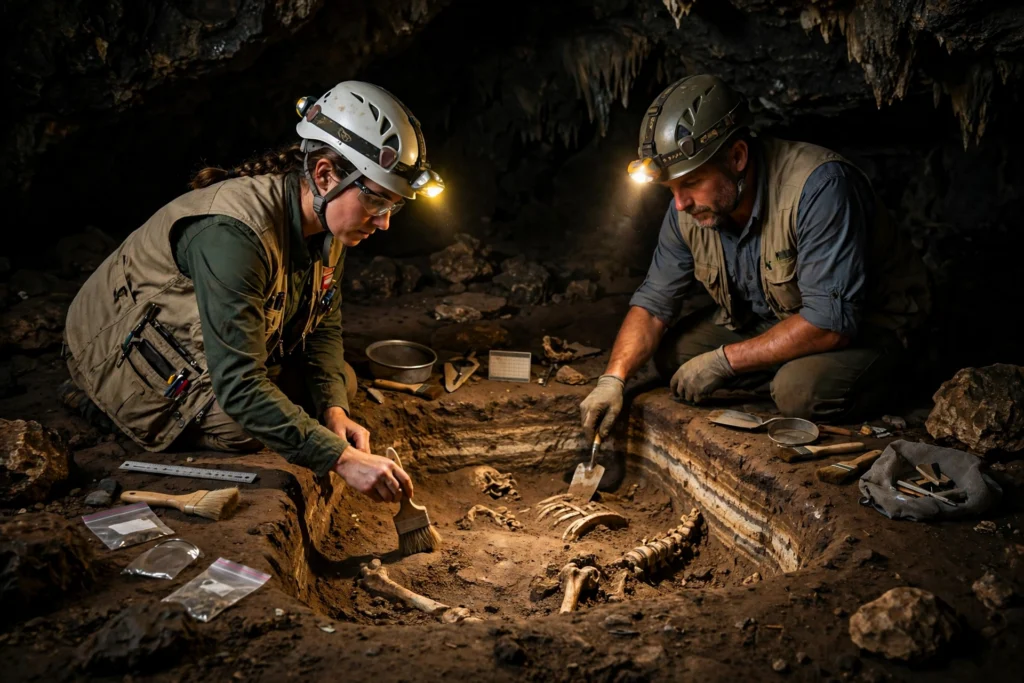
Archaeologists excavating a burial inside a Belize cave. The Bats’ub team screened 487 tooth and bone samples for ancient DNA.
Buried twice: a privilege reserved for the powerful
The paper’s abstract puts the idea in one striking sentence. Elite lineages, it says, created ancestors from their deceased relatives in geographically expansive ways. In plain language, the same people were buried in two places, at home and in a distant cave.
Why would anyone do that? The team reconstructed three family lineages spanning four, six and eight generations. The two larger ones were buried in elite tombs, while a third came from non-elite burials. And the pattern is stark. Twenty-five of 89 individuals from elite tombs had remains in more than one site. Of the 18 people from non-elite tombs, not one did. None of the cave teeth were linked to the non-elite lineage at all.
Science, reporting on the study on October 23, 2026, drew the obvious conclusion. Being buried in two places was a privilege reserved for the powerful. It was not a custom for everyone. It was something elite families did for their own, and only for their own.
That reading also fits the woman at the centre of the cave. She herself was not closely related to anyone in the study. The team found no first to third degree relatives of hers at any site, which they say is not unexpected, because she predates the earliest reconstructed lineage member by 104 years. But she is distantly related, at the fourth degree or beyond, to several individuals buried in the Plaza Tomb and in the cave. The authors interpret her as an ancestor, or an ancestor-like relative, whose real or fictive descendants venerated her with offerings of their teeth.
Read that again, because it is a beautiful and eerie idea. For centuries after she died, her descendants, real or claimed, walked across a mountain range carrying the teeth of their dead and left them at her grave. The cave was not a tomb. It was a shrine, and she was its saint.
What the teeth say about Maya families
The DNA results reach beyond the cave and into a long-running argument about how Maya society actually worked. The genetic data show that the individuals who link earlier and later generations within the elite lineages are disproportionately male. The authors write that their tests support patrilineal descent and patrilocal residence, with outside females marrying into the lineage. Being represented in the cave, interestingly, was not linked to sex. Men and women alike got the double burial treatment.
Some archaeologists have argued that elite Maya houses included kinship beyond genetic ties, that family was as much a social and political idea as a biological one. The Muklebal Tzul data instead fit descent through the male line. That is the kind of result that will keep specialists arguing for years, which is exactly what good science is supposed to do.
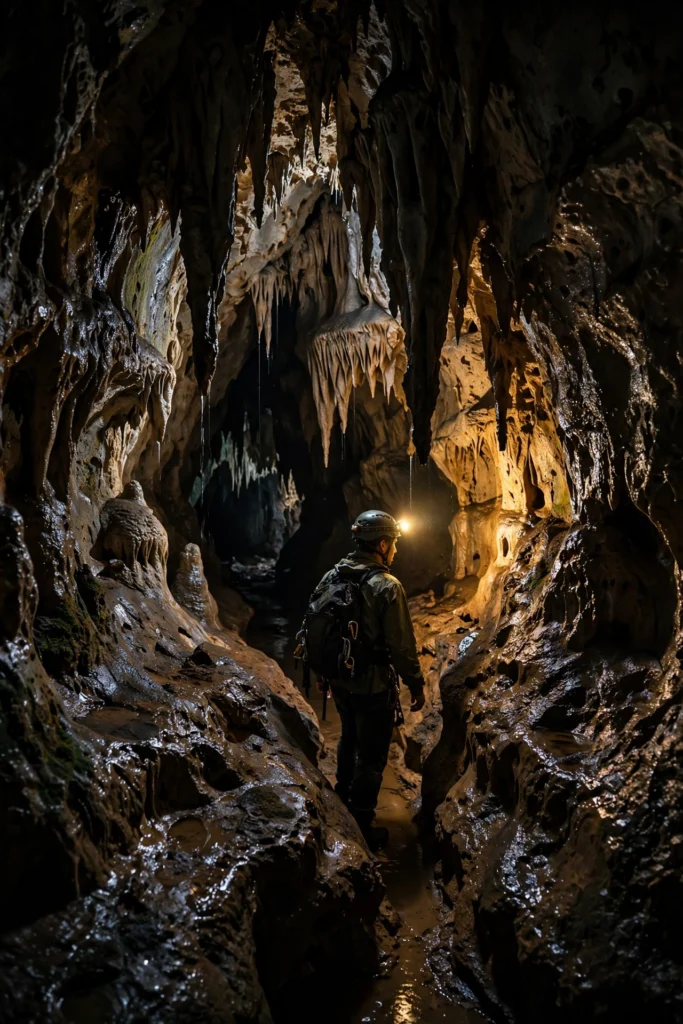
A lone explorer moves through a narrow limestone passage in Belize. The walk from Muklebal Tzul to Bats’ub Cave took more than a day on foot.
Why this cave, of all caves?
Here is the question that makes the whole story stranger. The preprint notes that there are many caves closer to Muklebal Tzul. If all you wanted was a cave, you had options. So the choice of Bats’ub seems to have been deliberate.
Keith Prufer put it simply in a presentation at the Society for American Archaeology meeting in May, as quoted by Science. Bones were still family. The line is short and it says a lot. The teeth were not refuse. They were not trophies. They were family members, carried across mountains to be with an ancestor.
We do not know exactly why Bats’ub was the chosen cave. Maybe it was the cave’s position, or its shape, or a story attached to it that is now lost. What we do know is that somebody chose it, and then kept choosing it, for centuries. That kind of loyalty to a place is its own kind of evidence.
The honest caveats (because they matter)
Before this discovery gets retold as settled fact, a few honest notes. The findings are set out in a preprint posted on bioRxiv, which means the work has not yet passed peer review. The researchers declined to talk to journalists until it does, according to Lizzie Wade’s report in Science. Archaeology Magazine covered the story on November 3, 2026, and both outlets are careful to say the same thing. This is promising, important, and not yet final.
A few questions also remain open. Science notes that the researchers do not specify whether the teeth were removed before or after death. That detail matters for how we picture the ritual, and it is not answered yet. The two statistical tests on the overlap also differ in strength, which is a point for peer reviewers to dig into. And the exact mechanism, how a tooth ended up separated from a body buried in an elite tomb, is still unknown.
None of that makes the discovery less exciting. It makes it science, done in public, with the uncertainties still attached. The DNA match itself is very hard to explain away. Twenty-four out of thirty people appearing in both places is not a coincidence, whatever the final statistics say.
Can you visit Belize’s Maya caves?
This is the part most readers actually care about, so let us be practical. Bats’ub Cave itself is not open to tourists. It sits inside the Bladen Nature Reserve, a protected area, and the excavation was a scientific project, not a visitor attraction. Do not try to find it on your own. You will not get in, and you would be trespassing in a protected reserve and a sacred site.
But Belize has something better, and it is open. Actun Tunichil Muknal, known as the ATM Cave, is one of the most extraordinary cave experiences anywhere on Earth. It is a wet cave, which means you hike through jungle, wade across rivers, swim through passages and climb over boulders to reach a dry chamber deep inside. That chamber holds the calcified skeleton of a young woman, the Crystal Maiden, along with pottery, jade and the remains of Maya rituals that stopped more than a thousand years ago and were left exactly where they fell.
A few things to know before you go. You can only visit the ATM Cave with a licensed guide, and you must book through a licensed tour operator, usually from San Ignacio in the Cayo District. Tours run most of the year, but the dry season, roughly November to May, is the most reliable window, because heavy rain can flood the cave and close it with little warning. You will get wet, you will swim, and you will climb, so wear shoes you can hike and swim in, and leave anything you cannot afford to soak behind. Cameras are not allowed inside, which is genuinely a blessing, because it forces you to look at the place instead of at a screen.
For a first trip, base yourself in San Ignacio for two or three days. The ATM Cave takes a full day. The Xunantunich Maya site is nearby and makes a perfect second day. And if caves have got under your skin by then, Belize has more, including cave tubing through the Caves Branch river system, which is the gentlest possible introduction to going underground and a good choice if the ATM Cave sounds too intense.
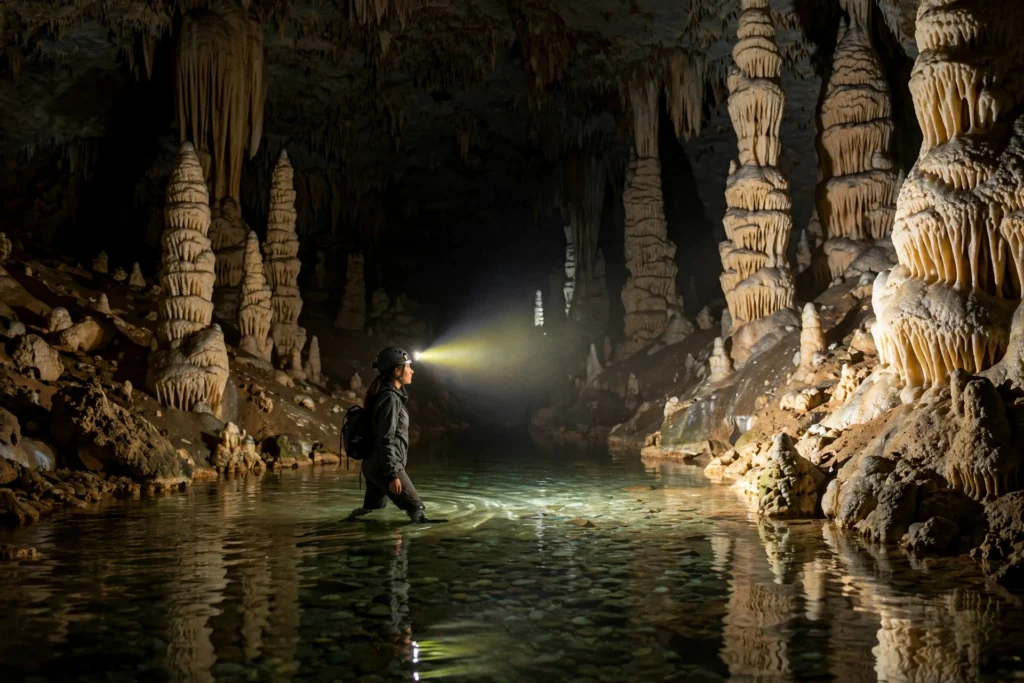
Wading through the underground river inside Actun Tunichil Muknal, Belize. The ATM Cave is the one Maya ritual cave you can actually visit.
Why this discovery matters
Archaeology has a habit of finding what it already expects. A new tomb here, a new inscription there, and the picture gets a little sharper. Bats’ub Cave is different, because it found something nobody was looking for: a whole burial custom, hidden in plain sight, proved by teeth that should not have matched and did.
It changes how we think about Maya elites. They were not just building tombs and carving stelae. They were maintaining relationships with the dead across distances and centuries, using caves as the meeting point. It changes how we think about caves, too. A cave was not just a shelter or a hiding place. For the Maya, it was an entrance to the underworld, a place to talk to ancestors, and a place worth walking across a mountain range to reach.
And it changes what we should expect from the next discovery. If one cave in the Maya Mountains held a secret like this for 1,700 years, how many more are still out there, waiting for someone to look properly? It is the same pattern we saw with the 15,000-year-old cave art found in Ireland, where markings sat in plain sight for decades before anyone spotted them. The answer, almost certainly, is more than we think.
If this story caught your imagination, there is more where it came from. Follow The Cavee on Pinterest for new cave discoveries, underground adventures and the wildest places on Earth, and read our guide to the 280 Ice Age engravings tourists walked past for 60 years in Spain, another cave that kept its secret in plain sight. The underground world is full of stories like this one. We go looking for them so you do not have to.
Sources: Brielle, E. S. et al. 2026, Buried in two places: Lineages from elite Maya tombs also found in distant caves, bioRxiv preprint (not peer reviewed); Lizzie Wade, Science, October 23, 2026; Archaeology Magazine, November 3, 2026. Read the original reporting in Science and Archaeology Magazine.