Giant Deer Bones in an Irish Cave Just Rewrote Ireland’s Human History
Some discoveries arrive with a bang. A new chamber opens, a torch beam catches a painted wall, and the world gasps. This one arrived quietly, in a cardboard box of old bones that had been sitting in a museum for nearly 150 years. And yet it may be the most important thing to happen to Irish archaeology in a decade.
On 26 November 2026, a study published in the Proceedings of the Royal Irish Academy reported that two giant deer bones from Ballynamintra Cave, near Dungarvan in County Waterford, carry marks consistent with human butchery. Radiocarbon dating at the University of Oxford put one of those bones at 13,573 to 13,321 years old. If the marks are what the researchers think they are, people were in southern Ireland around 13,500 years ago, nearly a thousand years earlier than anyone had been able to prove before.
That is a big claim, and the team behind it knows it. They have been careful to say the marks cannot yet be proven as definitively human-made. But the evidence is strong enough that Ireland’s story just got a new first chapter, and a small cave in Waterford is suddenly one of the most interesting places in European prehistory.
The bones that waited 145 years to be noticed
Ballynamintra Cave is not a famous cave. It is a 95 metre long passage in Carboniferous limestone, tucked away near Dungarvan, and it was first dug in a serious way between 1878 and 1882 by Victorian antiquarians. They pulled out boxes of bones: bear, reindeer, giant deer, and later, in 1928, arctic fox. The collections went to the National Museum of Ireland, where they sat, catalogued and largely forgotten, for more than a century.
That is how Irish cave archaeology keeps working. The same thing happened in 2016, when a butchered brown bear kneecap from Alice and Gwendoline Cave in County Clare, excavated in 1903 and stored in a cardboard box, turned out to be 12,500 years old and pushed the date of humans in Ireland back 2,500 years in a single afternoon. Ruth Carden, the National Museum of Ireland researcher who spotted the cut marks on that bear bone, is part of the Ballynamintra team too. She has made a career of looking again at things everyone else assumed had already told their story.
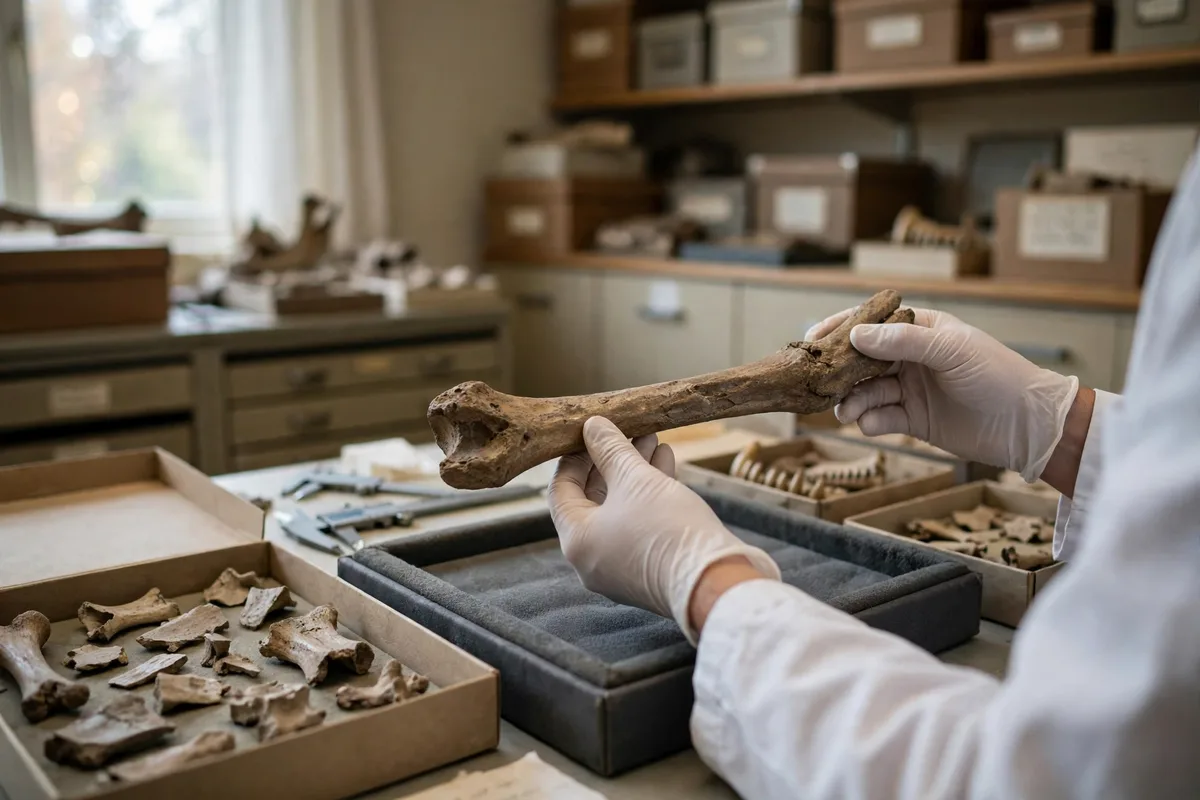
This time the re-examination found two leg bones from an extinct giant deer, Megaloceros giganteus, better known as the Irish elk. Both bones carry marks that look like they were made while the bone was still fresh, which is the detail that matters. Old dry bone breaks differently. Fresh bone, cut soon after death, leaves a signature that archaeologists can learn to read.
What the marks actually show
The first bone is an upper foreleg bone, a humerus. Across the elbow joint runs a clean, uniform chopping plane, the kind of mark a heavy-bladed stone tool leaves when someone hacks a joint apart. It is not a random scratch or a crack from the weight of soil. It looks deliberate, like someone working through a carcass with a purpose. Next to the chop marks are gnaw marks from a wolf, which tells its own small story: whatever happened to this deer, a wolf came along afterwards and scavenged what was left.
The second bone is a lower hindleg bone, a metatarsal. It shows a possible stone-tool percussion impact, a place where something hard struck the bone, and a fan of tiny microfractures above the impact point. Those fractures are what you get when a bone is split open while it is still fresh and mechanically sound, to get at the marrow inside. Marrow is rich food, and in a cold world at the end of an Ice Age, it was worth the effort.
It was this second bone that went to Oxford for high-precision radiocarbon dating. The result came back at 13,573 to 13,321 years ago. That number is the whole story in miniature. It lands squarely in a warm interval near the end of the last Ice Age called the Middle Allerod, when hunter-gatherers were already moving across Britain and north-west Europe, following the herds north as the ice pulled back.
Meet the giant deer, the animal with the impossible antlers
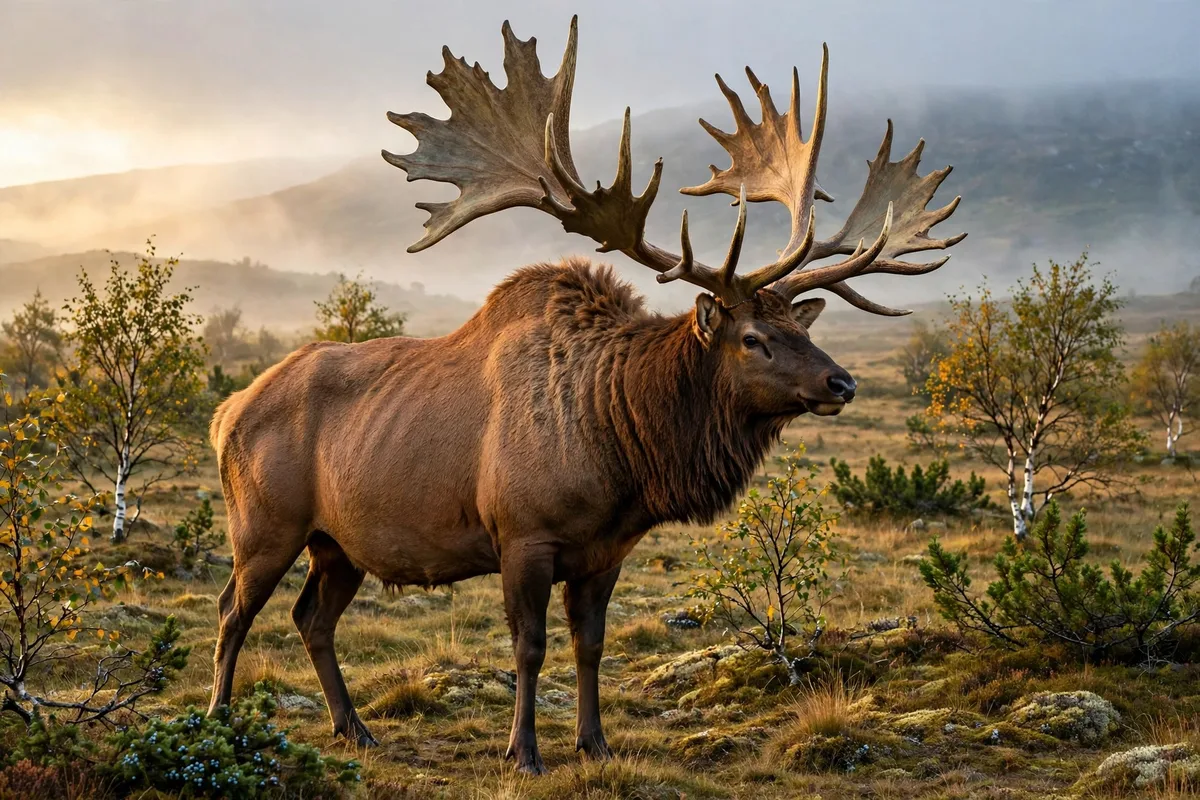
It helps to understand what kind of animal we are talking about, because the giant deer was not an ordinary deer. Megaloceros giganteus stood up to 2.1 metres at the shoulder, about the height of a tall doorway, and the males carried the largest antlers any deer has ever grown. They could span 3.5 metres from tip to tip and weigh around 40 kilograms, close to 90 pounds. The biggest males weighed about 680 kilograms, roughly the same as an Alaskan moose, and they shed those enormous antlers every year and grew a new pair each summer.
The name is a double misnomer, and scientists love pointing that out. The Irish elk was neither exclusively Irish nor an elk. Its range stretched from Ireland and northern Spain all the way to Lake Baikal in Siberia, and its closest living relative is the fallow deer, not the elk or moose. The first scientific description of its remains was made in 1695 by the Irish physician Thomas Molyneux, working from antlers dug up at Dardistown, and the animal has been famous ever since, partly because so many superb skeletons turned up in Irish bogs.
More than 20,000 years ago, people were already drawing this animal on cave walls in what is now southern France. A painting at Lascaux shows a deer with fantastically elongated antlers, and for a long time modern viewers assumed the artist was exaggerating. It was not an exaggeration. It was a portrait of an animal the artist knew well.
For a century, textbooks used the giant deer as the classic example of evolution gone wrong, claiming the antlers grew bigger and bigger until the animal could no longer cope. That idea, called orthogenesis, was abandoned in the 1930s. The modern view, built on decades of work by Natural History Museum expert Adrian Lister and others, is that sexual selection drove the antlers: males fought and displayed with them, females chose the winners, and the antlers were weapons as well as ornaments.
What actually finished the giant deer was climate. The species needed abundant, mineral-rich grasses, leaves and shoots, and that vegetation collapsed during the rapid cooling of the Younger Dryas, roughly 13,000 to 12,000 years ago. The last giant deer in Ireland died around 11,000 years ago, and the very last known remains anywhere, from western Siberia, date to about 7,700 years ago.
That timing is worth pausing on. The Ballynamintra bones date to about 13,500 years ago, right at the edge of the world the giant deer was about to lose. The people who may have butchered that deer were hunting one of the last great herds of an animal that was already living on borrowed time.

How a date gets made: Oxford, carbon, and a 13,500-year-old clock
Radiocarbon dating sounds like magic until you look at what it actually is, and it is worth a short detour because the whole claim rests on it. Living things take in carbon from the atmosphere, including a tiny amount of a radioactive form called carbon-14. When the organism dies, it stops taking in new carbon, and the carbon-14 it already holds starts to decay at a steady, known rate. Measure how much is left, and you can work out how long ago the animal died.
The Oxford laboratory that dated the Ballynamintra bone is one of the best in the world at this, and the date it returned, 13,573 to 13,321 years ago, is a calibrated range, meaning it has been corrected against known fluctuations in atmospheric carbon over time. It also matters that the bone was dated directly. The team did not date the soil around it or a charcoal fragment found nearby and assume the bone was the same age. They dated the bone itself. When the mark and the date sit on the same object, the argument gets much harder to dismiss.
The cave that kept its secrets
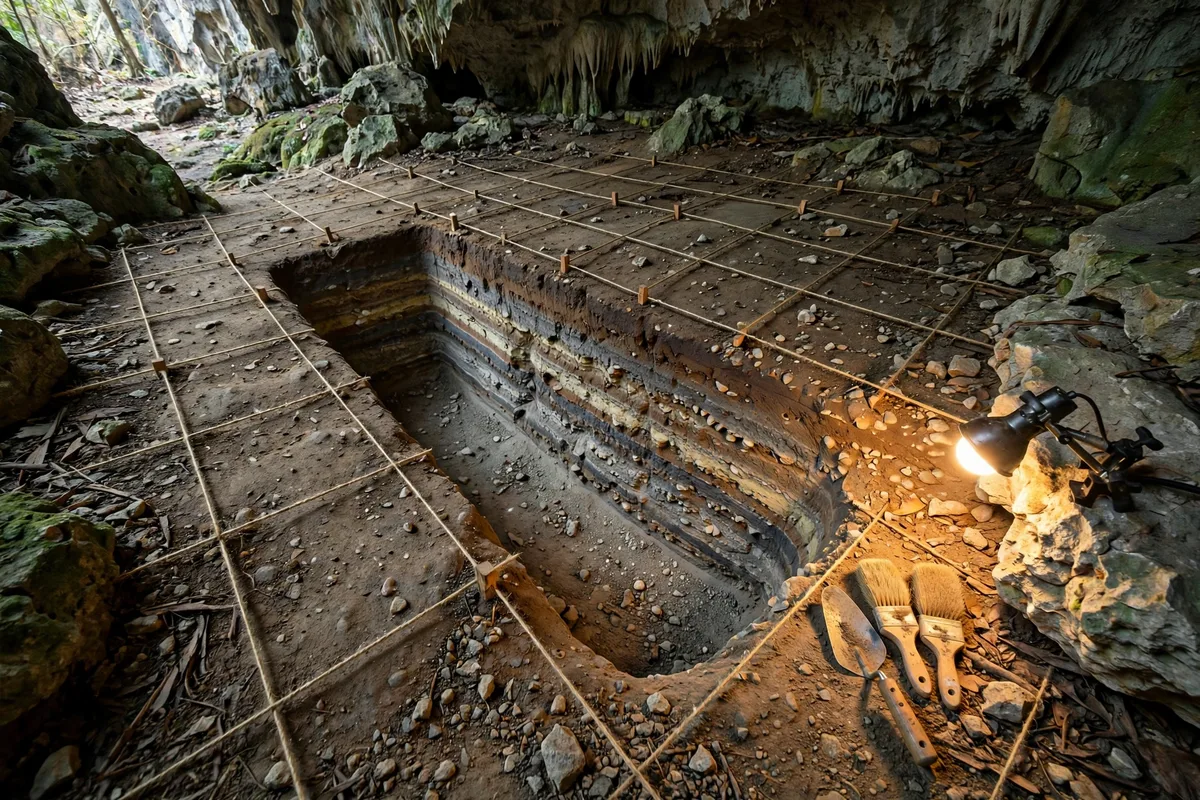
The new excavations at Ballynamintra are the other half of the story, and in some ways they are more exciting than the bones themselves. The Victorian digs of the 1870s and 1880s were thorough by the standards of their day, but they were not careful by ours, and for more than a century everyone assumed the cave had been emptied. It had not.
Working in the entrance chamber, the team found a section of sediment the Victorians never touched. Inside it were intact Ice Age layers holding three giant deer specimens and a red fox jawbone, radiocarbon dated to between 13,604 and 13,095 years ago, right in line with the museum bones. Preserved ancient pollen in the same layers paints the landscape: open grassland fringed with ferns, juniper and birch. Cold, open country, the kind of place a giant deer would have loved and a small band of hunters could read like a map.
Ruth Carden put it plainly in the announcement: “Re-examining the 1870s National Museum of Ireland collection alongside newly uncovered Ice Age sediments has transformed what we know about this cave.” She added that the missing meat-bearing bones, combined with the possible chopping and marrow-splitting marks, point to a kill site scavenged by wolves, and that further Ice Age deposits still lie waiting inside the cave.
That last part is the sentence to remember. The Ice Age deposits appear to continue into unexplored passages, and further excavations are already scheduled. The cave is not finished with us yet.
The wolf in the story
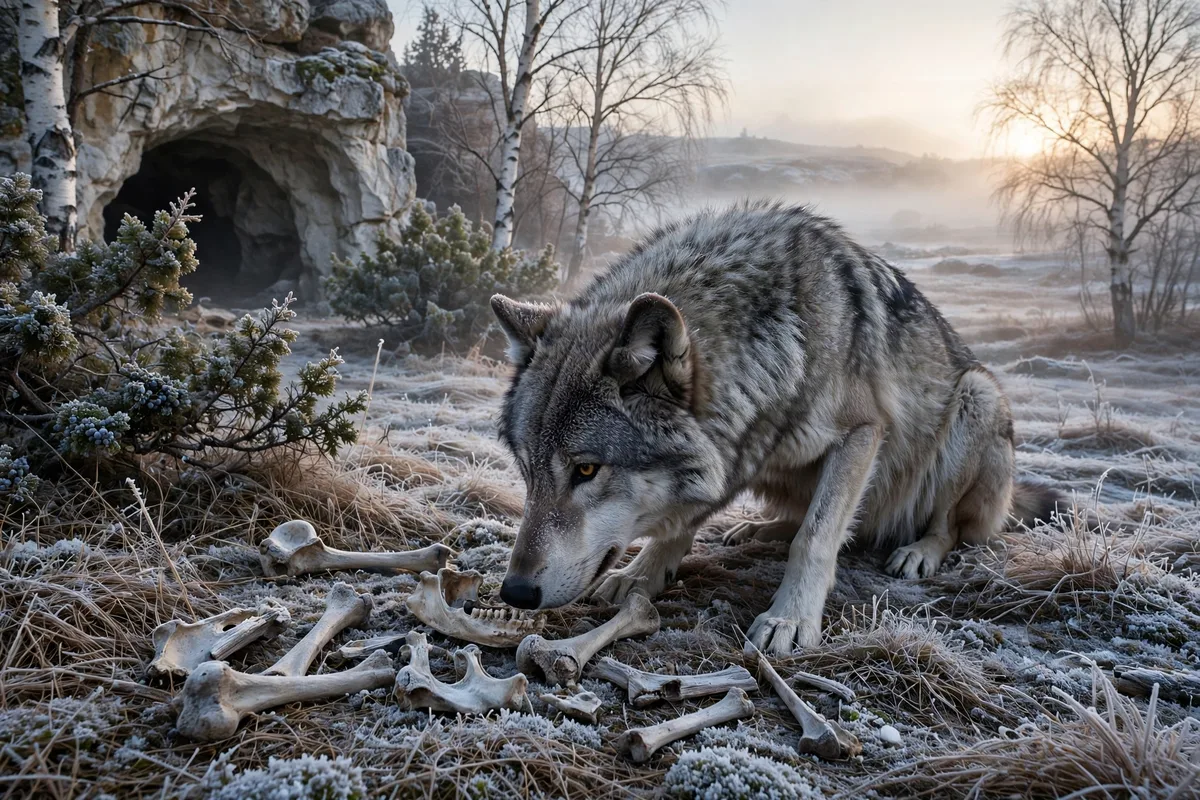
There is a small mystery tucked inside the Ballynamintra evidence, and it is the kind of detail that makes archaeology feel like detective work. The cave’s giant deer assemblage is missing most of the main meat-bearing bones: the upper legs, the ribs, the pelvises. What survives is mostly lower limb bones, the parts with less meat on them.
The researchers think that tells them something about what happened. The hunters probably butchered the carcasses somewhere else, took the best meat away, and left the lower legs behind. Wolves or bears then scavenged the remains and dragged some of them into the cave, which is why the wolf gnaw marks sit right next to the chop marks on the same bone. Two stories, layered on one piece of bone: humans first, wolves second. It is a neat picture, and it fits what we know about how Ice Age hunters worked. But it is also a reminder of how much interpretation sits on top of a small pile of evidence, and the researchers are honest about that.
Ireland’s timeline keeps moving
To see why this matters, you have to know how Ireland’s human story has been rewritten, step by step, over the past fifty years. For most of the last century, the conventional wisdom was simple: people arrived in Ireland around 8,000 BC, in the Mesolithic period, and that was that. The oldest known settlement, at Mount Sandel on the banks of the River Bann near Coleraine in County Derry, dates to about 7,900 to 7,600 BC. Peter Woodman excavated it in the 1970s ahead of a housing development and found circular huts about five metres across, hearths, and flint tools, the remains of a community that lived in one place for much of the year. It is still the oldest known settlement in Ireland, and it is a wonderful site. But it is no longer the first evidence of people.
That changed in 2016, when the Alice and Gwendoline bear bone pushed the date back to about 12,500 years ago. The bone had been dug up in 1903 in a cave outside Ennis in County Clare, noted in the original report as showing “clearly the incisions of a knife,” packed into a cardboard box, and stored in the National Museum of Ireland since the 1920s. Ruth Carden found it while re-analysing the museum’s bone collection in 2010 and 2011, and three separate bone specialists confirmed the seven cuts were made on fresh bone, probably by someone inexperienced using a long flint blade, cutting through the knee to get at the tendons.
Now Ballynamintra may push the date back another thousand years, to about 13,500 years ago. And there are hints of even older activity. A reindeer bone fragment from Castlepook Cave in County Cork was re-dated in 2021 to roughly 33,000 years ago, though that find is still contested and needs more confirmation. The pattern is clear: every time someone looks again at an old Irish cave collection with new tools, the story gets older.
This is part of a bigger shift in cave archaeology. In June 2026, a team working on the First Art project reported in Nature Communications that ancient human DNA can survive for thousands of years directly on cave walls, including at Escoural Cave in Portugal and Covaron Cave in northern Spain. Caves are turning out to be archives in ways nobody expected, holding DNA in their walls, art under their grime, and bones in boxes that everyone thought had been emptied.
If you want the wider Irish picture, our guide to the 15,000-year-old cave art found in Ireland tells the story of the Lost Land Bridge Project, where AI flagged 28 caves in the south-west and eight of them held prehistoric markings. The same caves, the same coastline, the same deep past, and now a new date that may make it all older still.
Why the scientists are being careful, and why you should be too
Here is the part that matters most, and the part that separates good science from a good headline. The Ballynamintra team has been explicit that the marks cannot be proven as definitively human-made without additional artefacts. The reason is simple and a little sad: thousands of years of surface weathering erased the microscopic tool striations on the bones, the tiny parallel scratches that would let a specialist say, with confidence, “a stone tool did this.”
What survives is the shape of the damage: a uniform chopping plane, a percussion impact, microfractures consistent with fresh-bone breakage. That is strong circumstantial evidence, and the timing lines up beautifully with hunter-gatherer activity across Britain and north-west Europe during the Middle Allerod. But it is not proof. Proof, in this case, would look like a stone tool found in the same Ice Age layer, or a bone point, or more butchered bones from the new excavations.
National Monuments Service archaeologist Coilin O Drisceoil said as much when the study was announced: further artefacts will need to be found to confirm that human presence in Ireland was earlier than presumed. The team agrees, and that is why the scheduled excavations matter so much. The cave still holds untouched Ice Age layers, and those layers may hold the stone tools that settle the question.
That honesty is exactly why this story deserves attention. The researchers could have hyped it. They did not. They published a careful claim, flagged its limits in the same breath, and told the world what would prove them right or wrong. That is how science is supposed to work, and it is also why, if the next dig does turn up a flint blade in that untouched sediment, the headline will be even bigger.
The pattern is familiar from other caves we have covered. At Cova 338 in the Pyrenees, a cave 2,235 metres up a mountain, archaeologists found a prehistoric copper mining camp with 23 hearths and a child’s finger bone, and they were equally careful about what the green mineral fragments did and did not prove. Caves reward patience. They punish anyone in a hurry.
Can you visit Ballynamintra Cave?
This is the question every cave lover asks first, and the honest answer is: not really, and please do not try. Ballynamintra is a protected archaeological and geological site, not a show cave. There are no tours, no paths, no ticket office, and the new excavations are active research, which means the cave is closed to casual visitors. The best way to respect a site like this is to leave it alone and let the archaeologists do their work.
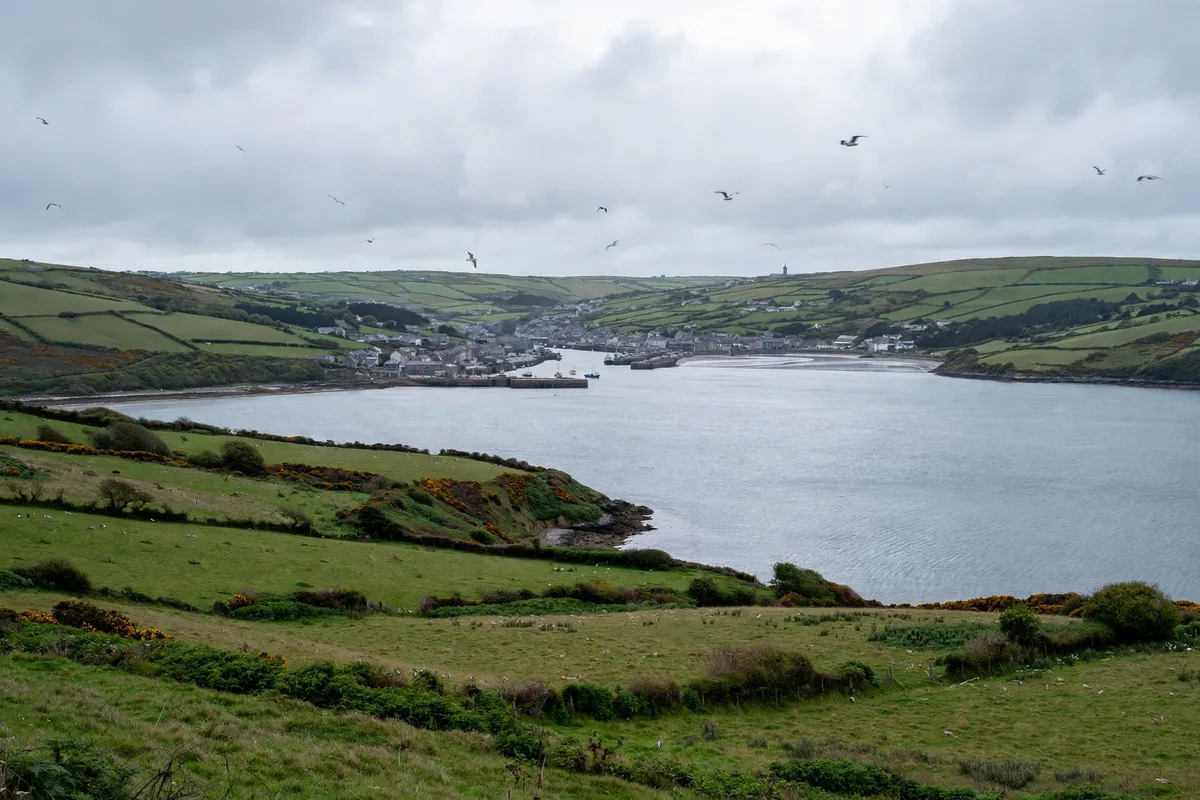
But the area around it is very much worth a trip. Dungarvan is a handsome harbour town on the Waterford coast, and the Copper Coast to the west is a UNESCO Global Geopark, a stretch of cliffs and coves with its own mining history. The National Museum of Ireland in Dublin holds the Ballynamintra collections, including the bones at the centre of this story, and its archaeology galleries are the best place in the country to see what Ice Age Ireland actually looked like.
If you are planning a cave trip in Ireland, pair the museum with the caves you can visit. The south-west of the country, where the Lost Land Bridge team found its cave art, is full of limestone country, and the Burren in County Clare, where Alice and Gwendoline Cave sits, is one of the great karst landscapes in Europe. You will not walk into Ballynamintra, but you can walk the same kind of country its hunters walked, and that is a strange and wonderful thing to do with a 13,500-year-old date in your head.
What this discovery changes for the rest of us
It is easy to treat a story like this as trivia, a date moving on a timeline. It is more than that. Every time the first arrival of people in a place gets pushed back, the picture of how humans spread across the world shifts a little. Ireland was an island at the edge of the known world at the end of the Ice Age, cold, open, and hard to reach. If people were there 13,500 years ago, they were moving further, faster, and earlier than we thought, following deer herds across a landscape that was still shaking off the ice.
There is also a practical lesson in here for anyone who loves caves. The Ballynamintra discovery came from two places at once: a museum storeroom and a patch of cave floor everyone thought was empty. Both had been written off. Both were wrong. If you care about caves, support the museums that keep their collections, and support the archaeologists who go back to old sites with new questions. The next rewrite of history is probably already sitting in a box somewhere, waiting for someone to look at it properly.
We will be watching the next excavation season at Ballynamintra closely. If a stone tool turns up in that untouched sediment, Ireland’s human story gets older again, and we will be here to tell you about it. For more cave discoveries as they happen, follow The Cavee on Pinterest, where every new story gets a pin, and explore the rest of thecavee.com for the world’s most extraordinary caves, from glowworm ceilings to underground rivers. Read the full story on thecavee.com, and if you want the science itself, the original reports are worth your time: Phys.org covered the Ballynamintra study on the day it was published, and the Natural History Museum’s guide to the Irish elk is the best short introduction to the animal at the centre of it all.