There is a road in America that people cross the world to drive, even though it officially stopped existing more than forty years ago. It has no number on modern maps. Bits of it vanish into cornfields. And yet, on November 11, 2026, thousands of people stood in downtown Tulsa, Oklahoma, in the cold, to sing happy birthday to it. Route 66 turned one hundred years old, and the party is still going.
If you have ever dreamed about the great American road trip, this is the year to stop dreaming and start planning. The centenary has put the Mother Road back in the spotlight, small towns along the route have spruced up their neon, and the whole 2,448-mile stretch from Chicago to Santa Monica feels alive again. This guide covers the full drive: how long it takes, what it costs, the stops that are actually worth your time, and the problems nobody warns you about until you are already in the middle of the Mojave with no signal.
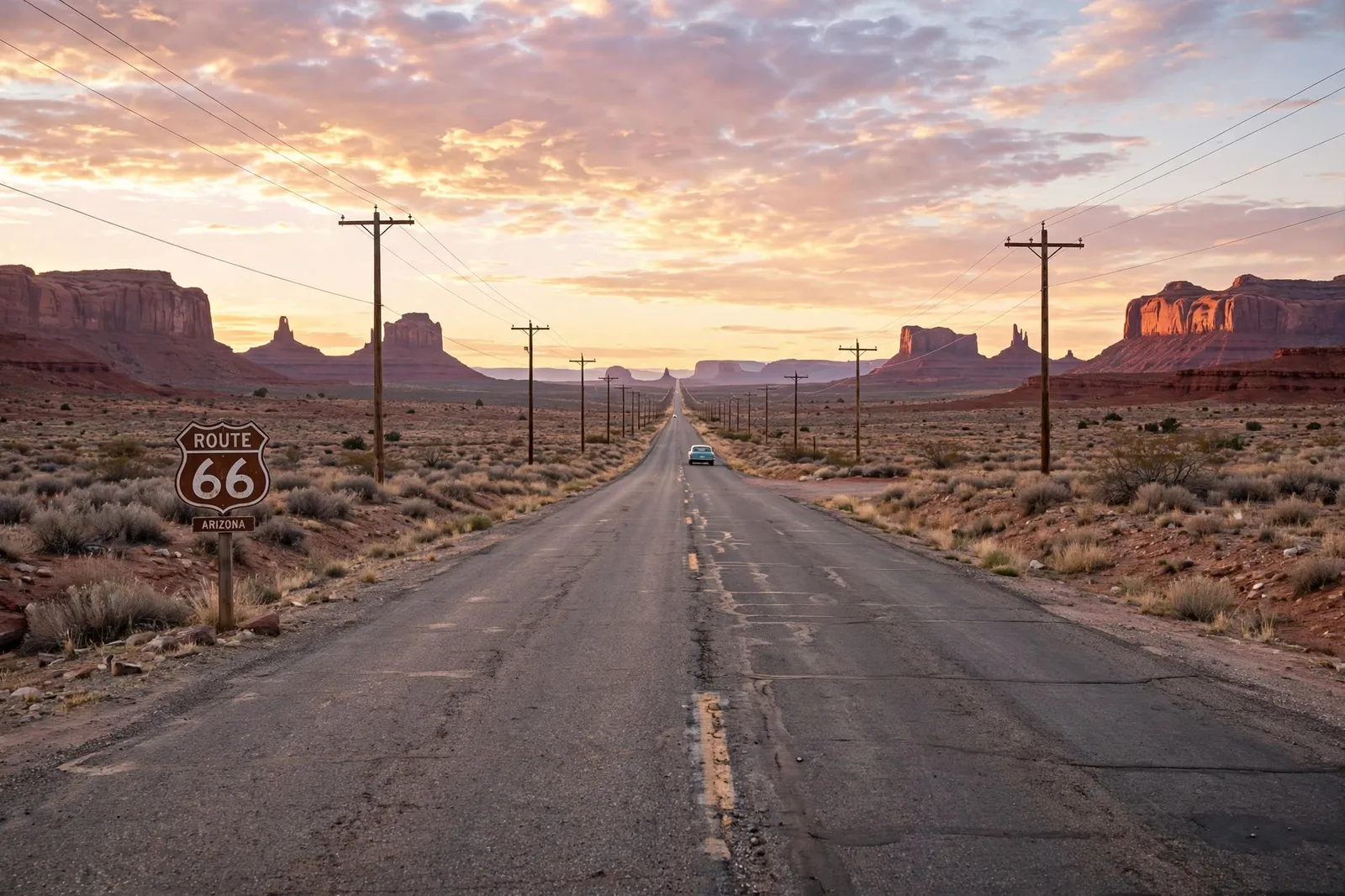
Why 2026 is the year to drive it
Route 66 was commissioned on November 11, 1926. It ran from Chicago to Santa Monica, stitching together small farm roads into one continuous highway, and it became the path Dust Bowl families took west in the 1930s. John Steinbeck called it the Mother Road in The Grapes of Wrath, and the name stuck. After the war it became the symbol of the American road trip itself: neon motels, chrome diners, and filling stations every few miles.
The interstate system killed it slowly. By 1985 the highway was officially decommissioned, its number retired. What saved it was the people who lived along it. They kept the signs up, restored the motels, and refused to let the road be forgotten. Roughly 85 percent of the original alignment is still drivable today, and the centenary year has given every town along it a reason to celebrate.
The main birthday party happened in Tulsa on November 11, 2026, the exact centenary date. Tulsa calls itself the Capital of Route 66, and it threw a free all-day celebration: a Veterans Day parade at 11 in the morning, a Centennial Crawl through eight downtown museums and cultural stops including the Woody Guthrie Center and the Bob Dylan Center, a street party on Main Street, and the official Centennial Moment at 5 in the afternoon. A free concert by Bob Wills’ Texas Playboys closed the night at Guthrie Green. If you missed the birthday itself, do not worry. Centenary events run through the end of 2026, including a film festival in Springfield, Illinois, from November 20 to 22, and celebrations keep popping up in towns all along the route.
The road in numbers
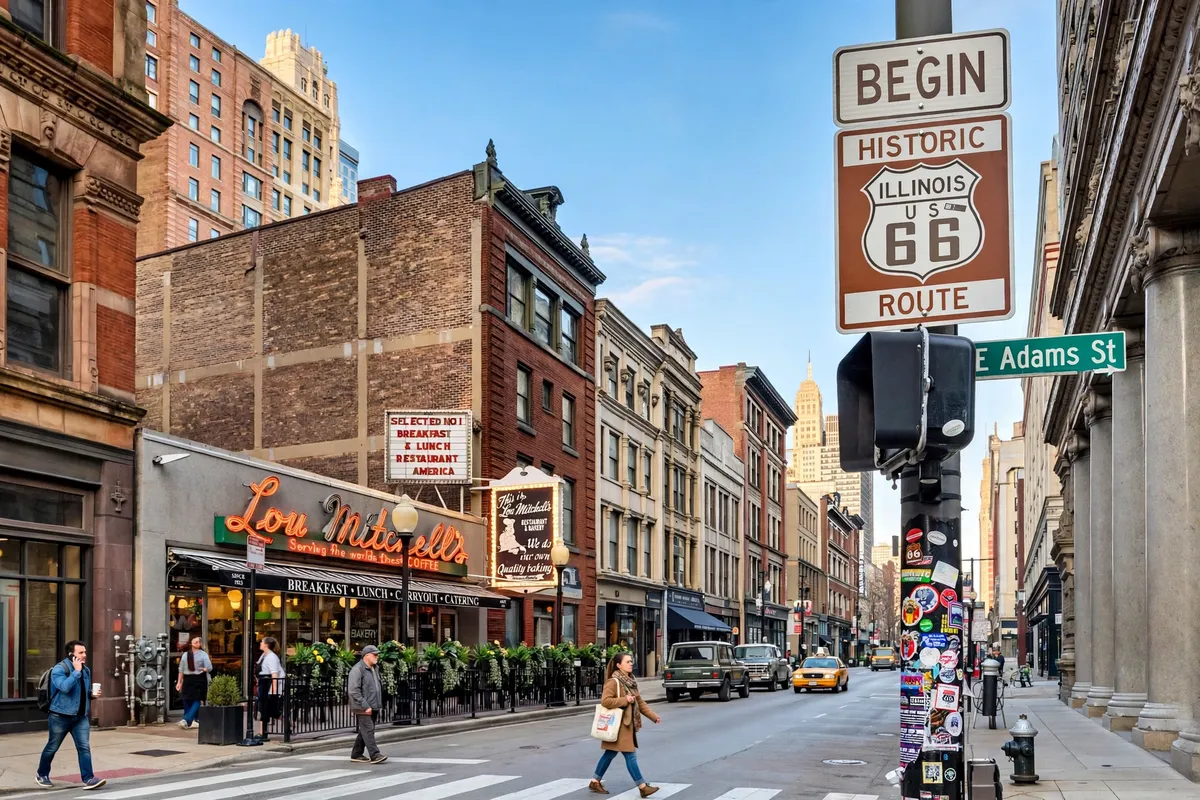
Before you plan anything, get the shape of the drive in your head. The full route is 2,448 miles from the Begin sign on Adams Street in downtown Chicago to the End of the Trail marker on Santa Monica Pier. It crosses eight states and three time zones. Illinois, Missouri, Kansas, Oklahoma, Texas, New Mexico, Arizona, and California. Kansas gets only 13 miles of it, a tiny corner near Galena you can cross in under half an hour, while Oklahoma has the longest drivable stretch at more than 400 miles.
Pure driving time, with no stops at all, is about 32 hours. Nobody does that, and nobody should. The road is not a highway anymore. It is a patchwork of old alignments, frontage roads, and stretches of interstate where the original road did not survive. You will get lost at least once. That is part of it.
How long do you actually need?
This is the question everyone asks, and the honest answer depends on how much you want to see. Seven to ten days is the minimum, and it means 250 to 350 miles a day, which is a lot of windshield time and not much lingering. You will drive past things worth stopping for, and you will feel it.
Fourteen days is the sweet spot. That works out to about 175 miles a day, enough to spend a full day at the Grand Canyon on a detour from Williams, Arizona, to walk around Cadillac Ranch instead of just photographing it from the car, and to sit on a motel porch at dusk without checking the clock. Three weeks is the full experience, with time for every ghost town, every roadside museum, and every conversation at a diner counter that turns into an hour.
Drive westbound, Chicago to Santa Monica. It is the traditional direction, it follows the path of the migrants and the dreamers, and it ends with the Pacific Ocean in front of you, which is the finest ending any road trip in America has.
The drive, state by state
Illinois and Missouri: neon, giants, and the Gateway Arch
Start at the Begin sign on Adams Street in Chicago, then point the car southwest. Illinois gives you about 300 miles of classic roadside Americana: the Gemini Giant, a towering fibreglass spaceman holding a rocket outside a closed drive-in in Wilmington, hand-painted murals in Pontiac, and small-town diners that have been serving the same breakfast since before your parents were born.
Missouri has some of the best-preserved original road anywhere, around 325 miles of rolling Ozark country. St. Louis gives you the Gateway Arch, and just outside the city sits Meramec Caverns, a huge cave system that Jesse James supposedly used as a hideout. It is touristy and proud of it, and the guided tour is genuinely fun.
Kansas and Oklahoma: thirteen miles, then the heartland
Kansas is the shortest state on the route and one of the most loved. Thirteen miles, three small towns, Galena, Riverton, and Baxter Springs, and a restored filling station in Galena that is said to have inspired a certain animated tow truck. You can have breakfast in Missouri, lunch in Kansas, and dinner in Oklahoma without even trying.
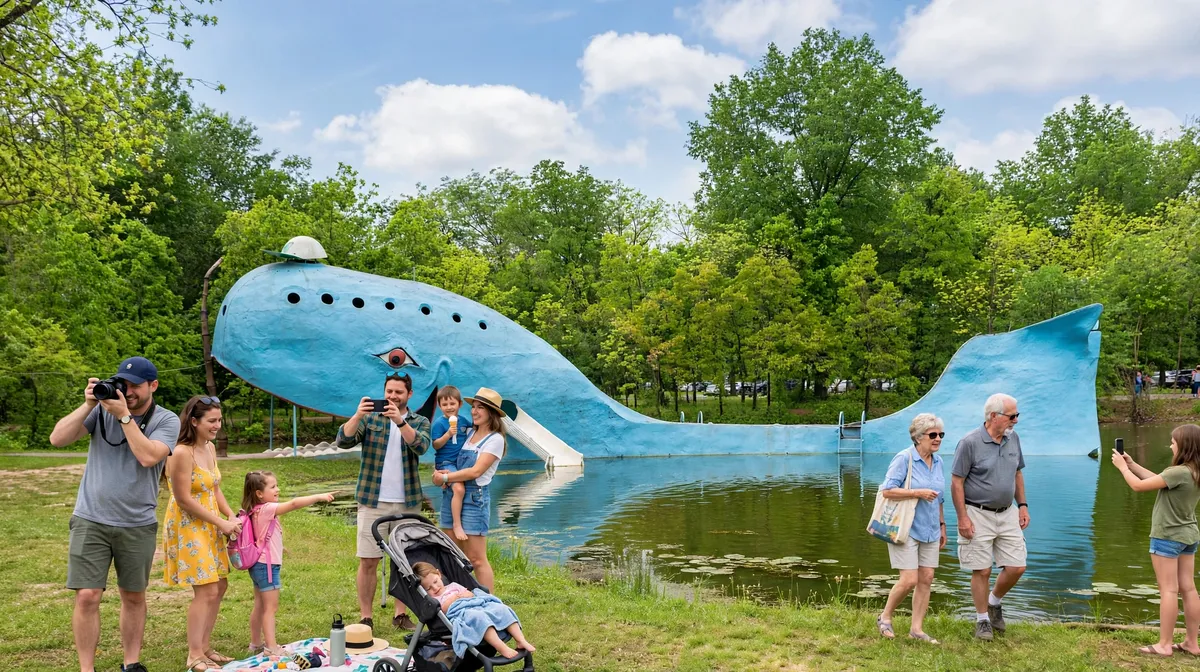
Oklahoma is the heart of the road, more than 400 miles of it, and the longest drivable stretch anywhere. Tulsa and Oklahoma City are full of Art Deco and neon, Clinton has a proper Route 66 Museum, and Catoosa has the Blue Whale, a giant smiling whale sculpture rising out of a pond that has been making travellers laugh since the 1970s. The round barn in Arcadia is worth the stop too.
Texas and New Mexico: spray paint, steak, and neon nights
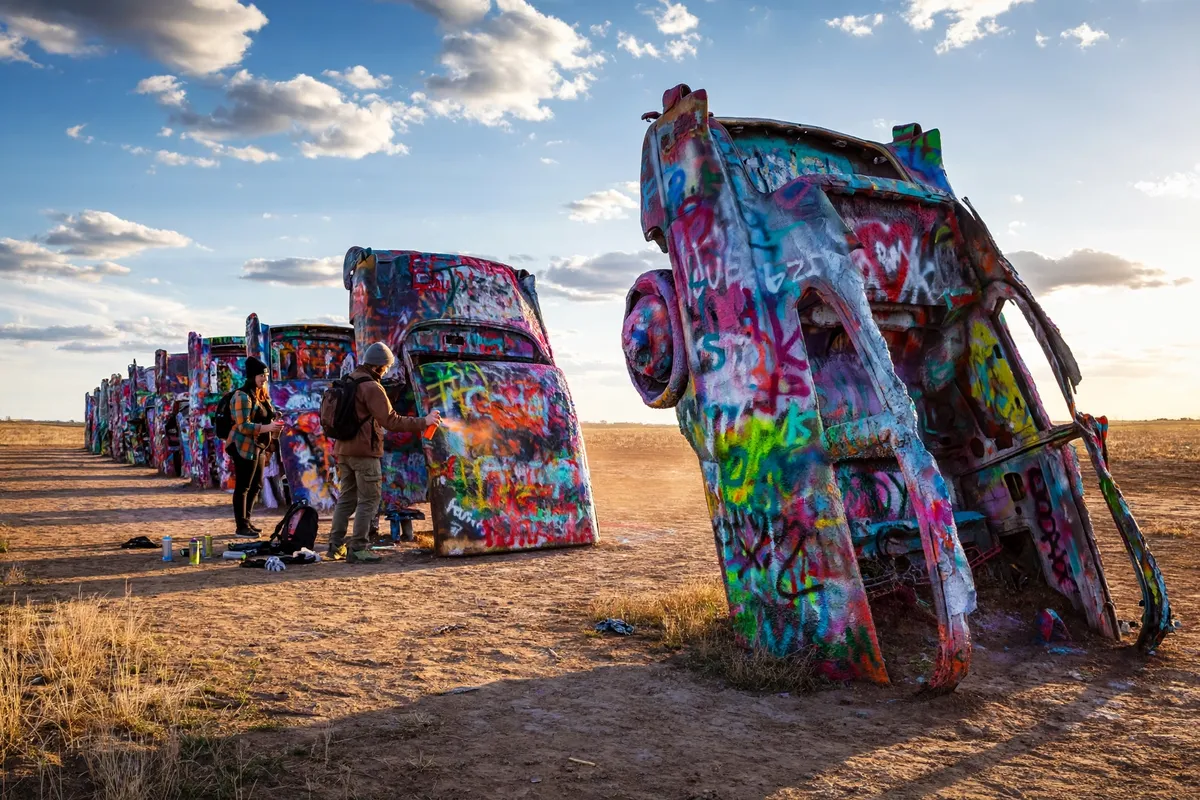
Texas is a short stretch, about 180 miles across the Panhandle, but it punches above its weight. Amarillo has Cadillac Ranch, ten old Cadillacs buried nose-down in a field, covered in layers of spray paint. Bring a can and add your own layer. The Big Texan Steak Ranch offers its famous 72-ounce steak challenge, free if you finish it all in an hour, and the Art Deco U-Drop Inn in Shamrock is one of the prettiest buildings on the entire route.
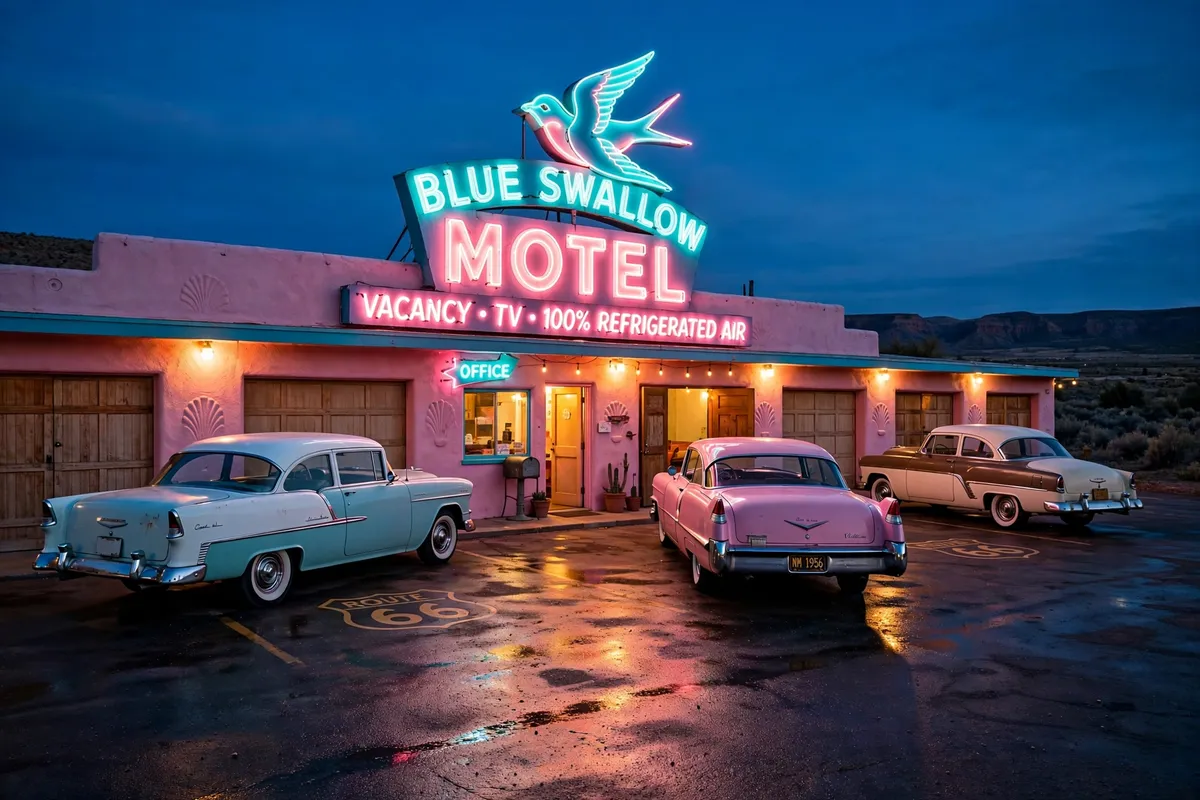
New Mexico is about 400 miles of high desert, adobe, and neon. Tucumcari is the neon capital of the route, a town that kept its signs glowing when everyone else switched theirs off. Albuquerque and Gallup are full of trading posts and old motels, and the Santa Fe detour is worth a full day if you have it.
Arizona and California: desert, pines, and the Pacific
Arizona is the most dramatic desert driving on the route, around 430 miles. The Petrified Forest, Winslow (yes, the town from the Eagles song, and yes, there is a statue of a guy standing on a corner), Flagstaff in the pines, and Oatman, a old mining town where wild burros wander the main street begging for carrots. Seligman is the town that saved the road: when the interstate bypassed it in 1978, a local barber named Angel Delgadillo campaigned until Route 66 was declared a historic highway. Every town on the route owes him something.
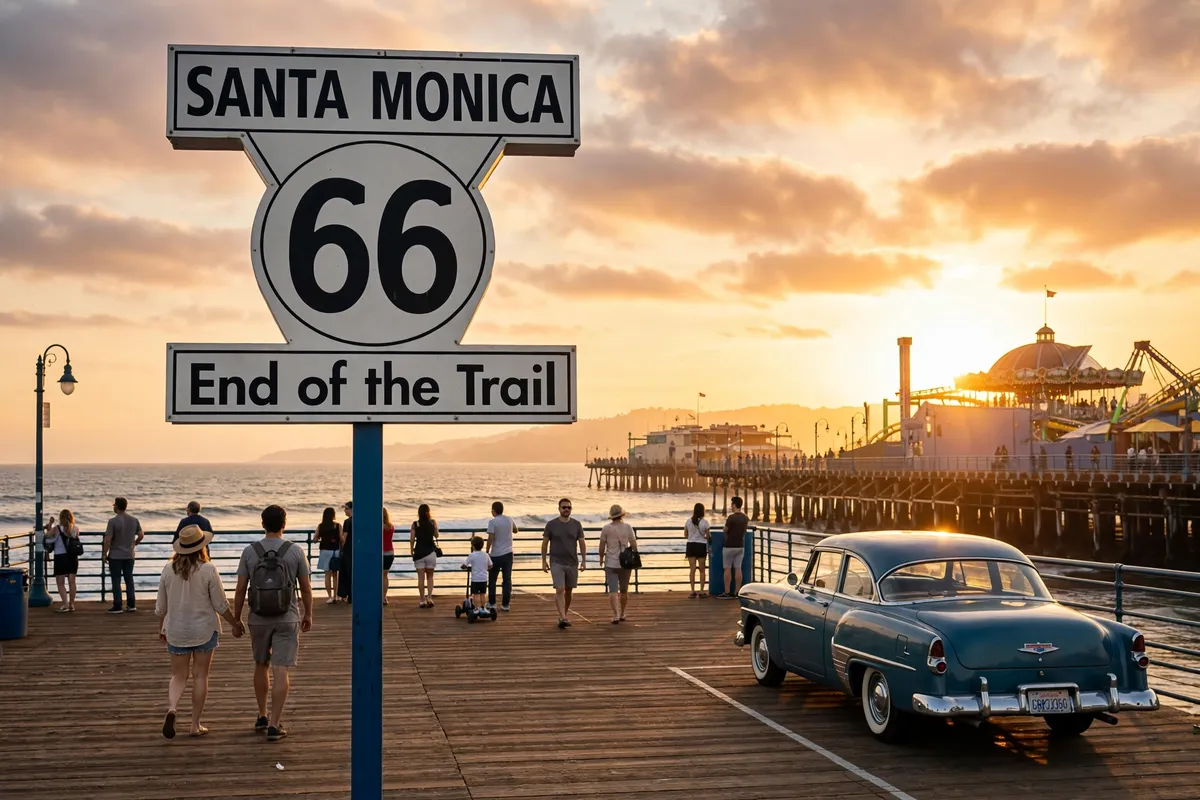
California is the last 345 miles, across the Mojave Desert, past Roy’s Motel and Cafe at Amboy with its famous neon sign, through Barstow and Pasadena, and finally to Santa Monica Pier. The End of the Trail sign is small and easy to miss. Stand under it, look back at the ocean behind you, and feel the 2,448 miles in your legs.
The stops you cannot skip
There are hundreds of roadside attractions on Route 66, and most of them are charming for about five minutes. A few are the real thing. Cadillac Ranch in Amarillo is one. The Blue Whale of Catoosa is another. Meramec Caverns in Missouri is the best cave on the route, and if caves are your thing, you will love it. The Wigwam Motels in Holbrook, Arizona, and San Bernardino, California, let you sleep in a concrete teepee, which is exactly as fun as it sounds. Seligman, Arizona, is worth an hour just to meet the people who kept the road alive. And the Gemini Giant in Illinois is the single best photo on the whole drive.
What it actually costs
Nobody can give you an exact number, because it depends on your car, your motels, and how many diner breakfasts you eat. But the shape of the budget is simple. Fuel is not the big cost. A car doing reasonable mileage will need roughly 80 to 100 gallons for the full 2,448 miles, and American gas prices make that the cheapest part of the trip.
Motels are the real cost. Classic Route 66 motels mostly run cheaper than chain hotels, and many are the experience itself, especially the neon motels in Tucumcari and the Wigwam Motels. Budget for a room every night for as many nights as you drive. Food is cheap if you eat at diners and cafes, which you should, because that is half the point. The guidebook most drivers swear by is the EZ66 Guide for Travelers by Jerry McClanahan, which costs about 22 dollars and is worth every cent for the turn-by-turn directions alone.
One cost that catches people out is the one-way rental. You pick the car up in Chicago and drop it off in Los Angeles, and rental companies charge a one-way drop fee for that, sometimes hundreds of dollars. Check it before you book, not after. Flying home from Los Angeles and leaving the car there is usually the plan, so build the flight into the budget from the start.
The problems nobody warns you about
Route 66 is not a normal road trip, and a few things will catch you out if you treat it like one. First, navigation. About 85 percent of the original road is drivable, but the missing 15 percent is scattered everywhere, and your phone will cheerfully route you onto the interstate without telling you. Get the EZ66 guidebook and a proper Route 66 map app, and check the route each morning instead of trusting the GPS blindly.
Second, phone signal. There are long stretches of desert in New Mexico, Arizona, and California with no coverage at all. Download your maps offline before you leave each morning. Third, the heat. The Mojave and the Arizona desert in summer are brutal, regularly over 40 degrees Celsius. Drive those sections early in the morning, carry more water than you think you need, and never let the fuel tank drop below half in the desert.
Fourth, opening hours. Small-town museums, cafes, and attractions on Route 66 keep small-town hours. Some are closed on Mondays. Some close for winter. Some just close because the owner felt like it. Check ahead for the places you really care about, and have a backup stop in mind. And finally, the road itself. Old alignments can be rough, narrow, and occasionally unpaved. If you are driving a low car, slow down on the rough sections and do not be proud about turning around.
When to go
Spring, from April to June, and fall, from September to October, are the best windows. The weather is mild across all eight states, the desert is bearable, and the crowds are thinner than summer. Summer works, but the desert sections are punishing and the popular stops are busy. Winter is quiet and cheap, but some small attractions close, and the high desert in New Mexico and Arizona gets properly cold at night.
If you want the centenary feeling, go before the end of 2026. The birthday events, the exhibitions, and the general buzz along the route will fade into 2027. The road itself is not going anywhere, but a hundredth birthday only happens once.
Your centenary road trip checklist
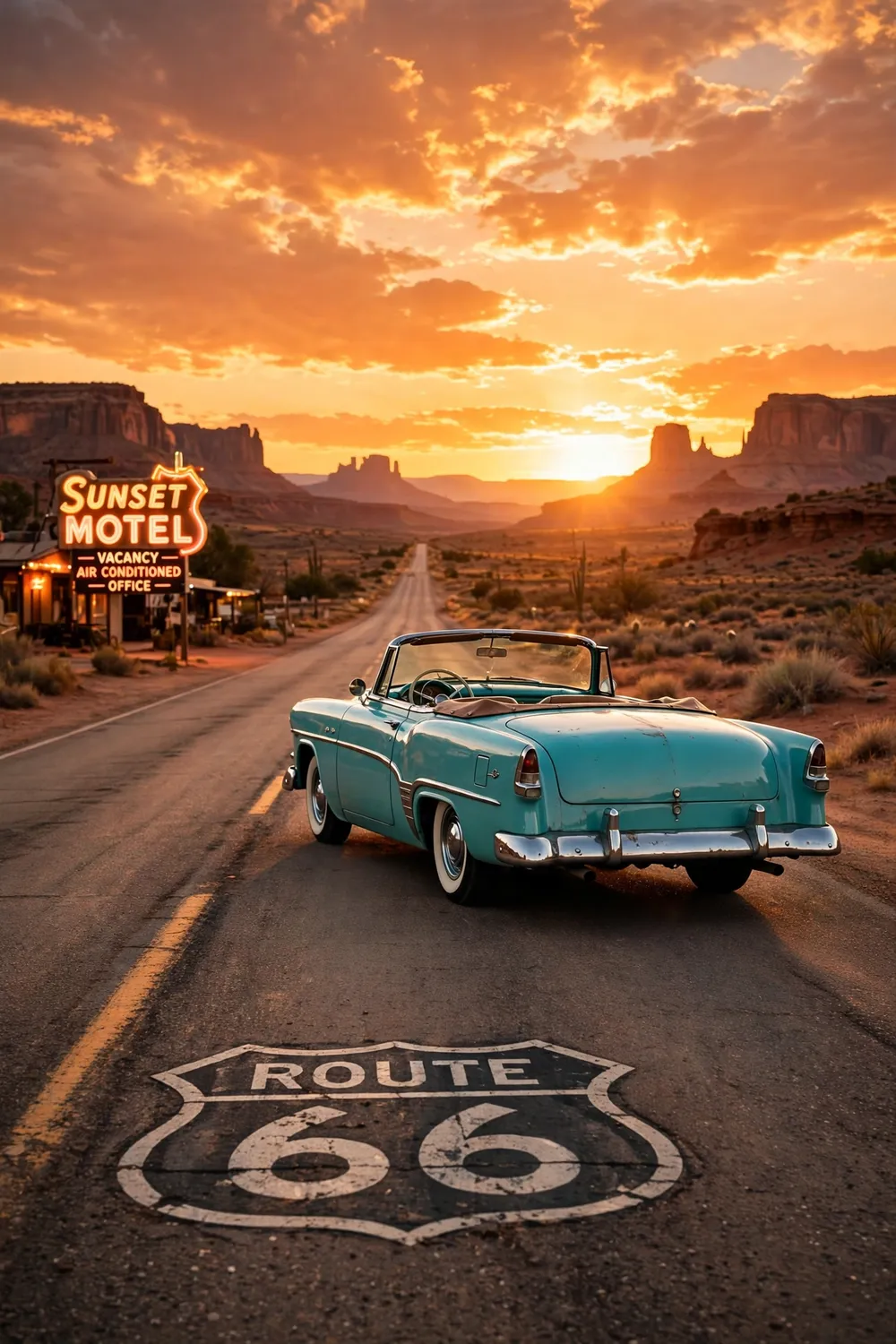
Start with the boring stuff, because it saves the fun stuff. Book the one-way rental early and confirm the drop fee in writing. Buy the EZ66 guidebook. Download offline maps for all eight states. Pack a paper map as a backup, because the desert does not care about your battery. Carry a cooler with water and snacks. Bring a spray paint can for Cadillac Ranch. Book the Wigwam Motel and the Blue Swallow Motel in advance, because they sell out in centenary year. And leave gaps in the schedule. The best moments on Route 66 are the unplanned ones: a diner owner who tells you about the town, a mural you were not expecting, a sunset over a road that has seen a hundred years of travellers.
One hundred years, and the road is still going
Route 66 was supposed to die in 1985. Instead, a hundred years after it was commissioned, people are still driving it, still painting Cadillacs, still sleeping in concrete teepees, and still standing on Santa Monica Pier feeling like they have done something that matters. The road is not the fastest way across America. It was never meant to be. It is the slowest, strangest, most human way across, and that is exactly why it survived.
If this guide has put the Mother Road on your list, save the pin and start planning. Two weeks, 2,448 miles, eight states, and a hundred years of stories. The road is waiting.
Love road trips that go beyond the ordinary? Read our guide to Vietnam’s Ha Giang Loop, a 300 kilometre motorbike adventure with new rules for 2026, and Nepal’s Upper Mustang, where the permit price dropped by 70 percent and the forbidden kingdom finally opened up. For pure thrill-seeking inspiration, see why Brazil was ranked the world’s top thrill-seeker destination for 2026. And for the official centenary events, check the Route 66 Centennial Celebration site before you go, because dates and times can change.
📌 Found this guide useful? Save it to your road trip board on Pinterest and share it with someone who needs a reason to drive. The Mother Road turns 100 only once, and the best way to celebrate is to drive it.