Ha Giang Loop 2026: Vietnam’s Wildest Motorbike Adventure (And the New Rules You Need to Know)
I’ll be honest with you. Most “adventure travel” these days is a zip line with a safety briefing and a gift shop at the end. The Ha Giang Loop is not that. It’s a 300-plus kilometer ribbon of mountain road in Vietnam’s far north where the limestone peaks are so jagged they look computer generated, where your easy rider will casually point at a cliff and tell you about the time the road simply wasn’t there yet, and where the biggest question of your day is whether your backside can survive another two hours in the saddle. It’s thrilling, it’s occasionally terrifying, and in 2026 it changed more than it has in a decade. If this trip is on your list, you need to know what happened before you go.
In this guide: what the loop actually is, the new 2026 safety rules that reshaped every tour, a realistic day-by-day itinerary, what it really costs (no sugarcoating), the easy rider vs self-drive debate settled honestly, and the practical stuff like permits and paperwork. Let’s ride.
What the Ha Giang Loop Actually Is
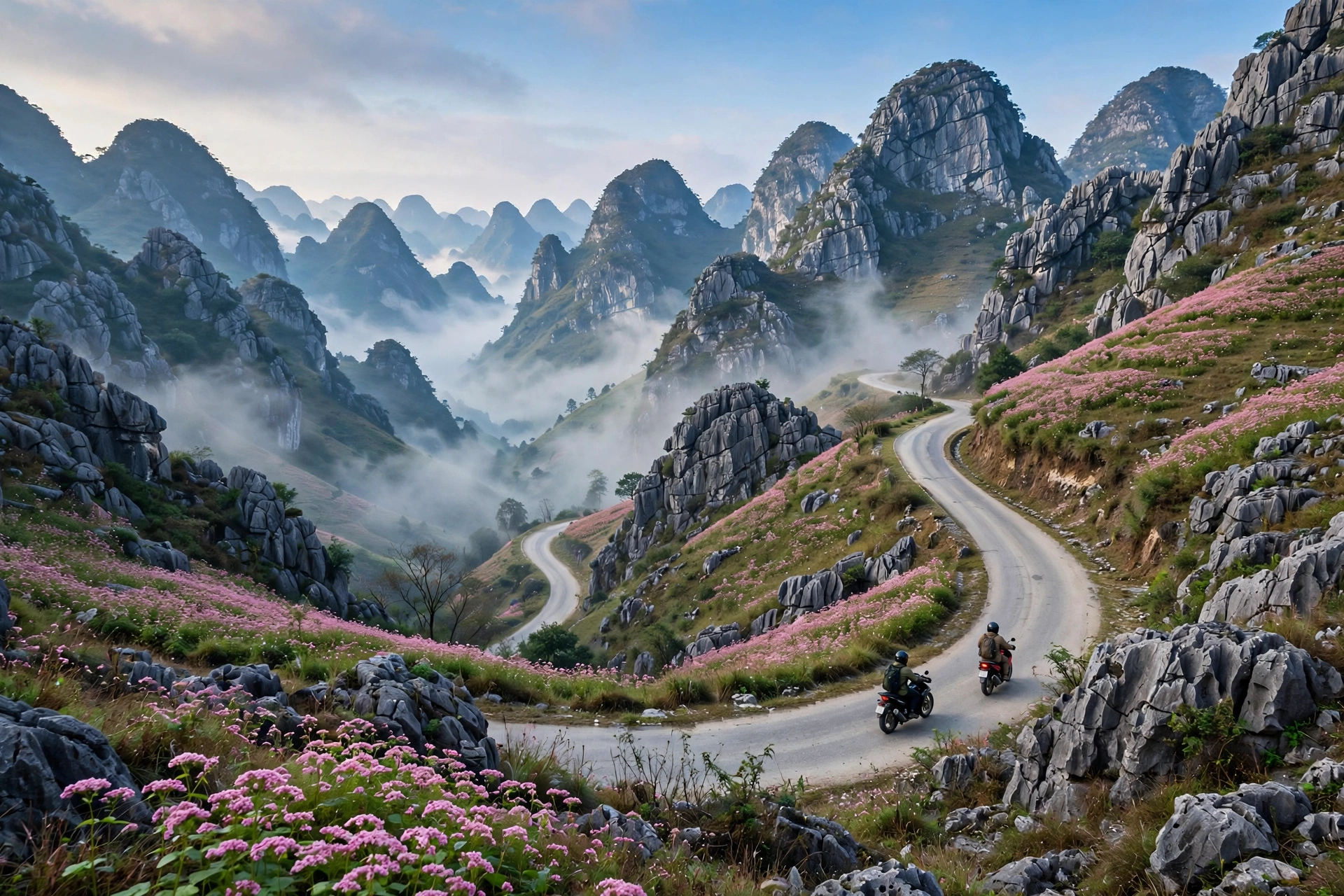
Ha Giang province sits at Vietnam’s northern tip, pressed right up against the Chinese border. For decades it was effectively closed to foreign travelers, which is why it feels so untouched compared to the rest of the country. The loop is the classic circuit everyone rides: start in Ha Giang city, climb through Quan Ba and Yen Minh, cross the Dong Van Karst Plateau (a UNESCO Global Geopark), drop down the legendary Ma Pi Leng Pass to Meo Vac, swing through Du Gia, and roll back to Ha Giang. The anticlockwise route most tours follow runs Quan Ba, Yen Minh, Dong Van, Ma Pi Leng, Meo Vac, Du Gia, in that order.
Most riders do it in three or four days. Three days is fast and furious, basically all saddle time. Four days is the sweet spot: enough to stop at the viewpoints without feeling rushed, do the Nho Que River boat ride, and actually breathe in Dong Van’s old quarter. The standard tour bike is a 110 to 150cc semi-automatic Honda, not a beast, but perfect for these roads. And when I say roads, I mean some of the most dramatic mountain tarmac on the planet.
If you want a sense of the scale of adventure Vietnam offers, our guide to Son Doong, the world’s largest cave, shows the same country hiding whole underground weather systems. Ha Giang is the surface-level version of that wildness.
Why 2026 Changed Everything
Here’s the part most travel blogs are glossing over. In April 2026, a British backpacker died in a motorbike accident on the loop. It was one of several tourist fatalities in 2024 to 2026, and it forced the province’s hand. Late in April 2026, Tuyen Quang province (which absorbed Ha Giang in Vietnam’s 2025 administrative restructure) issued a directive that rewrote how the loop operates:
- All motorbike tours must now run through licensed Vietnamese operators. The informal hostel-arranged trips that used to be the norm are no longer legal.
- Written contracts with explicit safety and insurance terms are required for every tour.
- Guides must hold valid licenses and registered employment contracts.
- Police actively check International Driving Permits at common checkpoints, including the Yen Minh entry, Dong Van town, and the Meo Vac descent.
The practical fallout? Legitimate operators raised prices 10 to 20 percent in May 2026 to absorb licensing and insurance costs. The unlicensed operators that used to charge $80 to $100 for guided 3-day tours have largely been pushed out of the market. Here’s a useful rule of thumb from the new reality: if an operator quotes you under $150 for a 3-day guided tour in 2026, treat it with suspicion. They probably don’t have the licensing the April directive requires, which means the safety and insurance protections aren’t in place either.
Is the loop less fun now? Honestly, no. If anything, the enforced professionalism killed off the sketchiest operators, and the ride itself hasn’t changed at all. The roads are still insane. The views are still ridiculous. It just costs a bit more and comes with actual paperwork. That’s a trade I’ll take every time.
The Route, Day by Day
Day 0: Hanoi to Ha Giang
Almost everyone starts with the overnight sleeper bus or a limousine van from Hanoi, roughly six to seven hours north. A sleeper bus round trip costs about $36 to $52; a limousine van runs $50 to $70 round trip. Arrive in Ha Giang city in the morning, stash your big bag at the tour office, meet your group, and do the test ride around the block. Pay attention to how the bike feels. If something’s off, say so now, not on a mountain pass.
Day 1: Ha Giang to Dong Van (via Heaven’s Gate)
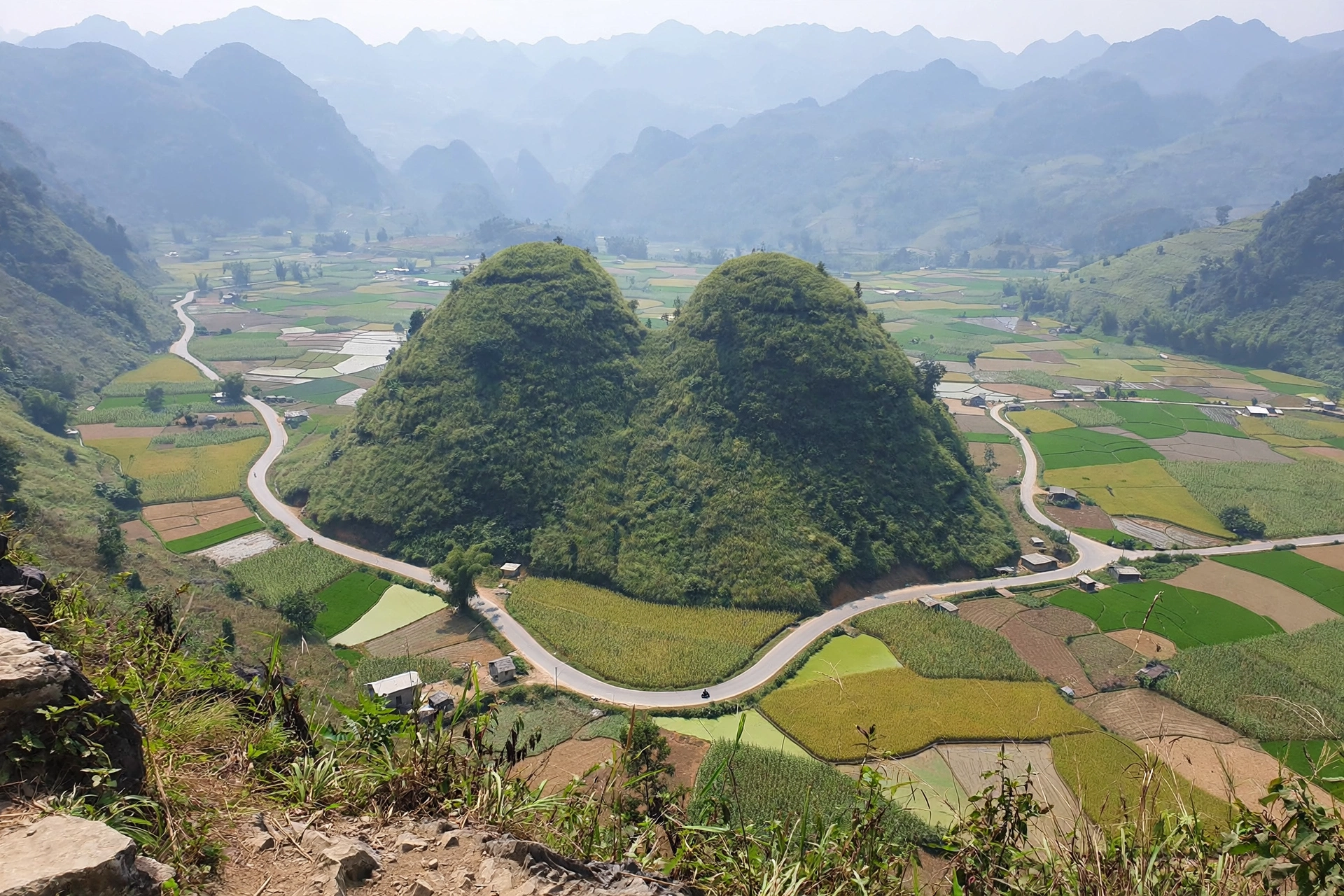
The first real day climbs fast. The Heaven’s Gate viewpoint in Quan Ba is your first stop, and it’s a proper jaw-dropper: the famous Twin Mountains (Nui Doi), two perfectly rounded green karst hills rising out of patchwork rice and corn fields, with hazy blue mountain layers stacked behind them.
You roll through Yen Minh (this is where police sometimes check permits, so have yours ready), then climb onto the Dong Van Karst Plateau. The landscape up here is genuinely alien: grey limestone everywhere, tiny Hmong villages clinging to impossible slopes, corn growing out of rock cracks. If time allows, detour north to the Lung Cu Flag Tower, Vietnam’s northernmost point, where the big red flag flies over terraced fields running right to the Chinese border.

Night one is in Dong Van. The old quarter is small but atmospheric, weathered yellow buildings in Chinese-Vietnamese style, red lanterns, locals buzzing past on motorbikes. Get the black pork and corn wine. You’ll thank me.

Day 2: Dong Van to Meo Vac (Ma Pi Leng Pass Day)
This is the day. The reason you’re here. Ma Pi Leng Pass is regularly called Vietnam’s most scenic mountain road, and it’s not hype. The pass drops off one side of a cliff, and the road is literally carved into the rock face hundreds of meters above the Nho Que River, which glows emerald green in the gorge below.
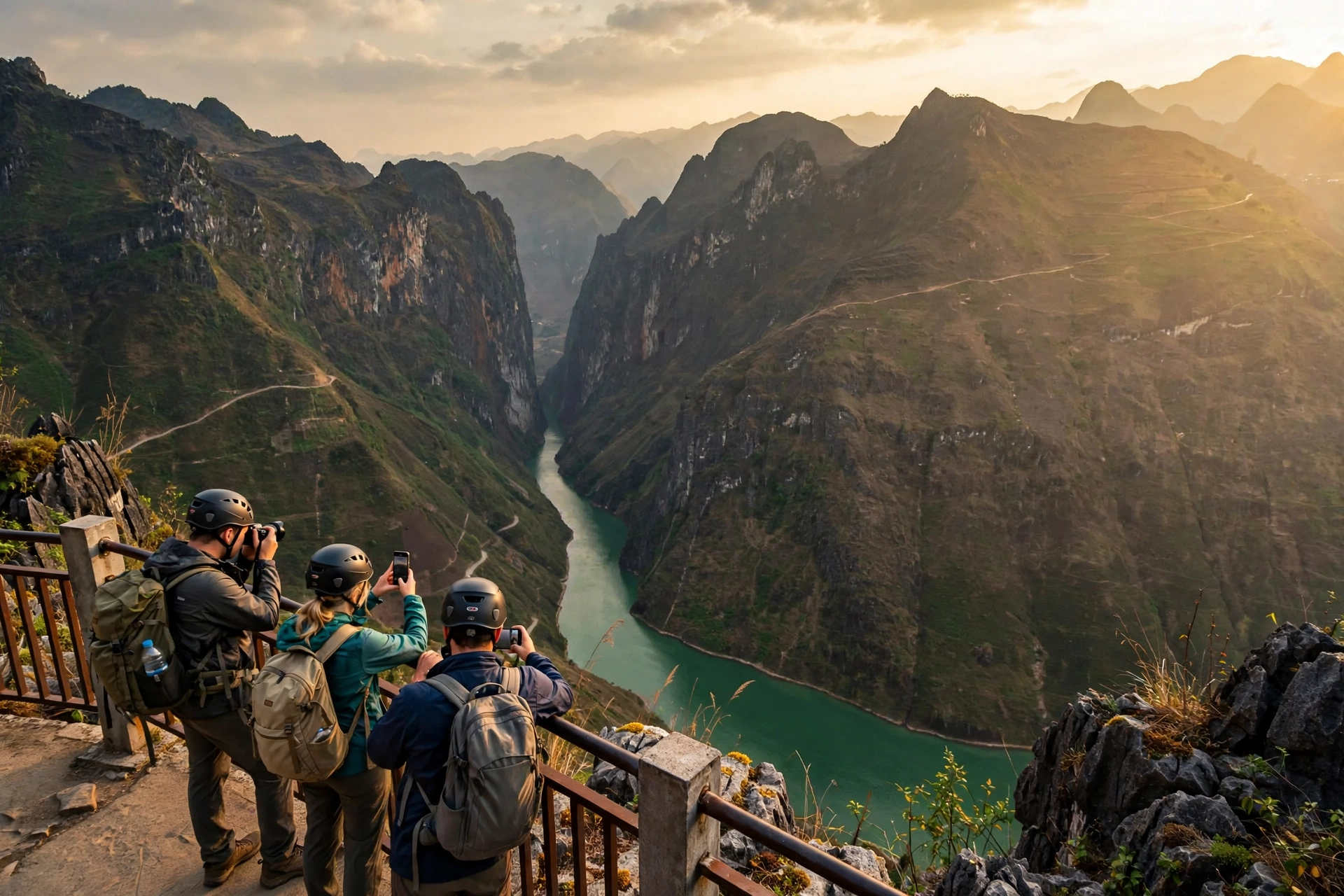
Stop at the skywalk viewpoint, take the obligatory photos, then keep going down to the river for the boat ride. Floating between those sheer limestone walls, looking up at the road you just rode, is one of the great perspective flips in travel. The boats run from the bottom of the gorge and take about 30 to 40 minutes.

Night two is in Meo Vac, smaller and quieter than Dong Van, with a great Sunday market if your timing lines up.
Day 3: Meo Vac to Du Gia
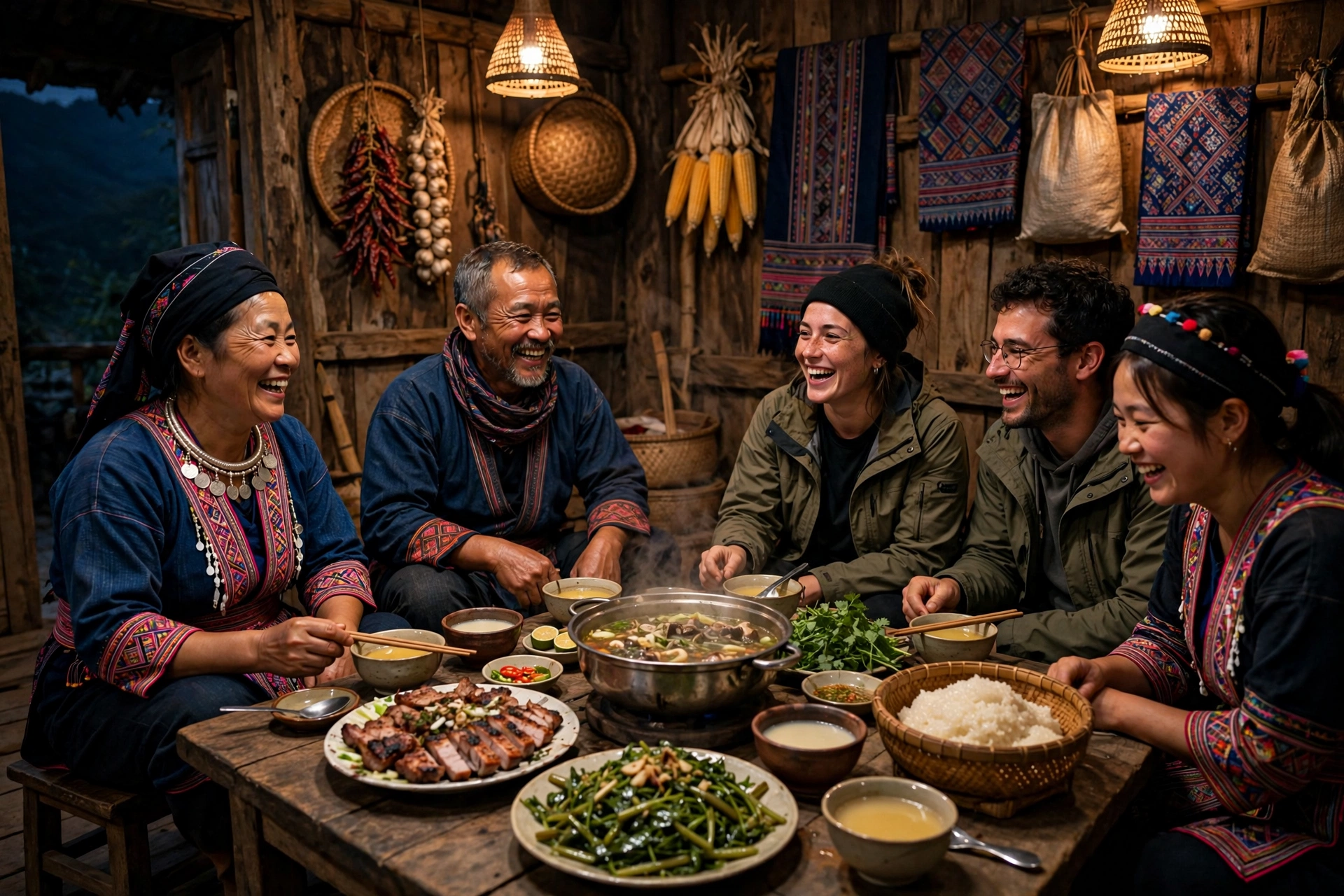
The road to Du Gia is gentler and greener, winding through valleys and past the Sa Ly rice terraces. Du Gia is famous for its waterfall, where half the tour groups in Ha Giang end up swimming in the afternoon. It’s touristy in the best way: cold water, warm sun, everyone comparing road stories. Night three is a homestay here, which brings me to one of the loop’s best parts.
Day 4: Du Gia back to Ha Giang
The final leg climbs over the 9 Turn Pass, Can Ty Pass, and Bac Sum Pass before dropping back to Ha Giang city. Most tours have you back by mid-afternoon, with the night bus or van back to Hanoi the same evening. You’ll be filthy, exhausted, and already planning your return. That’s just how it works.
Easy Rider vs Self-Drive: An Honest Comparison
This is the decision that defines your trip, so let’s settle it without the usual blog hedging.
Ride as a passenger (easy rider) if you don’t ride a motorbike regularly at home, full stop. You sit on the back, an experienced local driver handles the bike, and you’re free to actually look at the scenery instead of white-knuckling every hairpin. It costs $150 to $170 for three days or $190 to $230 for four days in 2026, including the bike, driver, fuel, homestays, family-style meals, border permit, entrance fees, and bag storage. Tip $10 to $20 a day. The route, bikes, and homestays barely change between companies, so what actually matters is: a separate English-speaking group leader, a small group size, a decent helmet, and drivers who aren’t drinking at dinner. Ask about those four things before you compare prices.
Self-drive only if you already ride a manual or semi-automatic motorbike at home and hold an International Driving Permit (the 1968 convention type matters here). Vietnam requires an IDP for self-driving bikes over 50cc, and police checkpoints on the loop are real in 2026. DIY costs run $90 to $130 for three days (bike, dorms, food), plus the sleeper bus. It’s cheaper and you get total freedom, but the roads are genuinely demanding: gravel patches, water buffalo with right of way, tour buses on blind corners. Be honest about your skill level. This is not the place to learn.
The problem most travelers face is booking on price alone and ending up with a sketchy operator. The 2026 rules actually help here: demand the written contract, confirm the operator’s license, and check the helmet they hand you before you pay. Those three steps solve 90 percent of the safety problem.
What It Really Costs in 2026
No vague “budget friendly” claims. Here are the real numbers, verified from current 2026 pricing:
- Backpacker DIY (4 days total): $126 to $192. Sleeper bus round trip ($36-52) + DIY 3-day loop ($90-130) + tips. No license-friendly option, you need riding skills and an IDP.
- Easy rider guided (3-4 days): $150 to $170 (3-day) or $190 to $230 (4-day), plus $10-20/day tip. This is what most people should book.
- Mid-range guided self-ride (4-5 days): $285 to $435 total. Limousine van ($50-70) + guided 4-day self-ride tour ($200-310) + guide tip + extras.
- Luxury easy rider (3-4 days): from $180 (3-day) or $290 (4-day), with nicer accommodation, VIP Hanoi transfers, and English-speaking guides.
Anything under $150 for a 3-day guided tour is a red flag under the 2026 rules. And note that the April directive’s 10 to 20 percent price bump is already baked into these numbers, so don’t expect to haggle back to 2024 prices.
For more adventure travel that punches above its price tag, check our guide to Brazil, ranked the world’s top thrill-seeker destination, or our Upper Mustang permit guide if you want another Himalayan-scale adventure with new 2026 rules of its own.
The Safety Problem Nobody Likes Talking About
Let’s not dance around it. People have died on this road, most recently in April 2026. The loop’s danger isn’t the road quality, which is mostly good tarmac, it’s the combination of inexperienced riders, overloaded tour groups, bad helmets, and occasionally drivers who’ve had too much corn wine at dinner. The 2026 licensing crackdown addressed the structural side. Here’s what you control:
- Book a licensed operator. Get the written contract the law now requires. Read the insurance terms.
- Check the helmet. It should be full-face or at least a solid half helmet that actually fits. If they hand you a plastic bowl with a strap, walk away.
- Keep the group small. Under 10 riders is ideal. Big convoys mean you spend the whole day eating dust and waiting.
- Don’t self-drive if you’re not a rider. Seriously. The easy rider option exists for exactly this reason and it costs barely more than DIY.
- Carry your IDP and passport copy every riding day. Checkpoints are routine now.
- This tour is not suitable for people with back or heart problems. That’s straight from the operators, and they’re right.
Permits and Paperwork (The Boring but Important Bit)
Foreign travelers need a border permit for most of the loop, including Lung Cu, Dong Van, and the Ma Pi Leng area. Don’t stress about this: every legitimate tour arranges it in advance, free of charge. You just send a passport photo via WhatsApp after booking. Riding without one risks a fine and being turned back at a checkpoint.
Self-drivers need an International Driving Permit valid for motorbikes over 50cc. Get this in your home country before you fly; you can’t sort it out in Hanoi. Police at the Yen Minh entry and Dong Van checkpoints are actively checking in 2026.
When to Go
October and November are prime time: dry weather, clear skies, and November brings the famous buckwheat flower season, when the hillsides turn pink and purple and the whole province hosts flower festivals. September is good too, with the rice terraces at their greenest. December to February gets cold and foggy up high, which kills the views. March to May is warm and pleasant, and June to August brings rain and the occasional landslide delay. If you can, aim for late October through November.
Quick Tips Before You Book
- Pack light. Your big bag stays at the tour office. A 20-liter daypack is plenty: rain jacket, warm layer (it gets cold at altitude), swimwear for Du Gia, sunscreen, and a power bank.
- Bring cash. ATMs exist in Ha Giang city but thin out fast on the loop. Small dong notes for drinks and snacks.
- Download offline maps. Signal drops in the gorges.
- Book 2026 tours through licensed operators only and confirm the written contract before paying anything.
- Give yourself a buffer day in Hanoi after the loop. You’ll want the sleep.
Final Word
The Ha Giang Loop earned its legend the hard way: absurd scenery, real adventure, and a price tag that kept it honest. The 2026 rule changes made it slightly more expensive and considerably more professional, and that’s a fair trade. Whether you ride pillion with an easy rider or take the handlebars yourself, four days on these roads will recalibrate what you think a road trip can be. Just check the helmet first.
Want more rides like this? Follow The Cavee on Pinterest for weekly adventure travel guides, and check the thecavee.com homepage for our latest underground and overland adventures. Read Full Story on thecavee.com, and I’ll see you on the road.