The moment the light changes
You step onto a flat wooden boat, you sit down low, and you duck your head without really thinking about it. The rock closes over you, the air drops to a steady cool, and the noise of the park outside just stops. Then the boatman pushes off, not with a motor roar but with a quiet pole and a hand on the ceiling, and you are floating on a river that should not exist. That is the first surprise of the San Jose Caves, known locally as the Coves de Sant Josep, in La Vall d’Uixo, about 43 kilometres north of Valencia. The second surprise is how calm it feels. This is not a white knuckle ride. It is a slow drift through a limestone world that water has been carving for millions of years, and it stays with you long after you are back in the sun.
What makes this cave different
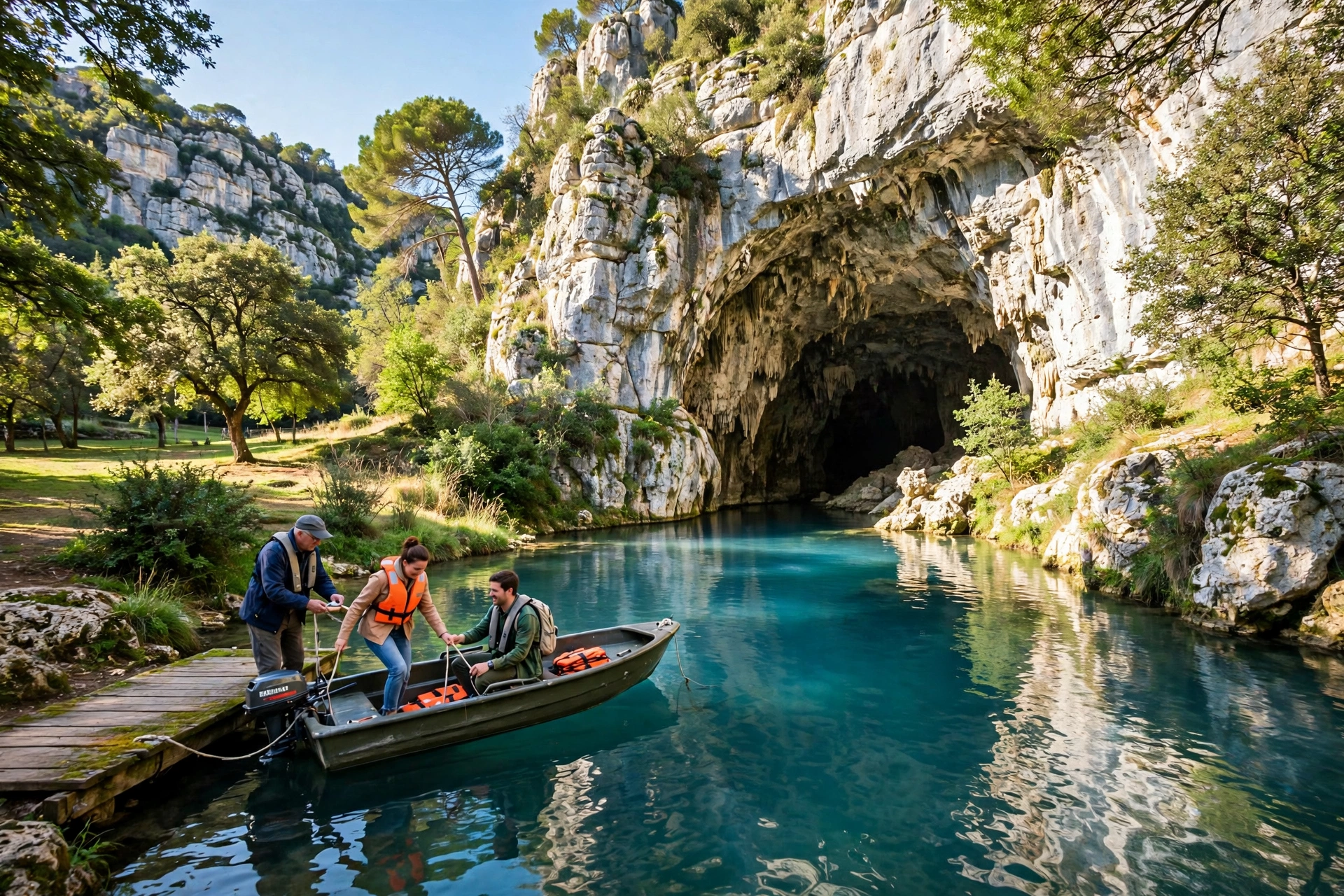
The headline claim is a big one, and it is the reason this place shows up on so many Spain lists. The San Jose Caves hold what is described as Europe’s longest navigable underground river. The boat route itself is about 800 metres, and the wider system has more than three kilometres of mapped underwater channels. The source of the spring that feeds it is still unknown, which is a lovely detail. You are floating on water that comes from somewhere nobody has fully traced.
The water is clear, often turquoise in the lit sections, and it runs between 1.5 and 11 metres deep along the boat path. The cave stays at about 20 degrees Celsius all year. On a hot Valencian summer day that feels like air conditioning made by nature. On a cool winter morning it feels almost warm. The chambers reach up to about 12 metres high in places, then the ceiling dips low in two narrow passages, and everyone ducks at the same time and laughs at the same time. It is a shared, slightly silly moment, and it breaks the ice on a boat full of strangers.
The boat ride, minute by minute
The whole visit lasts about 45 minutes inside the cave. Roughly 30 minutes are on the water and about 15 minutes are on foot. You check in at the Paratge de Sant Josep park area, and it is worth arriving about 15 minutes before your slot. The boats hold about 12 people, so you are close to your neighbours, but the water is so quiet that it never feels crowded in a noisy way. It feels hushed, like a library made of rock.
Your boatman steers with a pole and, in the tight spots, with handholds on the ceiling. That sounds old fashioned because it is, and it is part of the charm. There is no engine thrum to talk over. You hear drips, you hear the pole, you hear the guide. The route passes chambers with names that give you a hint of what to look for, including the Hall of Bats and Diana Lake, plus ribbed stalactite curtains that hang like stone fabric. Keep your arms inside the boat and your bag under your knees. The passages are narrow in places, and a phone dropped in deep water is gone for good.
Here is the practical point most first timers miss. Photography is strictly prohibited inside the cave, according to the visitor guide, to protect the rock from flash light and to stop phones falling into the water. I know, it is annoying when the light on the water looks perfect. Take your photos in the park and at the entrance instead, and then just watch the cave with your eyes. You will remember more of it that way, honestly.
The walk through the dry gallery
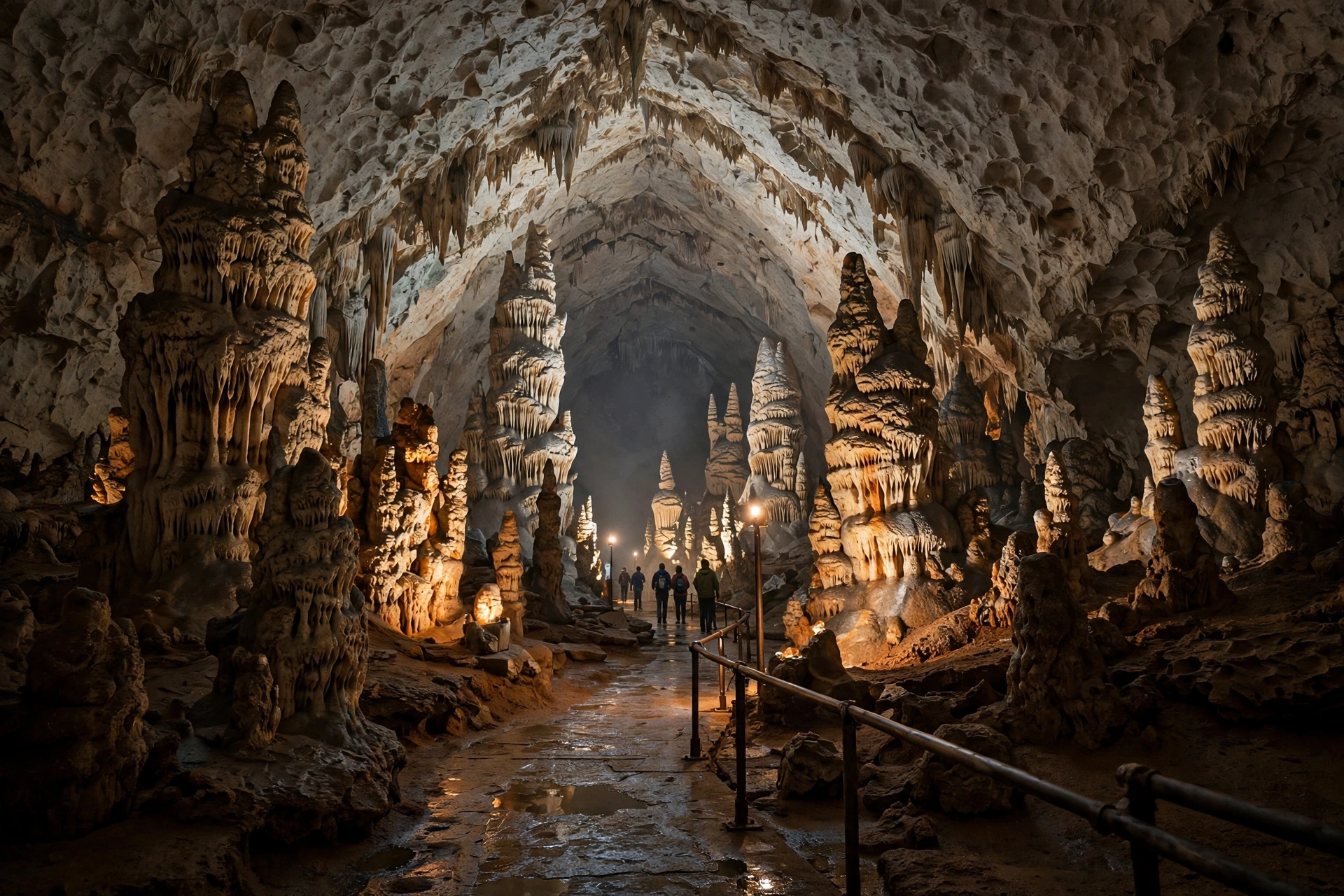
About halfway through, you step off at an inner pier for a 250 metre walking loop through the dry gallery. This is where the cave changes character. On the boat you are looking up at curtains and ceilings. On foot you are standing next to towering stalagmites and walking under cathedral-like vaults, including a section called the Waterfall. The path is damp and uneven, there are stairs at the entrance and along the walk, and there are low clearances where you need to duck. Wear shoes with grip. Skip the smooth sandals, even if it is 35 degrees outside.
A cave with 16,000 years of neighbours
The San Jose Caves are not just pretty rock. People have been hanging around this entrance for a very long time. The visitor guide puts human history here at about 16,000 years. Before you board, you can pause at an outdoor cliff shelter with fenced Levantine rock art, made thousands of years before the caverns were formally mapped. The paintings are listed as part of a UNESCO recognised rock art tradition, and they are a reminder that this was a meaningful place long before it was a ticketed attraction.
Later, Iberian builders raised a fortified village on the cliff directly above the cave. You do not need to know the full timeline to enjoy the visit, but it helps to know you are not just looking at geology. You are looking at a place that sheltered people, fed their stories, and probably scared them a little too. Caves did that. They still do, in the best way.
If you love this kind of layered history, you will enjoy our other underground river stories too. The Puerto Princesa Underground River in Palawan is a completely different scale, a whole river system running under a mountain, and our Waitomo Glowworm Caves guide shows what happens when the ceiling itself lights up. San Jose sits nicely between those two extremes. It is shorter, easier, and much closer to a major European city, which makes it perfect for a first underground river trip.
The problem most visitors run into, and how to dodge it
The single biggest problem with the San Jose Caves is not the cave itself. It is the ticket. Daily capacity is strictly capped to protect cave humidity and fragile formations, and morning and weekend slots often sell out online days ahead. People drive 40 minutes from Valencia, walk up to the kiosk, and find nothing left. That is a miserable start to a day trip, and it is completely avoidable.
Book online at least four days ahead if you can, and treat the timed slot as fixed. Arrive early, not just on time. The guide recommends about 15 minutes before your slot, and I would add a little extra on weekends for parking. The lower tiered car park is close, but the lot fills when tour coaches arrive. If you are driving from Valencia, take the V-21 north onto the AP-7 and exit toward La Vall d’Uixo on the CV-10. The address to aim for is Passeig de les Grutes, s/n, 12600 La Vall d’Uixo, Castello, Spain. Free surface parking sits about 200 metres from the dock, according to the visitor guide. Direct buses leave Valencia central station once daily on weekdays, so a car is much easier if you want a choice of times.
Language is the second small problem. Live commentary on the skiff is delivered in Spanish and Valencian. That is fine if you speak either, but if you do not, grab the free audio guide in English, French, or German via the smartphone QR codes at the gate before you board. Do not wait until you are on the water to sort this out. The boat moves, the guide talks, and you will spend the first chamber fiddling with your phone instead of looking up.
The third problem is expectations about access. The standard route is not wheelchair accessible, because of steps and narrow passages in the dry gallery, though a specialised adapted boat tour is available for wheelchair users and people with reduced mobility, booked in advance by email. Strollers and prams are not allowed inside the boat or cave walkways, for the same reason. Kids are very welcome, children under 13 must be with an adult, and children under 2 enter free but must sit on an adult’s lap. The surrounding park has playgrounds, picnic zones, and places to eat, so the non-boat part of the day still works for families.
Tickets and prices, with one honest warning
Prices vary between listings, so check the current price on the day you book rather than trusting a single number you read months ago. The visitor guide lists an online advance price of 14.50 euros for general admission, 8.50 euros for children aged 3 to 13, and 35 euros for a speleocanoe adventure on select dates. Other tour listings put standard adult entry at about 18 euros, and guided day trips from Valencia that include transport typically cost far more, often around 60 to 80 euros per person depending on group size and pickup.
Read that as a range, not a contradiction. The cheapest way in is almost always a direct timed ticket, booked online in advance, with your own transport. The most expensive way is a small group tour from Valencia with hotel pickup, which makes sense if you do not want to drive. What you should not do is assume a walk-up ticket will be there at the price you saw online. Capacity, not price, is the real constraint here.
The speleocanoe option is worth knowing about if you want more than the standard tour. On select dates, you paddle a tandem open canoe with a speleology guide into unlit, non-commercial branches of the cavern, wearing supplied wetsuits. It costs more, it needs advance booking, and it is a different experience from the gentle skiff ride. Book it only if you are comfortable in the dark, in a wetsuit, and in a canoe. For most first timers, the standard boat tour is plenty.
When to go
The cave is open year-round, and the 20 degree interior means there is no bad season inside. The difference is outside, and in the crowds. Weekday departures at 10:00 in the morning or after 5:00 in the afternoon tend to be thinner, with fewer tour coaches in the lower lot. The 10:00 slot gives you calm water before school groups and day trip buses arrive. A mid-afternoon lull around 2:00 can mean quicker parking and a quieter cafe. An evening departure, where available, lets you drive back toward Valencia as the light softens.
Make it a full day: Sagunto, the mountains, and the beach

The cave entrance borders the Sierra de Espadan Natural Park, which is a gift for anyone who hates a one-stop day trip. You can pair a morning underground with lunch in the historic centre of Sagunto, or an afternoon dip at the nearby beaches of Moncofa. Sagunto is about 18 minutes away by car, and it is criminally underrated. The hilltop fortress, the Castillo de Sagunto, stretches across a ridge with Roman and Moorish layers, and the Roman theatre below it is still used for performances. Walk the old town after the cave, eat something slow, and you have turned a 45 minute boat ride into a proper day out.
For a different kind of water cave, compare this with Benagil Cave in Portugal, where the thrill is a skylight sea cave reached by water, not a river running through a mountain. San Jose is calmer, darker, and stranger in a quiet way. Benagil is brighter and more exposed. Both are worth doing, but they scratch different itches.
What to wear and bring
A light sweater or a linen overshirt is plenty, even in summer, because the cave is humid and cool. Closed shoes with grip are the one non-negotiable item. The boat landing and the dry gallery path can be damp, and flip flops are a bad idea on wet stone and stairs. Bring a small bag you can stow under your knees on the boat. Leave the big backpack in the car or use the walk-in lockers on site.
Is it worth it?
Yes, with one condition. It is worth it if you book ahead, arrive early, and accept that you are buying a short, quiet, beautiful experience, not a full day theme park. If you want adrenaline, go elsewhere. If you want to float through a mountain on a river you cannot see the end of, while a guide points out rock art older than most countries, this is one of the easiest and most memorable ways to do it in Europe.
The San Jose Caves also solve a very specific travel problem. Valencia is wonderful, but after a few days of city walking, paella, and beach, you want a story to tell back home that is not just another restaurant. A boat ride under a mountain is that story. It is the kind of trip where you come out and immediately start describing the water, the ducking, the quiet, and the moment the light came back. That is what a good cave does. It gives you a memory that does not need a photo to prove it.
So book the slot, take the early boat, sit low, look up, and let the river do the work. When you are back in the park, blinking in the sun, you will understand why people keep recommending this unassuming cave in a small Valencian town. It is not the biggest cave in the world. It is one of the most quietly surprising.
Quick answers before you go
How long does the San Jose Caves tour take?
About 45 minutes inside the cave, with roughly 30 minutes on the boat and 15 minutes walking the dry gallery. Allow extra time for check-in, parking, and the park.
How much are San Jose Caves tickets?
The visitor guide lists 14.50 euros online in advance for adults and 8.50 euros for children aged 3 to 13, while other listings put standard entry at about 18 euros. Check the live price when you book, and book at least four days ahead for weekends.
Can you take photos inside the San Jose Caves?
No, photography is prohibited inside the cave according to the visitor guide, to protect the formations and prevent phones falling into the water. You can photograph freely in the park and at the entrance.
Is the San Jose Caves tour good for kids?
Yes, it is one of the gentler cave experiences in Spain. Children under 13 must be with an adult, children under 2 enter free on an adult’s lap, and strollers are not allowed inside the cave.
How do you get to the San Jose Caves from Valencia?
Drive north on the V-21 to the AP-7, then exit toward La Vall d’Uixo on the CV-10. It is about 43 minutes by car. Direct buses from Valencia central station run once daily on weekdays, so driving gives you far more choice.
Found this guide useful? Pin it for your Valencia trip, and read the full story on thecavee.com before you book. If you have floated this river yourself, tell us in the comments which chamber stopped you in your tracks. We read every one, and the best tips go straight into our next cave guide.