For most people, the phrase “scuba diving” conjures up images of sun-kissed coral reefs, sea turtles, and crystal-clear tropical waters. But there is a small, highly disciplined subculture of divers who prefer the dark. They seek out submerged labyrinthine tunnels, ancient stalactite forests, and untouched underground chambers.
This is cave diving, widely considered one of the most hostile and unforgiving extreme sports on Earth.
Unlike open-water diving, if something goes wrong inside a water-filled cave, you cannot simply swim to the surface. You are trapped under a ceiling of solid rock, sometimes thousands of feet away from breathable air. The margins for error are zero.
While thousands of caves have been safely mapped by technical professionals, a select few hold a reputation so fearsome they are known worldwide as “diver cemeteries.” These are the most dangerous caves in the world to dive.
1. Eagles Nest Sinkhole (Florida, USA)
The “Mount Everest” of Cave Diving
Located in the Chassahowitzka Wildlife Management Area in Florida, Eagles Nest looks completely unassuming from the surface. It appears to be nothing more than a remote, pine-fringed pond.
[ Surface Pond ]
       │
       ▼  (Narrow 100ft "Chimney Drop")
[ The Main Ballroom ] ───► Extends into massive, pitch-black miles of tunnels
But underneath the surface, a narrow vertical shaft drops like a chimney for over 100 feet ($30\text{ m}$) before opening up into a colossal, pitch-black underwater chamber called the “Main Ballroom.” From this room, vast tunnels branch off into miles of unexplored passages reaching depths of over 300 feet ($91\text{ m}$).
- Why it’s deadly: Extreme depth and the sheer scale of the rooms cause rapid nitrogen narcosis—a phenomenon often called “rapture of the deep,” which severely impairs judgment and mimics drunkenness. Divers frequently become disoriented in the darkness, miscalculate their gas supply, and fail to find the tiny chimney exit back to the surface.
- The Toll: At least 10 highly experienced divers have lost their lives here since 1981, prompting temporary bans on the site before it was reopened strictly for elite technical divers.
2. The Blue Hole (Dahab, Egypt)
The Diver’s Cemetery
Perched right on the coast of the Red Sea, the Dahab Blue Hole is a submarine sinkhole that drops straight down to an astonishing 426 feet ($130\text{ m}$). It is one of the most infamous dive sites on the planet.
The true hazard of the Blue Hole isn’t a cave roof, but a specific structural feature known as “The Arch.” At a depth of 184 feet ($56\text{ m}$), a massive, 85-foot-long tunnel connects the open ocean to the inside of the sinkhole.
- Why it’s deadly: The Arch is far below the safe limit for standard recreational diving ($130\text{ feet}$). Divers frequently try to swim through the Arch without proper tri-mix gas blends, succumb to severe nitrogen narcosis, and lose track of which way is up. Because the water is incredibly clear, the Arch looks much closer to the surface than it actually is, tricking divers into descending far past their physical limits.
- The Toll: It is estimated that anywhere between 130 to over 200 divers have perished here. The cliffs surrounding the Blue Hole are lined with stone plaques commemorating the dead.
3. Jacob’s Well (Texas, USA)
The Deceptive Inland Choke Point
Jacob’s Well is a perennial karstic spring located in the Texas Hill Country. On hot summer days, it is a beloved swimming hole where locals jump into the mouth of a pristine, crystal-clear opening.
Beneath the swimmers, however, lies a vertical grid of narrow, interlocking chambers that drop down over 120 feet ($37\text{ m}$).
- Why it’s deadly: Jacob’s Well is notoriously cramped. The lower chambers require divers to navigate “squeezes” so tight they must unclip their oxygen tanks just to slide through. The primary killer here is silt-out. The floors of the lower chambers are blanketed in incredibly fine limestone sediment. One single, improper fin kick stirs up the silt, instantly turning crystal-clear water into a murky “milkshake” with zero visibility. Divers get stuck in tight chimneys, panic, stir up more silt, and run out of air.
- The Toll: At least 8 fatalities have been officially recorded, primarily young explorers attempting to push into the lower chambers without cave certification.
4. Cenote Esqueleto / The Temple of Doom (Tulum, Mexico)
The Labyrinth of Dark Illusions
Mexico’s Yucatán Peninsula is famous for its cenotes—sunken limestone sinkholes leading to vast underwater cave networks. While many are beautiful and safe for guided tours, Cenote Esqueleto (aptly named “The Skull Cave” or “The Temple of Doom”) is a psychological gauntlet.
                  [ Sunlit Opening ]
                          │
     ┌────────────────────┴────────────────────┐
     ▼                                         ▼
[Dark Labyrinth Zone]                     [Dark Labyrinth Zone]
* Muddy silt floors                       * Halocline layers
* Disorienting tunnels                    * Total darkness
Divers enter the cave by dropping into a small, 20-foot hole via a rope or ladder. Once inside, there are very few natural light sources.
- Why it’s deadly: The Temple of Doom is an intricate maze of twisting, shallow limestone paths that all look identical—a phenomenon known as the Labyrinth Effect. If a diver strays off the main guideline, finding the way back is nearly impossible. Additionally, the cave features prominent haloclines—where fresh and saltwater meet but do not mix. Swimming through a halocline creates a shimmering, blurry visual distortion that makes reading dive gauges and navigating highly disorienting.
5. The Shaft Sinkhole (Mount Gambier, Australia)
The Ultimate Claustrophobic Drop
Located out in the middle of a flat, grassy cow pasture in South Australia, “The Shaft” is unique because you cannot see the water from the surface. The entrance is a tiny, dark manhole in the ground barely wide enough to fit a human body.
Divers must take off all their heavy gear, lower themselves down into the dark slot, and have their equipment lowered down to them via ropes.
- Why it’s deadly: Once inside the water, the cave opens up into a pitch-black, sprawling cavern that drops past 270 feet ($82\text{ m}$). It is completely devoid of natural light. Because the entrance is so restrictive, if an emergency happens or a diver experiences equipment failure, a rapid, panicked evacuation is physically impossible. You cannot ascend together in a rush through a hole the size of a mailbox.
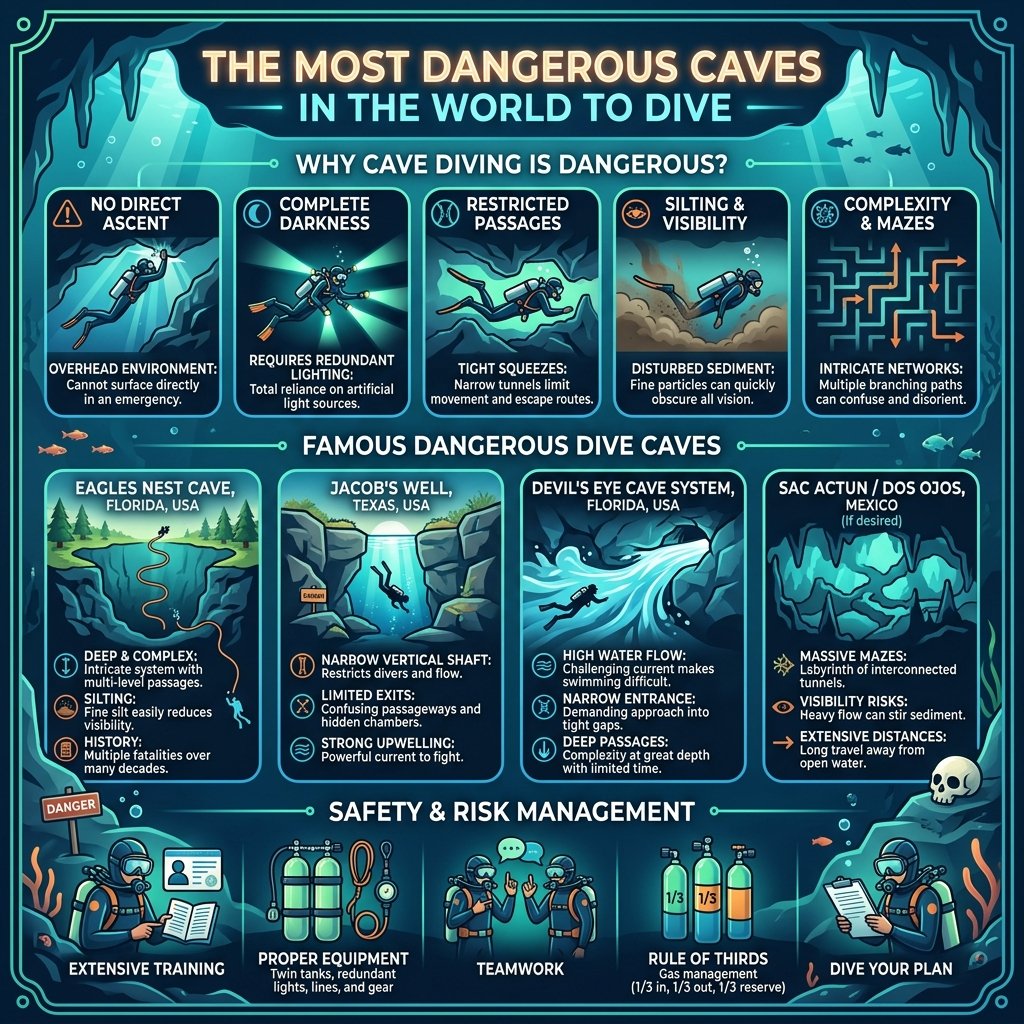
Summary: The Anatomy of Cave Diving Peril
To put these locations into perspective, the dangers of underwater cave exploration rarely stem from a single equipment failure, but rather a combination of environmental traps:
| Hazard Type | Main Cause | Real-World Consequence |
| Silt-Out | Fine limestone sediment | Instantly drops visibility to 0%, rendering flashlights useless. |
| Nitrogen Narcosis | High-pressure gas at depth | Causes “drunken” euphoria, confusion, and fatal decision-making. |
| Labyrinth Effect | Identical branching tunnels | Divers lose the guideline and swim further into the system until air runs out. |
| Overhead Restriction | Solid rock ceilings | Eradicates the possibility of an emergency direct vertical ascent. |
The Golden Rule of Cave Diving: Every certified cave diver is taught to follow the “Rule of Thirds”: $\frac{1}{3}$ of their total gas supply is used to swim into the cave, $\frac{1}{3}$ is used to swim out, and the final $\frac{1}{3}$ is strictly locked away, reserved for unexpected emergencies.
Ultimately, these underwater systems are stunning geological marvels, but they are spaces that command absolute respect. As the famous warning signs placed inside these cave entrances state: “There is nothing in this cave worth dying for.”