Designing a sprawling, claustrophobic underground cave system can be one of the most rewarding parts of worldbuilding. Whether you are a Dungeon Master (DM) prepping a high-stakes Dungeons & Dragons session, a fantasy author mapping out an underworld escape, or a game designer drafting a subterranean level, a cave system presents unique challenges.
Unlike castles, dungeons, or starships, nature doesn’t build in clean, right-angled grids. Real caves are messy, organic, and highly vertical.
If you are looking for an underground cave system map template to kickstart your next project, you are in the right place. This detailed guide breaks down how to choose the right template style, how to construct a realistic subterranean layout, and how to use templates to save hours of prep time.
Why You Need a Template for Subterranean Map Making
Starting with a completely blank canvas can lead to “writer’s block” for map makers. You sit down to draw a cave, and suddenly you’re just sketching random, repetitive blobs.
Using a template provides a structural skeleton while allowing you to retain full creative control over the aesthetic details.
- Saves Hours of Layout Time: You don’t have to figure out how a multi-level cavern naturally connects; the fundamental geometric flow is already handled.
- Maintains Organic Realism: Great templates mimic actual geological formations, ensuring your caves feel like they were carved by water and tectonic shifts, not a ruler.
- Improves Spatial Playability: For TTRPG players, a good template balances realistic chaos with functional combat zones, choke points, and exploration routes.
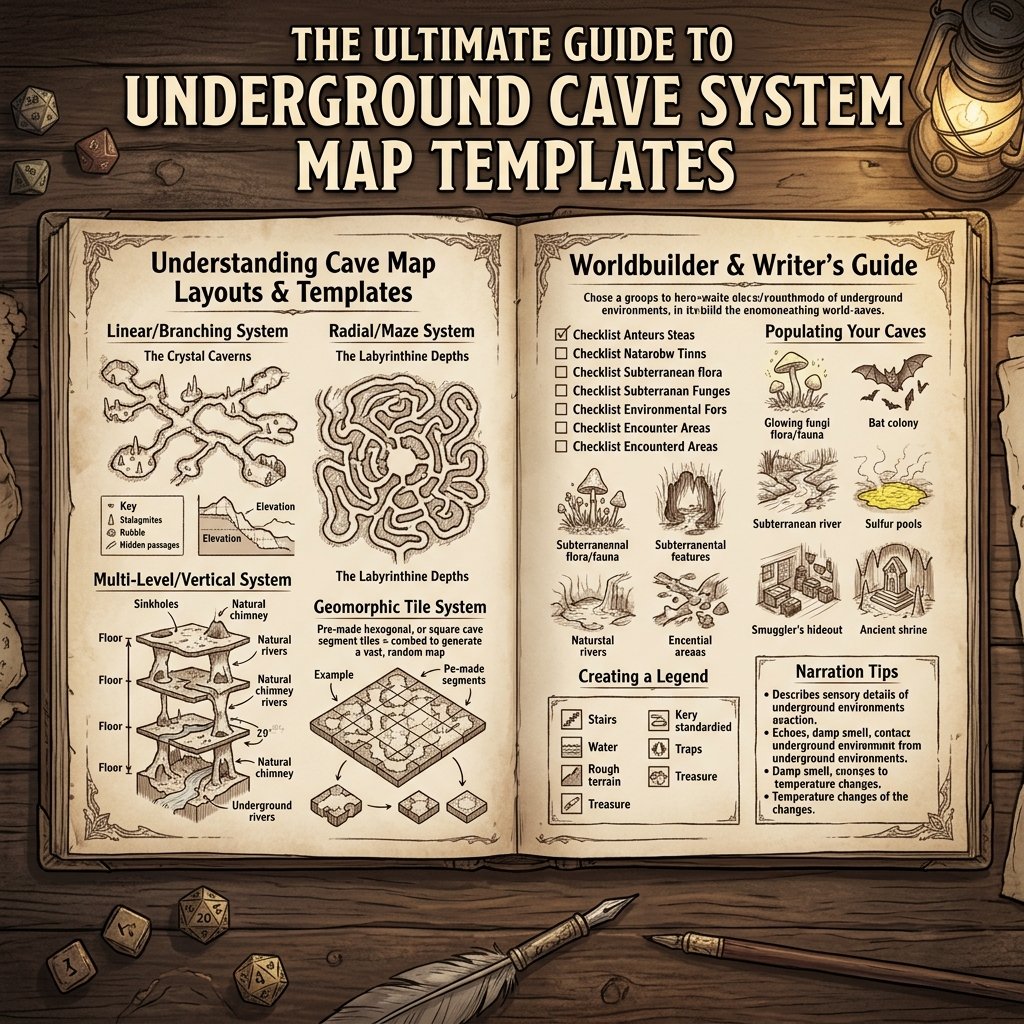
Types of Cave System Map Templates
Not all cave templates are created equal. Depending on your medium (hand-drawn, digital mapping software, or text-based outlines), you will want to select a template that matches your specific workflow.
1. The Functional Battlemap Grid (Best for TTRPGs)
This style features standard 1-inch squares or hexagonal overlays superimposed onto natural rock shapes. The template focuses heavily on tactical movement, indicating clear lines of sight, difficult terrain (like rubble or shallow water), and elevation changes.
2. The Node-Based / Flowchart Template (Best for Authors & Quick Prep)
If you don’t need a visual, square-by-square layout, a node template is your best friend. It treats caverns as “rooms” (nodes) and tunnels as “paths” (lines). This layout allows you to plan the narrative flow of a cave crawl—such as dead ends, puzzle chambers, and hidden loops—without worrying about exact dimensions.
3. The Cross-Section Vertical Template (Best for Complex Realism)
Most amateur maps look down from a top-down, bird’s-eye view. However, real caves go down. A cross-section template cuts the earth in half vertically, showing shafts, underground waterfalls, and multi-layered ledges that sit directly on top of one another.
Key Anatomy Elements of a Realistic Cave Template
To make your template feel alive, it needs to include specific geological and environmental zones. When customizing your base layout, ensure you incorporate these four core elements:
[Entrance / Sinkhole]
       │
[Squeeze / Choke Point]
       │
[Main Flow / Subterranean River] ─── [Hidden Sump / Flooded Cave]
       │
[The Great Chamber / Cavern]
- The Squeeze: Tight, narrow tunnels where characters or explorers must move single-file or crawl. These function as excellent tactical bottlenecks or high-tension narrative moments.
- The Sump: A cave passage that is completely submerged in water. Sumps act as natural gates, requiring diving gear, magic, or swimming checks to access the chambers hidden beyond.
- The Sinkhole (Dolines): Vertical openings where the surface ceiling has collapsed. These introduce natural sunlight, vegetation, or an alternative, dangerous entry point into the deeper layout.
- The Great Chamber: The focal point of the map. This is a massive cavern filled with stalactites, stalagmites, and pillars where major narrative encounters, boss fights, or underground settlements take place.
Step-by-Step: How to Use a Cave Template to Build Your Map
Once you download or sketch out a basic structural template, follow these sequential steps to turn that skeleton into a fully realized, immersive environment.
1.Establish the Water Source:Step 1.
Real caves are carved by water. Draw a subterranean river or a historical dry riverbed through your template. This naturally dictates where the largest tunnels and deepest chambers will form.
2.Define Elevation and Ledges:Step 2.
Break up flat surfaces. Use topo lines or shading to create elevated ledges, deep chasms, and tiered terraces. Verticality makes a cave environment instantly more dynamic.
3.Place Hazards and Difficult Terrain:Step 3.
Layer in environmental obstacles. Mark areas covered in slick mud, fields of razor-sharp stalagmites, patches of toxic subterranean fungi, or unstable ceilings prone to cave-ins.
4.Inject Light and Shadow:Step 4.
Determine the visibility profile. Mark where natural light fades out entirely, where bioluminescent moss glows soft green, or where geothermal vents cast a harsh, flickering red light.
Free Digital Tools for Generating Cave Templates
If you want to generate high-quality digital templates rather than drawing them from scratch, several powerful tools can help you build custom layouts in minutes:
- Donjon’s Dungeon Generator: A legendary, free web-based tool. By setting the layout style to “Cavernous,” it instantly generates random, node-connected grid maps complete with keys and descriptions.
- Inkarnate / Dungeondraft: Premium map-making software that features built-in “Cave Brush” tools. These brushes allow you to lay down rough, organic rock walls that snap beautifully to templates.
- Watabou’s One-Page Dungeon: A beautiful, minimalistic generator that creates highly artistic, stylized cave cross-sections and layouts perfect for old-school fantasy aesthetics.
Final Thoughts: Bring Your Underworld to Life
An underground cave system map template is a fantastic tool to streamline your creative process, but the true magic lies in the details you add on top of it. Focus on sensory descriptions—the steady drip-drop of water echoing in the dark, the drop in temperature as you descend deeper, and the smell of ancient stone. By anchoring your layout in structural realism and layering it with rich atmosphere, you will create a subterranean world your audience won’t easily forget.
When you are designing an underground cave system, you don’t need to rely on magical runes or mechanical tripwires to challenge your explorers. Nature is already remarkably hostile.
The most immersive hazards in a cave system utilize the actual environment—gravity, water, air quality, and geology. Layering these natural obstacles into your map creates tension without making the space feel like an artificial funhouse.
1. Atmospheric Hazards (The Invisible Killers)
The deeper you go into the earth, the more dangerous the air itself becomes. These hazards force players or characters to think about time management and resources.
- Bad Air Pockets (Choke Damp): Carbon dioxide ($CO_2$) is heavier than oxygen, causing it to pool in low-lying caverns and deep pits. There is no smell or visual warning; characters simply begin to fatigue, suffer headaches, and eventually suffocate.
- Combustible Gas (Fire Damp): Pockets of trapped methane gas can build up in sealed chambers. If someone walks in holding a burning torch or casts a fire spell, it triggers an immediate, devastating explosion.
- Geothermal Steam Vents: In volcanically active areas, narrow fissures can blast scalding steam into a tunnel at random intervals. This turns a narrow passageway into a high-stakes puzzle of timing.
2. Geological Hazards (The Floor and Ceiling)
Caves are constantly shifting, settling, and eroding. The very structure of the map can become an enemy.
- Chert Nodules & Razor Stone: Some limestone caves contain nodules of chert or flint. When the ceiling collapses or rocks break, these minerals fracture into edges sharper than surgical scalpels, creating patches of hazardous, damaging terrain.
- The Deceptive Floor (Flowstone Crusters): What looks like solid stone might actually be a thin, brittle crust of calcium carbonate formed over a deep, hidden drop-off. Step on it with too much weight, and the floor shatters beneath you.
- Unstable Scree Slopes: Steep banks of loose gravel and loose stones inside large caverns. Walking up them is exhausting, and a single wrong step can trigger a mini-landslide, sweeping anyone on the slope down into a dark pit.
3. Hydrological Hazards (Water Dynamics)
Water carved the cave, and water still rules it. Underground moisture is rarely peaceful.
- Flash Flooding (The Sump Trap): If it rains on the surface miles away, water can rapidly channel into the underground system. A dry, easily passable tunnel can transform into a raging torrent or a completely submerged “sump” within minutes.
- Freezing Hypothermia Pools: Cave water is notoriously cold, usually matching the average annual temperature of the region (often around $50^\circ\text{F}$ / $10^\circ\text{C}$ or lower). Getting soaked isn’t just uncomfortable; without a way to dry off, it quickly leads to debilitating hypothermia.
- Guano Mud Slurry: A beautiful mix of water and thick bat droppings. It creates a slick, knee-deep swamp that slows movement to a crawl, ruins equipment, and carries nasty fungal diseases if inhaled or tracking into open wounds.
How to Place Hazards Visually on Your Map
To make your map layout intuitive and fun to explore, try setting up a Hazard Gradient that increases in danger the further your characters move from the surface.
[SURFACE ENTRANCE]
       │
       ▼
[ZONE 1: LIGHT] ─── Slick Mud, Loose Scree Slopes (Low Risk)
       │
       ▼
[ZONE 2: DARK]  ─── Razor Stone, Freezing Pools, Deep Chasms (Medium Risk)
       │
       ▼
[ZONE 3: DEEP]  ─── Bad Air Pockets, Methane Gas, Flash Floods (High Risk)
Pro-Tip for Dungeon Masters & Writers
Always give your audience a clue before they hit a natural hazard:
- Don’t just tell them they are suffocating. Tell them their torches are starting to flicker out and burn dim due to the lack of oxygen.
- Don’t just drop them into a flash flood. Let them hear a low, rhythmic rumbling echoing through the stone walls a few minutes before the water arrives.