The Calendar You’ll Never Throw Away: Why This $32.99 Wooden Perpetual Calendar Has 987 Reviews
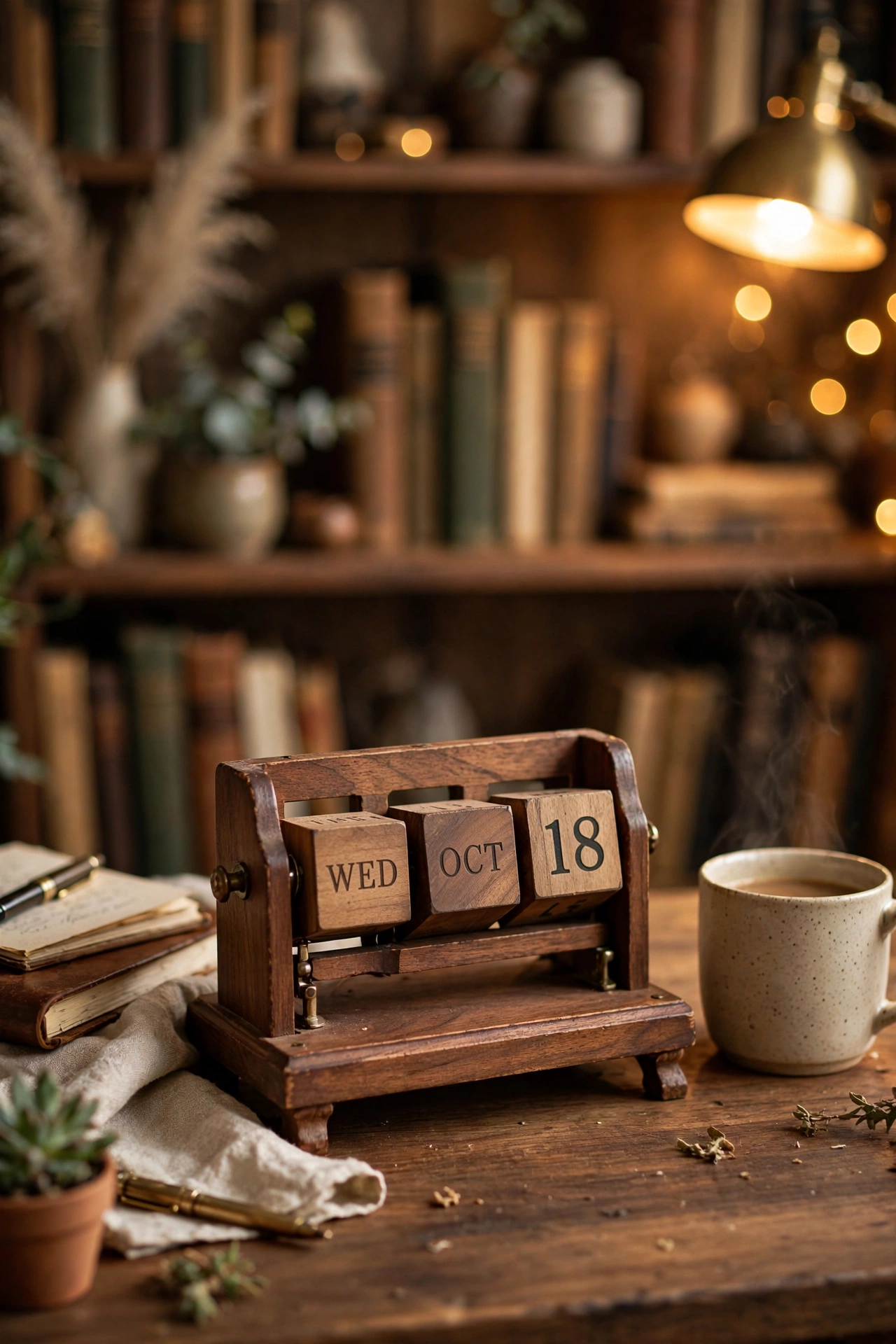
Every January, I do the same slightly ridiculous ritual. I walk into a stationery shop, pick up a wall calendar with landscapes I will never visit, pay for it, and hang it up knowing full well that in twelve months it will go straight in the bin. Every single year. And every single year, I tell myself I will find a better way next time.
This year, I actually found one. And it is a wooden calendar you never have to replace, because it has no fixed dates printed on it. You just rotate three little blocks every morning, weekday, month, and day, and it shows today’s date. Forever. The one I have been researching is made by a brand called Craftivon, it costs $32.99, and it has 987 customer reviews with over 100 orders placed in a single day recently. That is not a product people buy on a whim. That is a product that solves a problem.
If you are tired of the January calendar ritual, tired of plastic desk clutter, or just hunting for a gift that does not feel lazy, keep reading. This is the full story.
The January Problem Nobody Talks About
Here is the thing about disposable calendars: they are one of the few products we all agree to rebuy forever without questioning it. A decent desk calendar costs somewhere between $12 and $25. A nice wall calendar, $20 to $35. You buy it, enjoy it for eleven months, then quietly recycle it in January like it never mattered.
Run the math over a decade. At $18 a year, that is $180. At $25 a year, that is $250. And what did you get? Paper dates you never looked at after March, because by then your phone was handling everything anyway. The Green Matters investigation into office paper waste found that US businesses waste an estimated $250 per employee per year on printed documents that are never used, with half of all printed pages discarded within 24 hours. Calendars are one of the most visible versions of that same waste.
I am not here to guilt anyone. I have bought my share of cute calendars. But once you see the yearly rebuy for what it is, a subscription you never signed up for, the idea of a calendar you buy once and keep for the rest of your life starts to feel less like a novelty and more like common sense.
What Is a Perpetual Calendar, Actually?
A perpetual calendar is beautifully simple. Instead of printing every date of one specific year on paper, it uses rotating blocks. You get three of them: one for the weekday (Monday through Sunday), one for the month, and one for the date number (1 through 31). Every morning, or whenever you feel like it, you give each block a little turn until it shows today’s information.

That is the entire mechanism. No batteries. No app. No subscription. The blocks just spin, and you are set for next year, and the year after that, and the year after that. It is the kind of low-tech brilliance that makes you wonder why we ever started printing dates on paper in the first place.
My honest take: the ten-second morning ritual of rotating the blocks is oddly satisfying. It is a small, tactile moment in a day that is otherwise all screens. People underestimate how much their desk setup affects their mood. A wooden object you touch every morning beats a plastic desk gadget you forget by Tuesday.
Meet the Craftivon Vintage Wooden Perpetual Calendar
There are a lot of perpetual calendars out there, so why this one? The numbers, honestly. At the time of writing, the Craftivon version sits at $32.99 with 987 reviews, and the store reports more than 3,000 happy customers. Most telling of all: over 100 orders were placed in the last 24 hours alone. That kind of velocity means it is not just a nice product, it is a product that keeps converting first-time visitors into buyers, day after day.
The design is vintage-inspired, not modern-minimalist. Think warm wood tones, engraved lettering, and a slightly old-school desk accessory feel, like something you would find in a 1950s writer’s study. It fits on any desk without taking over the space, and it photographs beautifully, which matters if you care about your shelf or workspace aesthetic.
It is also small enough to be practical. This is not a chunky decorative piece that demands its own shelf. It sits beside your monitor, on a side table, or next to the coffee maker, and it earns its spot by being genuinely useful every single day of the year.
Three Styles to Choose From
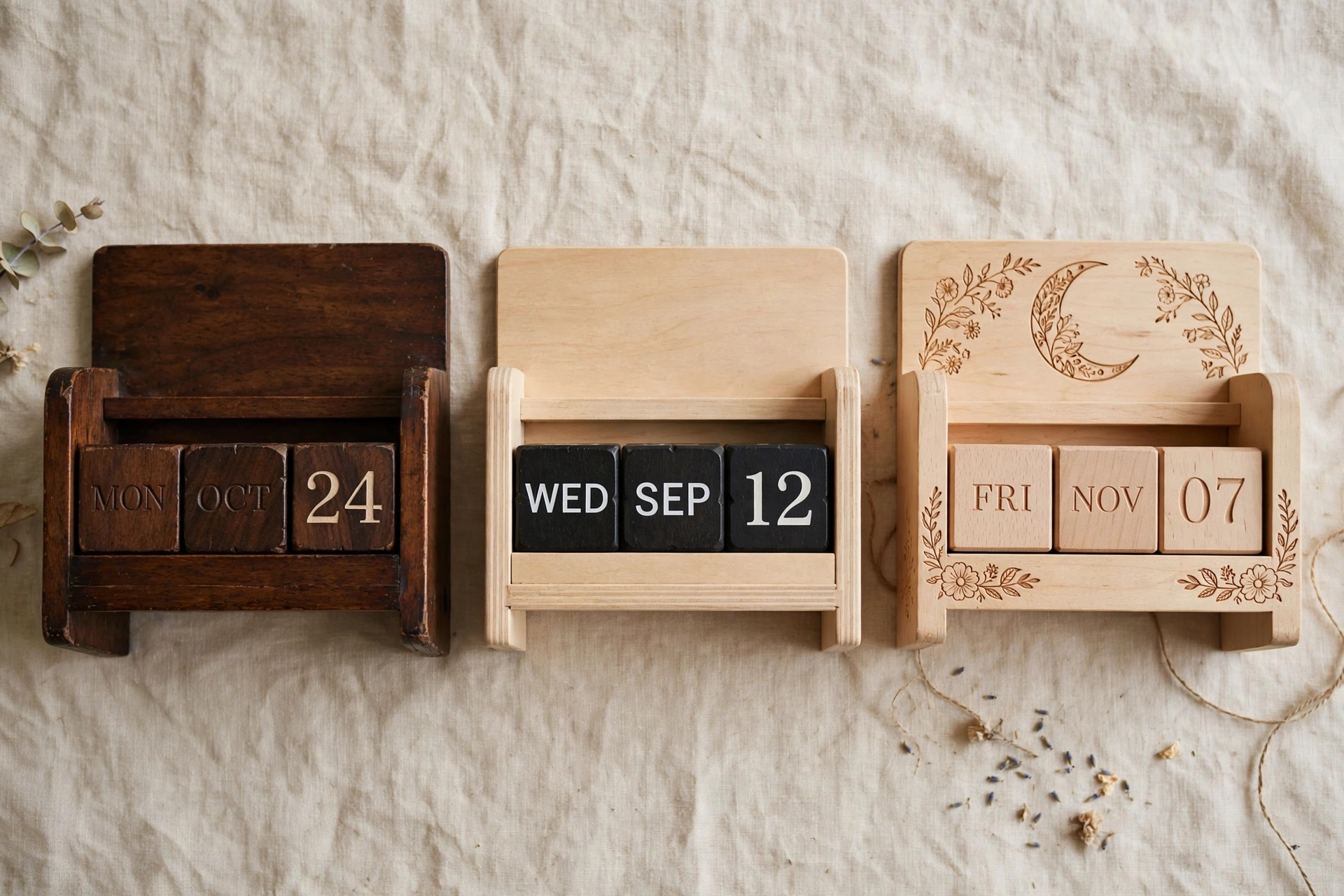
One thing I genuinely appreciate: you are not stuck with one look. The calendar comes in three finishes, so you can match it to your space instead of rearranging your space to match it.
Classic Walnut
The rich, dark brown finish. This is the one for traditional home offices, leather desk pads, and bookshelves full of hardcovers. It has that serious, executive-desk energy. If your workspace leans warm and classic, this is your pick.
Natural Contrast
A lighter, more varied wood tone that shows off the grain. This is the crowd-pleaser. It works in Scandinavian-style rooms, bright kitchens, craft corners, and anywhere you want warmth without darkness. If you are not sure which to pick, start here.
Botanical Crescent
The artsy one, with botanical detailing and a crescent motif. This is for plant lovers, journal keepers, and anyone whose desk doubles as a creative studio. It pairs beautifully with trailing pothos and handmade decor pieces.
My personal pick? Natural Contrast for most homes, Classic Walnut if you have dark furniture. But honestly, all three look good enough that you cannot really go wrong.
Why 987 People Left Reviews (And What They Actually Say)
Review counts this high do not happen by accident. When I dug into what buyers keep repeating, a few themes came up again and again.
It feels expensive but costs $32.99. Multiple reviewers mention that it looks like a $60 or $70 desk accessory. The wood finish and engraving give it a premium weight and feel that photographs alone do not fully capture. At $32.99, that gap between perceived value and price is exactly why it converts so well.
The blocks turn smoothly. This matters more than you think. A perpetual calendar with stiff, fiddly blocks becomes annoying by February. Buyers consistently note that the blocks rotate easily, which is the difference between a daily ritual you enjoy and a chore you abandon.
It is a gift magnet. A huge share of reviews mention buying it as a gift, or buying a second one after receiving it as a gift. That is the strongest signal a product can get. People do not re-gift mediocre things. They re-buy the ones that worked.
Are there complaints? A few reviewers note it is smaller than they expected, so check the dimensions against your desk before ordering. And like any wood product, it is not waterproof, so do not park it next to the sink. Neither is a dealbreaker, but both are worth knowing.
The Math: What You Actually Save Over 10 Years
Let us be honest about the numbers, because the “buy it once” pitch only works if the math checks out.
A mid-range desk calendar: $18 per year. Over 10 years: $180. A nicer one at $25 per year: $250 over a decade. The Craftivon perpetual calendar: $32.99, once. Even at the cheapest calendar price point, you break even in under two years. After that, every year is pure savings.
And that is before counting the hidden costs. The January trip to buy one. The plastic packaging. The year you forget and buy a clearance one in February that looks terrible. The year you buy two because you could not decide. The perpetual calendar eliminates the entire category of hassle, not just the cost.
Is $32.99 more than the cheapest paper calendar on the shelf? Yes, on day one. Is it cheaper than every calendar you will ever buy again? Also yes, by a lot.
The Eco Angle: One Less Thing in the Trash Every January
I will not pretend one wooden calendar saves the planet. But the direction matters. Every January, millions of paper calendars go into the recycling bin, or worse, the regular trash. Paper and cardboard make up roughly a quarter of landfill waste worldwide, and decomposing paper releases methane, a greenhouse gas far more potent than carbon dioxide in the short term.
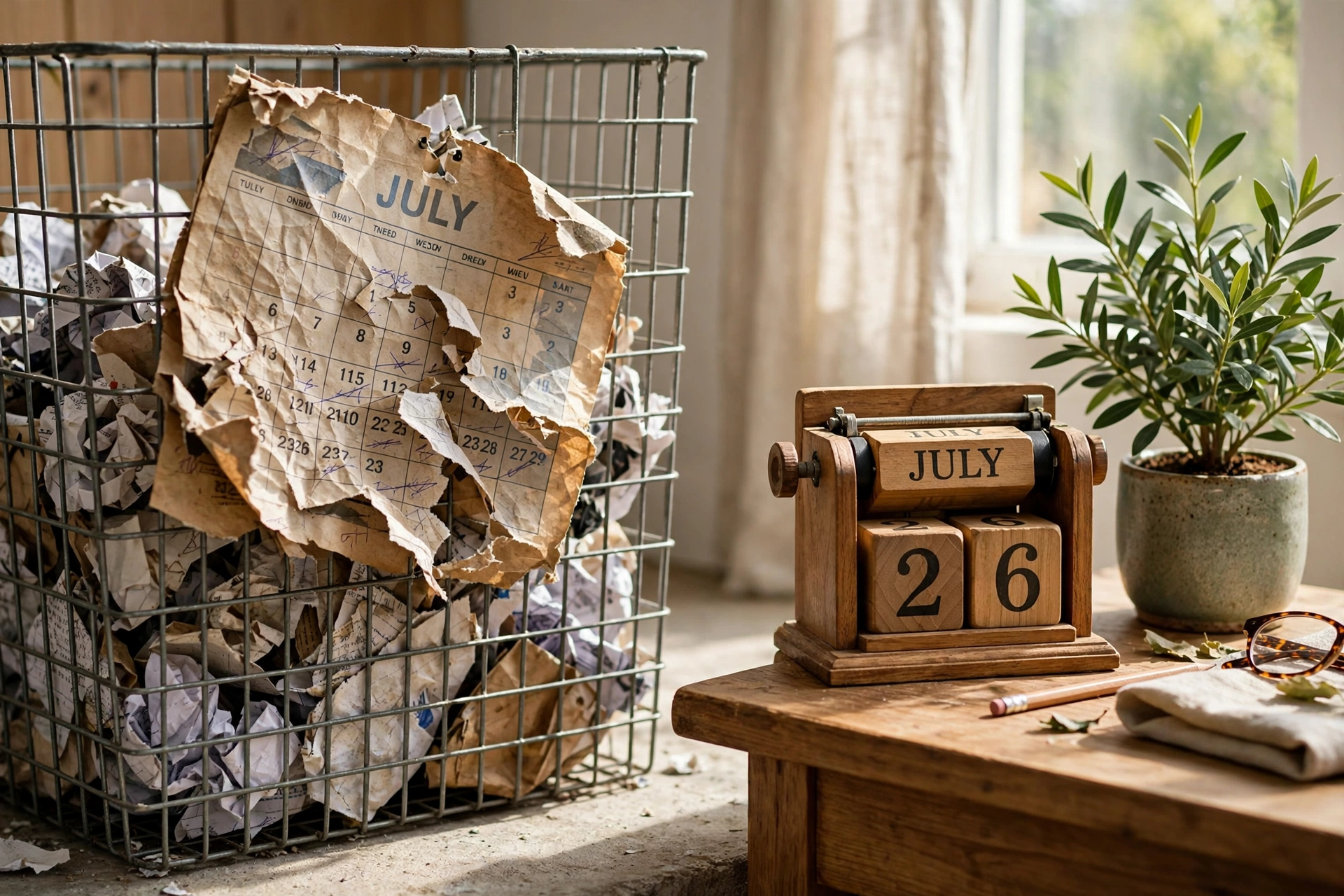
Choosing a reusable calendar is one of those rare eco swaps that costs you nothing in convenience. You still see today’s date every morning. You still have something attractive on your desk. You just never throw it away. For anyone already trying to cut paper waste at home, swapping the annual paper calendar for a perpetual one is the easiest win on the list.
If you like this kind of thinking, you will also appreciate our guide to handmade wood and epoxy resin coasters, another small swap that replaces disposable or plastic accessories with something built to last decades.
Where It Fits: The Home Office Desk
Let us talk placement, because where a perpetual calendar lives decides how much you will enjoy it.

The home office desk is the natural home. It sits in your peripheral vision all day, so you glance at the date without opening a tab or picking up your phone. For work-from-home folks, it adds warmth to a setup that is otherwise just a monitor and a mug. Wood does something to a workspace that plastic cannot. It makes the space feel intentional.
A few styling tips that work well: put it slightly off-center rather than dead center, so it reads as decor rather than a tool. Pair it with a small plant or a warm lamp, the contrast of wood and greenery is hard to beat. And if your desk has a theme, match the style: Classic Walnut with dark wood furniture, Natural Contrast with light or white desks, Botanical Crescent with plants and handmade pieces.
Speaking of handmade pieces, this calendar sits beautifully alongside other wooden desk accessories. Our wooden propagation station guide shows how a simple wood piece can turn plant cuttings into living decor, and the two together make a desk corner that genuinely makes you want to sit down and work.
The Bedside Table Test
Here is a placement most people do not consider: the bedside table.
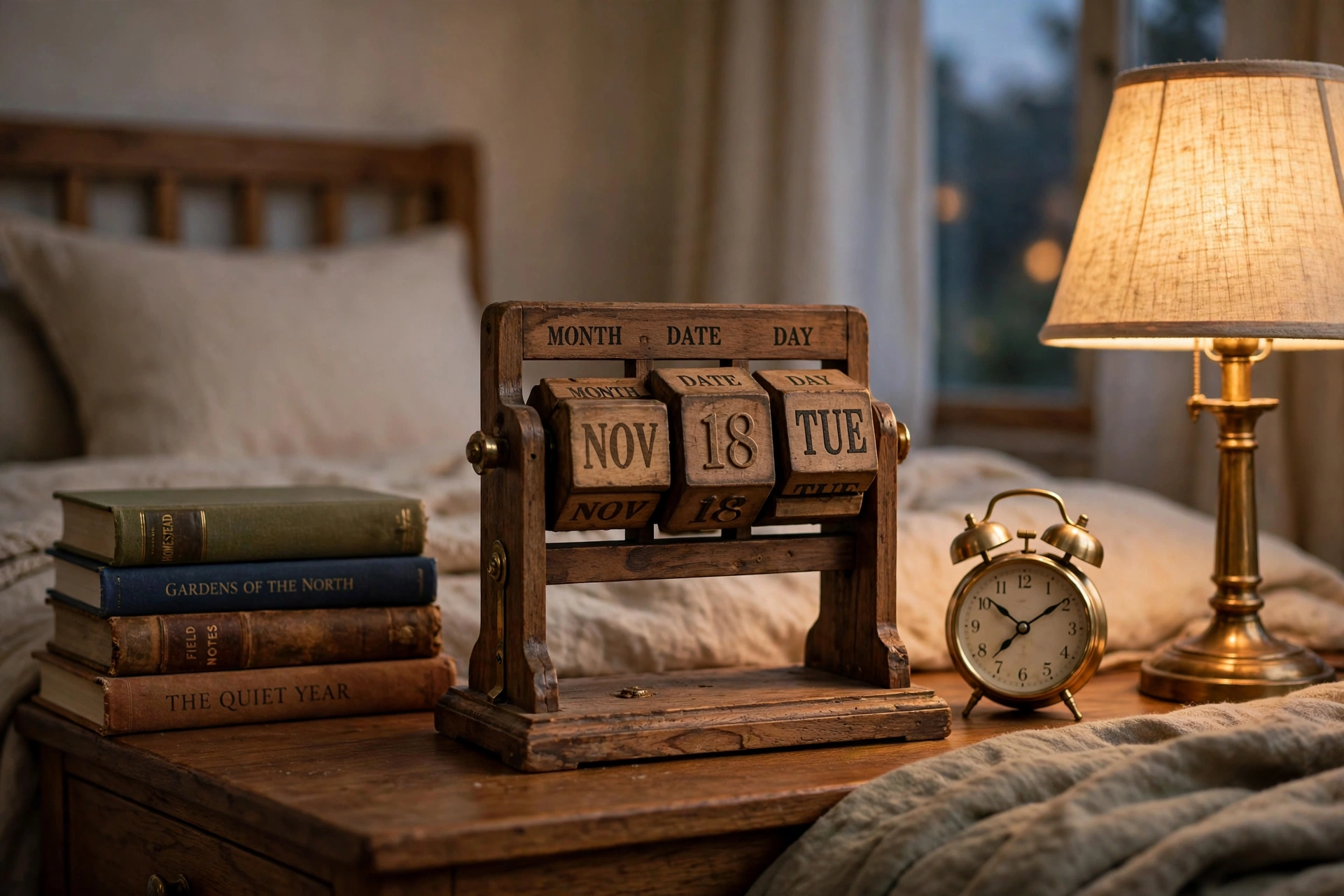
Think about it. You wake up, you glance over, and instead of the blue glare of your phone telling you the date, there is this warm wooden object that already knows. It is a small thing, but morning phone-checking is one of those habits a lot of us are trying to soften. A perpetual calendar will not cure phone addiction, obviously, but it removes one excuse to reach for the screen first thing.
It also just looks good there. Bedside tables tend to accumulate clutter, a book you will never finish, a charger, a half-empty glass. One warm, intentional object anchors the whole surface. The Botanical Crescent style in particular was made for this spot.
The Gift Question: Who Is This Actually For?
This is where the product really earns its review count. Let us count the occasions, because the gift math is remarkable.

Birthdays. It is personal without being risky. You are giving someone a daily-use object, not a novelty they will shelve. At $32.99, it sits right in the sweet spot for friend and family birthdays, not cheap enough to feel thoughtless, not expensive enough to feel awkward.
Housewarmings. This might be its best occasion. New homes need decor, and a perpetual calendar is the rare gift that is both decorative and useful from day one. It says “I thought about your new space” without the guesswork of art or the clutter of candles.
Father’s Day. Let us be real: dads are notoriously hard to shop for. The vintage, slightly old-school design hits the exact nostalgia button that works for fathers and grandfathers. It is the kind of object a dad puts on his desk and actually uses, then tells his friends about.
Christmas. Stocking-friendly? Not quite, it is bigger than that. But as a main small gift or a Secret Santa pick, it is ideal: universally useful, attractive under the tree, and at $32.99 it works for nearly any gift budget.
Four major gift occasions, one product, one purchase. That is why over 100 of them sold in a single day. And if you are building a gift list around handmade wooden items, our guide to the handmade wooden cookbook stand is another strong pick for the kitchen-loving people on your list.
How to Use It: 10 Seconds a Day
There is genuinely not much to learn, which is part of the charm. When you first unbox it, set the weekday, month, and date blocks to today. That takes about ten seconds. Then, each morning, give the date block a spin, and at month or week changes, spin the others.
That is it. There is no manual, no app pairing, no firmware updates. In a world where setting up a toaster apparently requires WiFi, there is something deeply refreshing about an object that just works the moment you touch it.
Honest Verdict: Is It Worth $32.99?
After researching this properly, here is my honest take.
Buy it if: you are tired of the yearly calendar rebuy, you want warmer desk or bedside decor, you need a reliable gift in the $30 range, or you care about cutting small bits of paper waste without any effort.
Skip it if: you genuinely never look at a physical calendar and your phone handles everything, or you want a big wall calendar with photos. This is a desk object, not a wall statement piece.
For most people reading a decor and gift guide, this falls squarely in the “buy it” camp. The price breaks even against paper calendars in under two years, the reviews are overwhelmingly positive, and the gift versatility is genuinely rare at this price point. You can see all three styles and the current reviews on the Craftivon product page.
It is not often that a $32.99 object can credibly claim to be the last one of its kind you will ever buy. This one can.
Found This via Pinterest?
Found this via Pinterest? Read the full story on thecavee.com, and explore our other guides to handmade wooden decor, from epoxy coasters to propagation stations to cookbook stands. Your desk deserves better than disposable.
Pingback: Black Solid Wood Floating Shelves: The $74.95 Wall Fix That Looks Custom
Pingback: Hand-Carved Wooden Chain Link Decor: The $40 Shelf Styling Trick That Makes Any Room Look Finished