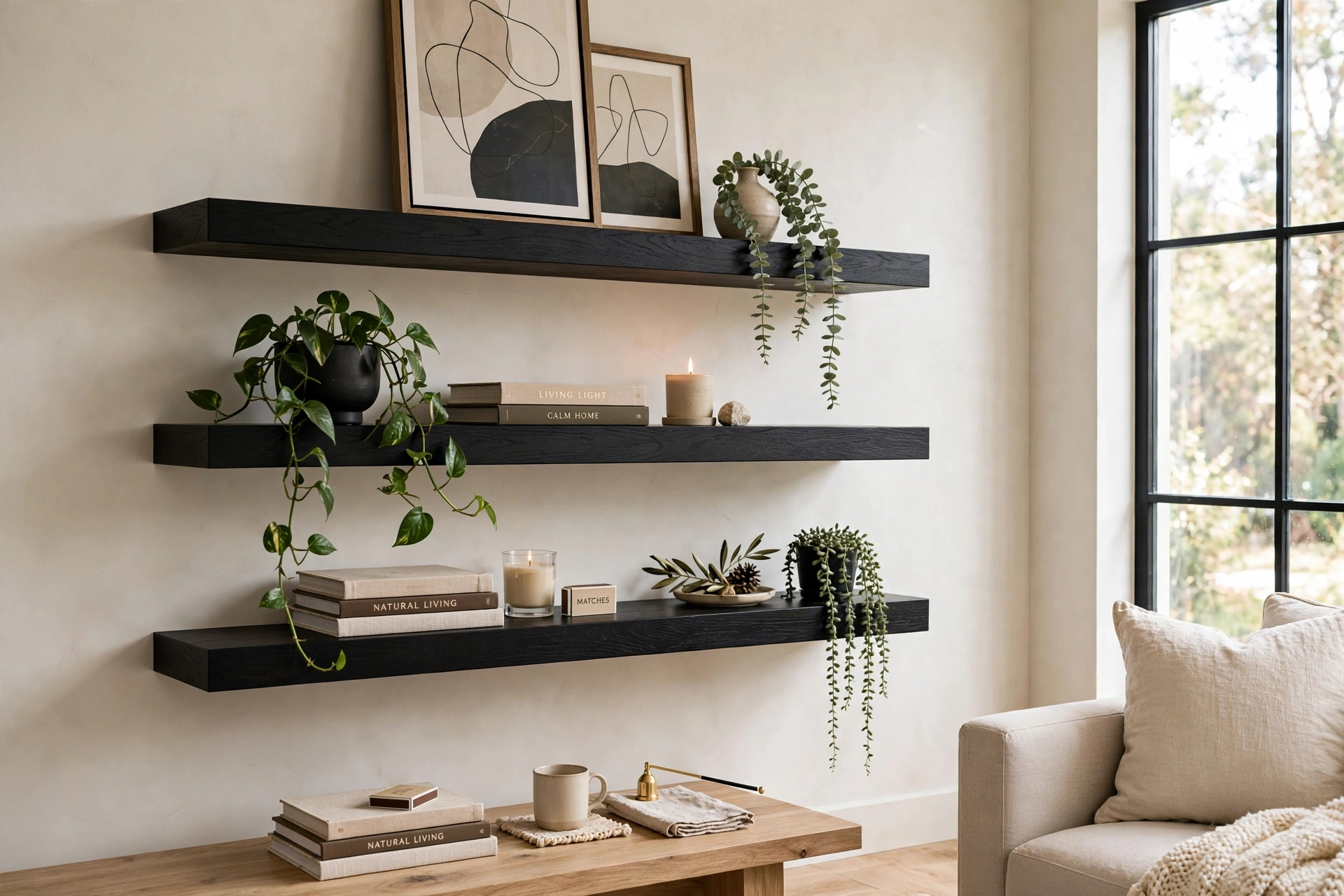
Every room in my place had the same problem for years. Bare walls. Not bare in a stylish, minimalist way. Bare in a “we moved in three years ago and never finished” way. Art felt like a commitment, and a full bookcase felt like giving up floor space I didn’t have. So the walls just sat there, blank, making every room feel slightly unfinished.
Floating shelves turned out to be the cheat code I was looking for. They take up zero floor space, they go up in an afternoon, and a good set of them does something weird to a room: it makes it look like you actually finished decorating, even when the rest of the place is still a work in progress. But not all floating shelves are equal. I have strong opinions about this now, because I bought the cheap ones first.
The cheap ones sag. Ask me how I know.
Three years ago I bought a pair of floating shelves from a big-box store for about twenty bucks. They looked fine in the photos. Hollow-core MDF with a printed “wood” finish that fooled me at a distance of six feet. I loaded them up with books, and within a year they had developed a visible droop in the middle. The classic sad-shelf smile. Eventually one of them pulled its bracket halfway out of the drywall, and the whole thing came down in the middle of the night with a crash that woke up the whole apartment.
That is the core lesson here: a floating shelf is only as good as what it is made of. Hollow MDF shelves with a picture of wood printed on them will sag under books, dishes, or anything heavier than a candle. Real solid wood does not do that. Solid wood has actual structural integrity. You can feel the difference the second you pick one up, and it is not subtle.
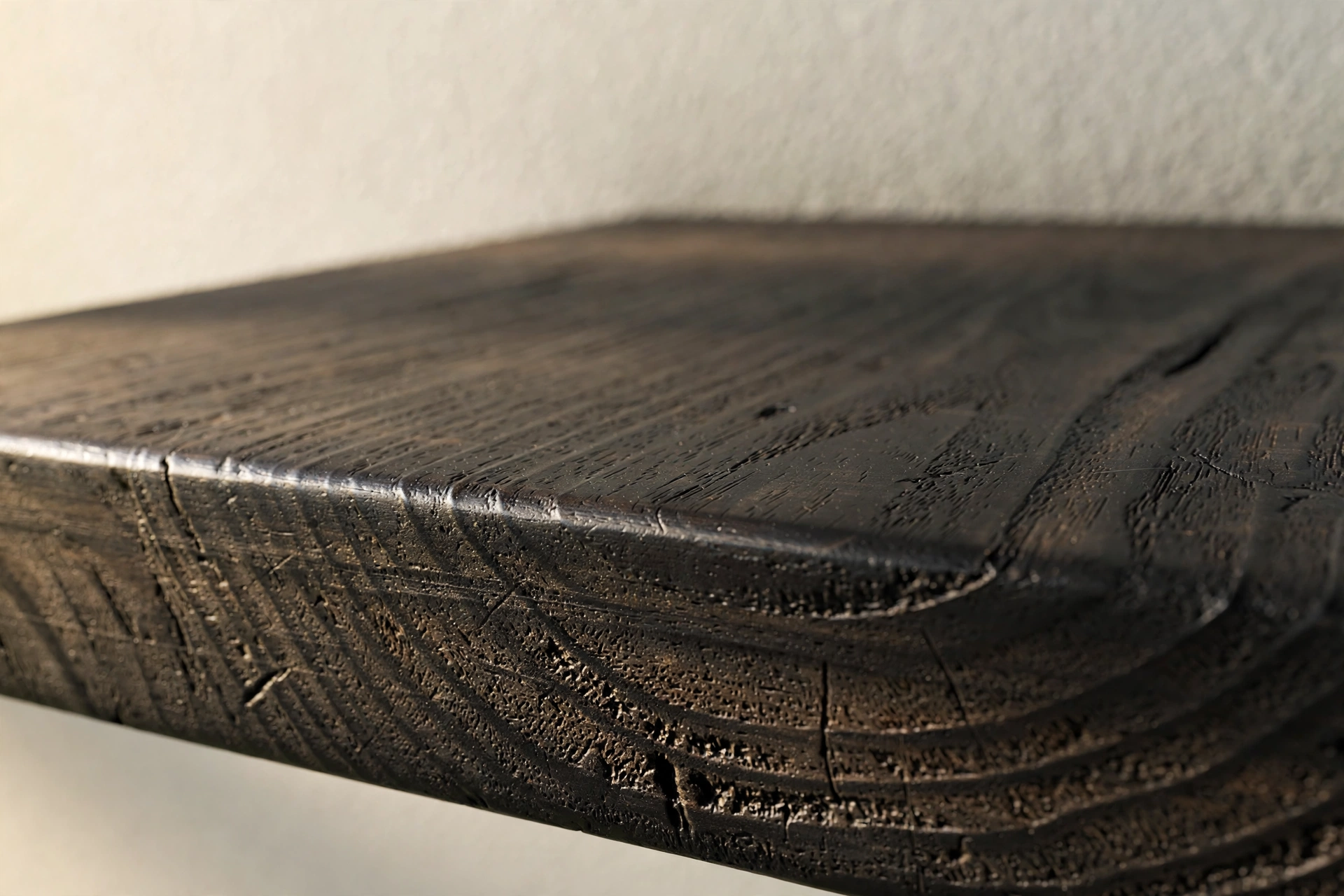
Why black, and why solid wood this time
Here is the thing about black shelving: it works in basically every room. Light wood shelves disappear against white walls. Dark walnut is beautiful but commits you to a warm palette. Black is neutral in the same way a black picture frame is neutral. It outlines whatever you put on it, it works with gray walls and beige walls and that rental-apartment white, and it makes green plants look ridiculously good.
Solid wood with a black finish gives you the best of both. The grain still shows through, so it reads as real wood instead of plastic, but the dark color hides dust and small scuffs the way light finishes never do. If you have kids, pets, or a life that involves actual living, that matters more than any design blog will admit.
The ones that caught my eye
I went down the Etsy rabbit hole on this one, because that is where the genuinely handmade shelves live now. The listing that kept pulling me back is a set of handcrafted black solid wood floating shelves: modern style, clean lines, no visible hardware, made to order.
The numbers are what sold me. This listing is sitting at 4.8 stars across 204 reviews. That is not a fluke number. Two hundred people is enough that the rating actually means something, and 4.8 means almost nobody was disappointed. The price is $74.95 USD, and shipping is free, which at this price point is doing a lot of the value math for you.
What you are actually getting
These are the verified facts from the listing: solid wood construction with a black finish, floating wall-mount design with concealed hardware, made to order rather than mass produced, and free shipping. No plywood core, no printed grain, no “wood-like” weasel words. The black finish is a stain, not paint, so the wood texture stays visible up close.
Made to order is worth a sentence here. It usually means a few extra days before your shelves ship, but it also means they are cut and finished when you order them, not sitting in a warehouse since last spring. For stained wood, freshness of finish actually matters.
The honest take
What I like: real solid wood at a price that sits right between the big-box MDF stuff and custom carpentry. The review count backs up the quality claim. Black goes with everything, and the no-visible-hardware look is the whole point of floating shelves.
What to know before you buy: measure your wall first. Floating shelves look best when they are sized to the space, not the other way around. And these are solid wood, which means they have real weight, so installation has to be done right. On that note, keep reading.
Five rooms where these earn their keep
This is the part where floating shelves stop being “decor” and start being the hardest-working thing on your wall. Black shelves are especially good at this because they fade into the background while whatever is on them pops.
The living room: the blank wall problem, solved
That one big wall that has been empty since you moved in? Two black floating shelves, staggered, with a mix of books, a plant, and one framed photo, and the room looks finished. The trick is odd numbers and breathing room. Three objects per shelf, not seven. Leave space between things. The shelf is the frame, not the storage unit.
The kitchen: dishes you actually use
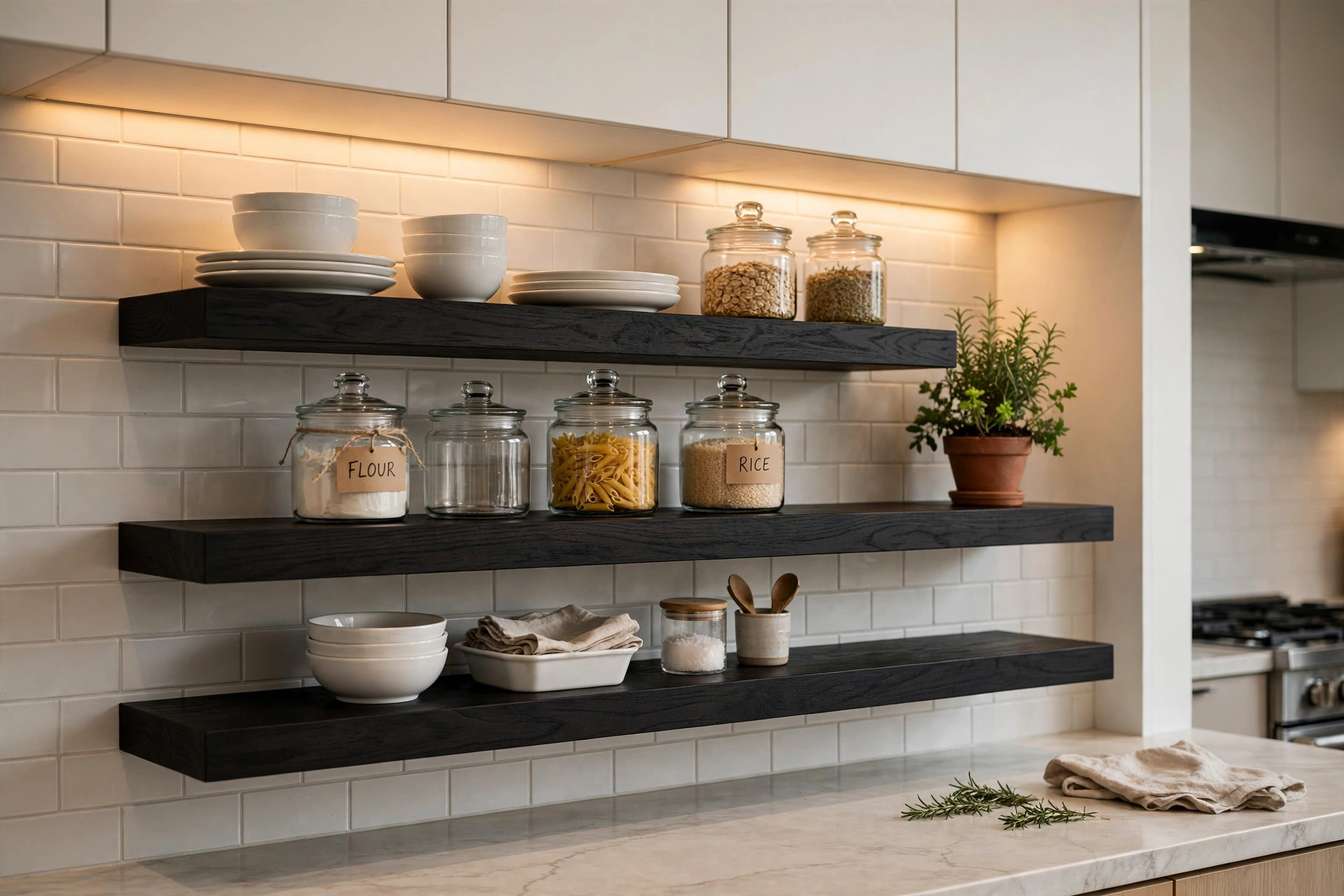
Kitchen floating shelves are the move nobody regrets. Your everyday dishes, a couple of glass jars with pasta and rice, a small herb pot. Everything you reach for daily, right where you can see it. Black shelves against a light backsplash look sharp, and the dark finish does not show cooking grease the way white shelves do. Keep the heavy stuff toward the studs, keep it honest.
The home office: the background of your life now
Since half of us are on video calls all day, the wall behind the desk is basically a set. Two black shelves with books, a small clock, and one framed photo beats a blank wall or a bookshelf that reads as cluttered. It is also genuinely useful: reference books, a notebook, the charger you can never find. One of my favorite small upgrades of the year was putting a handmade wooden perpetual calendar on my desk shelf. Ten seconds a morning, zero batteries, and it looks good on camera.

The entryway: the 30-second landing zone
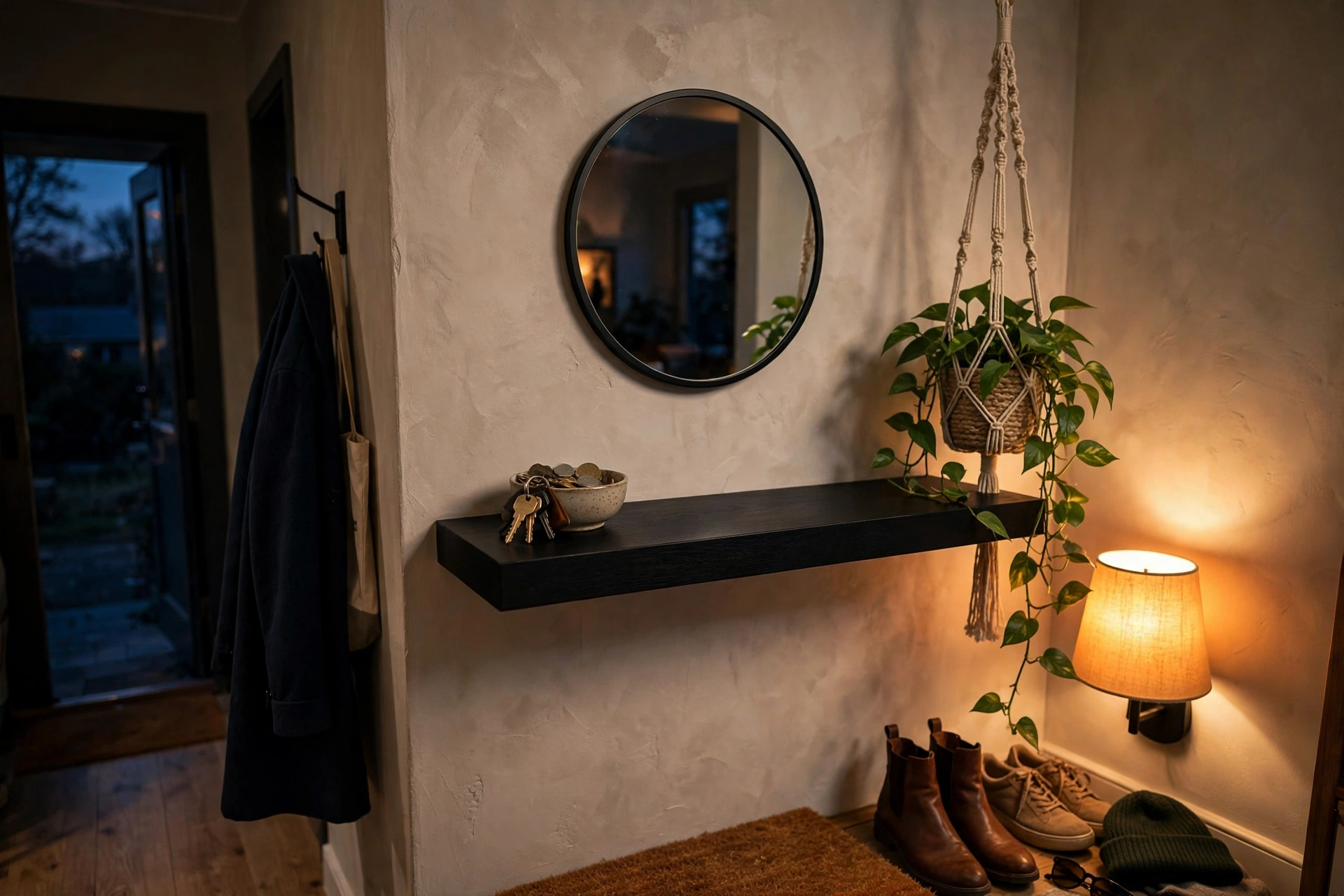
Keys, sunglasses, the mail you swear you will sort tonight. An entryway shelf with a small bowl on top turns the daily pocket-dump into something that looks intentional. Mount it at a height you can reach without thinking, and put a mirror above it. Small space, huge daily payoff.
The bedroom: the nightstand you don’t have to buy
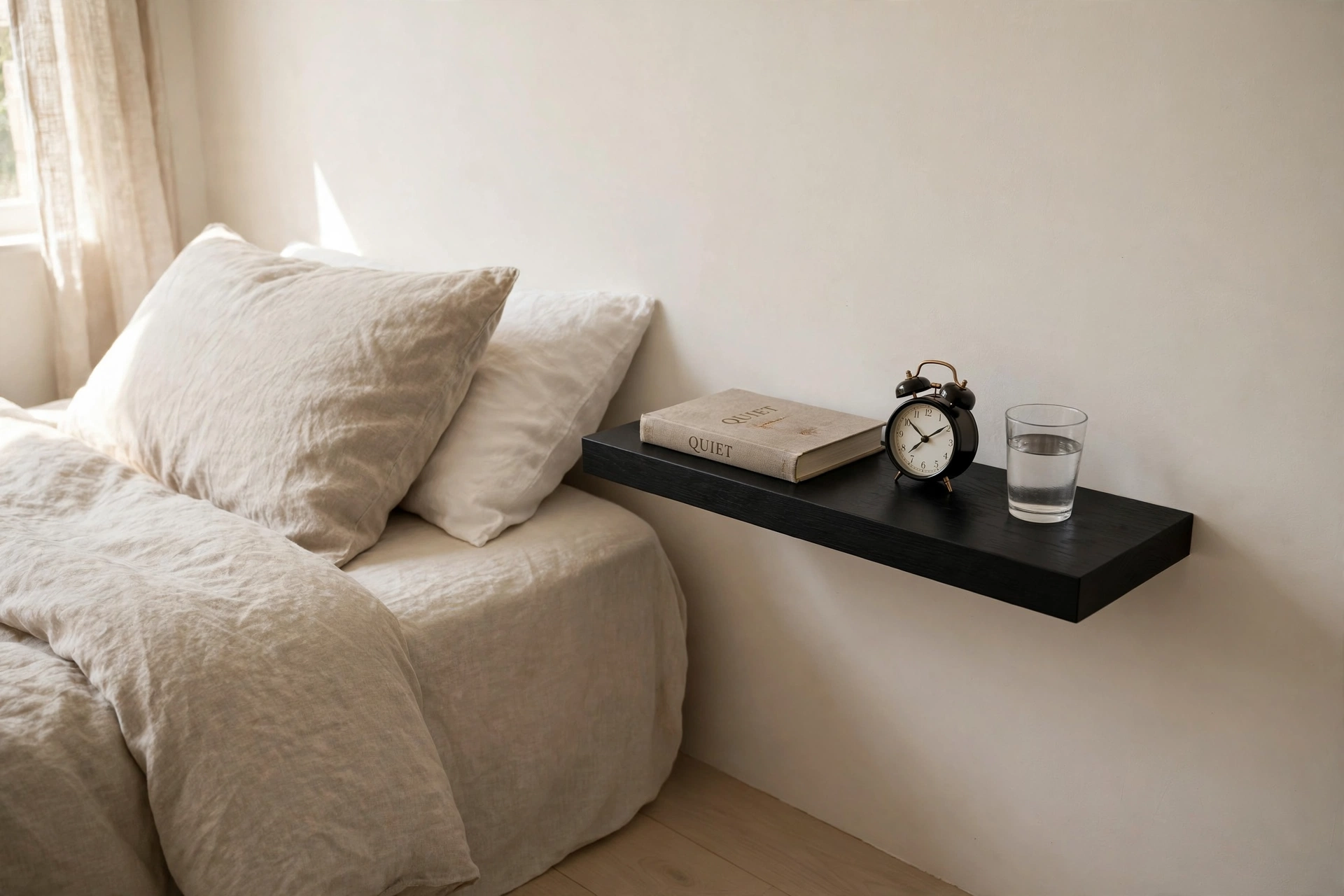
If your bedroom is small, a floating shelf beside the bed replaces a nightstand completely. Book, alarm clock, glass of water, done. No legs, no floor space, nothing to stub your toe on at 3am. I wish someone had told me this in my first apartment instead of me buying a wobbly particle-board nightstand that lasted eleven months.
Installing them without drama (the honest 30-minute guide)
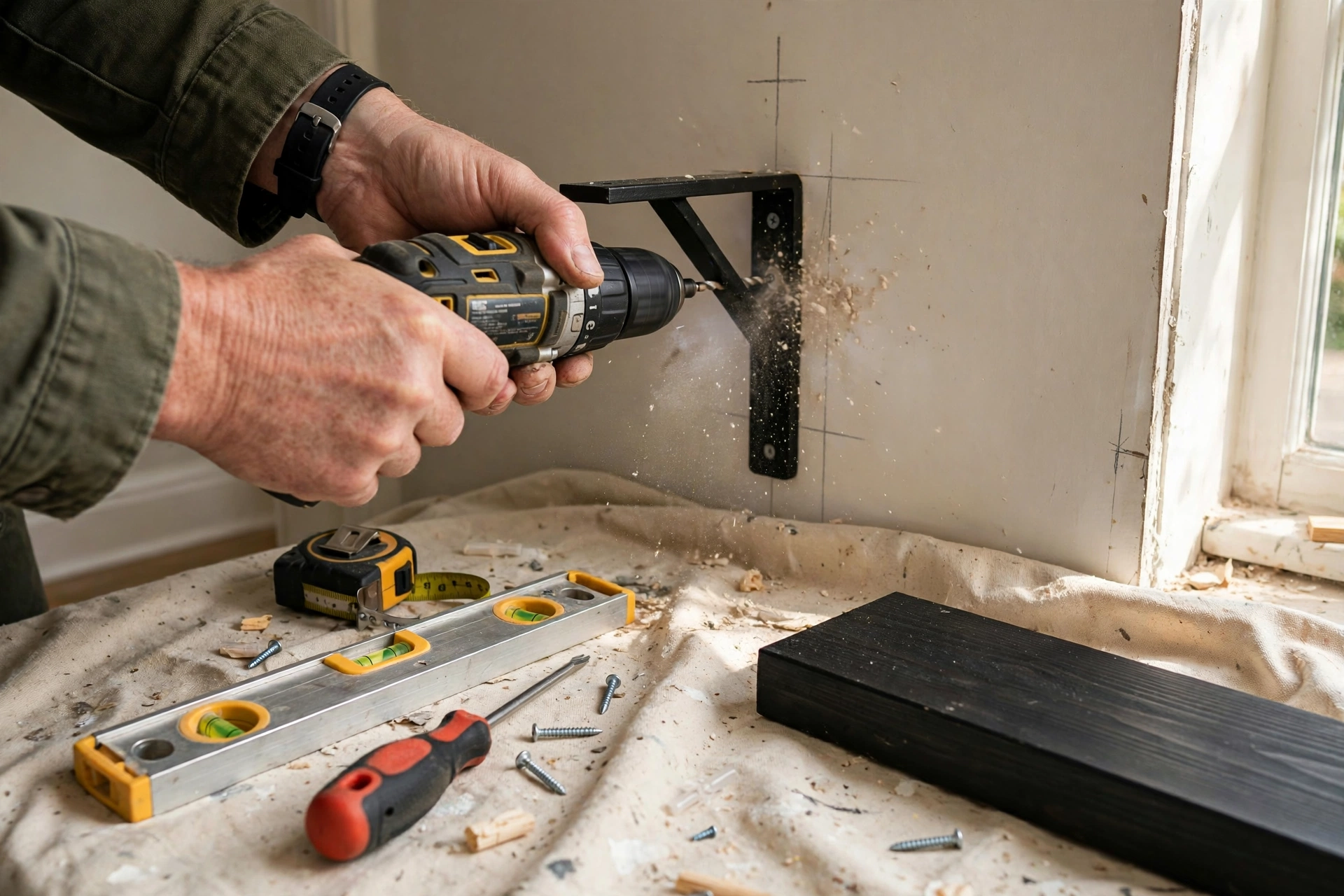
Here is where people mess up, and it is almost never the shelf’s fault. Floating shelves fail at the wall, not in the wood. The concealed bracket has to bite into something real: a stud, or a proper anchor. Drywall alone will betray you, as my 3am bookshelf avalanche taught me.
The process is simple if you respect it. Find the studs with a stud finder and confirm with a small pilot hole. Hold the bracket level (an actual level, not your eye) and mark your holes. Drill pilots, drive the screws into the studs, slide the shelf onto the rods, and check it with the level again. Then, and this is the step everyone skips, load it gradually and check for any movement before you walk away.
If you want the full technical version, Shelfology’s ultimate guide to floating shelves covers bracket types, spacing, and weight ratings in serious detail, and Engineer Fix has a solid step-by-step installation walkthrough with the stud-finding logic explained. Both are worth ten minutes before you drill.
When to skip the DIY and call someone: plaster walls, tile, or anything where you are not sure what is behind the surface. A handyman will charge you very little for two shelves and you will sleep better.
Styling them so they don’t look cluttered
The difference between a styled shelf and a junk shelf is restraint, and it is learnable. The rules that actually work:
Vary the heights. A tall plant next to a short stack of books next to a medium vase. If everything is the same height, it reads as a row, not a composition.
Leave empty space. About a third of the shelf should be empty. This feels wrong the first time. Do it anyway. The empty space is what makes the objects look curated instead of stored.
Group in odd numbers. Threes and fives. Nobody knows exactly why this works, but every stylist does it, and it works.
Repeat a material. If the shelf is black wood, echo it: a black frame, a dark ceramic pot. And mix in something warm, like a small handmade piece. A pair of handmade wood and epoxy resin coasters on a kitchen shelf looks great and gets used daily. In the kitchen, a wooden cookbook stand propped on the shelf keeps the current recipe at eye level.
Step back. Style from the doorway, not from six inches away. Shelves are viewed from across the room.
The price math
$74.95 with free shipping for made-to-order solid wood. Compare that to the actual alternatives. Custom carpentry for floating shelves starts around $200 per shelf in most cities and goes up fast. The big-box MDF pair is $20 to $40, but you already know how that story ends: sagging within a year, replacement within two. So the real comparison is $75 once versus $30 twice plus the afternoon you spend reinstalling. The handmade set wins on math, not just looks.
The verdict
If your walls have been blank since you moved in, or your current shelves are doing the sad middle droop, this is one of the highest-impact small upgrades you can make. Solid wood, honest reviews, a price that undercuts custom work by a mile, and a finish that works in every room. Order them, find your studs, and give yourself one afternoon. Your walls will finally look finished.
Want the visual version? I put together a pin with all the styling ideas over on our Pinterest, it is the fastest way to see what these look like in real rooms. Follow The Cavee on Pinterest for more handmade decor finds like this one, and read the full story here on thecavee.com whenever you want the details.
Quick answers
How much weight can black solid wood floating shelves hold?
It depends on the bracket and the wall, not just the wood. A solid wood shelf on a concealed bracket screwed into studs can typically hold 20 to 50 pounds per shelf. Always check the specific product’s rating and mount into studs for anything heavy like books.
Do floating shelves damage walls?
They leave screw holes like any wall-mounted item, which are easy to fill when you move. They are far less damaging than the big anchors cheap shelves need, and much easier to patch than a bookcase’s worth of wall damage from tipping.
Are black floating shelves hard to keep clean?
Easier than light ones. The dark finish hides dust between cleanings, and solid wood wipes down with a damp cloth. Avoid soaking them and skip the harsh cleaners; a little wood conditioner once a year keeps the finish rich.
Pingback: Your Vinyl Deserves Better: $199 Walnut Record Crate