The Race to the Bottom of the Earth: Inside the 2026 Expedition to Crown the World’s Deepest Cave
Somewhere under the pine-covered ridges of Mexico’s Sierra Juarez, a team of people is living in a world without sunrises. They sleep in tents pitched on cold rock more than a kilometer underground. They cook dinner by headlamp. They haven’t seen the sky in weeks, and they won’t, not for a while. Their goal sounds almost absurd when you say it out loud: they want to dive through a flooded tunnel at the bottom of the deepest hole humans have ever reached, and come out the other side with a world record.
This is the Cheve 2026 expedition. And if it works, the map of the underworld gets redrawn.
Sistema Cheve sits in Oaxaca, southern Mexico, in limestone mountains that have been swallowing rainwater for millions of years. Cavers have been pushing its passages since the 1980s, and every decade or so the cave gives up a little more of itself. As of the 2021 survey, Cheve runs 76,735 meters long and drops 1,536 meters deep. That alone makes it one of the most serious cave systems on the planet. But the explorers believe the real prize is still hidden: a terminal sump, a stretch of passage completely filled with water, at the very bottom. Beyond that sump, they think, the cave keeps going. Way down.
The US Deep Caving Team, led by Dr. Bill Stone and Dr. Gilly Elor (the same duo behind National Geographic’s film “Explorer: The Deepest Cave”), launched the Cheve 2026 expedition in February 2026 with one stated mission: dive that sump and prove Cheve is the deepest cave on Earth. If the full system connects the way the survey suggests, the integrated depth would hit 2,597 meters. To put that in perspective, the current record holder, Krubera Cave in Abkhazia, bottoms out at 2,224 meters. Cheve wouldn’t just beat it. It would beat it by more than the height of the Empire State Building.
Why the “world’s deepest cave” title actually matters
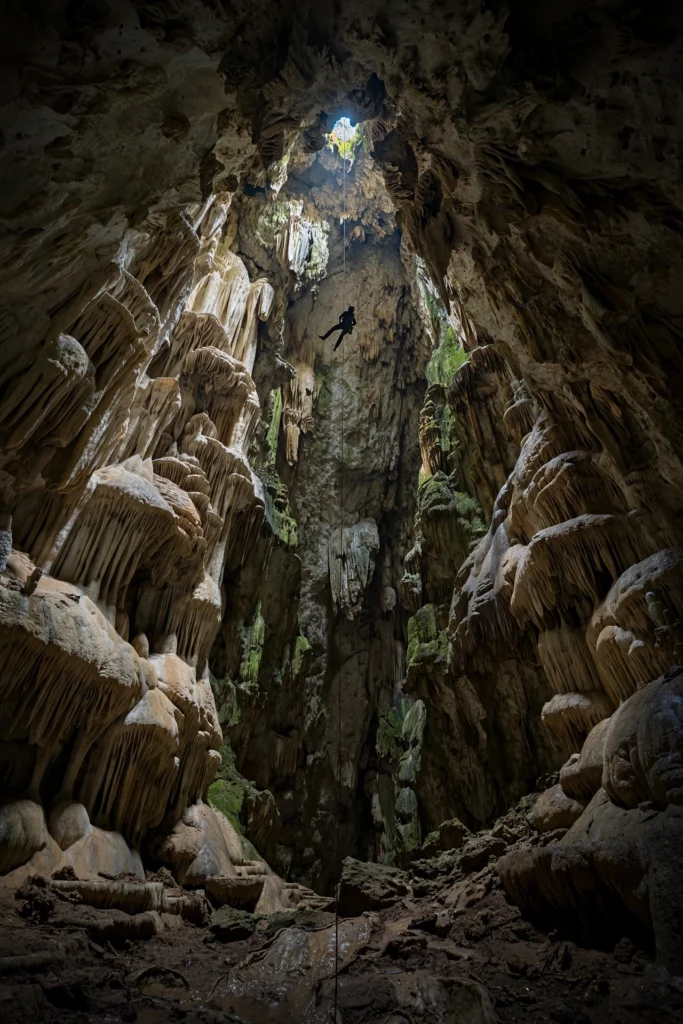
I’ll be honest: when I first heard cavers argue about depth records, I thought it was just bragging rights with extra steps. It’s not. Depth in a cave system is a proxy for everything scientists want to know about how water, rock, and life behave at the edge of the possible. The deeper you go, the weirder the chemistry gets, the stranger the ecosystems become, and the more the cave starts looking like an alien world that happens to be under your feet.
There’s also a very practical reason the record matters. Every meter of new depth is a meter of Earth nobody has ever seen. In an age when satellites have photographed every square inch of the surface, the deep cave remains one of the last places where a human being can stand somewhere no human being has ever stood. That’s not a metaphor. That’s the literal job description on the Cheve expedition.
And there’s the drama of it. The title of world’s deepest cave has been flipping between neighbors in recent years. In 2024, a resurvey put Krubera at 2,224 meters, officially deeper than its next-door rival Veryovkina at 2,209 meters. (If you want the full story of that rivalry, we covered Veryovkina’s claim to the crown here, and the 2026 science station now streaming live data from inside Krubera here.) Cheve entering this fight isn’t just another contender. It’s a contender from a different continent, a different rock formation, and a completely different style of exploration.
What the expedition is actually doing down there
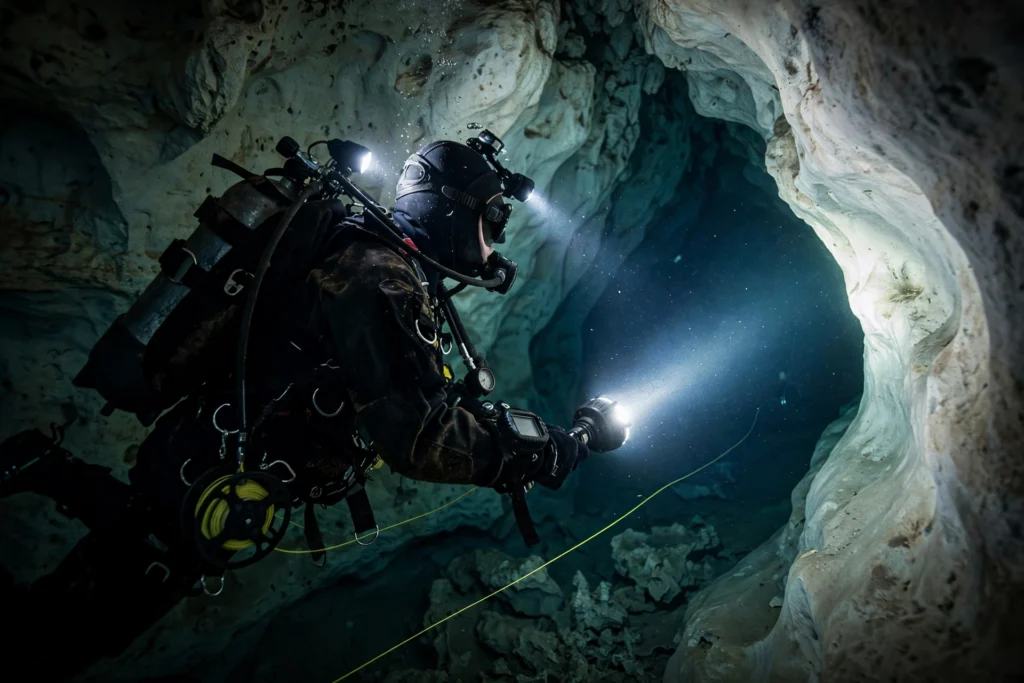
Here’s the part that bends my brain. The Cheve team isn’t doing day trips. You can’t, at these depths. The logistics read like a space mission planned by people with headlamps.
Underground camps in total darkness
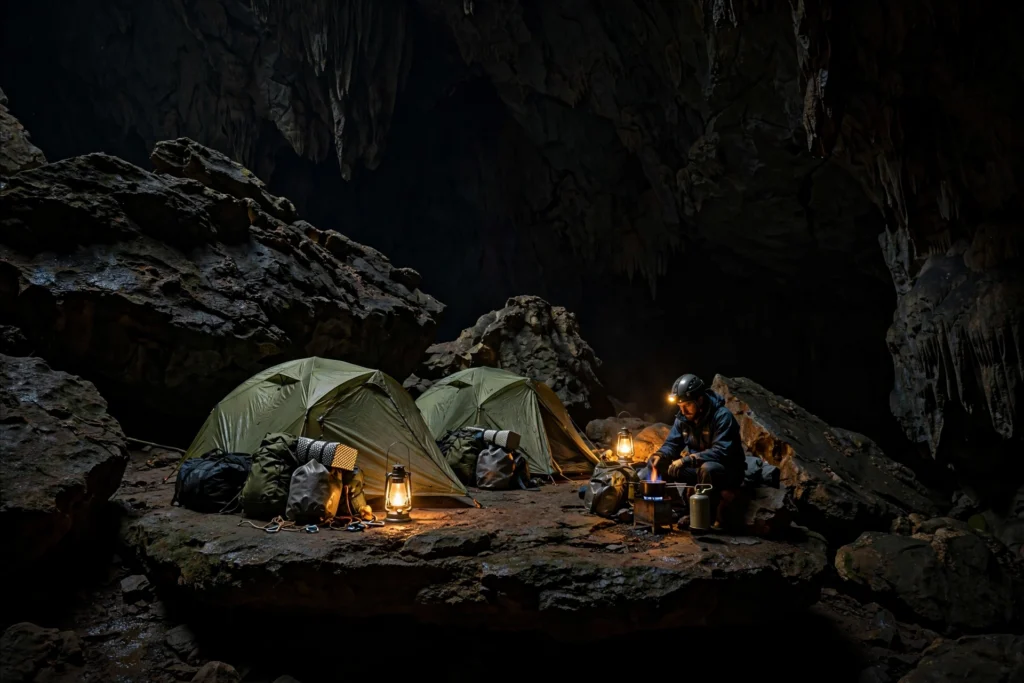
Explorers establish camps deep inside the cave and live there for weeks at a time. These aren’t base camps with hot showers. They’re a few tents on a rock shelf, a stove, sleeping bags, and supplies that had to be hauled down through vertical shafts on ropes. Every battery, every meal, every meter of rope went down the same way the cavers did: one person at a time, on a rope, in the dark.
The psychological load is hard to overstate. Underground, there is no day and no night. Your body clock free-runs. Sleep schedules drift. The air is cold and damp, everything you own is damp, and the ceiling above you is, in places, more than a kilometer of solid rock. The 2026 team is operating, in the words of expedition coverage, “beyond any possibility of rescue.” That’s not marketing copy. At 1,500 meters deep, if something goes seriously wrong, nobody is coming to get you quickly. The cave rescue playbook at that depth is basically: don’t need rescuing.
The sump: a flooded door at the bottom of the world
The entire expedition hinges on the terminal sump. A sump is a section of cave passage that dips below the water table and fills completely with water. To the 2021 team that found it, the sump was a locked door. To the 2026 team, it’s the whole point.
Cave diving is already one of the most dangerous things a human can do for fun. Cave diving at the bottom of the deepest explored cave system, after weeks underground, with gear you hauled down yourself, is something else entirely. The divers have to lay guideline through water so dark and so still it feels like being inside the rock itself, push through the flooded section, and surface in air-filled passage on the other side. Then they have to explore that new passage, survey it, and come back through the sump alive.
Bill Stone is not a random thrill-seeker, by the way. He’s a veteran of exactly this kind of work, the engineer-explorer type who builds the life-support systems he then bets his life on. The National Geographic documentary about the 2021 expedition showed how methodical this team is. The 2026 push is that method, scaled up, with the record on the line.
Surveying the unknown, meter by meter
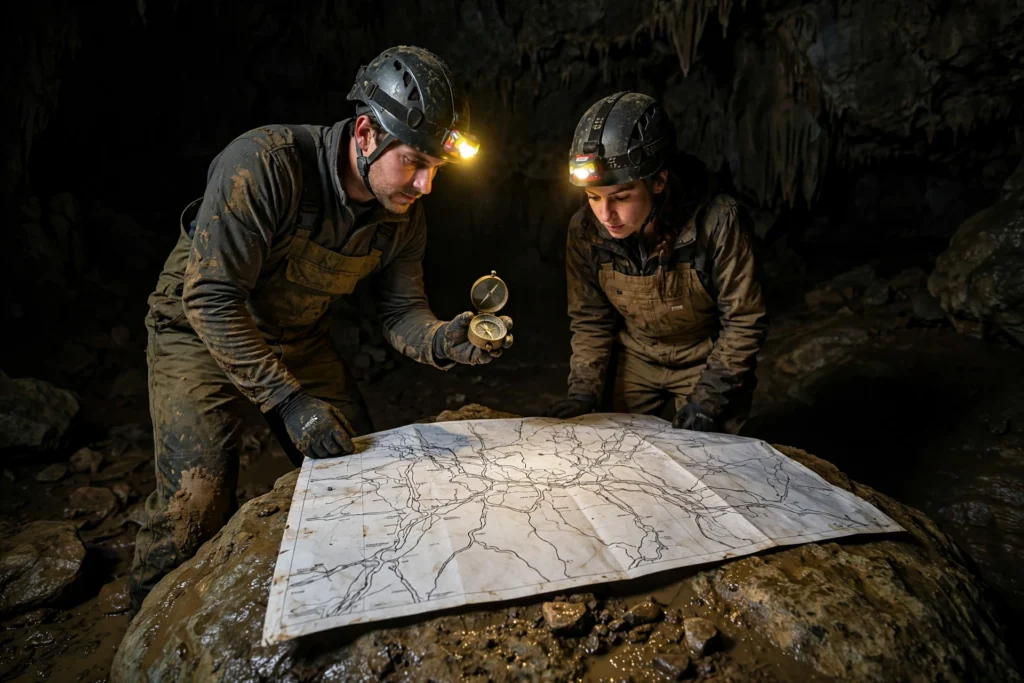
Every new passage gets surveyed: compass bearings, clinometer angles, tape distances, sketched cross-sections. It’s slow, painstaking work done by exhausted people in the cold, and it’s the only reason we know Cheve is 76,735 meters long. That number isn’t a guess. It’s thousands of individual measurements stitched together over decades. The 2026 expedition is adding to it in real time, and every survey shot past the sump is a shot into territory that has never appeared on any map of anything.
This matters for a reason most people miss. A cave survey isn’t just a trophy. It’s the dataset that tells hydrologists where the region’s water goes, tells biologists where to look for new species, and tells the next generation of explorers where the cave might still be hiding secrets. The map is the science.
The numbers that make your head spin
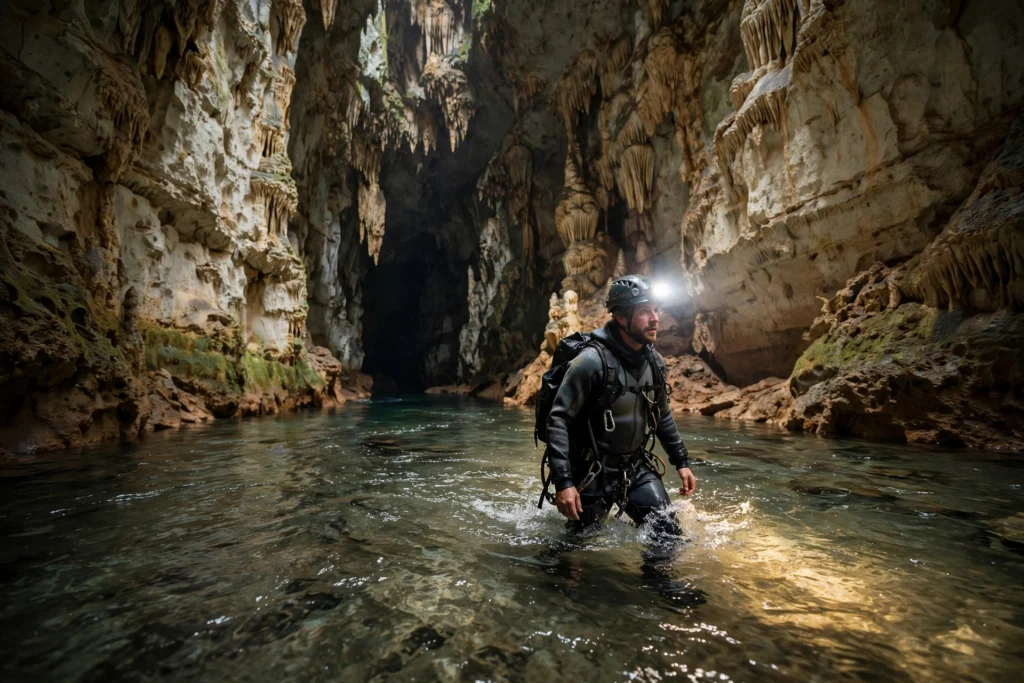
Let me line up the figures, because they’re genuinely staggering:
- 1,536 meters: Cheve’s confirmed depth from the 2021 survey. That’s roughly five Eiffel Towers stacked end to end, straight down.
- 76,735 meters: the surveyed length. If you walked it end to end without stopping, you’d be walking for the better part of a day, underground, in the dark.
- 2,597 meters: the projected depth if the sump connects Cheve to the deeper system the team believes is there. Nothing on Earth dug by nature goes deeper.
- 2,224 meters: Krubera’s current record, the number Cheve is trying to beat.
- Weeks to months: how long expedition members stay underground, living in camps with no sunlight.
Here’s another way to think about it. Commercial airliners cruise at about 10,000 meters. The Cheve team is trying to go a quarter of that distance straight down through solid rock, on ropes, in water, in darkness, carrying everything they need to survive. The word “extreme” gets thrown around a lot in adventure writing. This is one of the few places it isn’t an exaggeration.
Cheve vs. Krubera: a tale of two underworlds
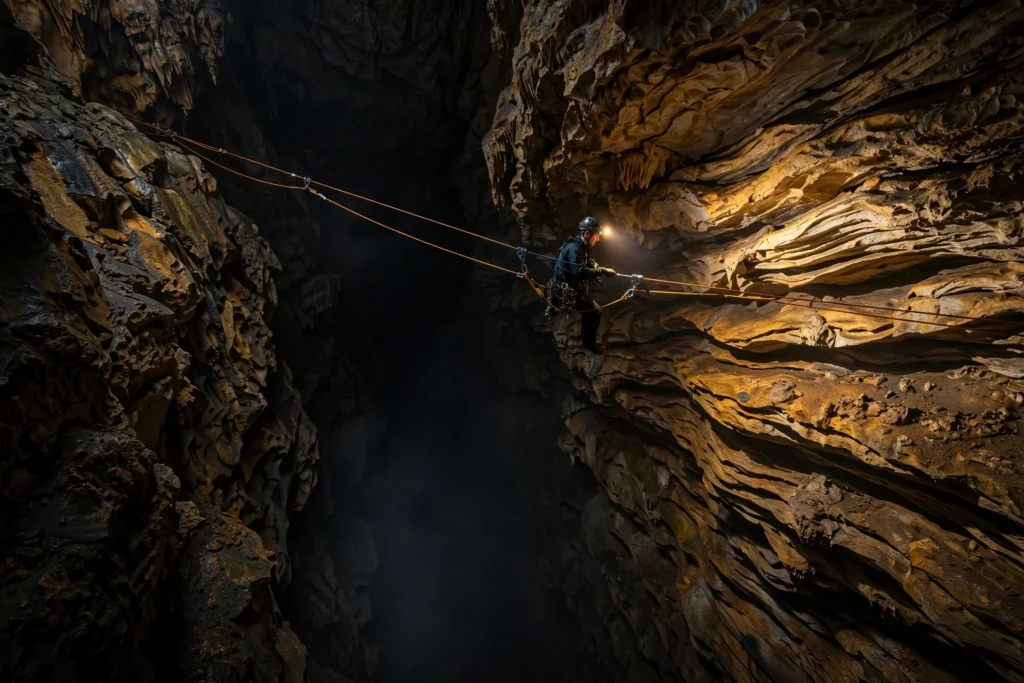
It’s worth pausing on the comparison, because the two caves could hardly be more different. Krubera sits in the Arabika Massif in Abkhazia, in the Caucasus mountains. It’s a vertical monster: shaft after shaft dropping through alpine limestone, explored by generations of Russian, Ukrainian, and international cavers. In September 2026, an international expedition even installed the world’s first deep-cave atmospheric monitoring network inside it, with stations at 60, 1,200, and 1,400 meters streaming data to the surface. Krubera is the establishment candidate: mapped, measured, instrumented.
Cheve is the insurgent. It’s in the cloud forests of Oaxaca, in a karst landscape that most of the world has never heard of. Its exploration has the flavor of old-school expedition caving: small teams, huge unknowns, National Geographic cameras along for the ride. Where Krubera’s story is about precision measurement, Cheve’s story is about the gamble. The sump might connect to a deeper system. It might not. That’s the whole beautiful, terrifying point.
For scale, the other giant that usually comes up in these conversations is Son Doong in Vietnam, the world’s largest cave by volume. Son Doong wins on sheer size: chambers big enough to hold city blocks. But Son Doong is a horizontal giant. Cheve is a vertical one. Different games, same obsession: how far down, or how far in, can a human being actually go?
The problem this solves (yes, really)
Okay, fair question: why should anyone who isn’t a caver care about a flooded tunnel in Oaxaca? Because the Cheve expedition is a masterclass in solving an impossible logistics problem, and the lessons leak into normal life in surprising ways.
Risk planning: the team operates where rescue is impossible, so every system has a backup and every backup has a backup. Divers carry redundant air, redundant lights, redundant guidelines. The rest of us can borrow the principle at a smaller scale: the adventure trip where your phone dies, your map is wrong, and the weather turns is the trip where redundancy stops being paranoia and starts being the plan.
Expedition thinking for your own trips: you will probably never dive a terminal sump, but the Oaxaca region around Cheve is genuinely visitable. The Sierra Juarez is pine forest and cloud forest, small mountain towns, and some of the most underrated hiking in Mexico. Travelers chasing the Cheve story can base in Oaxaca City, explore the region’s caves that ARE open to visitors, and stand on the limestone that hides the system. The expedition’s lesson for trip planning is simple: go where the story is, even if you can’t go as deep as the story does.
Why it matters for science: deep caves are time capsules. The water chemistry, the mineral deposits, the blind fish and translucent insects that show up in these systems, they all record conditions from thousands or millions of years ago. Every meter of new cave is a new page of Earth’s diary. Cheve’s sump, if it connects, opens a volume nobody has read.
How to follow the expedition (and plan your own Oaxaca cave adventure)
The Cheve 2026 expedition is a live story, which means you can actually follow it as it unfolds. The US Deep Caving Team’s site carries expedition updates, and the background on the system is well covered on Wikipedia’s Sistema Cheve page. If the sump dive succeeds, expect the announcement to land with the subtlety of a thunderclap: new deepest cave on Earth, new maps, new footage from a place no camera has ever been.
Want the adventure without the life-threatening part? Oaxaca is one of Mexico’s great adventure states, and it’s far more accessible than the expedition makes it sound:
- Base yourself in Oaxaca City. It’s a UNESCO-listed colonial city with absurdly good food, and it’s the jumping-off point for the Sierra Juarez.
- Visit show caves in the region. Several Oaxacan cave systems run guided tours. You’ll get the dripstone, the darkness, and the echo, with a guide and a hard hat and a defined exit.
- Hike the Sierra Juarez. Community-run ecotourism in villages like those along the highland routes offers cloud-forest trails literally above the Cheve system. You’re walking on the roof of the underworld.
- Time it right. The dry season (roughly November to April) is the sensible window for mountain travel in Oaxaca. The expedition itself launched in February for exactly this reason: less water in the system means a more diveable sump.
A word of honest caution: do not try to find Cheve’s entrance on your own. Expedition caves are not tourist caves. The entrances are remote, the terrain is serious, and the people down there are doing some of the most dangerous work in exploration. Admire from the region, not from the rope.
What happens next
As of this writing, the expedition is in its operational window. The sump dive is the crux: everything the team has hauled underground, every week spent in the dark, funnels down to a few divers, a flooded tunnel, and a question nobody on the surface can answer. Does the cave continue?
If yes, the record books get rewritten, the maps get longer, and somewhere under Oaxaca, a diver surfaces in a chamber where the air has never been breathed by a human being. If no, the team still comes home with new survey, new science, and a story about the edge of the possible. In exploration, “no” is also an answer. It’s just not the fun one.
Either way, I’ll be watching. The race to the bottom of the Earth is one of the last real races left, and it’s happening right now, in the dark, under Mexico.
Love underground worlds? Follow The Cavee on Pinterest for daily cave discoveries, expedition stories, and hidden-world travel ideas, and explore more deep-cave stories right here on thecavee.com. The underworld is bigger than you think.