Intro
There is a moment inside Siju Cave when your eyes adjust and the ceiling starts to move. Not the rock. The bats.
Thousands of them, packed into the dark above you, shifting and rustling like a crowd that has just noticed you walked in. Your headlamp catches a hundred tiny eyes at once. It is a little unnerving, and it is completely wonderful, and it is why Siju has stuck in the minds of cave researchers for more than a hundred years.
Siju is not the longest cave in India, or the deepest, or the easiest to reach. What it is, is a rare thing in cave travel: a genuinely wild limestone cave that an ordinary traveller can still visit, in the right season, with a local guide, without signing up for a multi day expedition. November is exactly that season. The monsoon has gone, the forest paths are drying out, and the Garo Hills feel like they are breathing again.
This guide sorts out the confusion around Siju, because there is a lot of it. Different websites give different lengths, different discovery dates, and different ideas about what you can actually do inside. Here is what is verified, what a visit really looks like, and how to plan it without ruining the cave for the bats, or yourself.
Why Siju, and why now
Meghalaya is famous for its Cherrapunji caves, and for good reason. But Cherrapunji gets the crowds and the well worn paths. Siju sits further south, in the South Garo Hills, near Siju village, Napak Lake and the Simsang River game reserve. It feels quieter, and older, in a good way. It feels like a cave that has not been tidied up for tourists.
November to March is the window most Meghalaya cave guides point to. The heavy rain is over, water levels inside the cave are lower, and the forest trails are far less slippery than in the monsoon months of June to September. That does not mean Siju is dry. It is a river cave, and you will get wet. It means the difference between a careful, enjoyable wade and a genuinely risky trip.
Siju also solves a simple planning problem. A lot of travellers want one cave experience that is not just a walkway and a railing. They want bats, water, darkness, and a guide who actually knows the place. Siju gives you all four, in a single day trip, if you base yourself sensibly and go with local help.
What Siju actually is
Siju Cave is also called Siju Dobakkol. Dobakkol means cave in the Garo language, so the name is really just Siju Cave, said twice in two languages. In English it is often called the Bat Cave, and that name is earned.
The verified numbers are these. Siju is a limestone cave in the Garo Hills. Its surveyed length is now 4,772 metres, which makes it the 14th longest cave in India today. Until 1981 it held the record as India’s longest cave, at 1,200 metres. Further exploration kept pushing that number up, which is why older websites still quote the old figure. If you see 1,200 metres, you are reading history, not the current survey.
Almost all of that 4.7 kilometres is filled with water and out of reach for normal visitors. You are not going to walk the whole cave. You will see the accessible entrance chambers, the bat colony, the formations, and a stretch of the underground river system, and that is plenty. The rest belongs to researchers, experienced cavers, and the bats.
Siju is also one of the most thoroughly researched caves in the Indian subcontinent. Scientists have studied its bats, insects, spiders, crabs and other cave life for a century, so a visit here is also a visit to a living laboratory. A 1927 study recorded the cave temperature between 21 and 26.4 degrees Celsius through the year, warm for a cave, and very different from the cold shock of an ice cave. If you have read our guide to Iceland’s ice caves, you will know what I mean by planning for the cave’s own climate, not the weather outside.
The bats: the whole point, and the whole responsibility
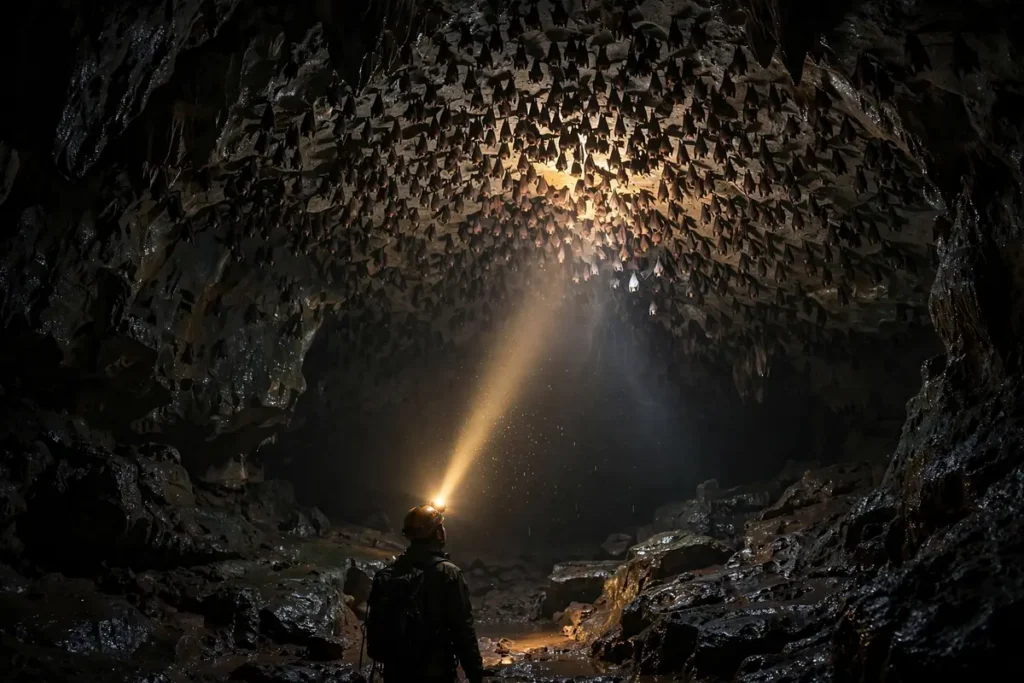
Most people come to Siju for the bats, even if they pretend they came for the geology. The cave is home to tens of thousands of bats, including rare species that have drawn researchers here for decades. One travel account describes hearing them before seeing them, a humming sound and a strong, musky smell as you go deeper, then hundreds of tiny glowing eyes as your eyes adjust. The first chamber you reach is a large one, busy with bats, and from there the cave opens into further chambers where streams come in from above.
Here is the part that matters more than any photo. Bats are not scenery. A loud group, a bright light held up for too long, or a flash fired straight at a roost can stress a colony that is already living on a tight energy budget. Keep your voice low, keep your headlamp pointed at the path when you are not looking at a formation, and ask your guide about photography rules before you lift a camera. If your guide says no flash near the roost, that is not them being difficult. That is them doing their job.
You will not get a perfect bat photo, and that is fine. The memory of that rustling ceiling, in the dark, with the river below your feet, is better than a blurry phone shot anyway.
The underground river you will wade through
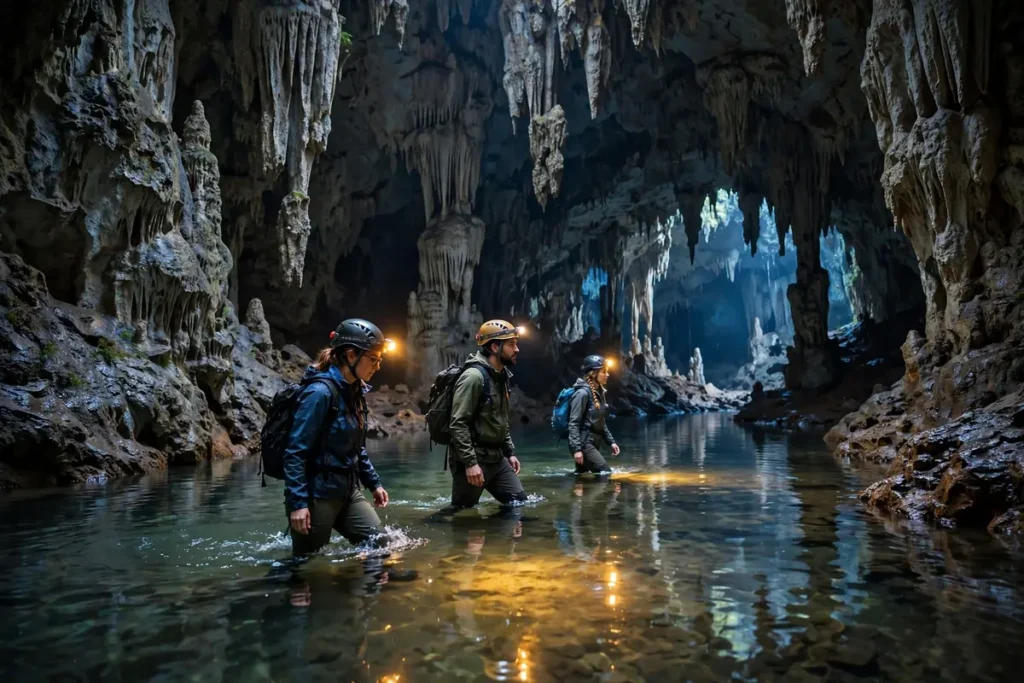
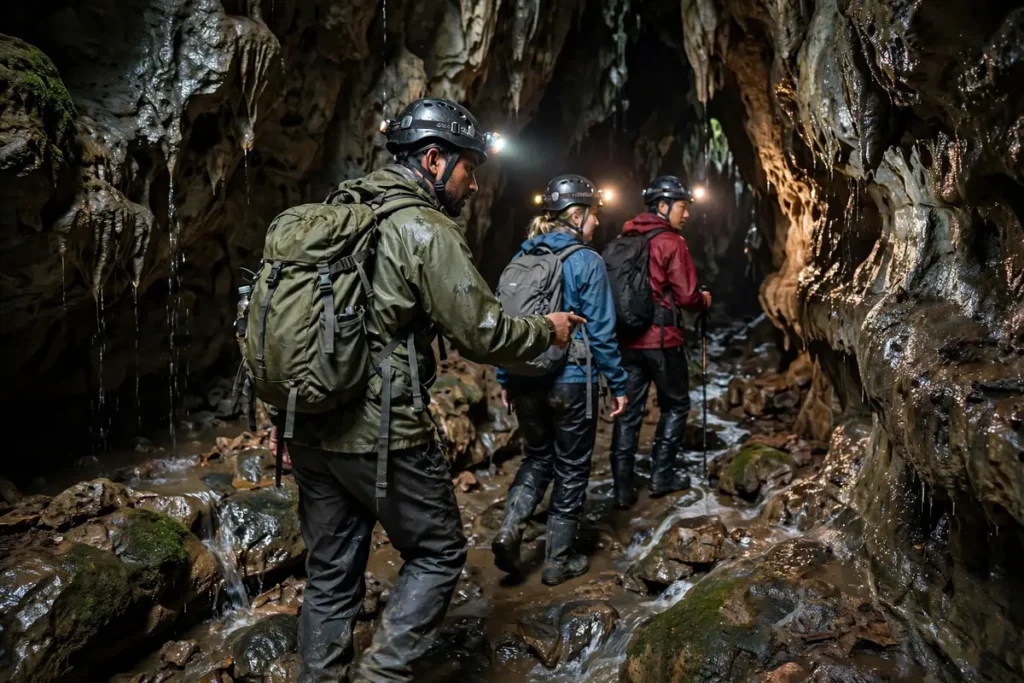
Siju is a river cave, and the river is not decoration. A stream runs through the main passage, for about 600 metres in the accessible section described in cave notes. You will walk, and wade, in it. Waterproof shoes with good grip are not optional, and neither is a willingness to get your lower legs wet.
This is where Siju separates the curious from the merely curious on paper. The water is cool, the rock underfoot is uneven, and the light is only what you and your guide carry. It is thrilling in the best way, the way that makes you laugh out loud and then immediately watch your footing again. It is also why you should not try this alone, or in the monsoon, or in shoes that slip.
A good guide does three things here. They pick a safe line through the water, they tell you when a passage narrows or deepens, and they tell you when to turn back. Listen to all three. The cave will still be there next year.
For scale, Siju’s river is nothing like the vast underground river systems of Son Doong in Vietnam, the world’s largest cave, which we covered in our Son Doong guide. Siju is smaller, wetter, and far more intimate. You are not looking at a cave from a viewing platform. You are in it, up to your calves, with bats overhead.
A short, honest history, because the dates get tangled
Siju has been known to local people for centuries. The scientific story starts later, and the dates get mixed up online, so here is the clean version.
The first geological expedition inside the cave was made in 1881 by T. D. La Touche of the Geological Survey of India, who noted the large bat colony inside. The systematic scientific exploration that made Siju famous came in 1922, when Stanley Kemp and K. Chopra, from what was then the Imperial Museum in Calcutta, now Kolkata, investigated the cave as part of an interdisciplinary research project. Their work, published in a series of papers, is why Siju became one of the best researched cave systems in the Indian subcontinent at the time.
You will also see 1925 quoted as a discovery date in some travel blogs. Treat that as a loose retelling, not the survey history. The 1881 and 1922 dates are the ones tied to named expeditions and published work. When a cave has been known for centuries, “discovered” is always a slippery word. The Garo people knew it first. The scientists wrote it down later.
That research history is also why Siju matters beyond tourism. Cave creatures here include spiders, harvestmen, millipedes, crickets, crabs, woodlice and springtails, animals adapted to darkness and damp. Some are found only in this region. When you step carefully and keep to the guide’s path, you are keeping that tiny, strange ecosystem intact.
Getting there without turning it into an ordeal
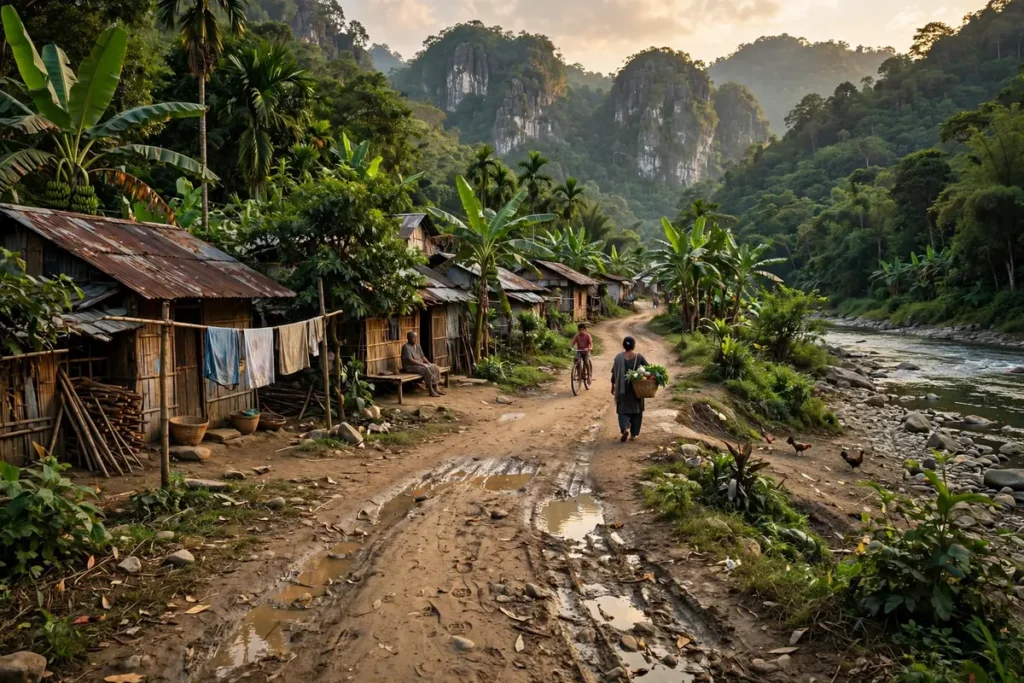
Siju is in Siju village, in the South Garo Hills district of Meghalaya. Travel guides put it about 255 kilometres from Shillong and about 125 kilometres from Tura, the Garo Hills administrative centre. Tura is the sensible base for most travellers. From Shillong, this is a long day, and most people will want to break the journey rather than race it.
Unlike some Meghalaya caves that need off roading and long treks, Siju is accessible by road, which is one of its advantages. That does not mean it is easy. Garo Hills roads are winding, and the last stretch is rural. Hire a local driver who knows the route, rather than relying on a phone map alone, and build in slack for slow traffic and road works.
From Tura, plan a full day: drive in, cave visit with a guide, time by the Simsang River, and drive back in daylight. Do not plan to drive the hill roads back in the dark if you can avoid it.
What a visit actually looks like
First, you arrive at Siju village and meet your guide. This is not a cave to wander into on your own. The entrance is reached by steps leading down, and the cave’s access is described as restricted, which in practice means go with a local guide, follow their instructions, and do not try to push into water filled passages on your own.
Second, you go down into the large entrance chamber. This is where the bats make themselves known, by sound, by smell, and then by sight. Take a minute here. Let your eyes adjust, instead of rushing through with a torch on full beam.
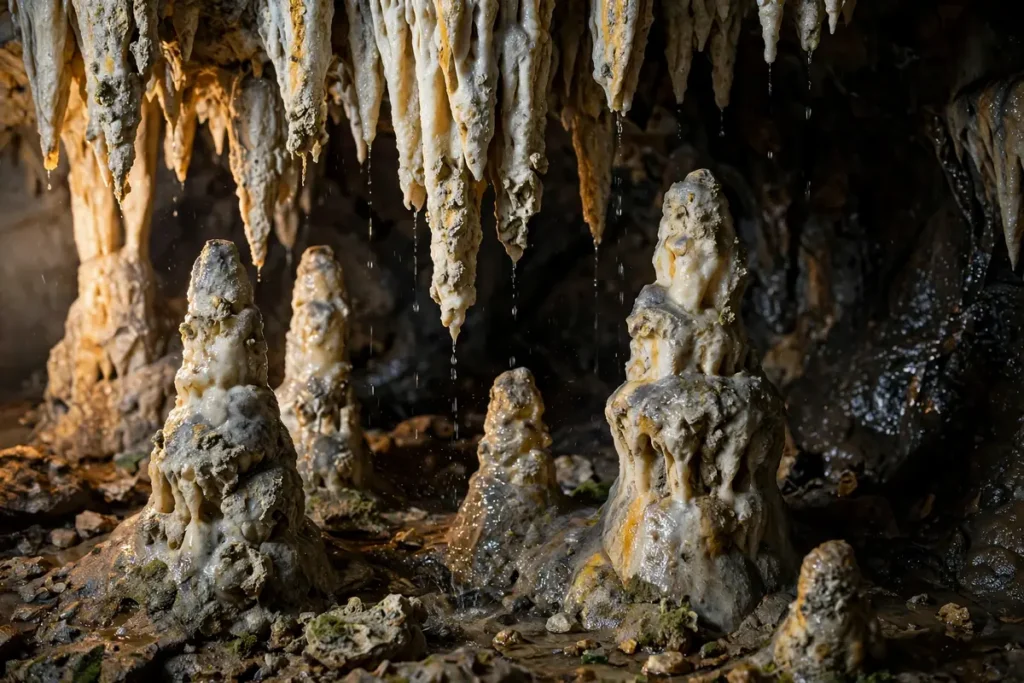
Third, you move deeper, wading through the river passage, past stalactites above and stalagmites rising from the floor. Guides point out formations with local nicknames, including shapes visitors compare to a dancing girl and an elephant. Whether you see those exact shapes is less important than slowing down enough to see how water, over millions of years, built them drop by drop.
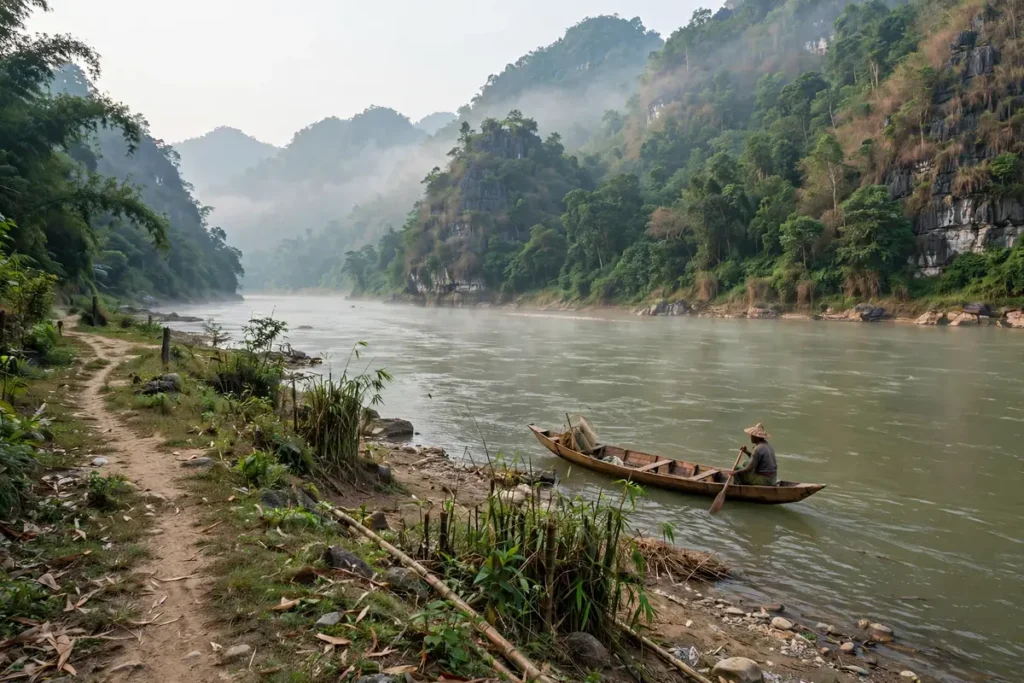
Fourth, you turn back at the guide’s point, retrace your steps through the water, and come out blinking into daylight, with the Simsang River and the forest waiting outside. That contrast, dark river cave one minute, green hills and bright water the next, is one of the best parts of the whole day.
Allow at least a couple of hours for the cave itself, plus travel time, plus time to eat and sit by the river afterwards. Rushing Siju misses the point. The cave rewards slow attention.
Practical planning: what to bring, what to skip
Bring a headlamp, even if your guide has one. A phone torch is a poor substitute in a river cave, because you need both hands free. Wear waterproof shoes with grip, quick dry clothes, and a change of clothes for afterwards. Pack your phone and camera in a waterproof pouch, and bring a small dry bag for anything you do not want soaked.
Do not bring white shoes you love, a heavy backpack you cannot keep dry, or a plan to swim the whole cave. The accessible visit is a wade, not a swim, and the deeper water filled passages are not for casual visitors.
On practical details, check them at the gate, because small sites change them without updating websites. One recent travel account reported an entry ticket of INR 20 per person, and a visiting window of 9 in the morning to 4 in the afternoon, Monday to Saturday, with the cave closed on Sundays. Treat those as a starting point, not a promise, and confirm hours and fees locally before you set out.
If you have claustrophobia, a bad knee, or a heart condition, talk to your guide honestly before you go in, and be ready to enjoy the entrance, the river outside, and the sanctuary instead. There is no shame in that. Siju’s surroundings are beautiful on their own, and a good trip is one you come back from in good shape.
Mistakes most first timers make
Do not go in the monsoon. June to September brings slippery trails, rising water, and flood risk. Do not trust a single website for facts: use the verified length of 4,772 metres and the 1881 and 1922 dates, then confirm hours at the gate. Do not treat the bats as a photo opportunity: low voices, low lights, no flash near a roost. And do not rush Siju as an add on to Cherrapunji. Give it its own day from Tura.
Frequently asked questions
How long is Siju Cave? The surveyed system is 4,772 metres long, making it India’s 14th longest cave today. Most of it is water filled and inaccessible to normal visitors. The part you visit is the entrance chambers and a stretch of river passage with a guide.
When is the best time to visit? November to March, in the dry season, when trails are safer and water levels are lower. Avoid June to September.
Can you visit without a guide? You should not try. Access is restricted, passages are water filled and uneven, and a local guide knows the safe line, the water levels, and the bat colony’s needs.
Is Siju safe for children? Older children who can walk on wet, uneven ground, follow instructions, and stay calm in the dark can enjoy it with a guide, but this is a judgement call for parents and guides, not a theme park ride.
How do I reach Siju? Base in Tura, about 125 kilometres away, and hire a local driver. Siju is about 255 kilometres from Shillong, so that route needs a full day and, for most travellers, an overnight break.
What should I wear? Waterproof shoes with grip, quick dry clothes, a headlamp, and a change of clothes for afterwards. Keep electronics in a waterproof pouch.
Why Siju deserves a place on your cave list
There are bigger caves, deeper caves, and caves with better lighting and smoother walkways. Siju is not trying to compete with them. What it offers is rarer: a cave scientists have studied for a hundred years, that tens of thousands of bats still call home, that you can enter by wading a real underground river, and that you can visit in November when Meghalaya is at its kindest.
If Siju has made you want to pack a headlamp and a dry bag, start with Tura, a local guide, and a November date. Go quietly, go carefully, and go soon, while the dry season is on your side.
If you loved the science and history side of Siju, you will also enjoy our guide to Ireland’s newly found cave art.
And if Siju’s underground river left you wanting more water underground, our Brazil Cave of Bones expedition, a flooded burial cave with human remains around 11,000 years old, is the next story to read.
For more cave adventures, follow The Cavee on Pinterest, where we share new cave guides every day. Read Full Story on thecavee.com, and share this guide with the one friend who would actually wade into a river cave with you.
Sources and further reading: Siju Cave on Wikipedia, and Meghalaya Tourism’s Siju Cave page, for the surveyed length, exploration history, and location details used in this guide.
Pingback: Alfred Caves Diglipur: Andaman's Wildest Hidden Cave Trek (2026 Guide)