Every caver learns one rule early: caves form in limestone. Rainwater, made slightly acidic by carbon dioxide, eats away at the rock over thousands of years and leaves behind passages, chambers, and rivers. It is a tidy rule, and it works almost everywhere on Earth. Then there is the cave under Mount Roraima, which breaks it completely.
High on a flat-topped mountain where Venezuela, Brazil, and Guyana meet, explorers have mapped more than 10 miles of cave passages through solid quartzite. Quartzite is not supposed to dissolve. It is one of the toughest rocks on the planet, the kind of stone that shrugs off water for millions of years. And yet, beneath Roraima’s summit, there is a stream, a maze of passages, crystals, and microbes that scientists had never found inside a cave before. The cave is called Cueva Ojos de Cristal, the Crystal Eyes Cave. This is the story of how it was found, why it should not exist, and what it might be hiding still.
A mountain that looks like the end of the world
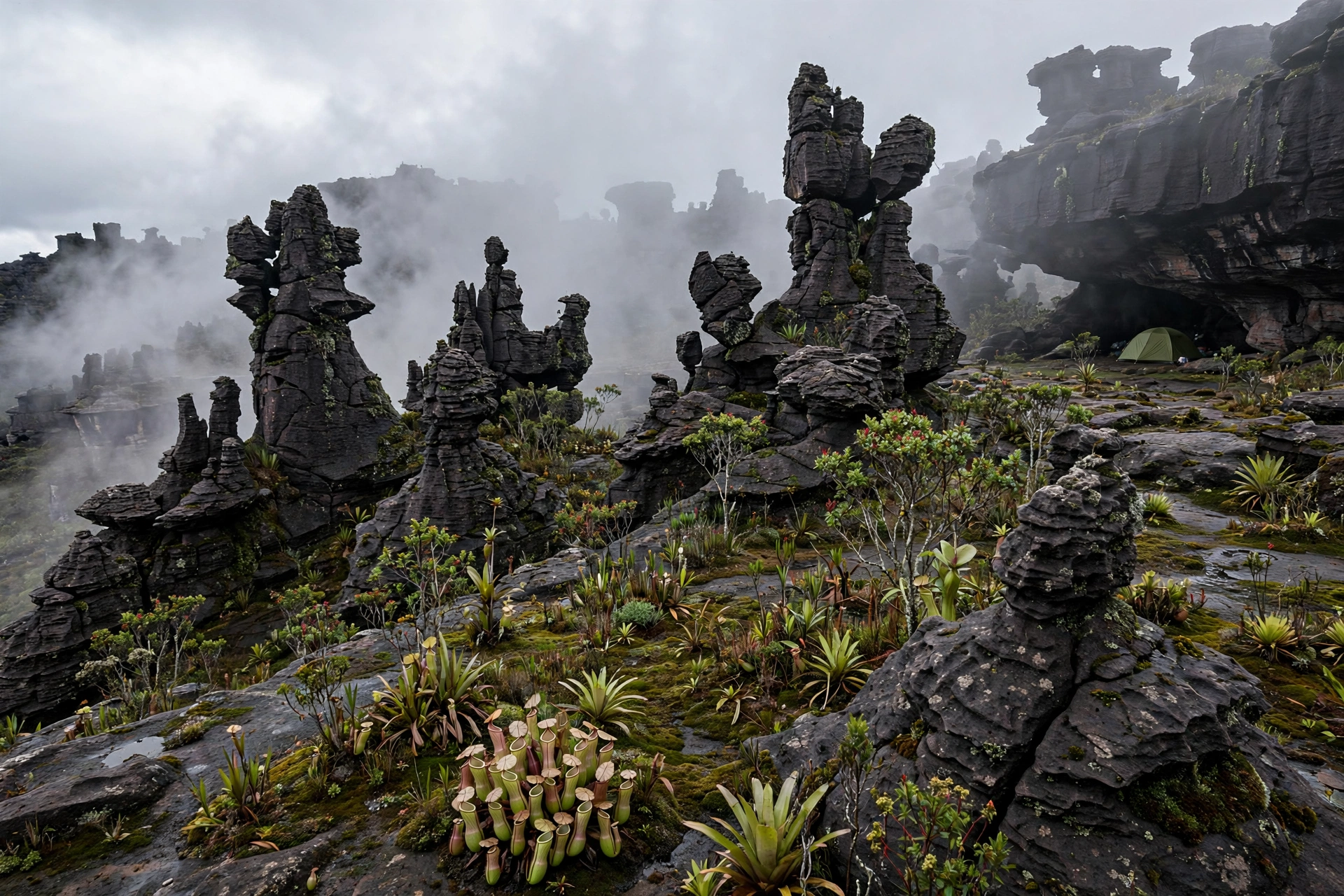
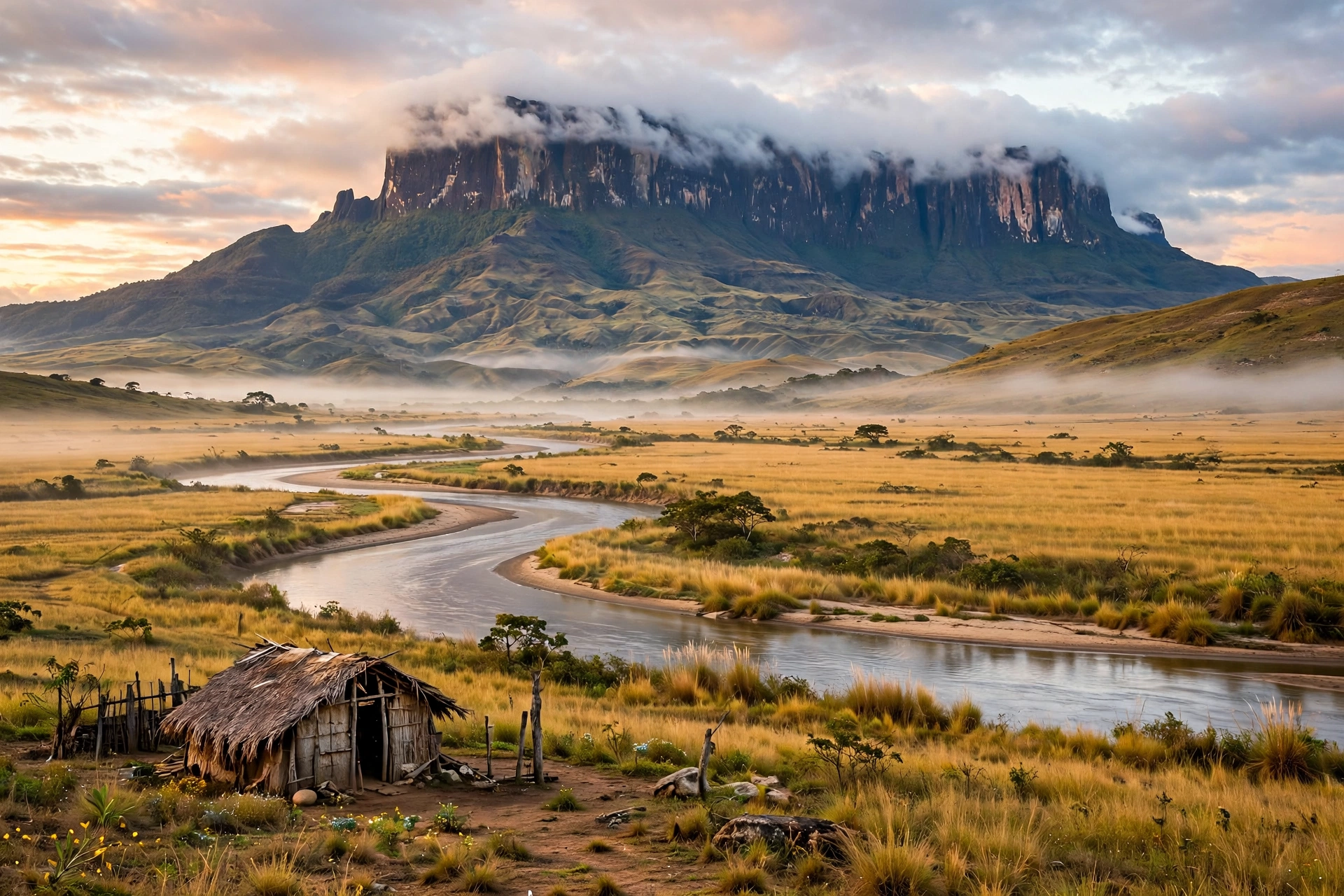
To understand the cave, you first have to picture the mountain. Roraima is a tepui, a sheer-sided table mountain that rises out of the Gran Sabana grasslands like a stone fortress. Its summit sits about 2,810 meters above sea level, and its cliffs drop vertically for hundreds of meters on every side. From the savanna below, it looks less like a mountain and more like an island floating in the sky, especially in the morning when cloud wraps around its base.
That otherworldly look is exactly why Roraima inspired Arthur Conan Doyle’s novel The Lost World, about an isolated plateau where prehistoric creatures survived. The real plateau is not home to dinosaurs, but it is home to plants and animals found nowhere else, cut off from the world below for millions of years. And underneath that isolated world, as it turns out, there is another one.
A small entrance, then a dead end
The cave’s modern story starts in 2002, when Slovak caver Zoltan Agh and Czech caver Marek Audy found a small entrance near the southern edge of Roraima’s summit plateau. They squeezed in and pushed forward for about 300 meters before the passage got too low to continue. It would have been easy to write the place off as a minor crack in the mountain.
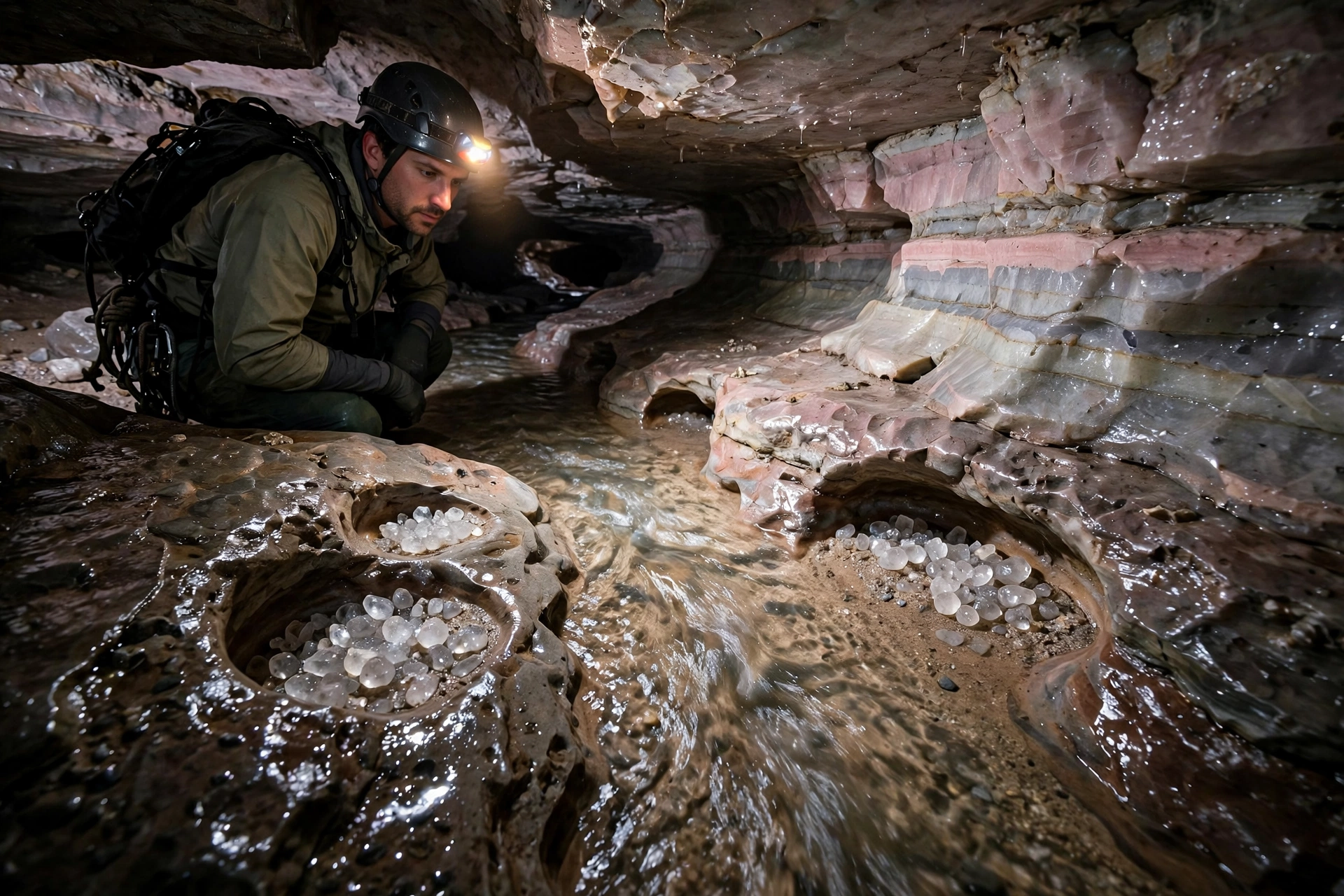
But the floor stopped them in their tracks. It was dotted with potholes full of rounded quartz crystals, glittering in their headlamps like eyes staring up from the rock. That is where the name came from: Cueva Ojos de Cristal, the Crystal Eyes Cave.
Agh and Audy came back in 2003 with a Slovak-Czech team and mapped 2.41 kilometers of stream passages in a single week-long trip. The cave was not a crack after all. It was a system, and it was growing fast.
The cave that kept growing
What happened next is a story cavers know well: two teams, two maps, and a polite argument that lasted years. A Venezuelan team, helped by the Oxford University Cave Club and Spain’s Sociedad de Ciencias Aranzadi, remapped the cave in 2004 and 2005 under a different name, Sistema Roraima Sur. Their March 2005 report counted 10,820 meters of passages and 18 entrances.
The Slovaks returned in 2006 and pushed the mapped length to 15.28 kilometers. In 2007, they connected two upper caves and registered a total of 16.14 kilometers, about 10 miles, with 73 meters of depth and 23 known entrances. Five of those entrances are windows in the cliff face, as much as 70 meters below the top of the plateau. The survey was published in a 2012 monograph by Comenius University in Bratislava, and the cave’s discovery, as the Slovak authors put it, evoked heated debates about its legitimacy inside the International Union of Speleology. Papers still use both names today.
Here is the part that should make you sit up: the cave runs almost flat, with a stream flowing through it from south to north. Earlier quartzite caves were mostly deep vertical cracks. This one is a proper horizontal cave system, and the Slovak team wrote that a cave crossing the entire mountain is at least theoretically possible. They believe at least 3 more kilometers may lie near the cliff and further into the mountain, unmapped. There is still no complete, agreed map of the whole system.
Why quartz caves should be impossible
Most of the world’s great caves, from Son Doong in Vietnam to Mammoth Cave in Kentucky, are dissolved out of limestone. Limestone is made of calcium carbonate, which acidic water can dissolve grain by grain. Quartzite is different. It is sandstone whose sand grains have been glued together with silica, essentially natural glass. It barely dissolves at all.
So how did 10 miles of passages open up inside it? Scientists still argue about it, and the argument is genuinely interesting. The Venezuelan team blamed a process called arenization: water slowly dissolves the silica cement between the grains, the rock crumbles back into loose sand, and the stream washes it away. The evidence fits in places. Every surface the researchers sampled was covered in loose sand, and dissolved silica in the stream rose from 4 to 15 milligrams per liter between their first and last sampling sites, as if the water was picking up silica as it traveled.
The Slovak geologists are not fully convinced. They argue that some layers were never cemented well in the first place, and that feldspar and mica rotting into red mud account for up to 30 percent of the empty space. In other words, the cave may not have been dissolved so much as rotted and washed out, one grain at a time, over unimaginable stretches of time.
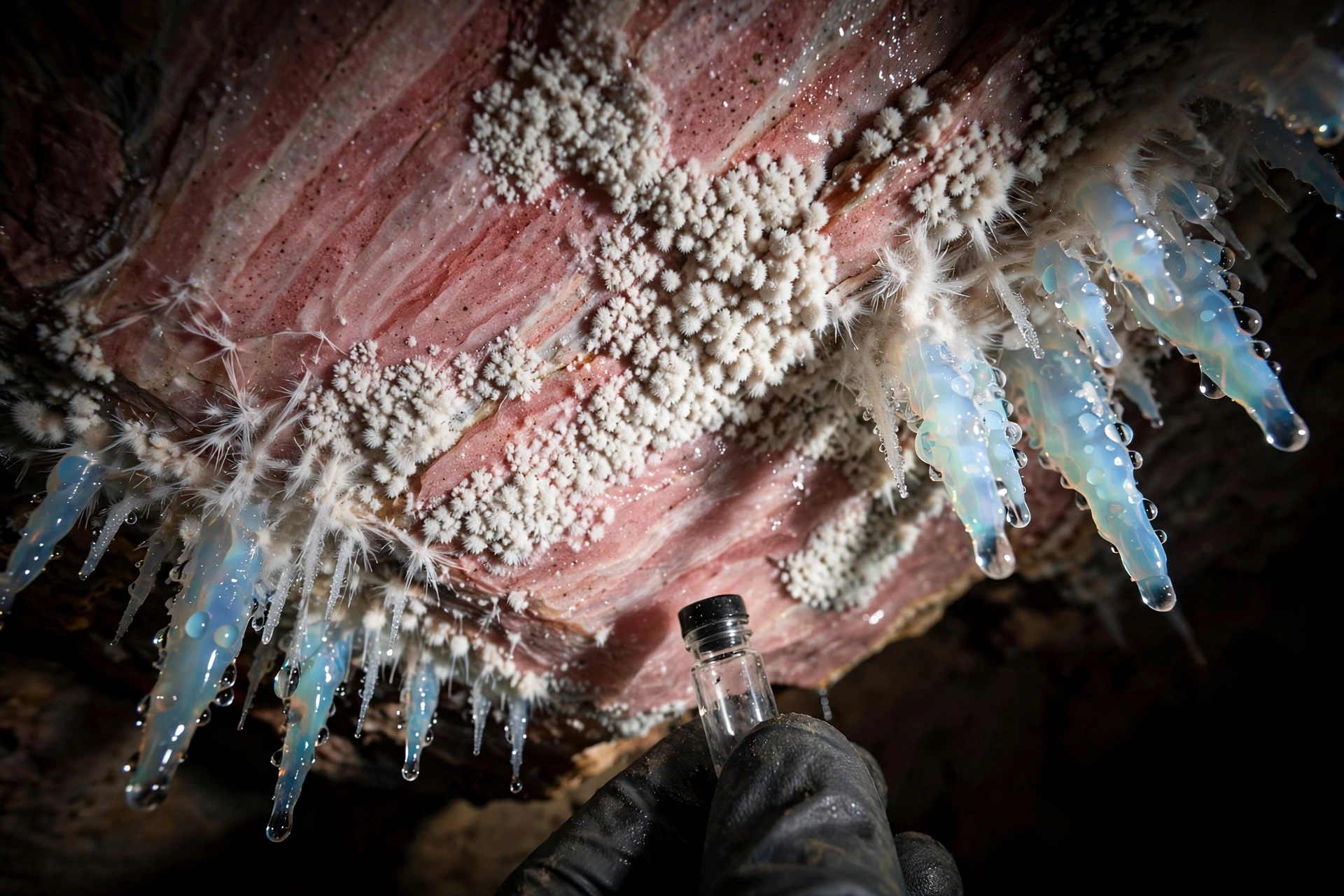
Either way, the result is a cave made of the wrong rock, and it produces formations you will not find in limestone caves. Where limestone grows calcite, Ojos de Cristal grows opal, a glassy silica that slowly turns to quartz. Many of its formations are cryptic stromatolites, layered lumps built by microbes, and the monograph says most of them are the largest known examples in caves anywhere.
The microbes nobody had seen in a cave
If the rock was the first surprise, the life inside it was the second, and it may turn out to be the bigger one. In January 2007, cave microbiologist Hazel Barton, then at the University of Akron and now at the University of Alabama, worked with researchers from Venezuela’s Universidad Simon Bolivar, NASA’s Jet Propulsion Laboratory, and other institutions to sample sand at three sites inside the cave, at 55, 90, and 300 meters in from the entrance.
The results were startling. An ATP test, which picks up the energy molecule in living cells, read as high as 34,062 units. In limestone caves, the same test usually scores between 80 and 1,400. Something in this cave was teeming with life at a level the researchers simply did not expect.
Deeper inside, 82 to 84 percent of the bacteria belonged to a single group called Ktedonobacterales. Their phylum is common in caves, but the authors called this the first identification of members of that class inside a cave at all. The team’s best guess for what the microbes eat is the stream itself, which carries about 19 milligrams of dissolved organic matter per liter down from the plants on the summit, against less than 0.5 milligrams in typical carbonate caves. The mountain’s surface, in other words, feeds its underground world.
The story did not stop there. In 2020, researchers isolated a strain of Pseudomonas aeruginosa from the cave’s water that resisted the antibiotics ceftriaxone, tigecycline, and imipenem. And on June 22, 2026, a team in Italy published genomes of Ktedonobacteria from silica-rich caves in the journal ISME Communications, using samples from a neighboring tepui cave and an Antarctic ice cave. They found genes for using trace gases from the air and fixing carbon dioxide in the dark. Microbes that can make a living from almost nothing, in a cave made of glass, on a mountain cut off from the world: if you are interested in how life might survive in extreme places, including places beyond Earth, this is exactly the kind of clue you look for.
The record that did not last
For a while, Roraima Sur held the title of the world’s longest quartzite cave, and it was a runaway record. Before Roraima, the record for a quartzite cave was only about 3 kilometers, in Brazil. Then, in 2010, the Charles Brewer Cave System on Churi Tepui was revised to 17.8 kilometers, taking the record. Then Imawari Yeuta, found on Auyan-tepui in 2013, was mapped at 23,079 meters, and a 2022 paper called it the world’s longest orthoquartzite cave.
Oddly, a January 2026 paper in the Brazilian Journal of Microbiology still calls Roraima Sur the world’s longest and deepest quartzite karst system. The confusion is part of the point: with no complete published map and two names in use, the total length is still debatable. What is not debatable is that these tepuis hold an entire family of caves in a rock type that was once thought to barely form caves at all. The map of the underground world is still being drawn, and Roraima’s chapter is unfinished.
Can you actually visit? The honest answer
Here is where I have to be straight with you. You cannot just buy a ticket and walk into Ojos de Cristal. It is not a show cave. There is no lit pathway, no guide waiting at the entrance, and reaching it means joining or organizing a serious expedition on top of one of the most remote mountains in South America. If a blog post tells you otherwise, it is guessing.
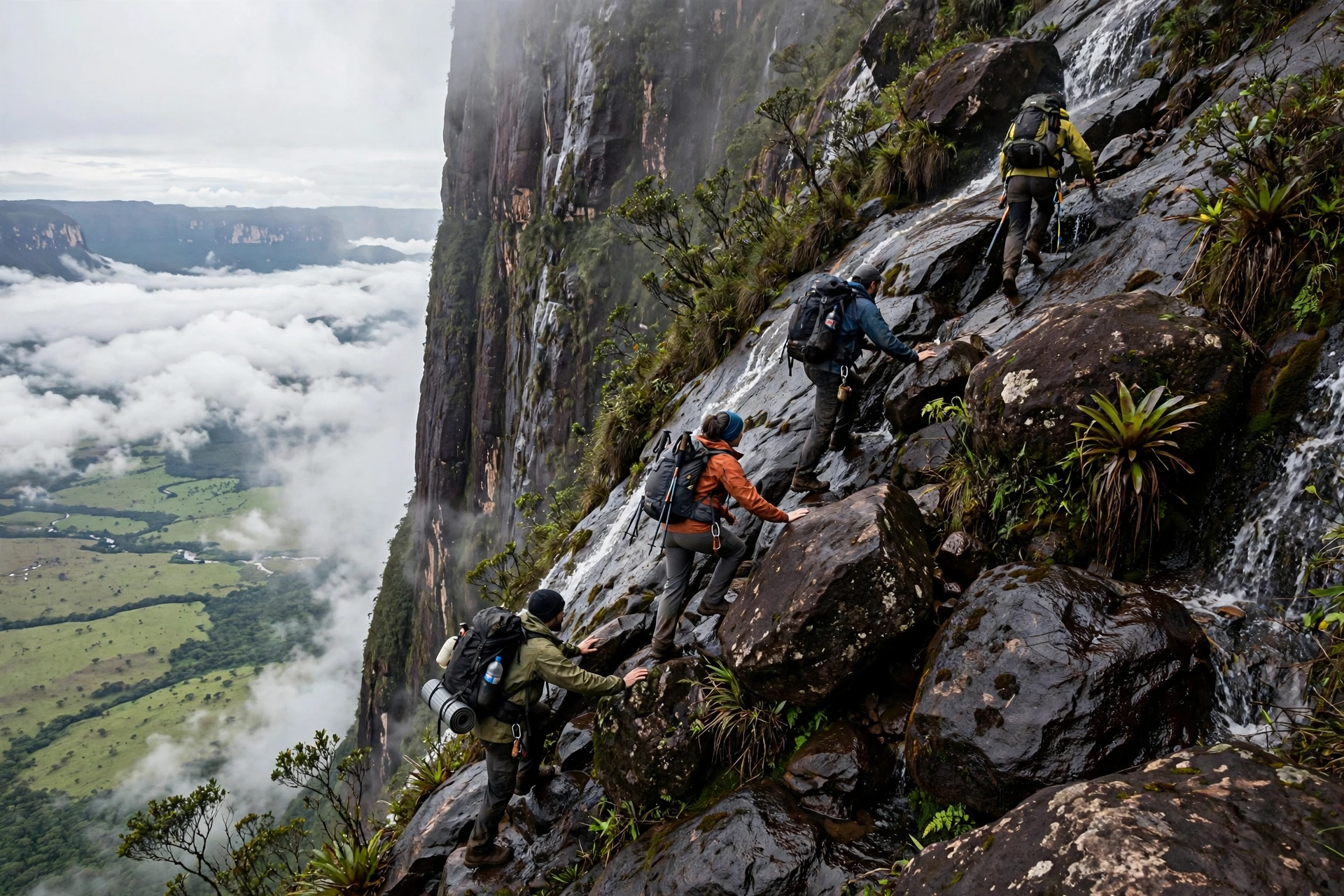
But you can visit the mountain that holds it, and that is an adventure worth planning properly. The standard Roraima trek starts from the village of Paraitepui on the Venezuelan side and takes 6 to 8 days: two days across the Gran Sabana, a climb up the mountain’s single natural ramp, called La Rampa, and a couple of nights on the summit plateau itself. A licensed guide from the local Pemon community is mandatory, and park authorities enforce it. The best season is the dry window from December to April, though rain can fall on the summit any day of the year. Nights on top drop close to freezing even in the dry season, and every piece of gear you bring needs to be genuinely waterproof.
Costs vary a lot depending on where you book. Locally arranged treks from Santa Elena de Uairen are often quoted around 400 to 700 US dollars per person for a 6 to 8 day trip including food, camping gear, and guide fees, while international operators charge far more. Check current travel advisories for Venezuela before you commit to anything, and book through an operator with a solid recent track record on this specific route. The mountain is not going anywhere. The right trip is worth waiting for.
What this cave teaches the rest of us
There is a practical lesson hiding in this story, and it is not just for cavers. Most of us walk around with a mental list of things that are impossible: rocks that cannot form caves, dark places that cannot support life, mountains that have already given up all their secrets. Ojos de Cristal quietly crosses out all three.
The cave is a reminder that the most interesting discoveries often sit in the gap between two things we think we understand. Geologists understood quartzite, and they understood caves, and they were sure the two did not mix. Then two cavers followed a glittering floor for 300 meters and the whole picture changed. The microbes add a second lesson: life does not need comfortable conditions, it needs an energy source and time, and it will find both in places we would never think to look.
That is also why this cave matters beyond caving circles. The same kind of detective work, following water, chemistry, and tiny signs of life in extreme places, is how scientists think about searching for life elsewhere. Roraima will never be a tourist attraction in the usual sense, and that is probably for the best. Some places are more valuable as questions than as answers.
Planning your own Lost World trip
If Roraima has made it onto your list, here is the short version of what to get right. Go in the dry season, December to April, and still pack for rain. Book a Pemon guide through a reputable operator and confirm exactly what is included: transport to Paraitepui, food, tents, and porters. Train for 6 to 8 hour walking days on uneven, often slippery ground, and break in your boots before you fly. Bring a warm sleeping bag rated for near-freezing nights, a waterproof jacket and pack cover, and a headlamp you trust. And build in a spare day or two, because summit weather does not care about your flight home.
While you are dreaming, you can explore more underground worlds here on the site. Waitomo’s glowworm caves in New Zealand show what living light looks like underground, and our guide to Iceland’s ice caves covers a completely different kind of cave, one carved from frozen water instead of rock. For the deeper science on Roraima’s cave, the October 2026 report on the Slovak survey and the microbe study is worth reading in full, and trekking practicals are covered well by the Mad Traveller Roraima guide.
Some caves impress you with size. Some impress you with beauty. Ojos de Cristal impresses you by existing at all, and by the life it quietly shelters in the dark. Ten miles of passages through glass rock, microbes never seen in a cave before, and at least 3 more kilometers still waiting somewhere near the cliff. The Lost World, it turns out, has a basement, and we have only just started exploring it.
Found this story fascinating? Save it on Pinterest and share it with someone who loves real adventure. Read Full Story on thecavee.com, and follow The Cavee for a new underground wonder every day.