Colca Canyon Is Twice as Deep as the Grand Canyon (And the Condors Fly Right Past Your Face)
Here is a number that stops most people mid-sentence. The Grand Canyon, the one on every postcard and every bucket list, is about 1,830 metres deep at its deepest point. The Colca Canyon in southern Peru drops around 3,270 metres. That is not a little deeper. That is nearly twice as deep, and it is the first thing you should know before you go, because nothing about this place feels small once you are standing on its edge.
The second thing you should know is quieter, and it is the reason most travellers make the trip. Every morning, between about 8 and 10, Andean condors rise out of the canyon on warm air currents and glide past the Cruz del Condor viewpoint at eye level. These birds have wingspans up to 3.5 metres, wider than a small car is long, and they do not flap much. They just appear, silent, enormous, close enough that you can see the white ruff around their necks. People who have seen the Grand Canyon a dozen times still talk about that morning in Colca like it happened yesterday.
This guide covers the whole trip the way it actually works in 2026: the real prices, the ticket that confuses everyone, the 1-day versus 2-day choice, the hike down to the oasis at the bottom, and the mistakes that cost people money and mornings. November is a good month to go, by the way. The dry season runs May to November, so the skies are still clear, the trails are still dry, and the condors are still flying on schedule.
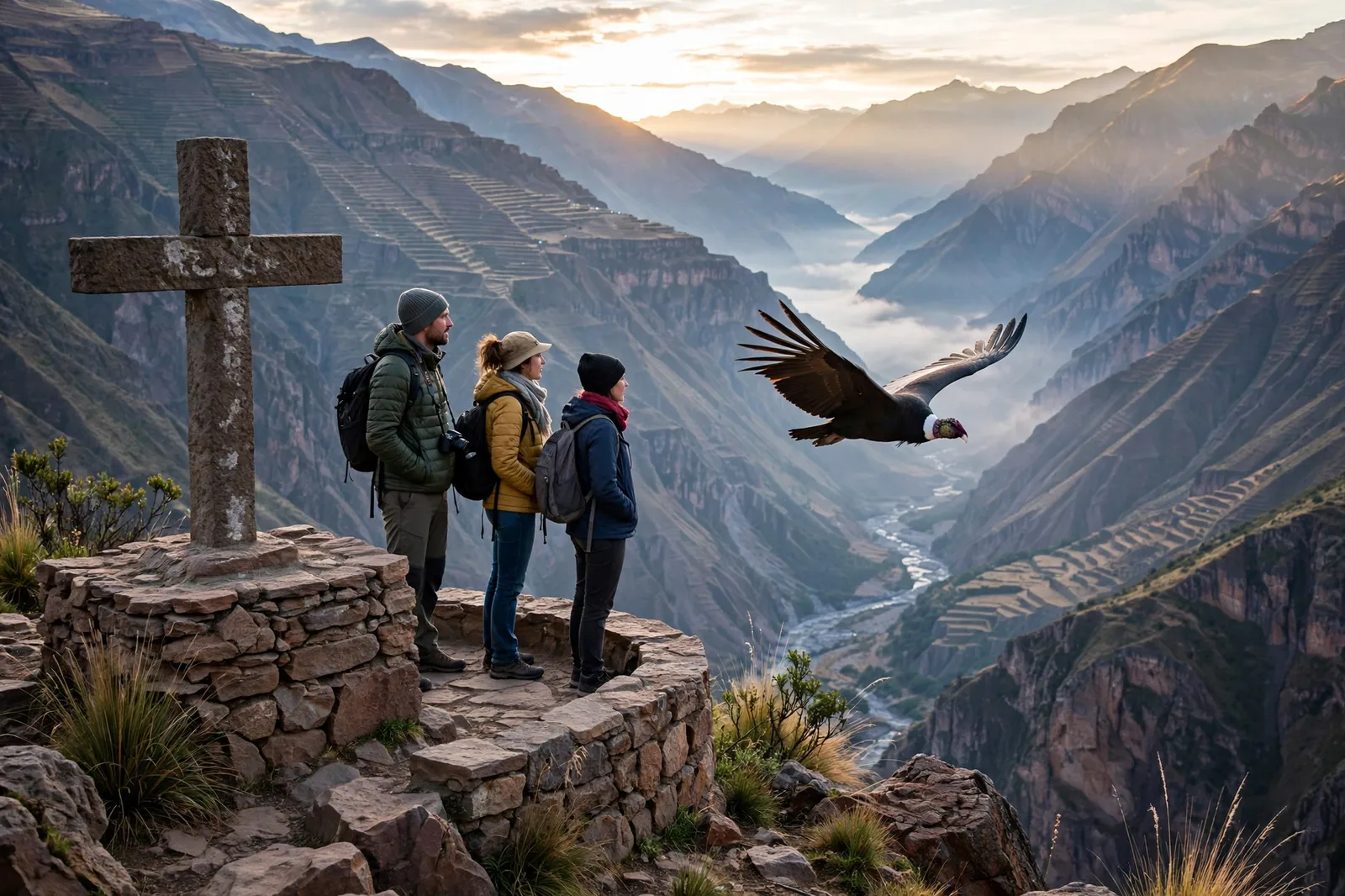
Andean condors glide past the Cruz del Condor viewpoint most mornings between 8 and 10.
Why Colca Canyon Beats the Grand Canyon (On Paper, At Least)
Let us get the numbers straight, because the internet argues about them constantly. The Colca Canyon reaches roughly 3,270 metres deep where the Colca River has cut hardest into the Andes, in the Huambo district of Caylloma province. Some sources quote 3,300 or even 3,400 metres depending on where exactly you measure. Either way, it is about twice the depth of the Grand Canyon, and it is widely listed as the second deepest canyon in the world.
The deepest? That would be the nearby Cotahuasi Canyon, also in the Arequipa region, at about 3,535 metres. Colca just gets more visitors because it is easier to reach and because it has the condors.
But depth is only a number until you stand at the rim. The canyon stretches about 70 kilometres, and the walls are not bare rock the way the Grand Canyon is. They are stepped with pre-Inca agricultural terraces, some of them more than a thousand years old, still farmed today. Green rectangles climb the slopes in neat rows, villages with whitewashed churches sit in the valley floor, and alpacas graze where the terraces flatten out. It looks less like a desert gorge and more like a whole civilisation decided to garden the inside of a canyon. That is the view that makes people put their cameras down for a second and just stare.
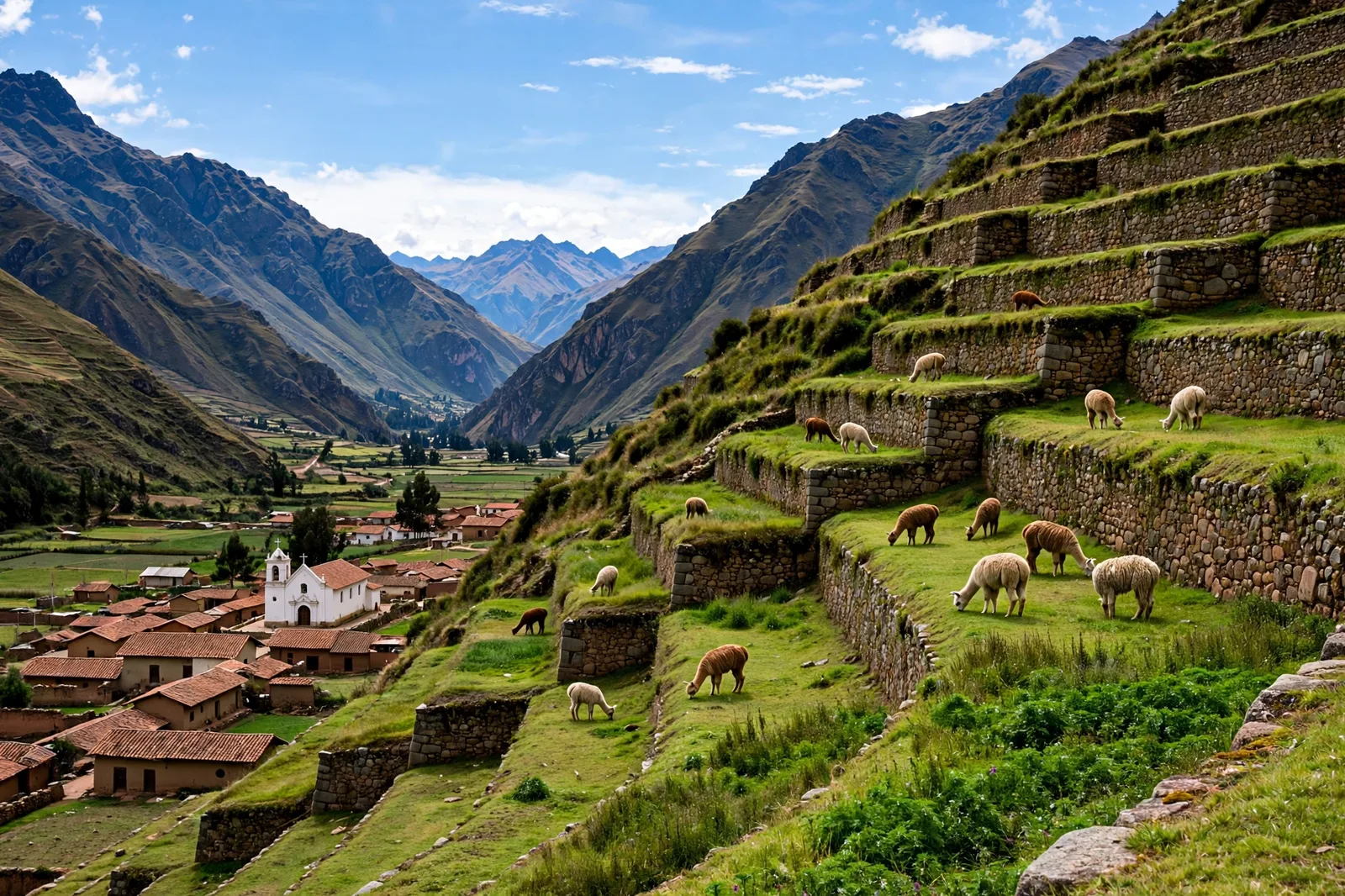
Pre-Inca terraces still farmed today climb the walls of the Colca Valley, with village churches in the valley floor.
The Condor Moment: What Actually Happens at Cruz del Condor
Cruz del Condor, the Cross of the Condor, is a stone lookout on the canyon rim about an hour past the town of Chivay. Tour buses arrive in a wave from around 8 in the morning, and for the first half hour or so, nothing much happens. People lean on the railing. Guides check their watches. Someone always asks if the condors are coming.
Then the sun warms the canyon walls, the thermals start rising, and a condor appears from below the rim, which is the strange part. The bird comes up from underneath you, not from above, because it has been riding the warm air up from the river 1,200 metres below. It crosses the viewpoint at roughly your eye level, close enough to see individual feathers, and then it is gone around the bend of the canyon. A minute later there is another one. On a good morning you might see half a dozen, sometimes a dozen, including juveniles with brown plumage and adults with the black and white pattern.
The honest version: sightings are not guaranteed, and the season matters. Operators quote an 80 to 90 percent chance depending on the time of year, and the dry season is your friend here. The best window is 8 to 10 in the morning, and the 2-day tours get two chances at it, once in the afternoon and once at sunrise the next day, which is a real advantage. If condors are the whole reason you are going, that alone is a decent argument for the slower trip.
The Ticket That Confuses Everyone (The BTC, S/70)
To enter the Colca Valley you need the Boleto Turistico Colca, the BTC. In 2026 it costs S/70 for foreign adults, roughly 18 US dollars, S/40 for Latin American residents, and S/20 for children aged 6 to 15. You pay it in cash at the Chivay checkpoint on the way in, and it is valid for a week.
Here is the confusion: most tour prices do not include it. A tour advertised at 25 dollars per person sounds cheap until you add the ticket, the hot springs entry, and lunch, and suddenly you are paying 50. That is not a scam, exactly. It is just how the pricing works, and the operators who are upfront about it are the ones worth booking with. Before you pay anything, ask one question: does this price include the BTC? If the answer is vague, assume it does not.
Getting There: The Drive From Arequipa Is Half the Trip
Almost every Colca trip starts in Arequipa, Peru’s white stone city, about 160 kilometres southeast of the canyon. The drive takes around four hours, and it is not a boring transfer. The road climbs out of the city, crosses the high altiplano, and tops out at the Patapampa viewpoint, also called the Mirador de los Volcanes, at 4,910 metres. That is higher than any mountain in the Alps. On a clear day you can see the snow capped volcanoes Ampato, Sabancaya and Misti lined up on the horizon, and herds of vicuna graze the plains below the road.
The altitude is the part people underestimate. Arequipa itself sits at 2,335 metres, Chivay at 3,635 metres, and the pass at 4,910 metres. If you flew into Arequipa the day before, you are probably fine. If you flew in that morning from sea level Lima, you might feel it. Headache, short breath on stairs, a strange urge to nap at noon. It passes, usually within a day, but the fix is simple and boring: drink water constantly, eat light on day one, skip the alcohol the first night, and do not sprint up the stairs at the viewpoint to get a photo. Coca tea helps some people and does nothing for others, but nobody ever regretted drinking the water.
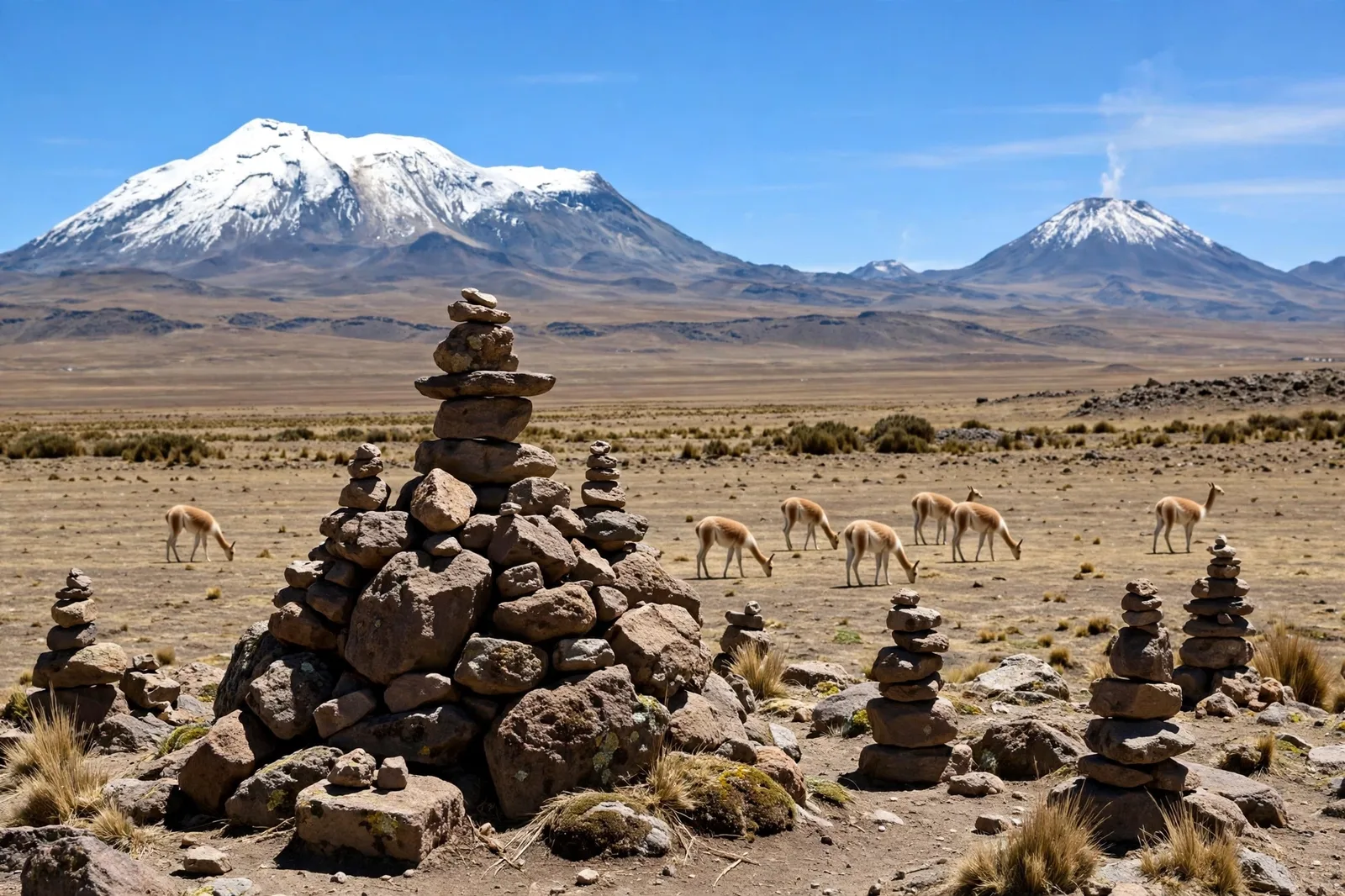
The Patapampa pass at 4,910 metres, with the volcanoes Ampato and Sabancaya on the horizon.
1 Day or 2 Days: The Honest Comparison
This is the decision every traveller agonises over, so here it is plainly. A 1-day tour from Arequipa costs roughly 25 to 35 dollars per person for a shared group, or from about 70 dollars with a better operator. You leave around 3 in the morning, reach Chivay for breakfast, stop at the viewpoints, watch the condors from 9 to 11, eat lunch, soak in the hot springs if time allows, and get back to Arequipa around 5 or 6 in the evening. It is a long day, about 14 hours, most of it on a bus.
A 2-day tour costs roughly 55 to 80 dollars per person, with an overnight stay in Chivay or Cabanaconde included. Day one is the same viewpoints and condor watching, but slower, and day two is the descent into the canyon or a relaxed morning before the drive back. You get two chances at the condors, a proper night’s sleep at altitude, and time to actually look at the villages instead of photographing them through a bus window.
Which one should you pick? If you are short on time and mostly want the condor photo and the viewpoint, the 1-day trip does the job. If you like hiking, or if you have ever been disappointed by a rushed tour, take the 2 days. The price difference is about the cost of a decent dinner, and the second day is where the canyon stops being a viewpoint and starts being a place.
The Hike Down: Sangalle Oasis and the Hardest Staircase of Your Life
The classic Colca trek starts in Cabanaconde, the village at the top of the canyon, and drops about 1,200 metres down to the Sangalle Oasis on the canyon floor. The trail is a series of dusty switchbacks, and going down takes about three hours. At the bottom there is a cluster of palm trees, simple lodges, and a swimming pool that feels like a miracle after the descent. People swim, eat, and sleep in the oasis, and the next morning they climb back out.
That climb is the part nobody warns you about properly. It takes two to three hours of steady uphill, starting before dawn to beat the heat, and the last stretch is a set of stone steps that feels endless. Fit hikers manage it fine. Everyone else manages it slowly, with breaks, and that is completely normal. Mules are available to carry your bag, and for about the price of a lunch you can ride one up yourself if your knees object. There is no shame in it. The mule drivers have seen everything.
If a full trek sounds like too much, there is a gentler version. Several operators run a 2-day trip where you walk down to the oasis, sleep there, and take transport back up the next day instead of climbing. Ask for it by name when you book, because it is not always the default itinerary.
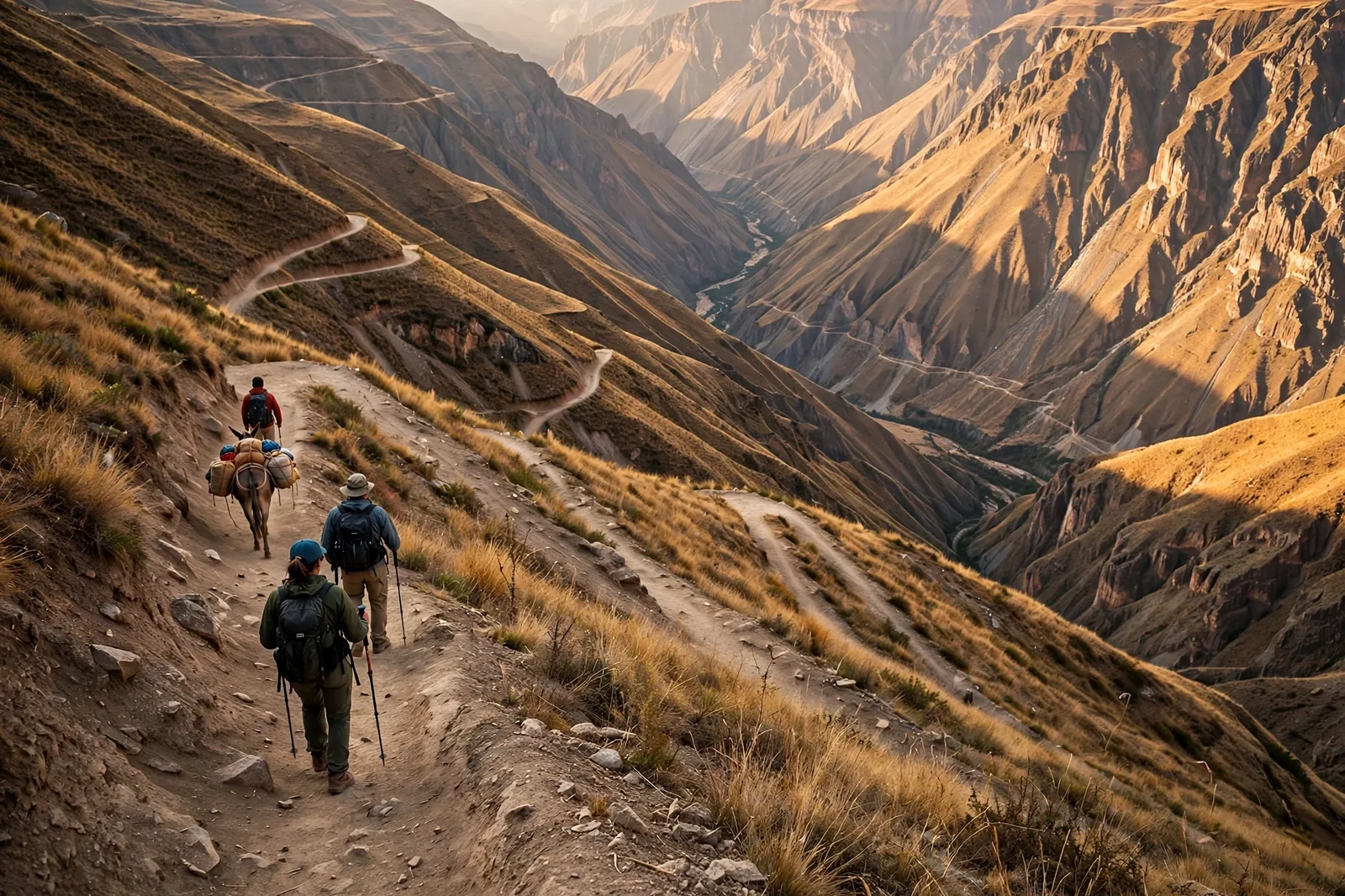
The switchback trail from Cabanaconde drops about 1,200 metres to the canyon floor.

The Sangalle Oasis: palm trees and a pool at the bottom of one of the deepest canyons on Earth.
Where to Stay and Eat
Chivay is the main town in the valley, with the most hotels, restaurants and hot springs, and it is where most 1-day tours stop for breakfast. It is practical rather than pretty. Cabanaconde is smaller, quieter, and closer to the trekking trailheads, which makes it the better base if you are hiking. Yanque is the village in between, known for its hot springs and for the traditional dances in the main square some mornings.
Food in the valley is hearty Andean cooking. Expect quinoa soup, alpaca steak, trout from the river, and rocoto relleno, a stuffed spicy pepper that is Arequipa’s signature dish. A set lunch in Chivay costs a few dollars and is usually the best value meal of the trip.
Hot Springs, Villages and the Rest of the Valley
After a day of altitude and dust, the hot springs at La Calera, just outside Chivay, are the reward. There are several stone pools built into the hillside above the river, with water around 38 degrees, and entry costs about 17 soles, roughly 4 to 5 dollars. Go at dusk if you can. The steam rises off the pools, the canyon walls turn gold, and the whole valley goes quiet.
Between the viewpoints, stop in the villages. Coporaque has a colonial church and terraces that drop to the river. Yanque has a church built in 1691 and a small museum. These stops take twenty minutes each and they are what turn a canyon tour into a trip through a living valley instead of a drive past scenery.

The La Calera hot springs near Chivay, best visited at dusk when the steam rises over the valley.
When to Go and What November Gives You
The dry season, May to November, is the recommended window: clear skies, dry trails, and the best condor visibility. The rainy season, December to April, brings afternoon storms, muddy trails, and fewer condors at the viewpoint. November sits at the friendly end of the dry season. The days are still clear, the mornings are crisp, and the crowds thin out as the high season ends.
Pack for two climates at once. Mornings at the viewpoint are cold, often close to freezing before the sun comes up. By midday in the canyon it is warm and the sun is strong at altitude. Layers are the answer: a warm jacket for the morning, a sun hat and sunscreen for midday, and good walking shoes for the trails.
How Much It Really Costs in 2026
Here is a realistic budget for a 2-day trip, per person, using the prices operators are actually quoting in 2026. A shared 2-day tour runs 55 to 80 dollars. The BTC ticket is S/70, about 18 dollars, paid in cash. Hot springs entry is about 17 soles, around 5 dollars. Meals run 5 to 10 dollars each in the valley restaurants. All in, a comfortable 2-day trip lands around 120 to 160 dollars per person, not counting your hotel in Arequipa.
The 1-day version is cheaper: 25 to 35 dollars for the tour, plus the S/70 ticket, plus lunch, which puts you around 60 to 70 dollars all in. Private tours cost more, from around 140 dollars per person for a 2-day private trip, and they are worth it if you want to control the pace and the stops.
Mistakes That Cost People Money and Mornings
First, booking the cheapest tour without asking what is included. The 25 dollar tour that excludes the ticket, lunch and hot springs is not actually cheaper than the 55 dollar tour that includes them. Ask for the full list before you pay.
Second, flying into Arequipa and heading straight to the canyon the same morning. Altitude sickness is not dramatic most of the time, it is just a headache and a ruined day, and it is avoidable. Spend one night in Arequipa first.
Third, skipping the condor window. The birds fly on thermals, which need the sun. If your tour arrives at Cruz del Condor at noon, you have missed the show. Check the itinerary timing before you book, not after.
Fourth, forgetting cash. The BTC ticket is cash only, the hot springs take cash, and the small village restaurants do not take cards. Bring soles, not just dollars, and bring more small notes than you think you need.
A Simple 2-Day Itinerary That Works
Day one: leave Arequipa around 8 in the morning, cross the Patapampa pass, stop for photos with the volcanoes, reach Chivay for lunch, visit the viewpoints in the afternoon, and watch the condors if the light is right. Sleep in Chivay or Cabanaconde. Day two: up before dawn, down to the Sangalle Oasis or out to Cruz del Condor for the morning condor window, breakfast in the village, hot springs at La Calera in the afternoon, and back to Arequipa by early evening.
The Bottom Line
The Grand Canyon is famous for a reason, but it is not the deepest canyon on Earth, and it does not have condors the size of small aeroplanes gliding past your face at breakfast time. Colca Canyon does. It has the depth, the terraces, the villages, the oasis at the bottom, and a morning ritual with the largest flying bird in the world that costs less than a fancy dinner to witness.
Go in November while the dry season is still holding. Book the 2-day trip if you can. Ask what the price includes before you pay. And when the first condor rises out of the canyon below you, put the camera down for ten seconds and watch it with your own eyes. That is the part you will remember.
Love places that make you feel small in the best way? Follow The Cavee on Pinterest for more wild canyons, mountain adventures and hidden corners of the world, and read more adventure guides on thecavee.com. If Colca Canyon is on your list, save this guide for your Peru trip.
Frequently Asked Questions
How deep is Colca Canyon really?
About 3,270 metres at its deepest point, roughly twice the depth of the Grand Canyon at 1,830 metres. It is the second deepest canyon in the world after the nearby Cotahuasi Canyon at about 3,535 metres.
What is the best time to see condors in Colca Canyon?
Between 8 and 10 in the morning at the Cruz del Condor viewpoint, when the sun warms the canyon walls and the thermals lift the birds up past the rim. The dry season, May to November, gives the most reliable sightings.
How much does a Colca Canyon tour cost in 2026?
A shared 1-day tour costs about 25 to 35 dollars per person, and a 2-day tour about 55 to 80 dollars. Add the S/70 tourist ticket (about 18 dollars, cash only), meals, and hot springs entry on top.
Can you do Colca Canyon in one day?
Yes, but it is a 14-hour day with a 3 am start and most of it on a bus. The 2-day trip is better if you want to hike to the oasis or get two chances at the condors.
Is Colca Canyon safe for beginners?
The viewpoints and the 1-day tour are easy for anyone who can handle the altitude. The trek to the oasis is a real hike with a hard climb back out, so take it slowly, carry water, and consider a mule for your bag.
Pingback: Huayna Picchu Hike 2026: Tickets, Prices, Stairs of Death and How to Get a Permit