Your Knives Are Dull and You Know It: The $159 Walnut Roller That Fixes Them in Minutes
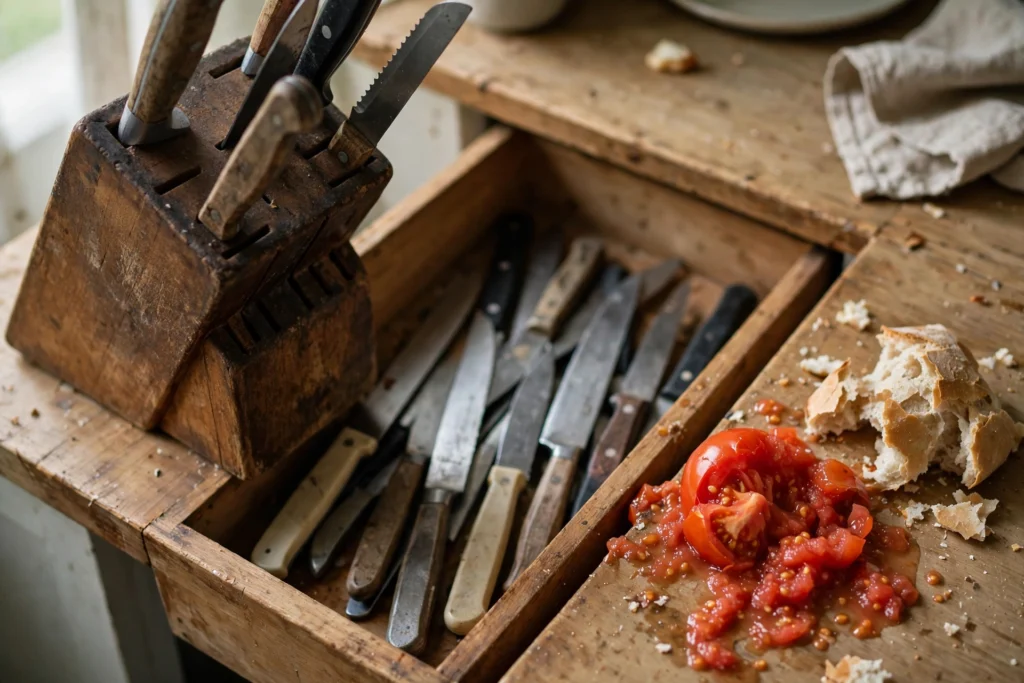
Here is a test you can do right now, in your own kitchen. Take your best chef’s knife, the one you reach for every single day, and try to slice a ripe tomato. Not saw it. Slice it. One smooth draw, no pressure.
If the skin dents in and the tomato squashes before the blade bites, your knife is dull. Mine was too. For years, I just lived with it. I pressed harder. I sawed back and forth. I blamed the tomatoes, the cutting board, the brand of the knife. The knife was never the problem. The edge was.
That is the whole story behind the HORL 2, a walnut rolling knife sharpener from Germany that has become one of the most talked about kitchen tools of 2026. It costs $159, which sounds absurd for something that sharpens knives, until you use it once and realize your knives were never actually sharp to begin with.
The problem is not your knives, it is your edge
A knife does not go dull because the steel wears out. It goes dull because the microscopic edge folds over, chips, and rounds off a little more every time it hits a cutting board. After a few months of daily use, the edge looks fine to your eye but under a microscope it looks like a bent paperclip. That is why it crushes tomatoes instead of cutting them, why onions make you cry more (you are crushing cells instead of slicing them cleanly), and why herbs turn brown at the cut instead of staying bright green.
Most of us deal with this in one of three ways, and all three are bad. We do nothing, and cooking slowly gets more annoying and more dangerous, because a dull knife slips. We buy a cheap pull-through sharpener, which grinds a rough, toothy edge that feels sharp for a week and then gets worse than before. Or we buy a whetstone, watch two videos, use it once, and quietly put it in a drawer because holding a steady 15 degree angle by hand is a skill that takes months to learn.
I have done all three. The whetstone is still in my drawer. The pull-through sharpener went in the bin years ago.
Here is the thing nobody tells you about knife sharpening: the hard part was never the grinding. It was always the angle. Hold the blade at the wrong angle and you are either polishing the side of the knife or chewing up the edge. Get the angle right and almost any abrasive will do the job. That is the one problem the HORL 2 solves, and it solves it with a magnet.
So what is the HORL 2, exactly?
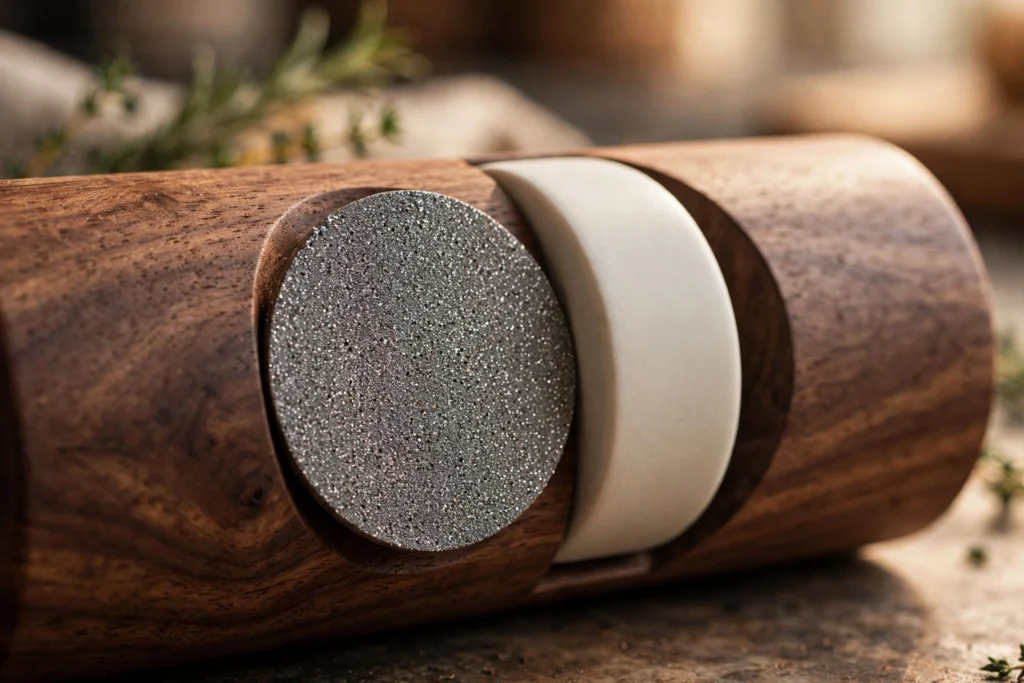
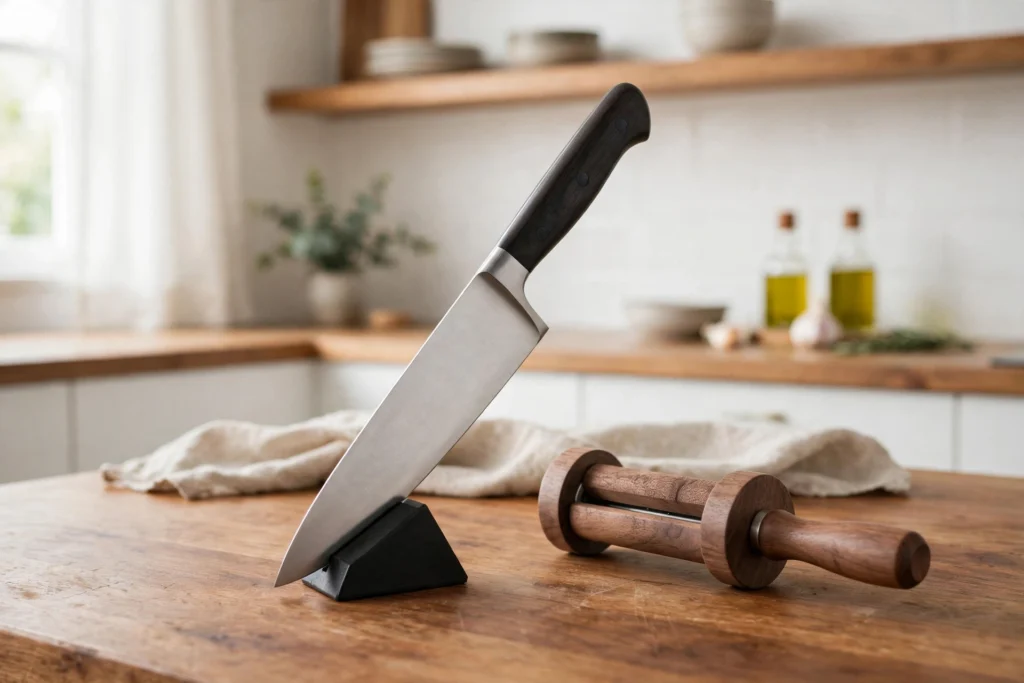
The HORL 2 is a rolling sharpener, and it looks nothing like the sharpeners you grew up with. There is no handle to grip, no slot to drag a knife through, no motor. It is two pieces. The first is a smooth cylinder of solid walnut wood, about the size of a rolling pin for a dollhouse, with a grinding disc on one end. The second is a small black magnetic angle support, a block that holds your knife blade flat and steady at a fixed angle.
You stick the knife to the magnetic block, blade facing out. The magnet holds it at either 15 degrees or 20 degrees, depending on which side of the block you use. Then you roll the walnut cylinder back and forth along the edge, like rolling a tiny paint roller along a wall. The diamond disc does the sharpening. The ceramic disc, which you swap in afterward, does the honing. That is the whole system.
It is made in Germany, and you can feel it the moment you pick it up. The walnut is warm and dense, not plastic pretending to be wood. The roller turns on ball bearings, so it glides instead of juddering. The magnet in the block is strong enough that the knife stays put while you work, which matters more than it sounds, because a knife that shifts mid-stroke is how you get an uneven edge.
Two details are worth knowing before you buy. First, the diamond disc is roughly 400 grit and the ceramic honing disc is roughly 1200 grit, so the system takes you from a genuinely dull edge to a polished, paper-slicing edge in two stages. Second, the discs are interchangeable, so if you want a finer finish later you can buy extra discs instead of a whole new sharpener. The HORL 3, the newer model, works the same way but attaches its discs differently, and costs about $20 more for the same sharpening performance.
How to use it without messing up
The first time feels strange. You are used to moving the knife. Here, the knife stays still and the sharpener moves. Give it one practice run on your cheapest knife and the strangeness disappears in about thirty seconds.
Start by picking your angle. Fifteen degrees gives you a finer, sharper edge, the kind that glides through tomatoes and fish. It is the right choice for most Japanese style knives and for anyone who mainly slices vegetables and boneless meat. Twenty degrees gives you a tougher, more durable edge that stands up to bones, hard squash, and general abuse. Most Western chef’s knives live happily at 20 degrees. If you are not sure, use 20. You can always go finer later.
Stick the blade to the magnetic block with the edge facing away from you and the flat of the blade against the magnet. The block holds it at your chosen angle, so there is nothing to measure and nothing to hold steady. Put the roller on the counter next to the blade, diamond disc facing the edge, and roll it slowly back and forth along the full length of the blade, from heel to tip. Light pressure. Let the diamond do the work. Ten to fifteen passes is usually enough for a dull knife, and you will feel the roller bite less as the edge comes back.
Then swap the diamond disc for the ceramic one and repeat the same rolling motion, another ten passes or so. The ceramic disc does not remove much metal. It polishes the edge and takes off the tiny burr the diamond disc leaves behind. That burr is the difference between a knife that feels sharp and a knife that actually is sharp, so do not skip this step.
Wipe the blade clean, rinse it, dry it, and do the tomato test again. The first time I did this, the knife went through a tomato under its own weight, and I just stood there for a second, slightly annoyed at how many years I had spent sawing.
What it does brilliantly
The best thing about the HORL 2 is that it removes skill from the equation. A whetstone demands a steady hand and a trained eye. A pull-through sharpener demands nothing but gives you a mediocre edge in return. The HORL 2 sits in the middle: it gives you a genuinely good edge, the kind that slices paper and shaves arm hair, without asking you to learn anything. That is a real achievement, and it is why a chef-tested roundup updated in November 2026 picked it as the best rolling sharpener on Amazon, with a 4.4 star average across thousands of reviews.
It is also quiet, small, and oddly satisfying to use. There is no motor, no dust cloud, no sparks. It lives in a drawer or stands on a shelf and looks like a piece of kitchen decor, not a workshop tool. The walnut body is the reason. It is a crafted wooden object in a kitchen full of plastic and stainless steel, and it warms the whole counter up just by sitting there.
It is also kind to your knives. Because the angle is fixed and the pressure is light, you remove far less metal than a pull-through sharpener or an electric grinder. A good chef’s knife can last decades if you sharpen it this way. A cheap knife becomes shockingly usable.
The honest downsides
Nothing this expensive gets a free pass, so here are the real complaints, including the ones owners repeat most often.
First, the price. At $159, the HORL 2 costs more than many people’s entire knife set. That is a fair objection. If you own three cheap knives and replace them every couple of years, this sharpener will never pay for itself. It only makes financial sense if you already own knives worth keeping, or if you cook most days and care about how food prep feels.
Second, it does not do serrated knives. Bread knives, tomato knives with teeth, and serrated steak knives need a different tool entirely, usually a tapered ceramic rod. If serrated blades are half your kitchen, this is not a complete solution.
Third, you only get two angles, 15 and 20 degrees. That covers almost every kitchen knife, but if you own a specialty blade that wants 12 degrees, or a heavy cleaver that wants 25, you are out of luck. The fixed angles are the whole point of the design, so this is a trade-off, not a bug, but it is worth knowing.
Fourth, the first setup feels fiddly. Getting the knife seated flat on the magnetic block takes a try or two, and left-handed cooks report that the motion feels backwards until they get used to it. It is a five minute learning curve, not a real problem, but a few owners mention it in reviews, and it is the kind of thing that makes someone put it back in the box on day one.
Finally, the HORL 3 exists now. It sharpens exactly the same way, with the same discs and the same angles, but its discs attach differently and it costs about $20 more. If you like buying the latest version of things, look at both before you decide.

Is $159 actually worth it?
Let us do the math honestly, because $159 is real money. A professional sharpening service charges roughly $5 to $10 per knife, and most home cooks need their main three knives done two or three times a year. That is $30 to $90 a year, every year, plus the hassle of dropping knives off and picking them up. The HORL 2 pays for itself in about two years on that math alone, and then it keeps working for free.
Compare it with the alternatives. A decent whetstone set costs $30 to $60, plus months of practice before your edges are consistent. An electric sharpener costs $60 to $150 and removes a lot of steel. A pull-through sharpener costs $15 and is, frankly, the reason your knives are dull in the first place. If you are still weighing the options, this practical guide to choosing a knife sharpener lays out the trade-offs well. The HORL 2 is the most expensive option on this list, and also the only one that gives a beginner a professional quality edge on the first try.
There is also a hidden cost to dull knives that never shows up in a spreadsheet: time and safety. Dull knives slow you down, they bruise herbs, they crush tomatoes, and they slip. A sharp knife is a safer knife, because it goes where you tell it to go.
Who should buy it? Anyone who owns at least one good knife, cooks most days, and has no interest in learning whetstone technique. Who should skip it? Anyone with a drawer full of $10 knives, anyone who mostly uses serrated blades, and anyone who genuinely enjoys the ritual of a whetstone. All three are fine choices. Know which one you are before you spend the money.
If $159 still feels steep, watch for holiday pricing. The sharpener has been seen around $109 in older listings, and the newer HORL 3 sometimes goes on sale too. Prices move, so check the current listing before you buy, and be careful with third-party sellers. The real product is made in Germany and sold through Amazon, where the November 2026 chef-tested roundup verified the listing with a working add to cart and new stock.
A better gift than another gadget
We are in mid-November, which means the gift guides are already everywhere, and most of them are full of gadgets nobody asked for. The HORL 2 is a genuinely good gift for the cook in your life, for a few reasons that have nothing to do with sharpening.
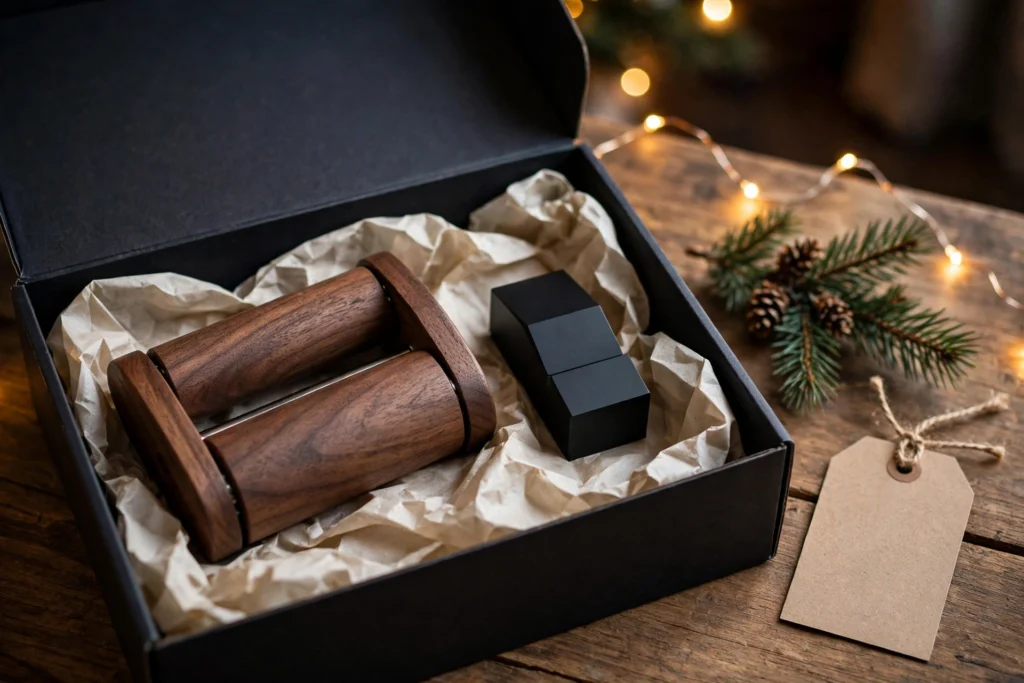
First, it is the kind of thing people never buy for themselves. It sits in that awkward price range, too expensive to impulse buy, too niche to ask for, which is exactly where the best gifts live. Second, it is beautiful. A walnut roller in a gift box looks like a considered present, not a last minute grab from a discount shelf. Third, it solves a problem the recipient actually has, even if they have never said it out loud.
Pair it with something small and the gift lands even better. A good wooden cutting board, a bottle of decent olive oil, or a hand-poured candle for the kitchen table, and you have a gift that looks like you thought about it for more than five minutes. If you want ideas for the cutting board half of that pairing, our guide to book-shaped acacia cutting boards is a good place to start, and our handmade wood and epoxy resin coasters make a matching stocking filler.
How to keep it, and your knives, in good shape
The sharpener itself needs almost no care. Wipe the walnut roller with a dry cloth after use, and rub in a drop of food-safe mineral oil every few months if the wood starts to look dry. Keep the discs clean and dry, and store the whole kit somewhere it will not get knocked around. That is it. There are no batteries, no parts to replace on a schedule, and nothing to calibrate.
Your knives need a little more attention, and the sharpener works best when it is part of a routine rather than a rescue mission. Hone your main knife with the ceramic disc every week or two, just a few passes, and you will rarely need the diamond disc at all. Store knives on a magnetic strip or in a block with the edges protected, never loose in a drawer where they bang against each other. And wash them by hand. A dishwasher does not just dull the edge, it loosens handles and spots the steel.
One last habit worth building: test your edge every Sunday. Slice a tomato, or shave a little paper. If it drags, five minutes with the roller fixes it.
The verdict
The HORL 2 walnut rolling knife sharpener is expensive, it cannot sharpen serrated knives, and it only offers two angles. Those are real limits, and you should know them before you buy. But for the job it is designed to do, turning a dull straight-edged kitchen knife into a razor sharp one with no skill and no learning curve, it is the best tool I have used, and the walnut body makes it the best looking one too.
If you own good knives and you cook most days, $159 buys you years of sharp edges, safer prep, and food that actually gets sliced instead of squashed. If your knives are cheap and you replace them often, save your money. Either way, stop cooking with dull blades. Your tomatoes will thank you.
Want more ideas for a kitchen that works as good as it looks? See our handmade wooden home pieces on thecavee.com, and follow us on Pinterest for a new handcrafted find every day.