Walk Inside a Volcano’s Throat: Your 2026 Guide to Iceland’s Raufarholsshellir Lava Tunnel
Most people go to Iceland for the waterfalls. They are loud, they are tall, and they photograph well, which is exactly why your feed is full of them. But the strangest thing I have done in Iceland did not involve looking up at anything. It involved walking down into the ground, into a tunnel that a river of molten rock carved out more than 5,000 years ago. Raufarholsshellir is a lava tube about 30 minutes from Reykjavik, and it is one of the few places on Earth where you can stroll, on a proper walkway, straight through the inside of a volcano’s plumbing.
It is not a climb, it is not a crawl, and it is not one of those adventures that only works if you are 25 and fearless. Kids as young as three can do the standard tour, and the whole thing takes about an hour. This guide covers what the tunnel actually is, what the tour is like, what it costs in 2026, and the honest bits the brochures leave out.
What Raufarholsshellir actually is
Raufarholsshellir (pronounced roughly ROW-var-hols-hetl-ir, though nobody will judge you for just calling it the Lava Tunnel) is a lava tube in the Leitahraun lava flow, south of Reykjavik, near the foot of the Blajfoll mountains. The tube is 1,360 metres long, up to 30 metres wide in its biggest chambers, and about 10 metres high in places. That makes it one of the longest lava tubes in Iceland, and one of the most accessible anywhere in the world.
Here is the short version of how it formed. About 5,200 years ago, an eruption east of the Blajfoll mountains poured out a huge flow of runny basalt lava. The surface of the flow cooled first and hardened into a crust, while the molten rock underneath kept moving. Think of it like a river that froze over on top while the water kept flowing below. Eventually the eruption stopped, the remaining lava drained out downhill, and what was left behind was a hollow tube: a long, empty corridor with a rippled floor, a vaulted ceiling, and walls that still show the wrinkles of the flow that made them.
The cave sits under the road locals call the Threngsli road, route 39, which runs toward Thorlakshofn on the south coast. For centuries it was just a hole in the lava field that farmers knew about and everyone else ignored. Today it is one of only two lava tunnels in Iceland you can visit on a regular guided tour. The other is Vidgelmir in the west, which is bigger at 1,585 metres but further from Reykjavik.
What you actually see down there
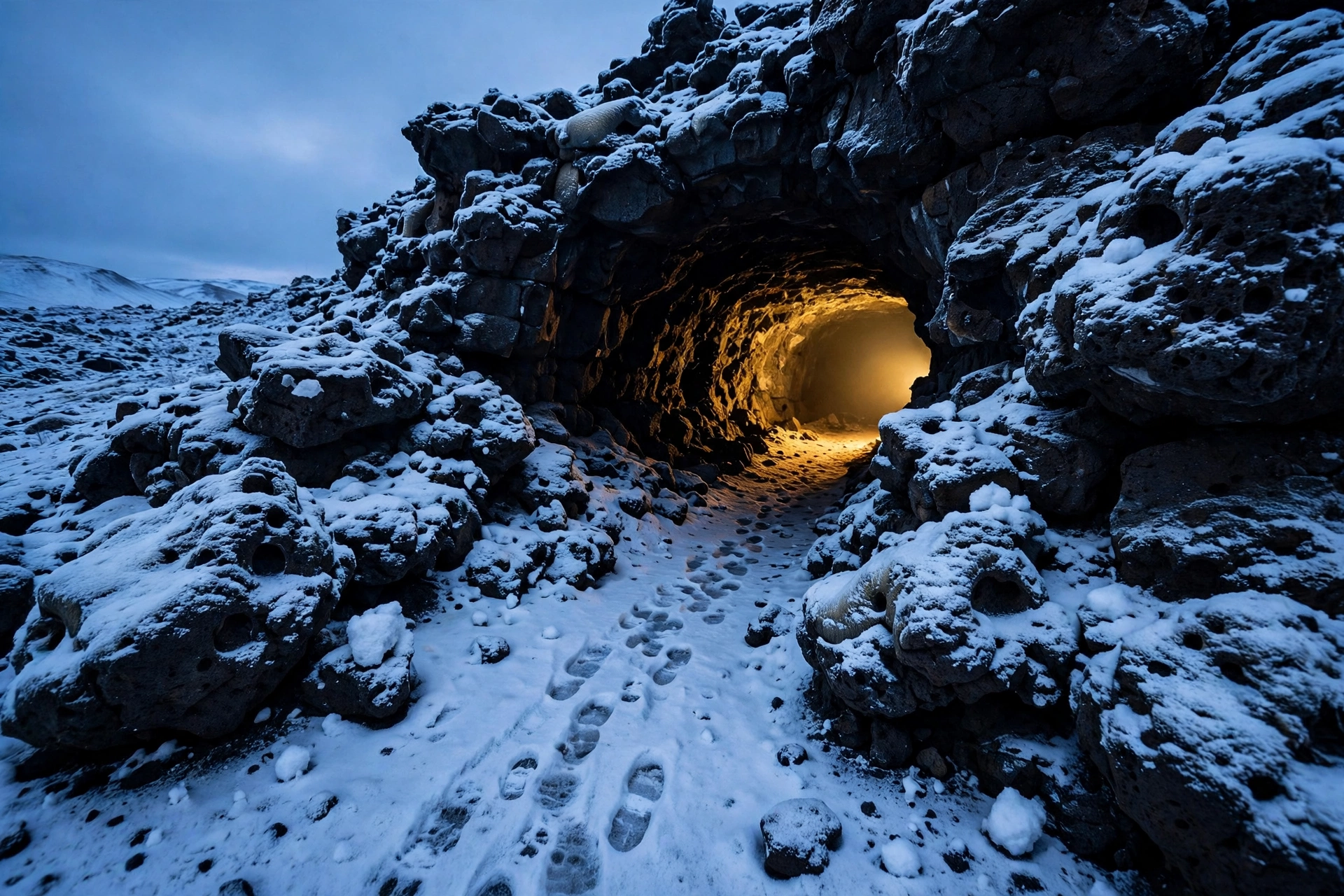
The standard tour follows a built walkway with permanent lighting through roughly the first third of the tunnel. That sounds tame, and in a way it is, but the scale of the place does the work for you. You walk in through a collapsed section where daylight still reaches, and within a few minutes the light thins out and the lamps take over. The ceiling arches above you like the inside of a cathedral built out of cooling rock. In the widest chamber you could park a bus sideways and still have room.
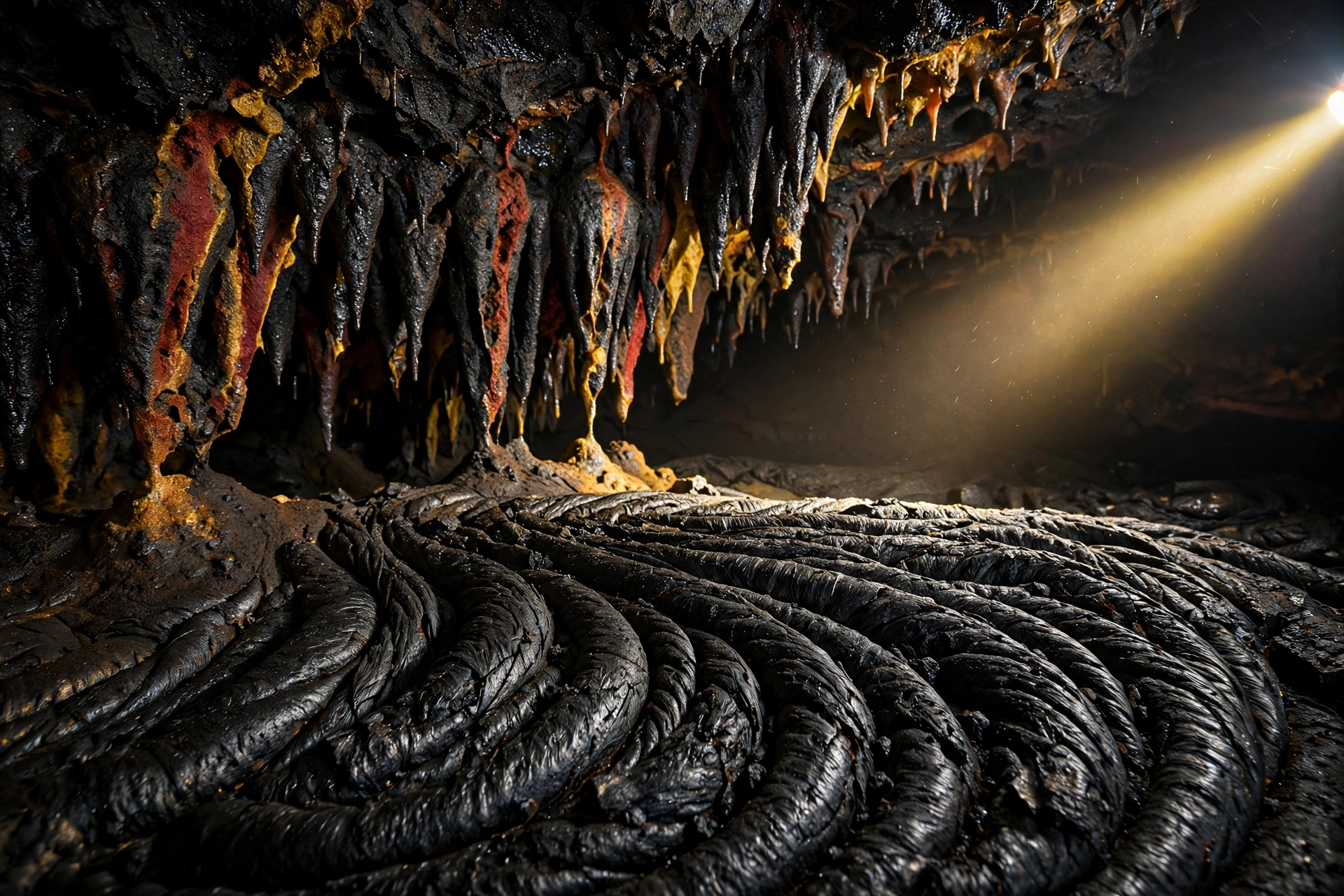
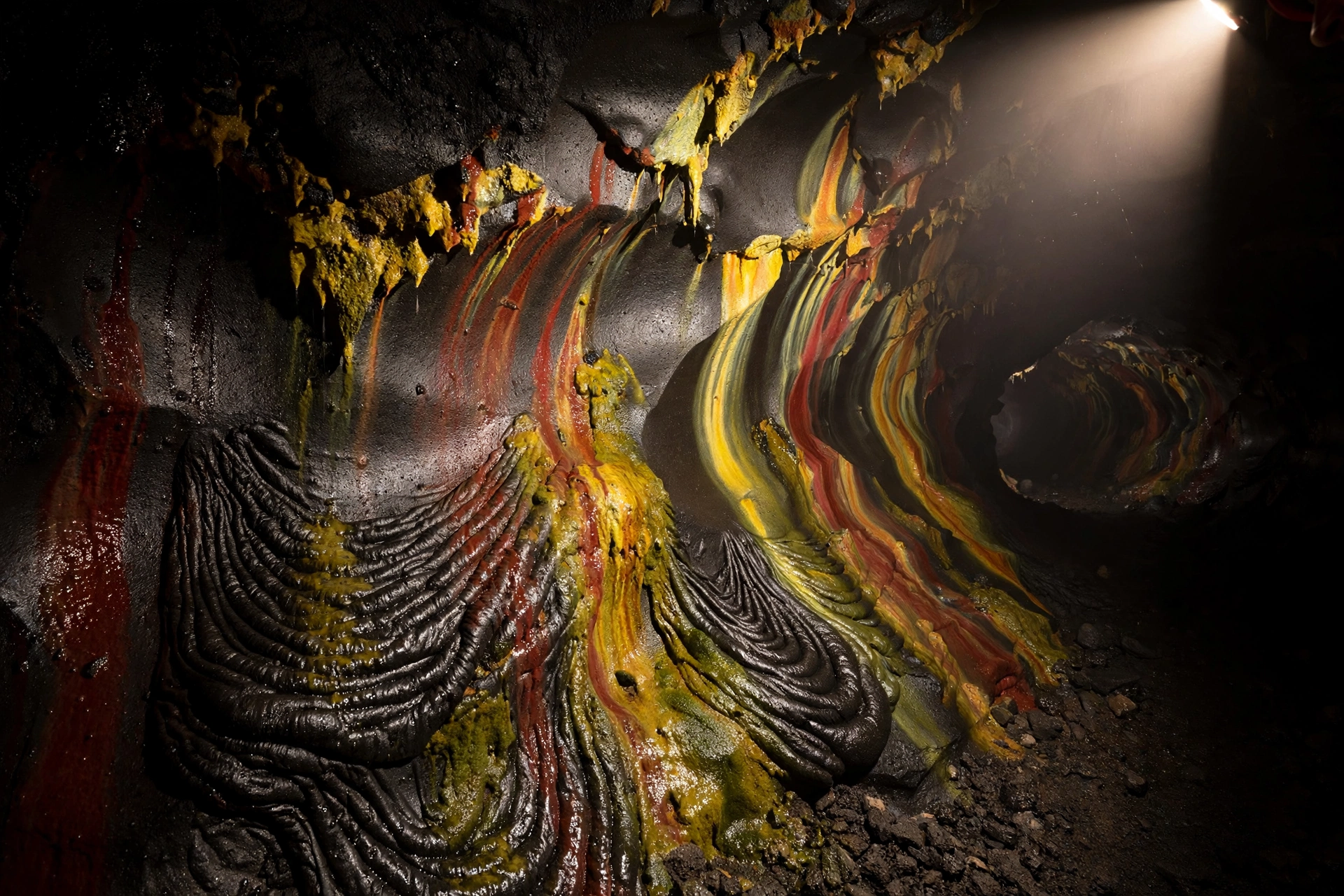
Look down and the floor tells the story. It is rippled and folded like a frozen river, because that is literally what it is. In places the lava dripped from the ceiling as it cooled, leaving lava stalactites that look like stone icicles. Look closely at the walls and you will see streaks of colour, rust red, ochre yellow, olive green, where minerals in the rock oxidised over thousands of years. The guides point out the details you would walk straight past: a shelf where the lava level once sat and then dropped, a side passage that branches off into the dark, a spot where the roof collapsed long ago and let a shaft of daylight in.
About halfway along the lit section, the guide usually does the thing every cave guide does. They turn the lights off. For a few seconds you stand in total darkness, the kind of dark you never get in a city, and you listen to water dripping somewhere you cannot see. It is a small moment, but it is the one people remember. Then the lights come back on and everyone laughs a little too loudly, which is how you know it worked.
The standard tour: one hour, easy walking
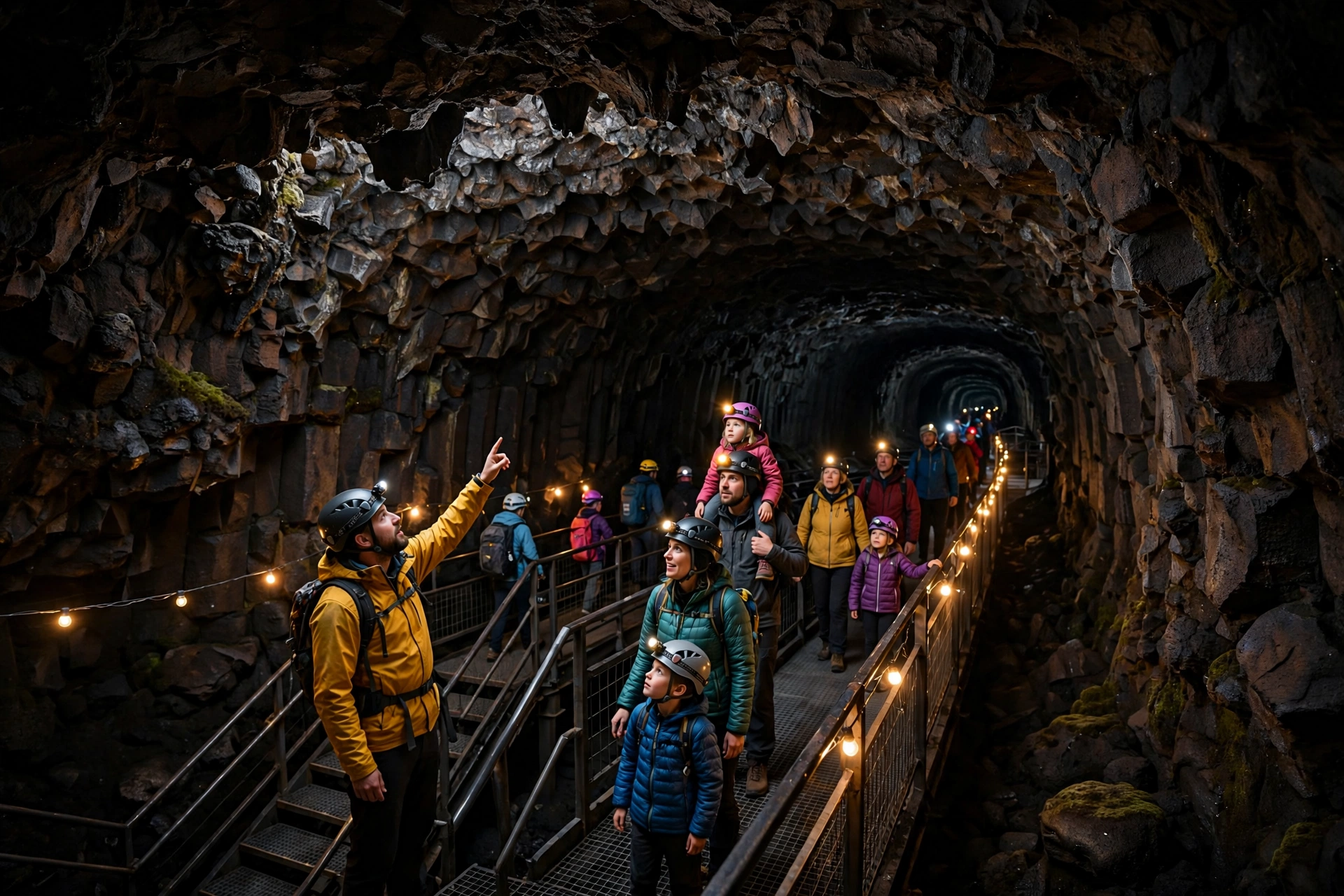
The standard tour, called the Underground Expedition by the operator, lasts 55 to 60 minutes inside the cave. Tours leave every hour from 9 in the morning to 5 in the afternoon, all year round. You meet at the cave itself, which is about 30 kilometres and under 30 minutes by car from the edge of Reykjavik, or you book a version with transport from the city that takes around three hours door to door.
Helmets and lights are included, and the guiding is in English. There is no crawling, no squeezing through gaps, and no rope work. You walk on paths, a footbridge, and some stairs, so anyone who can manage uneven ground and a flight of stairs will be fine. Children from the age of three can join, which makes this one of the rare Icelandic adventures that actually works for a whole family, grandparents included.
The Lava Falls Adventure: three hours in the dark
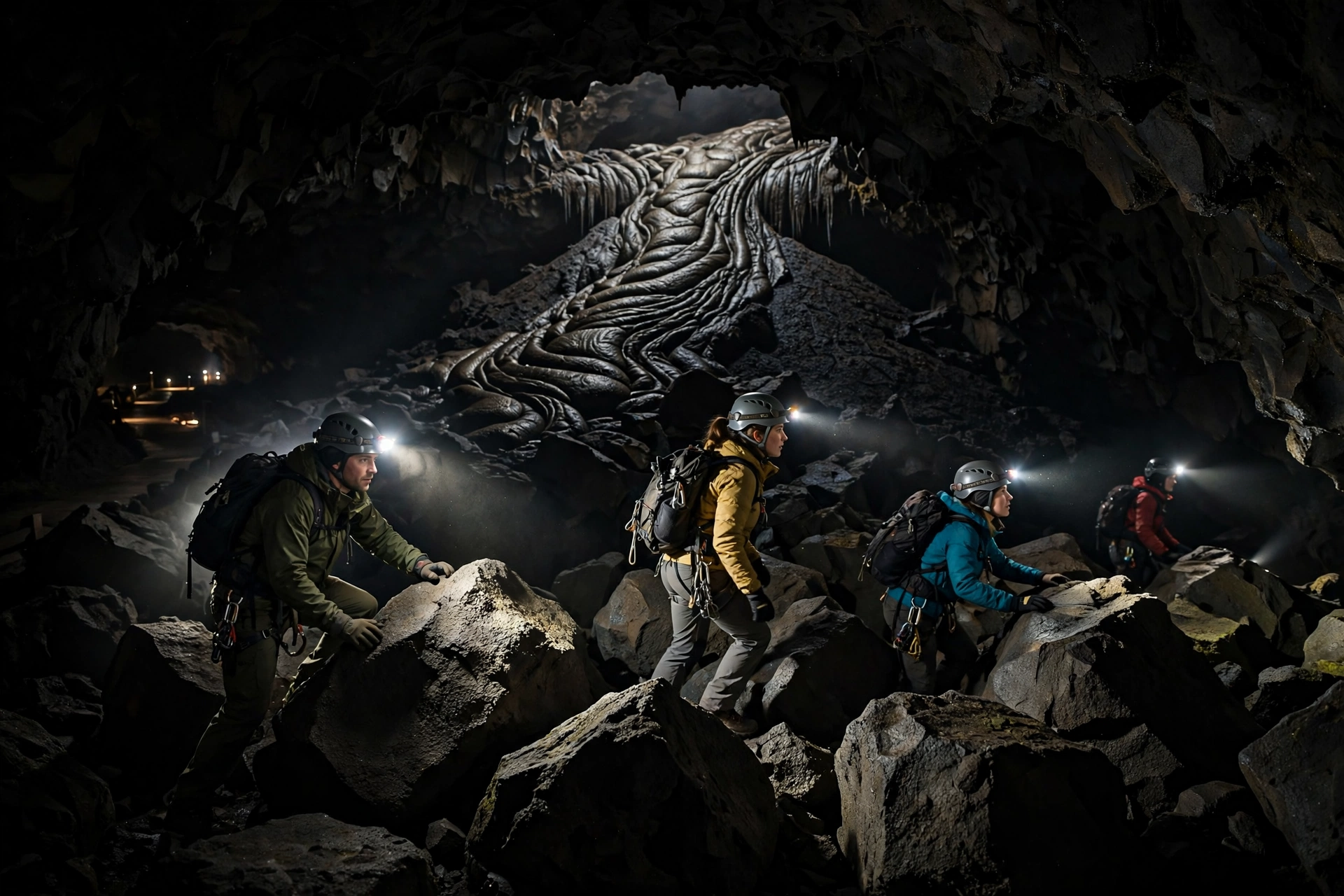
Past the end of the lit walkway, the tunnel keeps going, and it gets rougher, darker, and much more interesting. The Lava Falls Adventure is the operator’s longer tour. It runs three to four hours, it goes all the way to the far end of the tube, and it leaves the walkway behind. You cross collapsed roof blocks, duck under low sections, and walk in the dark with only your headlamp for light. At the far end you reach the lava falls, a frozen cascade of rock where the lava once poured down a step in the tunnel floor.
The price reflects that. The Lava Falls Adventure costs 27,900 Icelandic krona per person, which works out to roughly 219 US dollars, and it has an age limit of 12. Groups are capped at eight people, and you need to book at least a day ahead. It is not technical, you do not need experience, but you do need to be comfortable with uneven ground, crouching, and a few hours underground. If the standard tour is a museum visit, this one is a proper expedition, just with a guide who knows where the floor is.
Which one should you pick? If you have kids under 12, the choice makes itself. If you are short on time, take the standard tour. If you have done caves before and found them too tame, or if you are the kind of traveller who always wonders what is past the rope, the Lava Falls tour is the one you will still be talking about at dinner.
Prices, hours and booking in 2026
Prices shift a little between sellers, so treat these as the numbers to budget around, and check the operator’s site before you book. The standard tour, meeting at the cave, costs 8,900 Icelandic krona for an adult, which is roughly 67 to 70 US dollars depending on the exchange rate. Children aged 6 to 15 pay 4,450 krona, and children aged 3 to 6 go free. The same price applies whether you book ahead or walk up on the day, though in summer the hourly slots can fill up, so booking ahead is the safer move.
With transport from Reykjavik, the standard tour costs about 14,900 krona and takes around three hours in total. Resellers list the same tour from about 52 to 70 euros at the door, or 103 euros and up with a bus transfer, so the operator’s own price is usually the cheapest way in.
Hours are simple: every day, all year, with departures on the hour from 9 in the morning to 5 in the afternoon. That year-round opening is a real advantage over Iceland’s other famous underground trip, the Thrihnukagigur volcano tour, which runs only from about May to October and costs around 51,000 krona. In the depths of an Icelandic winter, Raufarholsshellir is still open and still running on the hour.
Getting there from Reykjavik
Driving is the easy option. Take route 1, the Ring Road, south out of Reykjavik, then turn onto route 39, the Threngsli road toward Thorlakshofn. The cave is about 12 kilometres along route 39, roughly 30 kilometres in total from the city, and the drive takes under 30 minutes from the edge of town. There is parking at the site.
If you do not have a car, the bus tours from Reykjavik handle the transport, and they pick up from hotels and the main bus terminal. The three-hour version with transport is the simplest choice. There is no public bus that drops you at the cave door, so do not plan on figuring it out with a city bus pass.
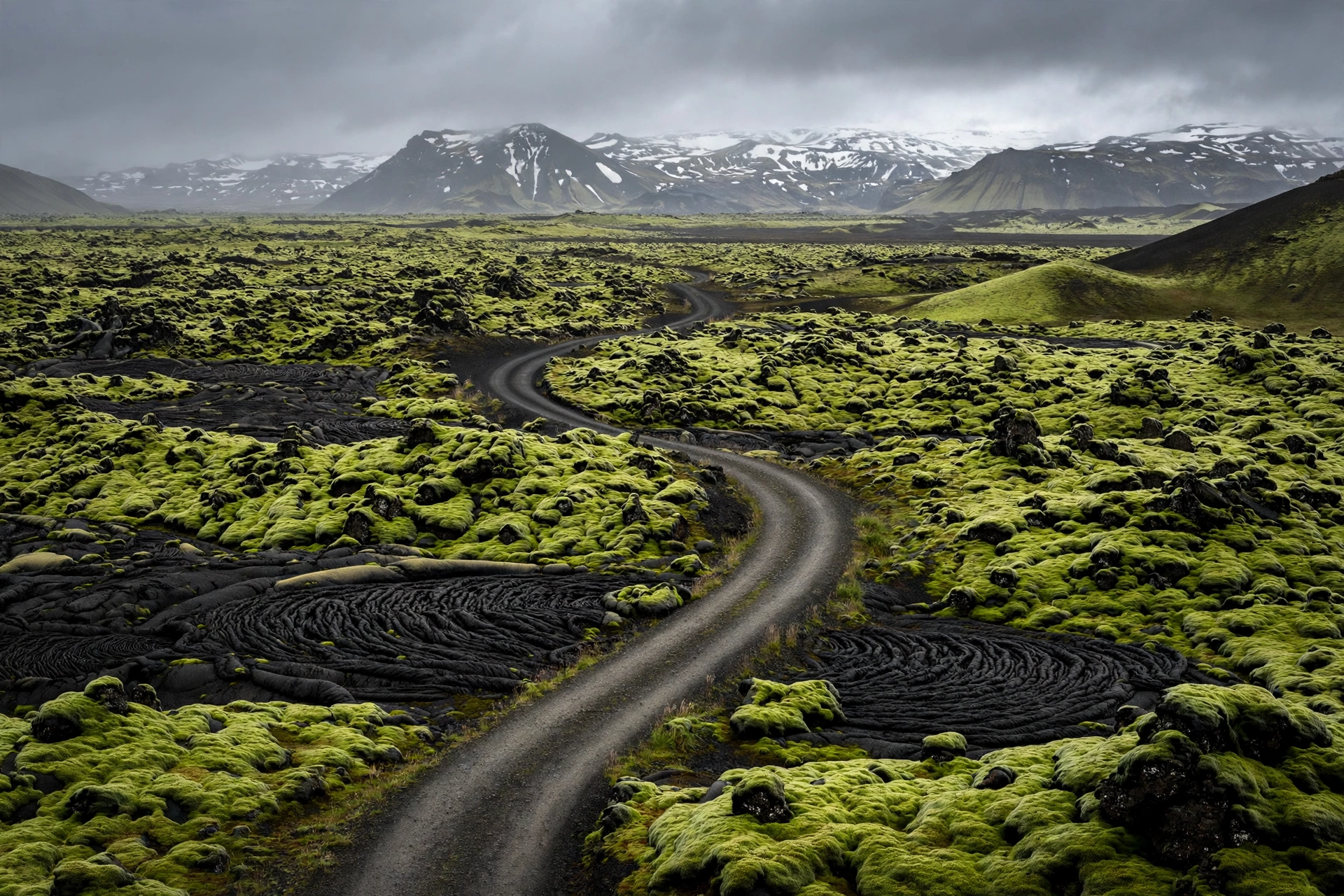
Allow a little buffer. The tours leave on the hour, and if you arrive ten minutes late you will wait for the next one. Get there 20 to 30 minutes early, use the facilities, and take a look at the lava field outside. It is worth a few minutes on its own: black, rippled rock covered in thick green moss, with the Blajfoll mountains behind it. It looks like the surface of another planet, and in a sense it is the roof of the cave you are about to walk through.
What to wear and what to bring
This is the section that saves people from a miserable hour, so read it even if you skip everything else. Wear sturdy, closed shoes with a good grip. The walkway is fine, but the ground around it and the approach paths are uneven basalt, and it can be slick when wet. Trainers are fine, flip flops are not, and I have seen both.
Wear warm layers. The temperature inside sits around freezing to a few degrees above it all year, and it feels colder when you stop moving to listen to the guide. A waterproof jacket is smart even on a dry day, because water drips from the ceiling in places. A hat and gloves are worth packing from October to April, and honestly in the other months too.
Bring a camera or a phone with a decent low-light mode. The walkway is lit, but the best shots come from the moments when the guide pauses and the lamps catch the colours in the rock. Bring water, especially for the Lava Falls tour, and use the toilet before you go in. There are no facilities inside the tunnel, for reasons that should be obvious. Leave the big backpack in the car if you can. On the longer tour you will be glad you travelled light.
Is it actually worth it? An honest answer
Yes, with one caveat. If you have never been inside a cave, or never been inside a lava tube, this is a superb first one. It is close to Reykjavik, it is cheap by Icelandic standards, it runs all year, and it delivers a genuine sense of scale that photos do not capture. The moment when you stand in a chamber 30 metres wide and realise the whole thing was once full of flowing rock is the kind of thing that rearranges how you think about the ground under your feet.
What to pair it with
Raufarholsshellir works best as part of a day, not as the whole day. The classic pairing is the Golden Circle, since the cave sits roughly on the way between Reykjavik and Thingvellir National Park. Do the cave first in the morning, then head to Thingvellir, where you can walk between two tectonic plates, and finish at the Geysir area or Gullfoss waterfall. That is a full day, and a very Icelandic one: fire below ground in the morning, water and steam above ground in the afternoon.
If you are staying in Reykjavik for a few days, the cave also makes a good bad-weather plan. Rain does not matter underground, and a wet, windy day outside makes the still air inside the tunnel feel even better.
Quick answers before you go
How long is the tunnel? The tube is 1,360 metres long, up to 30 metres wide, and about 10 metres high in its largest chambers. The standard tour covers the lit first section in about an hour.
How old is it? The lava flowed about 5,200 years ago, from an eruption east of the Blajfoll mountains. The tunnel has been there ever since.
Do I need to book ahead? Not always, the same price applies on the day, but summer weekends and the Lava Falls tour do sell out, so booking ahead is sensible. One honest caveat: this is a show cave, not a wilderness cave. The lights, the walkway, and the hourly groups mean it never feels lonely or dangerous, and if you have explored wild caves before, the standard tour may feel a bit packaged. That is exactly why the Lava Falls tour exists.
Can kids go? Yes. Children from three years old can join the standard tour, and it is free for ages three to six. The Lava Falls Adventure is 12 and up.
Is it open in winter? Yes, all year, with tours every hour from 9 to 5. Winter is actually a lovely time to go, because the contrast between the snow outside and the still air inside is at its best.
What if I am claustrophobic or have limited mobility? The standard tour chambers are huge and the walkway is open, so most nervous visitors are fine, but the Lava Falls tour has low sections and long dark stretches with no quick exit, so skip that one. The standard tour involves stairs and uneven ground and is not wheelchair accessible, so email the operator first if you are unsure.
The bottom line
Iceland gives you a lot of ways to look at volcanoes from the outside. You can hike their slopes, photograph their craters, and soak in the hot water they heat. Raufarholsshellir is the rare chance to go inside one instead, to walk the exact path the lava took, and to stand in a space that was glowing orange 5,200 years ago and is now cool, dark, and quiet. It costs about the same as a decent dinner in Reykjavik, it takes an hour, and it is 30 minutes from the city. That is a hard combination to beat.
Love caves like this? We collect the world’s strangest underground places, from glowworm caves to lava tubes. Follow The Cavee on Pinterest for a new cave adventure every day, and read the full story on thecavee.com. If you have been to Raufarholsshellir, tell us which tour you took, the easy walkway or the Lava Falls scramble, and which one you would pick again.
Planning more Iceland adventures? Start with our Iceland ice cave tours guide for 2026 and 2027, then compare the scale of the world’s biggest cave systems in our Son Doong guide. And if underground rivers are more your thing, our Labouiche underground river guide covers Europe’s longest navigable underground river by boat.
For prices and booking details, check the operator’s own site at raufarholshellirlavatunnel.com, and compare Iceland’s lava caves at Discover Iceland’s lava tunnel guide.