Labouiche Underground River: Boat 60 Metres Under France on Europe’s Longest Navigable Underground River
Most caves ask you to walk. Labouiche asks you to sit down, stay quiet for a second, and float. Sixty metres under the green hills of the French Pyrenees, a river runs through the dark, and the only way to see it is by boat. No headlamp hike, no crawling, no ropes. Just a small metal boat, a guide pulling a cable, and a kilometre and a half of black water under solid rock.
It sounds made up. It is not. The Riviere souterraine de Labouiche, near the town of Foix in southern France, is the longest navigable underground river in Europe that is open to the public. People have been riding it since 1938, and somehow it still feels like a secret. If you like caves, boats, or just the idea of doing something your friends have never heard of, this one belongs on your list.
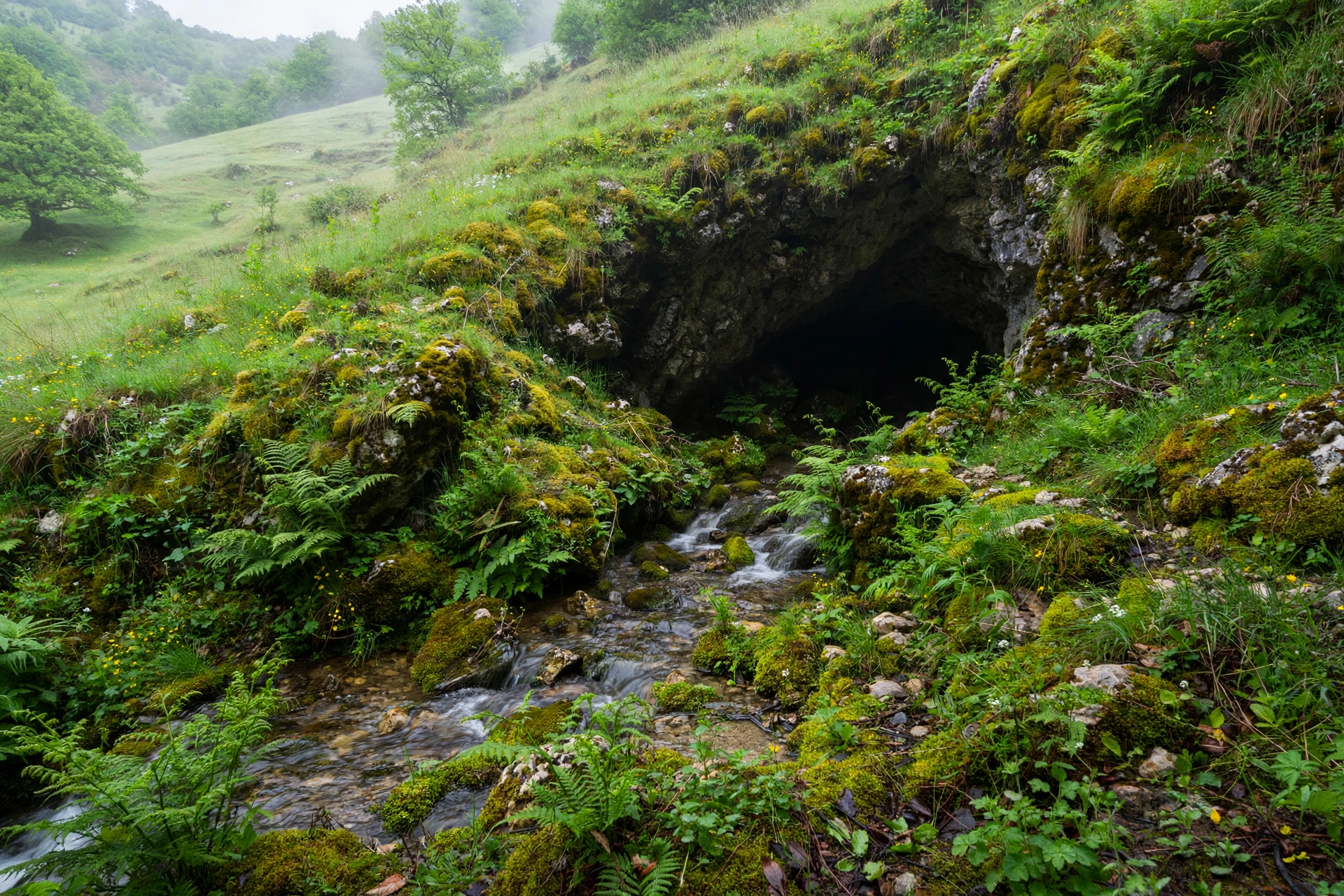
What exactly is Labouiche?
Labouiche is a river that went underground and never came back up. The full network of connected galleries runs about 3,850 metres through limestone, 6 kilometres northwest of Foix, between the villages of Vernajoul and Baulou, inside the Ariege Pyrenees Regional Natural Park. The part you can visit is 1.5 kilometres of it, done mostly by boat, 60 metres below the surface.
The water stays at 13 degrees Celsius all year. The air does too. The cave is a classified site, which in France means it has real legal protection, and it is also a prehistoric site. The upper galleries held Magdalenian art, which puts human history here at more than 12,000 years back. You are not just floating through a pretty cave. You are floating through a place where Ice Age people left their mark.
Ariege is the most cave-packed corner of France. The same department holds Niaux, with its 14,000-year-old bison paintings, and Lombrives, the largest cave in Europe. Labouiche is the odd one out in that family, because here the river is the main character, not the walls. If you have already read our guide to Italy’s Grotte di Castellana, think of Labouiche as its wilder French cousin: less polished, more water, and a lot more darkness.
How a village doctor found a river under his feet
The story starts in August 1908, and it starts the way the best cave stories always start, with someone local poking around where nobody had thought to look. Dr Jules Dunac, a doctor from Foix, went into a hole in the ground called Aigo Perdent with his two sons and two young officers. They got 280 metres in before the water stopped them at a flooded passage called a sump.
That was only the beginning. In 1935, explorers Paul Salette and Pierre Cremadells, helped by the famous caver Norbert Casteret and Joseph Delteil, pushed through and mapped 3,800 metres of active river network before a second sump stopped them. Three years later, in 1938, Salette fitted the cave out and opened it to the public. The boats, by the way, were carried in piece by piece and welded together underground, because there was no other way to get them in. They are still down there.
People keep trying to find where the river actually comes from. In 2015, divers went into the upstream sump looking for the source and came back without an answer. The river still keeps that secret. I like that. Not everything underground needs a full explanation.
What the boat ride is actually like
Here is the part everyone wants to know. You do not paddle. You do not steer. You sit in a flat metal boat that holds about a dozen people, and your guide pulls the boat along by a rubber cable fixed to the walls. Sometimes the cable goes quiet and the boat just drifts. The only sounds are water dripping, the cable creaking, and somebody in the back whispering because the dark makes everyone whisper.
The visit lasts about an hour and fifteen minutes. You will change boats twice along the way, stepping from one to another at small landings in the dark, which is half the fun and the part that makes kids go wide-eyed. Some galleries are lit, some are deliberately left dark, and the guide switches the lights on and off to show you what the cave looks like with and without them. Without them, it is the kind of dark you cannot find above ground anymore.
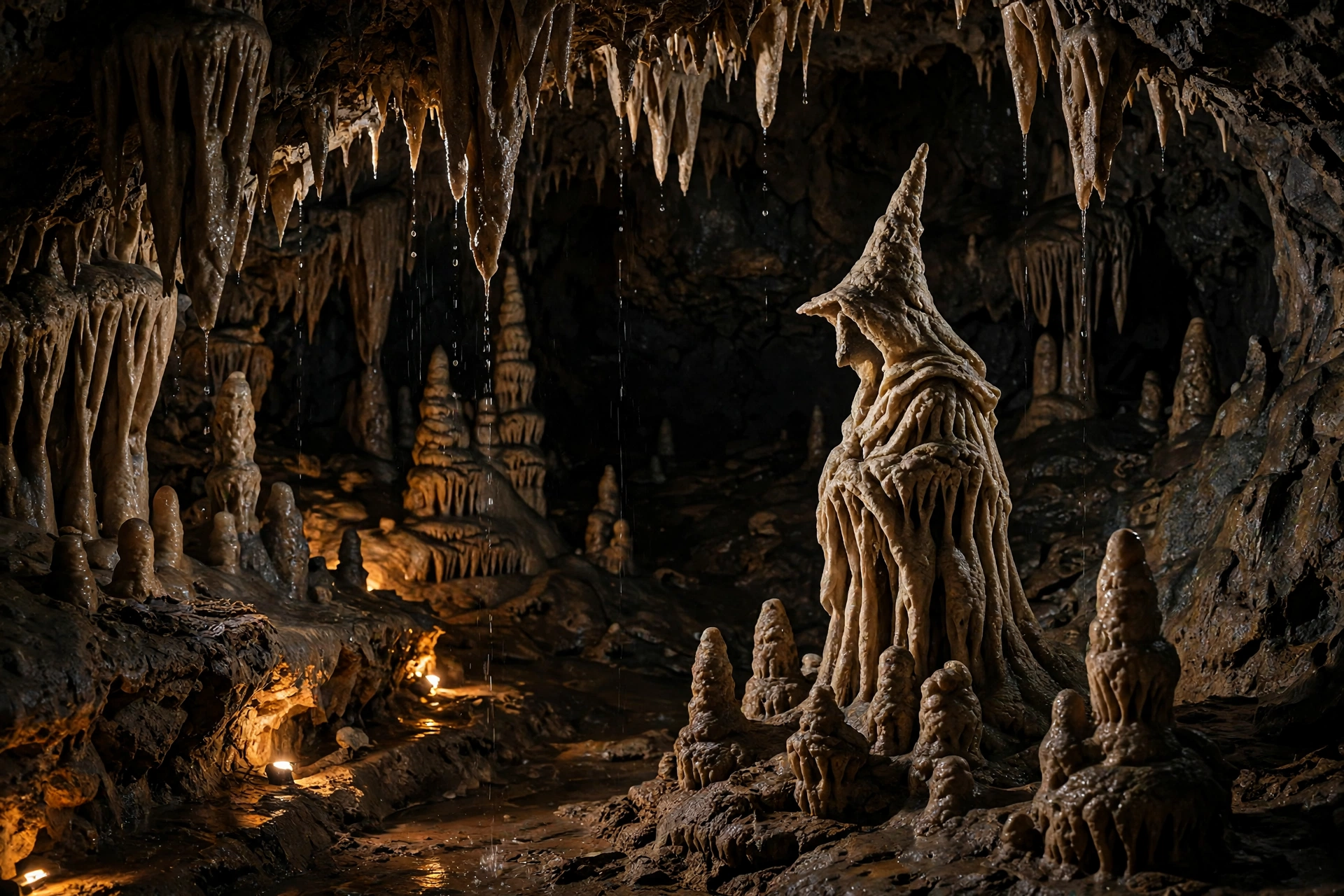
The formations have names, because French cave guides love names. Look out for la Sorciere, the Witch, and la Licorne, the Unicorn, two rock shapes the guide will point out with a lamp. There is a waterfall inside too, and in the quiet stretches you can hear it before you see it. The rock walls change colour as you go, orange and tan layers sloping overhead, and the water below throws the lamplight back at the ceiling in slow ripples.
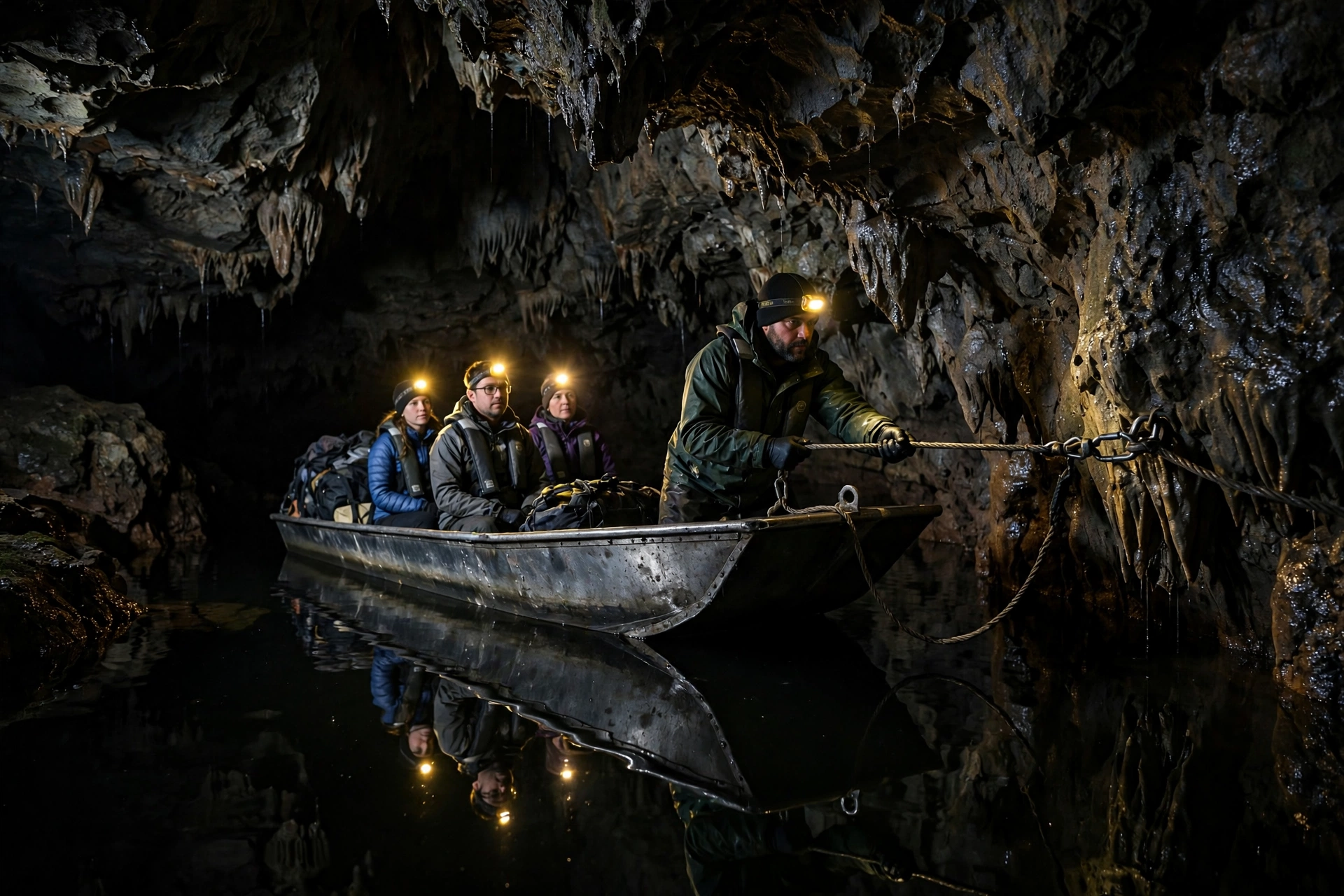
Is it scary? Honestly, a little, in the good way. The ceiling drops low in places, the passages narrow, and at one point another boat coming the other way has to wait while yours squeezes past. TripAdvisor reviews from 2026 keep saying the same thing: the boats bump the walls, the guide has to call out to the other boat, and everyone laughs about it afterwards. It feels like an expedition, not a theme park ride. That is the whole point.
One thing worth knowing: the cave is not a walk in the park, literally. There are no paved tourist paths with handrails the whole way. You are in a boat, in the dark, 60 metres down. If that sentence excites you, you will love it. If it makes your stomach tighten, keep reading, because the next section is the honest part.
The 200 steps nobody warns you about
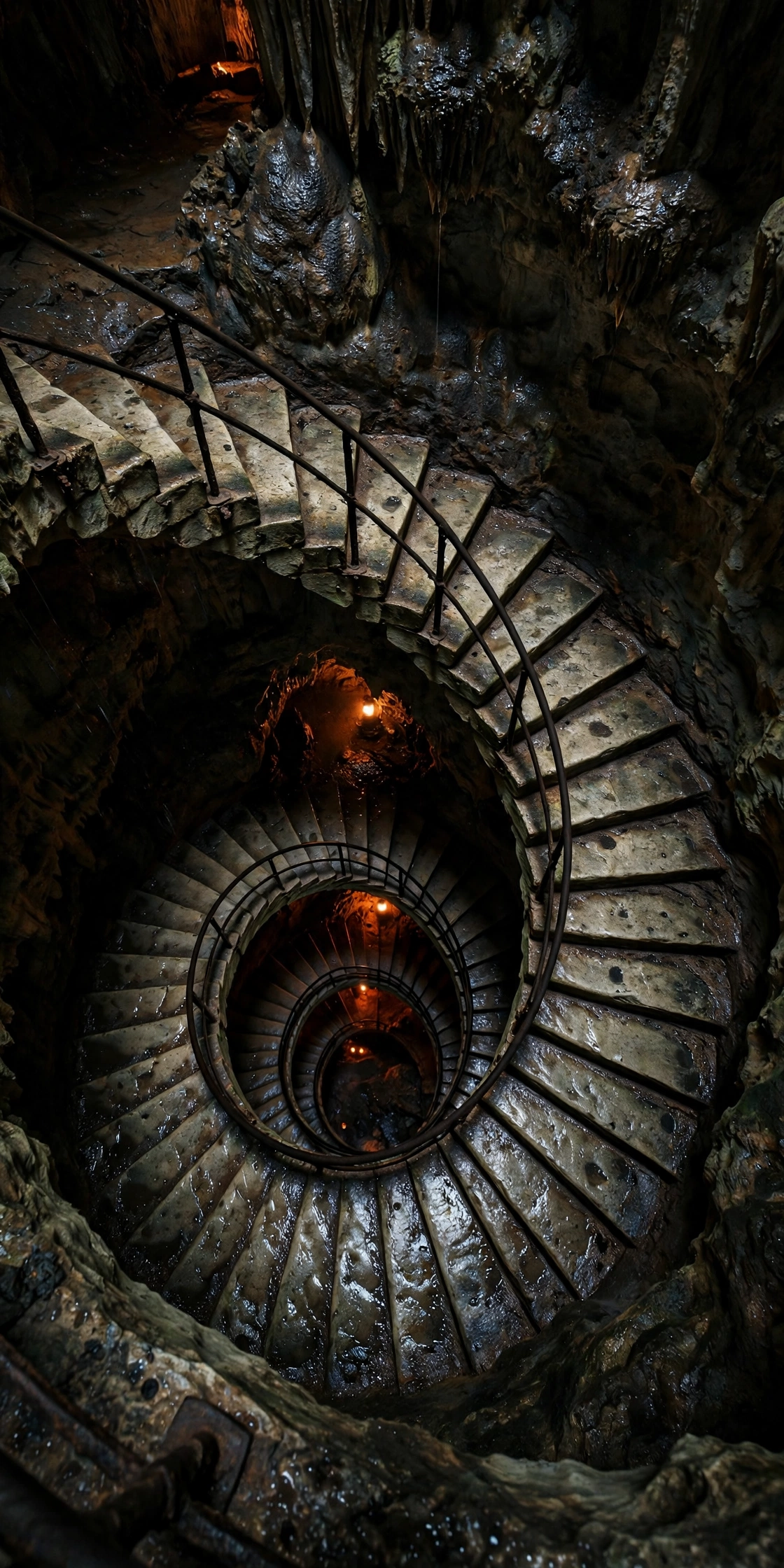
Here is the catch, and it is the one thing that surprises people. Getting down to the river means stairs. About 200 of them, down a spiral staircase, if you enter through the artificial entrance. The natural entrance is a small hiking path down instead. Either way, what goes down must come back up, and the other entrance is how you leave. So you will climb about 200 steps at some point in the visit.
It is not a race, and the guides are used to people taking their time, but you do need to be in reasonable shape and comfortable with stairs. Good shoes matter, because the steps and the cave floor can be wet. The official advice is simple: bring a sweater, wear shoes that grip, and do not try it in flip-flops. At 13 degrees, the cave feels cold after the first ten minutes, even on a hot July day in the Pyrenees. That cold is actually a relief in summer, but only if you dressed for it.
Animals are not allowed, even in a bag. The cave is home to bats and to the Pyrenean newt, a small amphibian called a calotriton that lives in these underground waters. The wildlife is part of why the cave is not open every month of the year. The current season runs from February to mid-November 2026, plus a Christmas window from December 19, 2026 to January 3, 2027. Check the official site before you go, because hours change with the season.
The Ice Age art hidden in the upper galleries
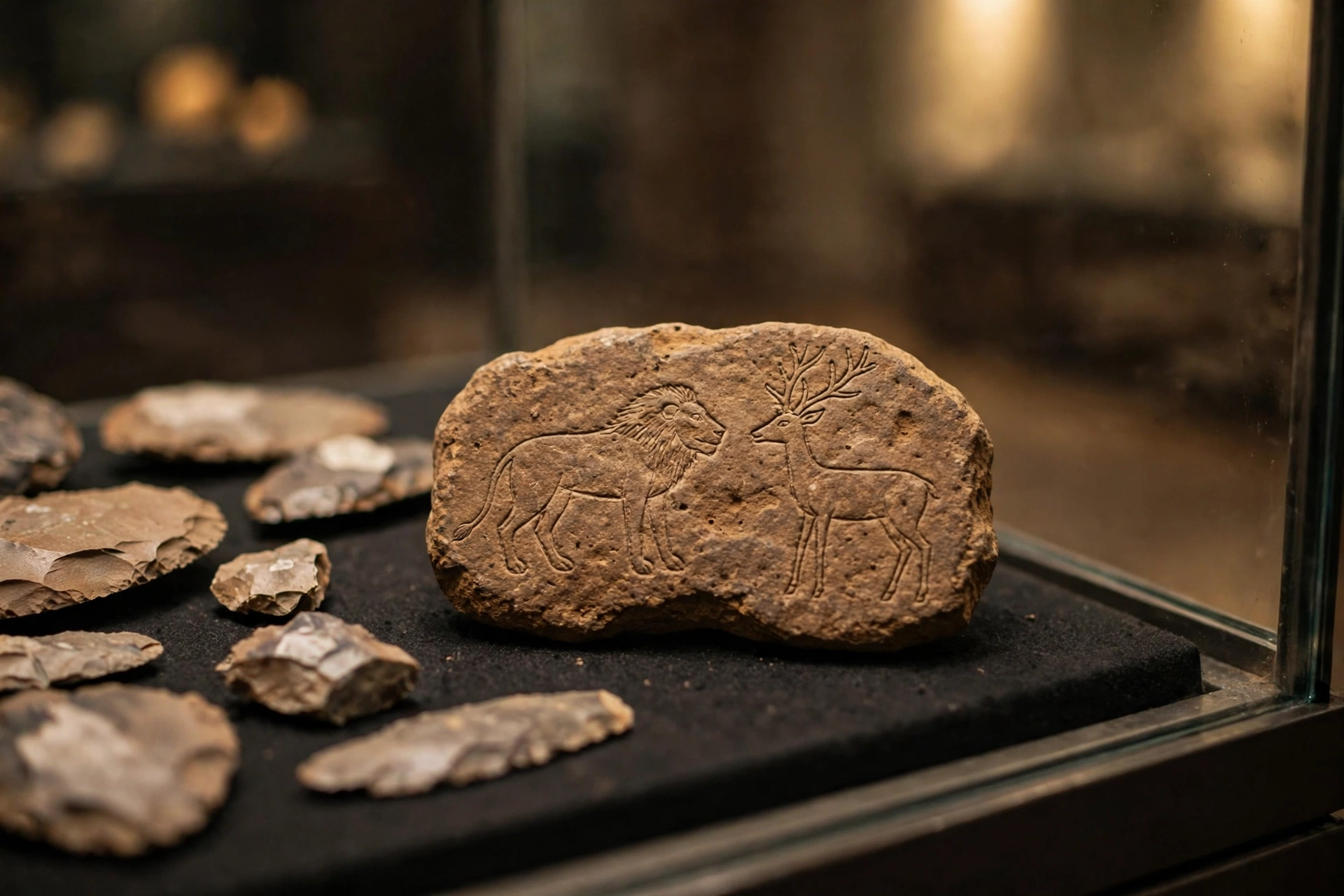
Most visitors come for the boat. The archaeologists come for what is above the water. The upper galleries of Labouiche held portable Magdalenian art: engraved sandstone plaques showing a lion and fragments of deer, and a bison modelled in clay. These are not cave wall paintings you can stare at from the boat. They are small, portable pieces, the kind of thing a person 12,000 years ago made and carried, and they are remarkable for one reason above all: the lion.
Only about 150 lion figures are known in prehistoric parietal art anywhere, and about 120 of them are in France. A lion engraving in a river cave in the Pyrenees is a rare thing. Lions lived in Ice Age Europe, hunting alongside the people who drew them, and then they vanished from the continent. The plaques are a reminder that the cave was not just a geological curiosity. People knew this place, used it, and left art in it while mammoths still walked the valleys outside.
If cave art is your thing, Ariege is the right department to be standing in. Niaux, about half an hour away, has real bison and horse paintings on the wall you can see by torchlight on a guided visit. Labouiche and Niaux together make a full day of Ice Age France, and they are very different experiences: one you walk, one you float. For more on how deep human history runs in caves, our piece on Son Doong, the world’s largest cave, is a good reminder that caves have been shaping human stories for a very long time.
Prices, hours and tickets for 2026
Prices are refreshingly normal for a French attraction. From September 1, 2026 to January 3, 2027, an adult ticket is 17.80 euros, a child ticket is 14.90 euros, and a family package for two adults and two children between 3 and 11 years old is 61 euros. Children under 3 go free at many French sites, but confirm at booking. Tickets are sold through the official Labouiche website and through the Foix tourism office, and reservations are strongly recommended, especially in July and August, when boats fill up.
Opening hours in the autumn season (September 1 to November 11, 2026) are 10:00 to 11:00 in the morning and 14:00 to 16:00 in the afternoon, every day. In summer the hours stretch longer. The site has earned a Tripadvisor Travellers’ Choice award for 2026 and holds a 4.7 out of 5 rating, which for a cave that makes you climb 200 steps is saying something.
Book ahead if you can. The boats hold around 10 to 12 people, groups are small by design, and the most popular slots go first. If you show up without a booking on a sunny August Saturday, expect to wait or to come back another day. The ticket office phone is +33 5 61 65 04 11 if you prefer to call.
Getting there and what to pair it with
Labouiche sits at Lieu-dit Labouiche, 09000 Baulou, about 6 kilometres northwest of Foix. From Toulouse it is roughly an hour by car. From Foix train station, a greenway cycling and walking path leads toward the site, which makes it one of the rare French caves you can reach without a car if you are willing to walk or rent a bike.
Foix itself deserves half a day. The town has a medieval castle on a rocky hill above red rooftops, and the old town below it is made for slow wandering. Pair Labouiche with the castle in the morning and the river in the afternoon, and you have one of the best single days in the Pyrenees.
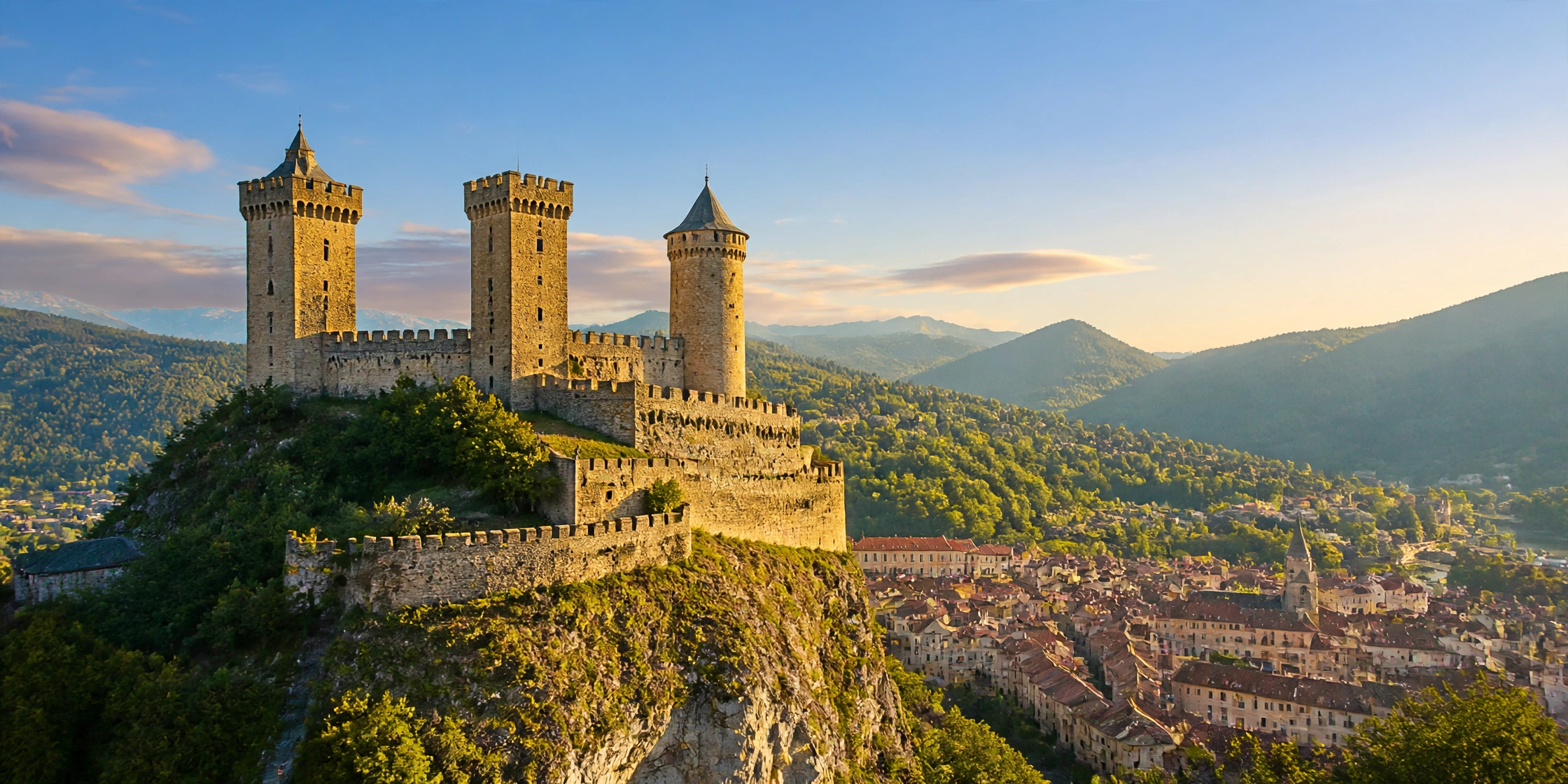
If you have a second day, go to Niaux for the cave paintings, and if you have a third, drive to Lombrives, the largest cave in Europe, at Ussat-les-Bains. Three caves, three completely different experiences, all within an hour of each other. Ariege is not the part of France most tourists think of first, and that is exactly why it works. The crowds are in the Dordogne. The caves here are just as good, and you will not queue for an hour to see them.
For a different kind of cold and dark, our guide to Iceland’s ice cave season covers what it is like when the cave itself is made of ice. Labouiche is the warmer, wetter, French version of the same thrill.
Who should skip it, honestly
Not every cave suits every person, and Labouiche is no exception. Skip it or think twice if any of these apply to you.
If steep stairs are a problem, this is not your cave. Two hundred steps down and two hundred steps up is the price of admission, and there is no lift. If you have bad knees, a heart condition, or you get winded easily, the climb back up is the part to worry about, not the boat.
If you are strongly claustrophobic, be careful. The boat passages are not tight in the crawling sense, but the ceiling comes low, the dark is total when the guide switches the lights off, and you cannot just step out and leave. You are committed for the full hour and fifteen minutes once the boat pushes off. People who are mildly nervous usually end up fine and even enjoy it, but if enclosed dark spaces genuinely scare you, pick a walk-through cave instead.
Small children can go, and plenty of families do, but the visit is long, dark, and quiet, and the stairs are real. Kids who like adventure will remember it forever. Kids who are afraid of the dark will remember it for the wrong reasons. You know your child. Trust that.
Tips that make the trip better
Go in the morning if you can. The first boats of the day feel quieter, the guides are fresh, and the light at the entrance is better for photos. Speaking of photos, take them at the entrance and on the walk down, because once you are in the boat, photography is tricky. It is dark, the boat moves, and flash is a bad idea in a cave full of bats. A few people manage a moody shot with a phone, but most of the good photos from Labouiche are taken before the boat or after it.
Wear layers. A light jacket you can tie around your waist outside and put on inside is perfect. Wear shoes with grip, not smooth soles. Bring water, but drink it before you go down, because there are no toilets in the cave. And use the bathroom at the visitor area before the tour starts. An hour and fifteen minutes in a boat with no exit is a long time if you forgot.
Finally, listen to the guide. The guides at Labouiche are not reading a script. They know the cave, they know its history, and they are the reason the visit works. Ask them questions. Ask about the boats welded underground, ask about the 2015 dive, ask about the lion plaque. The best part of the trip is often something the guide says that no website mentions.
Why Labouiche sticks with you
I have been in a lot of caves, and most of them blur together after a while. Another stalactite, another big chamber, another guide with a laser pointer. Labouiche does not blur. It sticks because it is the only cave I know where the river does the work and you just sit there and let it carry you. There is something old-fashioned about it, in a good way. No light show, no music, no glass walkway. A boat, a cable, a lamp, and a river that has been running under France since before anyone kept records.
Europe’s longest navigable underground river is not in some remote corner of the map. It is an hour from Toulouse, six kilometres from a town with a castle, and it costs less than a dinner out. Go before everyone else figures that out.
Found this guide useful? Save it to your travel board on Pinterest and share it with the one friend who always says yes to weird plans. And if you want more underground adventures, follow The Cavee on Pinterest, where we post a new cave, trail, or handcrafted treasure every single day. Read the full story and more cave guides on thecavee.com.
Pingback: Walk Inside a Volcano's Throat: Raufarholsshellir Lava Tunnel Guide 2026