Socotra Island Looks Like Another Planet: Your 2026 Guide to Yemen’s Alien Island of Dragon’s Blood Trees
There is a specific kind of tiredness that hits you after your tenth “hidden gem” that turns out to have a queue for photos and a gift shop. You scroll, you see the same viewpoint from the same angle, and you start to wonder if there is anywhere left on Earth that still feels genuinely undiscovered. Somewhere your phone cannot quite explain.
Socotra is that place, and it is not even close.
This is an island in the Arabian Sea, about 350 kilometers south of the Arabian Peninsula and 240 kilometers east of the Horn of Africa, where a third of the plant life grows nowhere else on the planet. The trees look like umbrellas stuck on sticks. The beaches are white enough to hurt your eyes, the sea is the color of a swimming pool in a dream, and there is a cave with inscriptions on its walls from travelers who passed through two thousand years ago.
It is also, honestly, one of the hardest trips on Earth to plan. Flights are weekly, you cannot book them yourself, and the island belongs to Yemen, a country most governments tell their citizens to avoid. That tension is the whole story of Socotra in 2026. It is the most alien place you can visit, and getting there takes real effort, real money, and a clear head about the risks.
This guide tells you the truth about all of it. What it looks like, what a week there actually feels like, what it costs, and the safety questions you need to answer for yourself before you go.
What Makes Socotra Feel Like Another Planet
Socotra is an archipelago of four islands, and the main island is 132 kilometers long and 42 kilometers across at its widest, about 3,625 square kilometers in total. It broke away from the African mainland millions of years ago and then just sat there, alone in the sea, evolving in its own direction.
The numbers are the kind that make biologists go quiet. Around 825 plant species grow on the archipelago, and about 37 percent of them are found nowhere else on Earth. Roughly 90 percent of the reptile species are endemic. About 95 percent of the land snails. Six bird species exist only here. It is one of the highest concentrations of unique life anywhere, and you can see most of it on a single week-long drive. UNESCO put it on the World Heritage list in 2008, and the nickname stuck: the Galapagos of the Indian Ocean.
The Trees That Should Not Exist
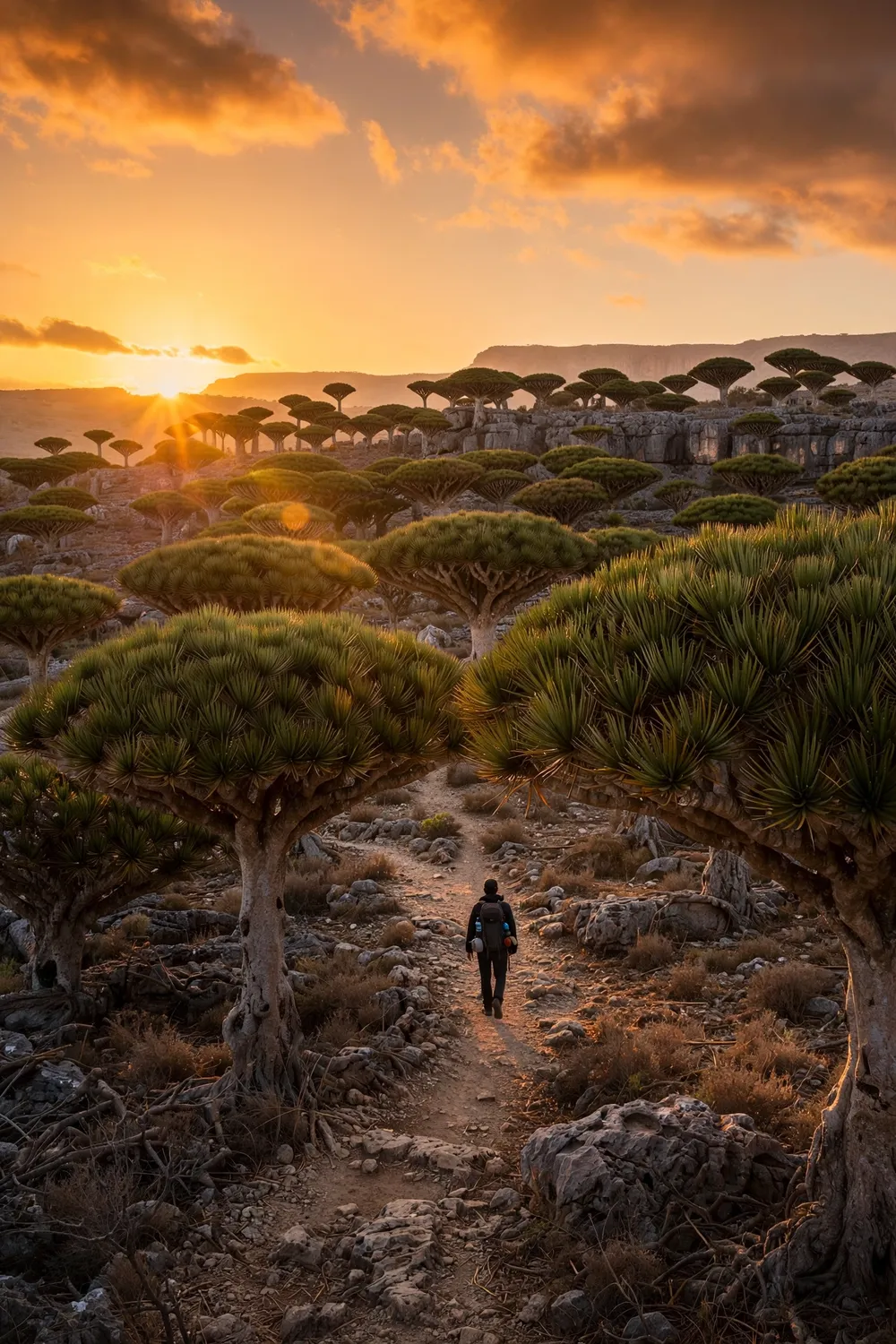
The dragon’s blood tree is the one on every postcard, and it earns it. Dracaena cinnabari grows an umbrella-shaped crown on a thick trunk, and it bleeds a crimson resin that people have traded since ancient times for medicine and dye. Stand under one at sunset on the Diksam Plateau and the whole tree looks like it is floating. The best forests are on the Diksam and Firmihin plateaus, and most tours spend a full morning up there, because once you see a whole hillside of them, a single tree stops being enough.
Then there is the desert rose, Adenium socotranum, which looks like someone planted an elephant’s leg in the rock and stuck pink flowers on top. It stores water in that swollen trunk through the long dry season, and it blooms best in February and March. And keep an eye out for the cucumber tree, the only tree in the entire cucumber family, which looks like a pale green cucumber the size of a small house.
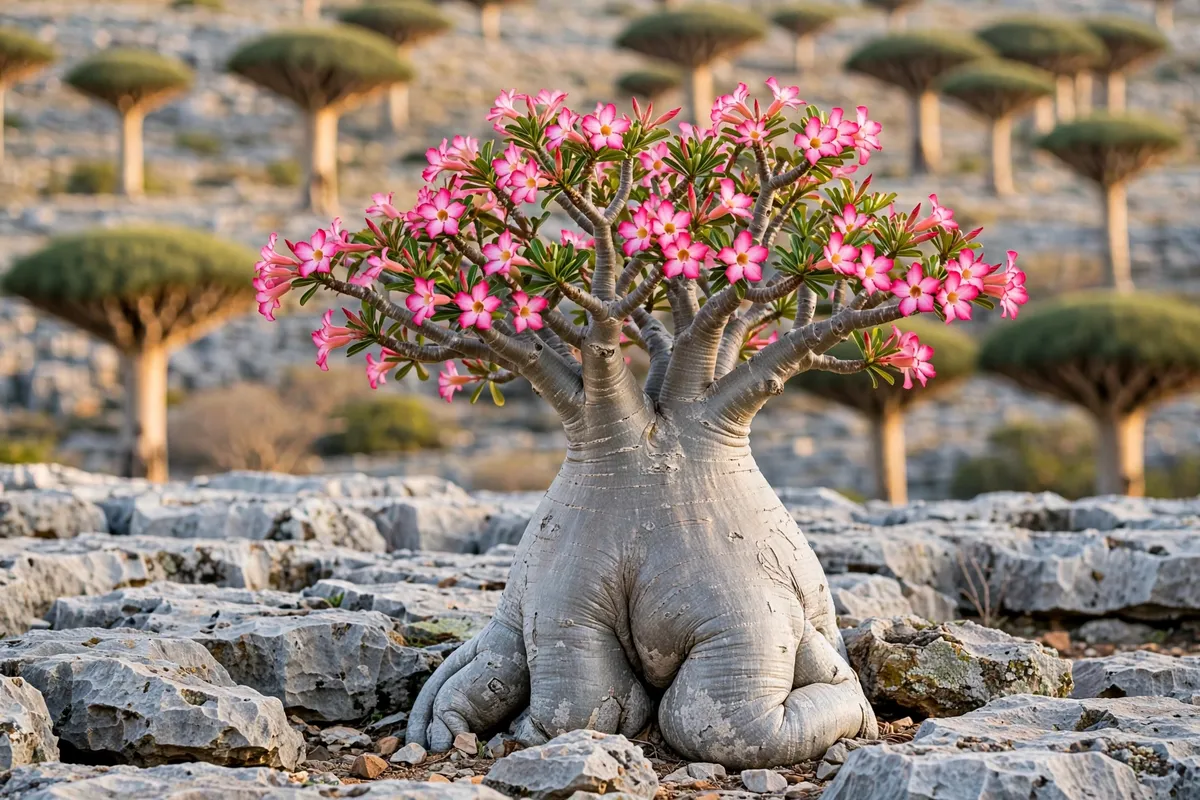
That desert rose above is the whole island in one frame. A plant that solved the problem of surviving on dry rock by becoming its own water tank, and then decided to flower pink while it was at it. Socotra does not do subtle.
The 7-Day Rhythm: What a Socotra Trip Actually Looks Like
Almost every Socotra trip follows the same shape, because the flights force it. You fly in once a week, you spend eight days and seven nights on the island, and you fly out on the same weekday. That sounds restrictive until you realize it is actually a gift. Nobody is rushing. The island sets the pace, and the pace is slow.
A typical week goes something like this. You land at Socotra Airport near the capital, Hadibu, and drive straight to the east coast. Day one is Arher Beach, where a giant white sand dune, about 150 meters high, slides straight down into the turquoise sea. A freshwater spring runs across the sand, which means you can stand in one spot and watch salt water and fresh water meet. You camp on the beach that night, and if you climb the dune before dawn, the sunrise is worth the burning legs.
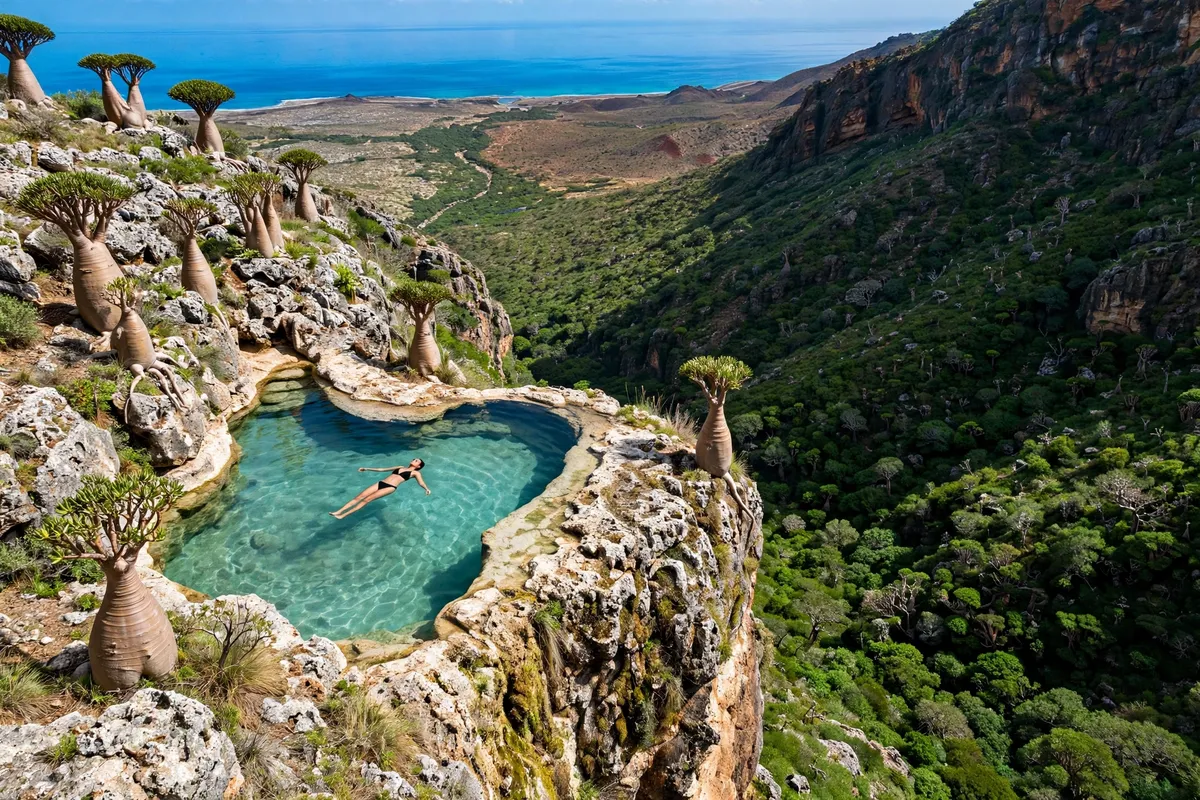
Day two is usually the Homhil protected area, home to a natural infinity pool perched on a cliff edge above a deep green valley. You swim in it, you look out over the island, and you try to take a photo that does it justice. You will fail. Everyone does.
The middle of the week is for the high ground. The Diksam Plateau and the Firmihin forest, where the dragon’s blood trees grow thickest. You hike between them, you eat lunch in their shade, and your guide points out plants you have never heard of, because there is a good chance no one outside the island has either. This is also where you start to understand the scale of the place. The plateau rolls on for miles, and the trees just keep coming.
The last days belong to the west. Qalansiyah, the island’s second town, and the Detwah Lagoon just beyond it. Then a boat to Shuab Beach, which you can only reach by sea. Dolphins usually show up on the way. They seem to know the schedule.
Hoq Cave: The Island’s Underground Secret
This is a cave website, so let us talk about the cave. Hoq Cave is one of the largest caves in the Arabian region, stretching more than three kilometers into a limestone mountain above the north coast. The hike up from the trailhead takes about an hour to an hour and a half, and you want to start early before the sun gets serious. Inside, you walk another 45 minutes into the dark, past stalactites and stalagmites and rock pools, until you reach the end.
What makes Hoq special is not the size, though. It is the writing on the walls. Traders sailing the Indian Ocean left inscriptions here in the first and second centuries AD, along with pottery fragments and a drawing of a ship preserved under a glaze of calcite. People were sheltering in this cave two thousand years ago, on their way between continents, and their graffiti is still there.
Socotra sat on one of the great sea routes of the ancient world, and the cave is the proof. If you love underground places the way we do, Hoq alone is worth the trip.
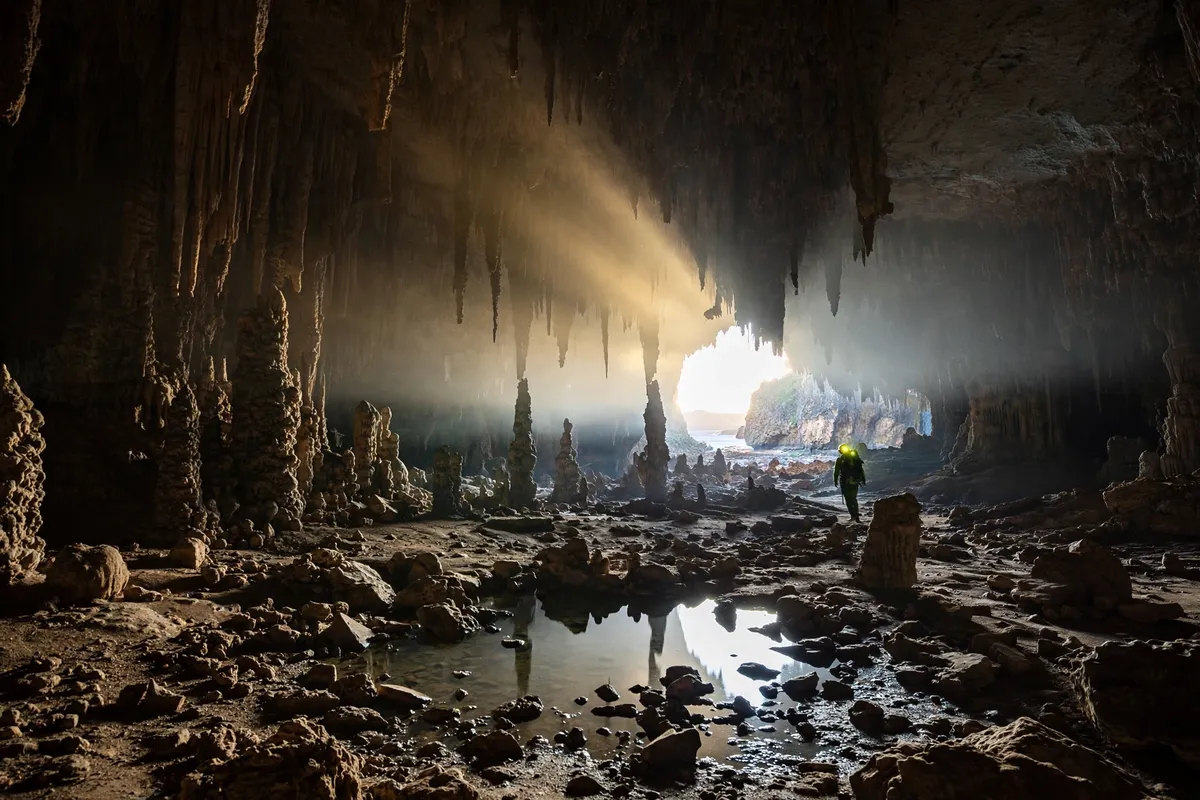
Bring a headlamp, even if your guide has one. The cave is unlit, the floor is uneven, and the best details are the small ones. The inscriptions are easy to miss if you are only looking at the big formations. We have covered far bigger caves, like Son Doong in Vietnam, but Hoq is the most human cave we know.
The Beaches That Ruin Other Beaches
Socotra’s beaches are the part nobody believes until they see the photos, and then they do not believe the photos either. The sand is white, the water is clear enough to see your feet in waist-deep water, and most of the time you will have the whole beach to yourself.
Detwah Lagoon, on the west coast near Qalansiyah, is a shallow tidal lagoon and a UNESCO Biosphere Reserve. The water is so clear and so still that it looks like a sheet of glass, and underneath it are stingrays, pufferfish, sea cucumbers and turtles. Walk out into it at low tide and the sandbar curls around you like a white tongue.
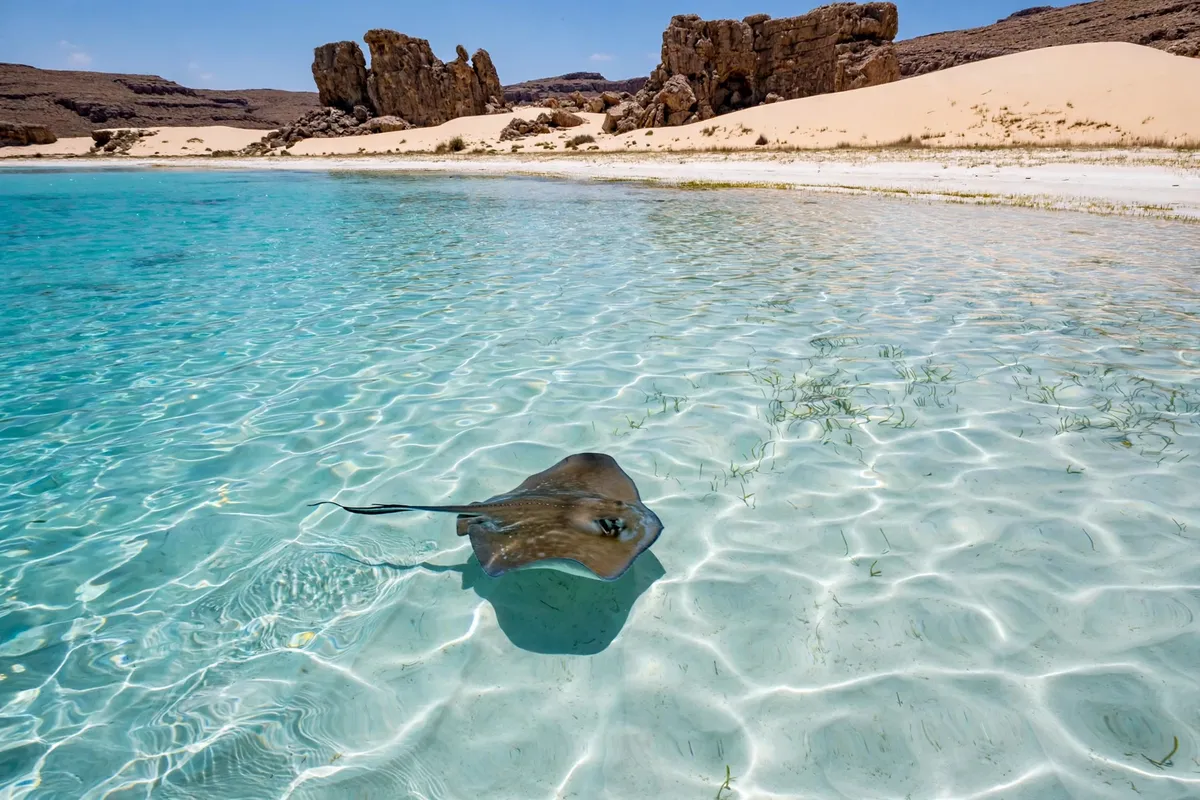
Arher is the drama beach. The dune, the spring, the cliffs behind you, the sea in front of you. Climb the dune at sunrise, run back down it like a kid, and then swim in water warm enough to stay in for an hour.
Shuab Beach is the one you have to earn. There is no road, only a boat from Qalansiyah, about an hour to an hour and a half along the cliffs, and the dolphins that usually escort you most of the way. The beach itself is white sand and clear water backed by towering cliffs, and it is one of the most untouched stretches of coastline on the island.
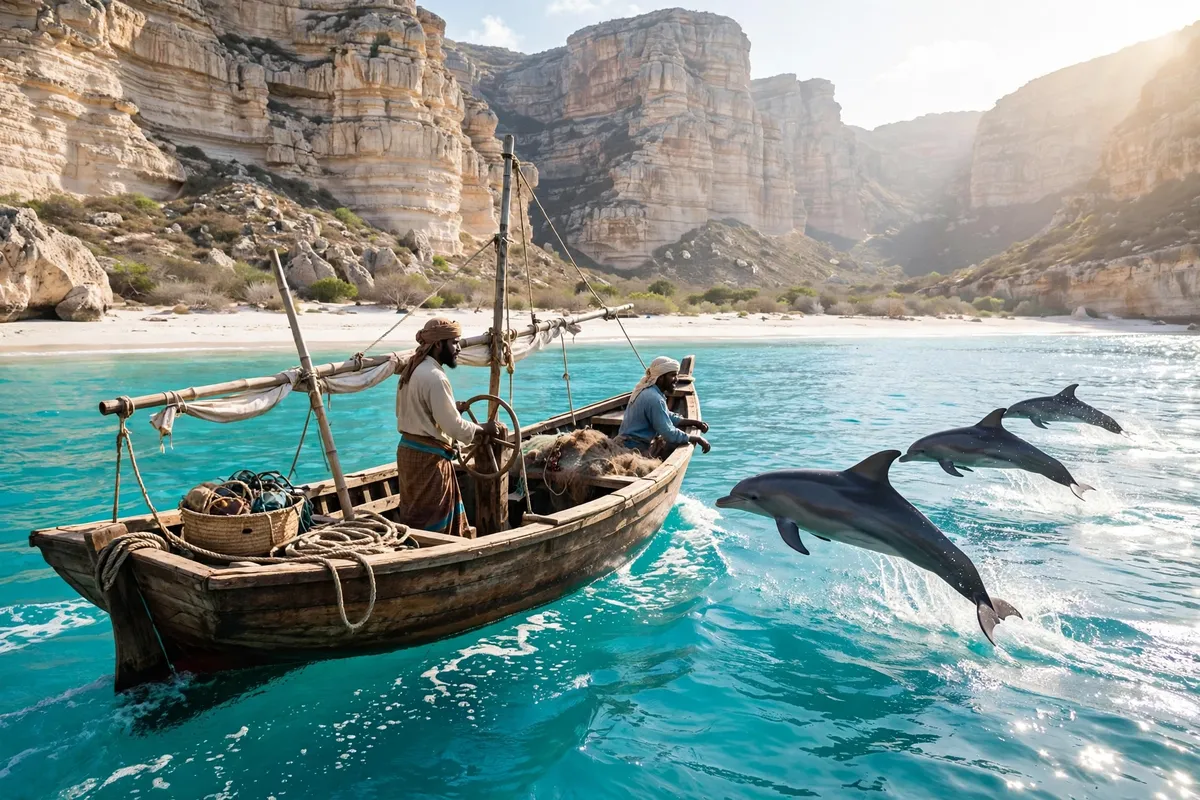
For snorkeling, ask your guide about Dihamri Marine Protected Area on the north coast. It has one of the island’s richest coral reefs, and the visibility in March and April is at its best. If you have dived the Red Sea, this is the same ocean neighborhood with a fraction of the people. We covered the Saudi Red Sea coast earlier this year, and Socotra is the wilder, emptier cousin of that same underwater world.
When to Go, and When Not to Bother
The season is October to April, and that is not a suggestion. It is the window when flights run, tours operate, and the sea is calm enough for boats. June to September is the southwest monsoon, and the island more or less closes to visitors. The wind is strong, the sea is rough, and the tour companies do not run standard trips.
Inside the season, the months have different personalities. October and November are green and fresh after the monsoon. December to February brings the coolest temperatures, around 26 to 28 degrees, and the most reliable weather. March and April are the show-offs: the desert roses in full bloom, the calmest seas, and the best snorkeling visibility. Most photographers pick March. Most first-timers pick January. Both are right.
How You Actually Get There
This is the part where most Socotra dreams die, so let us be specific. You cannot just book a flight and show up. There are no Socotra flights on the usual booking sites, and you cannot get the entry permit on your own. You go through a licensed tour operator, and the operator handles the flights, the permit, the 4×4, the camping gear, the food, and the guide.
As of late 2026, the most reliable route is Jeddah to Socotra with Yemenia Airways, flying on Tuesdays and Thursdays. The outbound flight leaves Jeddah around 11 in the morning and lands around 2 in the afternoon. The return leaves Socotra around 3 and lands around 7. A round trip costs roughly 950 to 1,100 US dollars, and it is not bookable online. Your operator books it.
The Abu Dhabi charter route, which used to be the favorite, was cancelled at the start of January 2026, with no confirmed date to return, so check the current situation with your operator before planning around it. Flight schedules can change at short notice, so build a buffer day into your plans on both ends. For the latest on routes and seasons, this 2026 Socotra travel guide is a useful cross-check alongside your operator’s own updates.
The Honest Safety Talk
Let us not dance around this. Socotra is part of Yemen, and most governments advise against travel to Yemen. That advice covers the whole country, including the island, and you need to read your own government’s current guidance before you decide anything. Travel insurance is also a real problem. Many standard policies exclude Yemen entirely, and you will need a specialist policy that covers you there.
Here is the other side, and it matters too. Socotra is about 350 kilometers from the mainland, and it has stayed calm while the mainland has not. Tour operators have run trips through the conflict years. The risks that actually affect visitors are practical ones: a cancelled flight, a rough road, dehydration on a hike, a stingray in a lagoon. The guides know all of them, and they manage them every week.
What I would say is this. Socotra is not a trip you book on a whim, and it is not a trip you take to prove something. Read the advisories, talk to an operator who is on the island right now, and decide with your eyes open. If any part of that makes you uncomfortable, listen to that feeling.
One more honest note. Socotra’s ecosystems are fragile, and UNESCO put the archipelago on its In Danger list in 2021. Go with an operator that follows leave-no-trace rules, do not pick plants, and do not take rocks or shells. The island has survived millions of years of isolation. The least we can do is not be the thing that breaks it.
What It Costs, All In
Money is the second question everyone asks, so here is a realistic budget for one person on a standard eight-day group tour in the 2026 season.
- Round-trip flight Jeddah to Socotra: about 950 to 1,100 US dollars, booked through your operator
- Visa and permit fee: 210 US dollars
- Eight-day tour: about 1,500 to 3,500 US dollars per person, covering 4×4 transport, guide, camping gear, food and boat trips
- Getting to Jeddah: your own international flight, which varies wildly by where you live
- Specialist travel insurance: more than a normal policy, and essential, because most standard policies exclude Yemen
- Tips and extras: a few hundred dollars for your guide, driver and camp crew, who work hard for it
All in, most travelers spend somewhere in the range of 3,000 to 5,000 US dollars before their flight to Jeddah. That is a lot of money. For a beach holiday, no, it is not worth it. For a week on an island that looks like another planet, the people who go tend to say yes.
What to Pack (the Short Version)
Socotra is a camping trip with a boat ride and a cave hike, so pack like it. Sturdy walking shoes with grip, because the Hoq Cave trail and the dune climbs are no joke. A headlamp, because Hoq is unlit and camp life runs on headlamps after dark. Sun protection that actually works, because the sun is strong and the shade is thin. A dry bag for the boat trip to Shuab, because your camera will thank you.
Bring cash in US dollars, small bills, because there are no ATMs that work for foreign cards and card payments are rare. Bring any medication you need, because the pharmacies in Hadibu are basic. Download your maps and reading material before you fly, because the internet on the island is slow and patchy. You will be offline most of the week, and you will be surprised how little you miss it.
The Problem Socotra Solves
Here is the problem, stated plainly. Travel has started to feel like a copy of a copy. The same ten places, the same photo, the same queue. You go somewhere extraordinary and find a hundred people who had the exact same idea, standing in the exact same spot.
Socotra solves that by being genuinely hard to reach, which keeps it genuinely empty. Visitor numbers are tiny compared with any mainstream destination. There are no crowds because there cannot be crowds. One flight a week, small groups, and an island the size of a small country. You can spend a whole day at a beach and see nobody who is not in your group. If you have ever wanted to photograph a landscape that looks like science fiction, this is the island. We have written about Zhangjiajie, the real-life Avatar mountains, and Socotra is the same feeling in a completely different landscape.
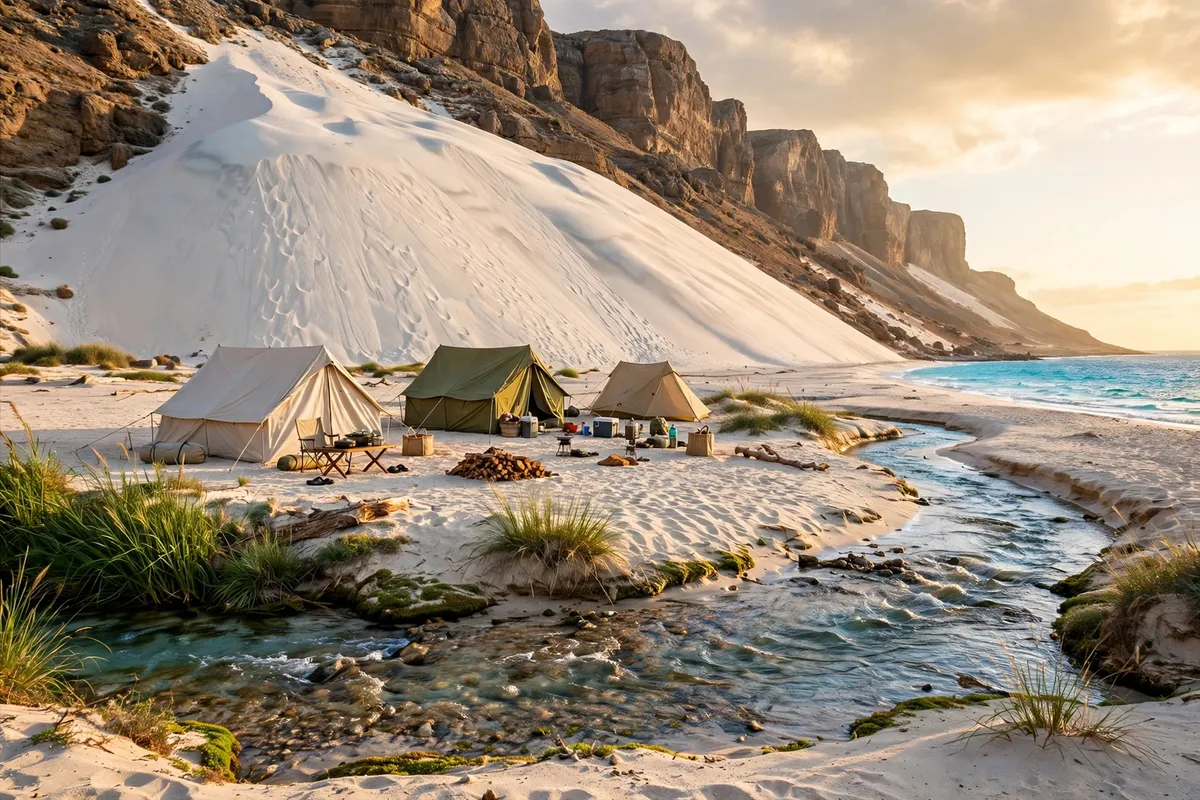
That is Arher, and it is the photo I would put on my wall. A dune the height of a skyscraper, sliding into the sea, with a spring running across the sand. It does not look real, and it is.
Quick Answers Before You Go
Is Socotra safe to visit? The island itself has stayed calm, and operators run trips throughout the year, but Socotra is part of Yemen and most governments advise against travel to Yemen. Read your government’s current advice, talk to an operator on the island, and get specialist insurance before you decide.
When is the best time to visit Socotra? October to April. January and February have the most reliable weather, March and April have the best snorkeling and the desert roses in bloom. June to September is the monsoon, and tours do not run.
How much does a Socotra trip cost? Roughly 3,000 to 5,000 US dollars per person all in, before your flight to Jeddah. That covers the Jeddah to Socotra round trip at about 950 to 1,100 dollars, the 210 dollar visa fee, and an eight-day tour at about 1,500 to 3,500 dollars.
Can I visit Socotra independently? Realistically, no. Flights are not bookable online, permits need an operator, there is no public transport or car rental, and the roads are unpaved tracks. Every visitor goes with a licensed tour company.
What is the one thing I should not miss? The dragon’s blood forest on the Diksam Plateau at sunset. But if you ask me again tomorrow, I will say Hoq Cave. And the day after that, the boat to Shuab Beach. That is the problem with Socotra. It refuses to have just one best thing.
Do I need to be very fit? You need to be reasonably active. The Hoq Cave hike is about an hour uphill, the Arher dune climb is steep soft sand, and the days are long and hot. You do not need to be an athlete, but you should be comfortable walking for a few hours in the heat.
The Bottom Line
Socotra is not an easy trip, and that is exactly why it is still extraordinary. The weekly flights, the permits, the camping, the cost, all of it filters out the casual visitor and leaves the island for the people who really want to be there. What you get in return is a week on an island that looks like another planet, with trees that exist nowhere else, a cave with two-thousand-year-old writing on its walls, and beaches so empty you will check behind you to make sure you are not dreaming.
If you go, go in the season, go with a good operator, go with your eyes open about the advisories, and go gently. Take photos, leave nothing, and let the island stay the way it is. Places like this do not come along often, and they do not stay this way forever.
Want to see it first? We put the best of Socotra on our Pinterest, dragon’s blood trees and all, and every pin links back to the full guides here on thecavee.com. Save this one for the trip you have not booked yet. And if you have been to Socotra, or if you are planning to go, tell us in the comments. We want to hear what the island did to you.
Found this useful? Pin it for later, and explore our other adventure travel guides on thecavee.com. The planet is weirder than you think, and Socotra is the proof.