Your Mug Cabinet Is a War Zone. This $24.99 Wooden Mug Tree Ends the Chaos
You know the sound. You open the cabinet for one mug, just one, and the whole shelf shifts. Something slides, something else tips, and then a ceramic avalanche comes at your face. You catch two mugs with your elbows, lose a third to the counter, and stand there wondering how a collection of coffee cups turned into a booby trap.
I counted mine last month. Thirty-one mugs. Thirty-one. I live alone and I work from home, which means I use maybe three of them on rotation. The rest sit there, stacked two deep, handles locked together like wrestlers, gathering dust and quietly judging me every morning.
Here is the thing nobody tells you about mugs: they multiply. A friend visits and leaves one behind. You pick up a souvenir mug on a trip. Someone gifts you one with a funny slogan. Your favorite one chips, so you buy a replacement, but you keep the chipped one anyway because it was a gift from your sister. Before you know it, your cabinet is full and your mornings start with a small act of bravery.
The fix turned out to be embarrassingly simple, and it costs less than a dinner out. A wooden mug tree.
The Mug Cabinet Problem Nobody Talks About
Mugs are the worst shape for storage. They are bulky, they are round, their handles stick out at odd angles, and they do not stack neatly no matter what the packaging promises. Stacking them is how chips happen. Hanging them on hooks inside a cabinet works until the hooks run out. And the moment you need the mug at the back, you have to move six others to get to it.
Most of us solve this by buying a bigger cabinet, which is like solving a messy drawer by buying a bigger drawer. The mugs just spread out and the problem follows you.
A mug tree attacks the problem from a different angle. Instead of hiding your mugs in a dark cabinet, it puts your six favorites out in the open, on the counter, where you can actually reach them. The rest can go into storage, or better yet, into a donation box. You keep the ones you love within arm’s reach and the cabinet gets its life back.
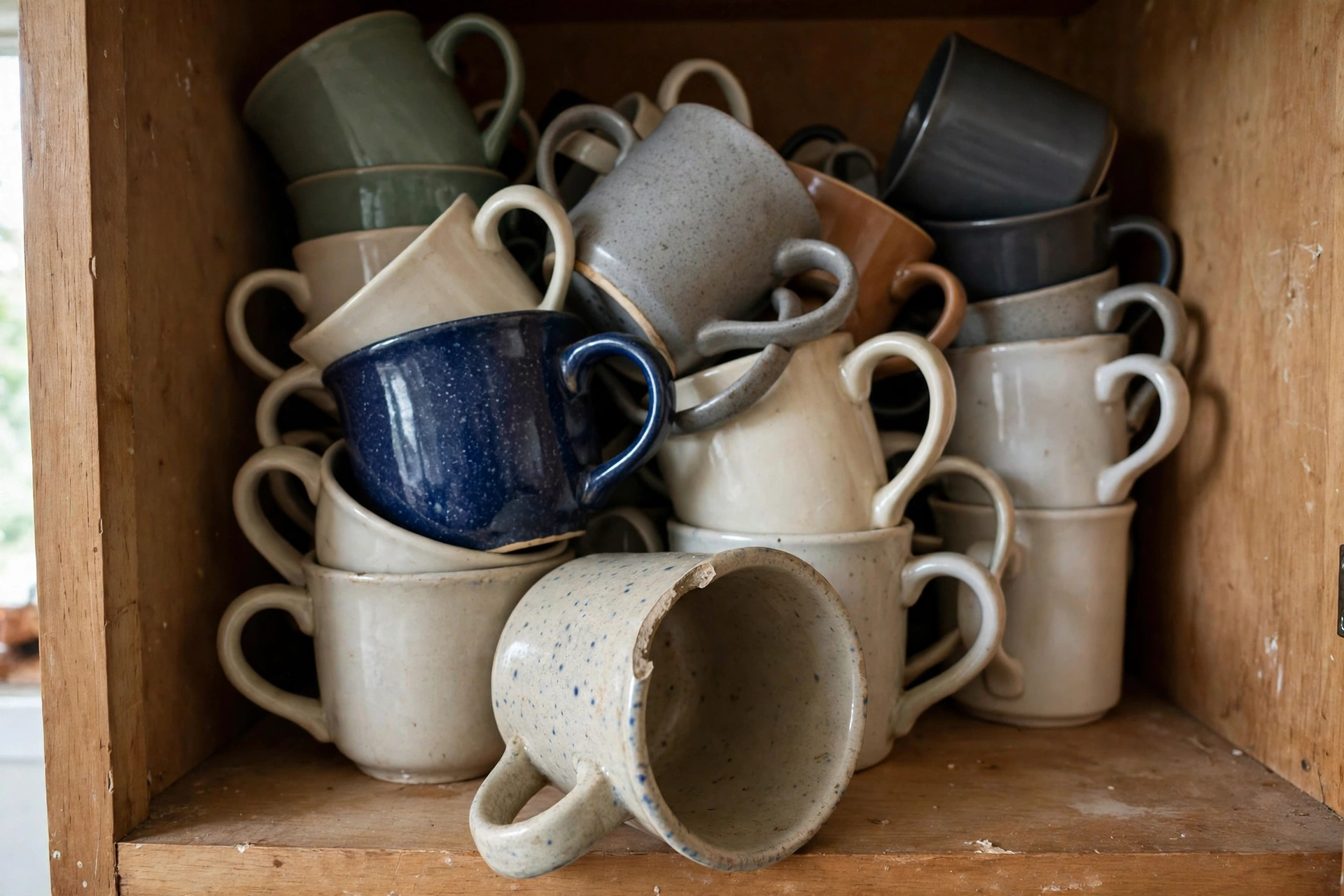
That photo above is what my cabinet looked like before I stopped pretending the system worked. Mugs wedged sideways, one lying on its side, handles hooked through other handles. Every morning was a small excavation. If your cabinet looks anything like that, keep reading, because the rest of this is basically a rescue plan.
What Exactly Is a Wooden Mug Tree?
A mug tree is a small standing rack, usually about 14 to 18 inches tall, with a central post, a weighted base, and hooks branching off the top. You hang your mugs by their handles, and they dangle in a neat little circle, easy to grab and easy to admire.
The wooden ones are the ones worth buying. Metal mug trees exist, and they do the job, but they tend to look like something from a restaurant supply catalog. Wood brings warmth to a kitchen counter. It matches cutting boards, knife blocks, and all the other wooden things that make a kitchen feel like a room people actually live in rather than a showroom.
Acacia is the wood you want if you can get it. It is dense, it is hard, and it has that warm honey-brown grain that looks better the longer you own it. It also handles kitchen humidity without warping, which matters for something that lives next to a kettle. Cheaper mug trees use rubberwood or pine, which are fine, but acacia is the one that still looks good in five years.
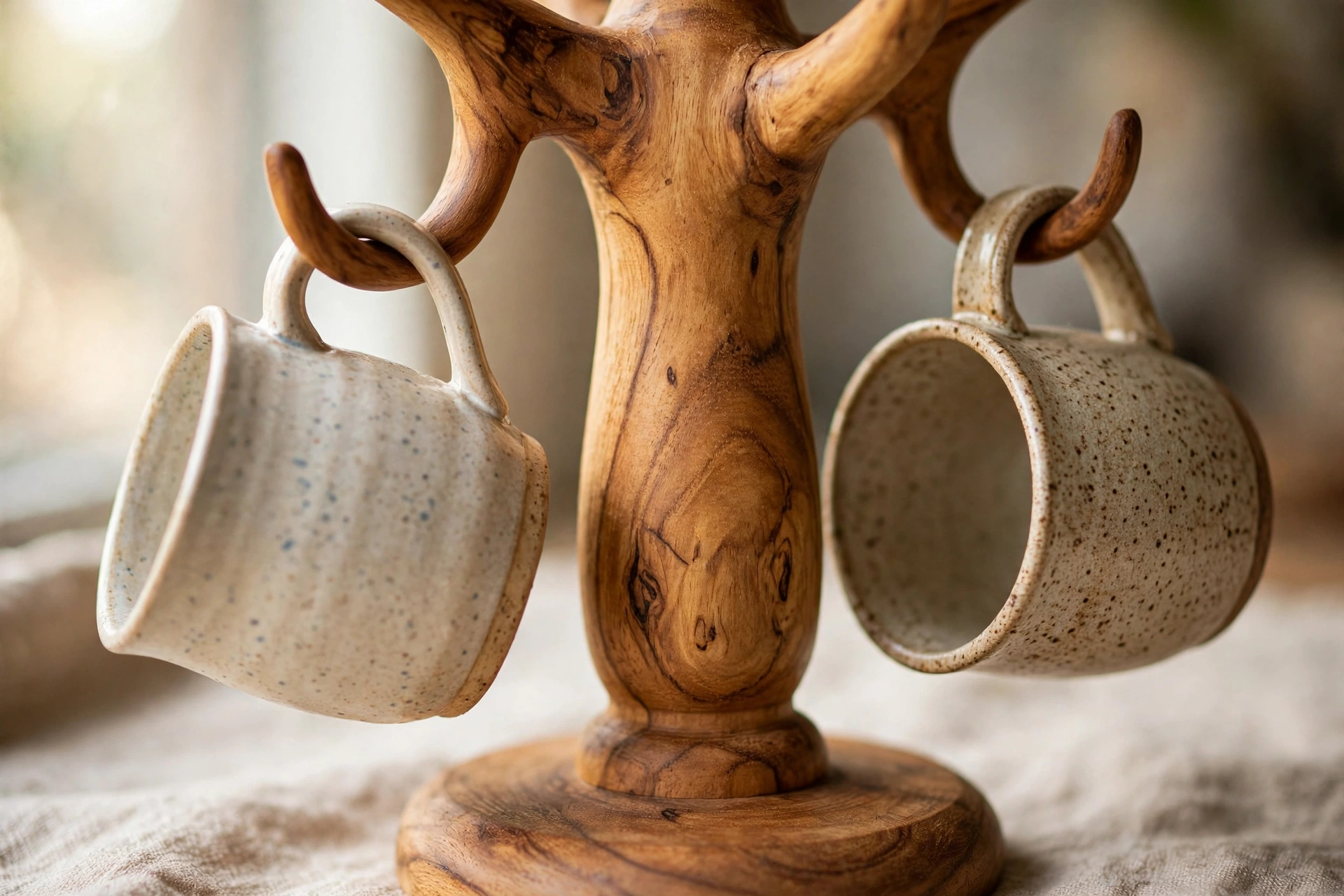
Look at the grain in that close-up. That is the whole appeal in one photo. No two pieces look exactly alike, and the wood deepens in color as it ages. A plastic mug rack will never do that.
The $24.99 One Everyone Keeps Buying
So which mug tree should you actually buy? The one with the most convincing track record right now is the Wooden Mug Tree from Hearth and Hand with Magnolia, sold at Target for $24.99.
Here is why it stood out to me. It has 4.8 out of 5 stars from 493 ratings on Target, and the kitchen site The Kitchn wrote about it earlier this year, noting more than 600 five-star ratings from shoppers who kept coming back to praise how sturdy and good-looking it is. That is a lot of people agreeing on one small kitchen object.
The specs are simple and honest. It is made from acacia wood, it has six hooks, and it is tall enough for standard mugs without them banging into the counter. Six hooks sounds small until you realize six is exactly the number of mugs most people actually use. Your daily mug, your big weekend mug, the one your kid insists on, a guest mug or two, and one spare. Everything else is decoration, and decoration belongs in a box, not in your way.
At $24.99, it costs less than most single mugs at a boutique coffee shop. I have paid more for a mug that I then chipped within a week. This is a piece of furniture for your counter, and it costs less than the drinkware it holds.
You can see it here: Wooden Mug Tree, Hearth and Hand with Magnolia, $24.99 at Target.
Six Ways a Mug Tree Fixes Your Kitchen
1. It gives you back a whole shelf
Move six mugs out of the cabinet and onto the tree, and you have just freed up real space. Not imaginary space, not “if I stack things differently” space. An actual empty shelf you can use for plates, or glasses, or nothing at all. Empty shelf space in a kitchen feels like a luxury, and this is the cheapest way I know to buy some.
2. Your favorite mugs stop getting chipped
Most mug chips happen in the cabinet, not in the dishwasher. Mugs knock together when you reach past them, and rims catch on handles. Hanging them separately means they never touch each other. My favorite chipped mug, the one from my sister, would probably still be intact if it had lived on a tree instead of in a pile.
3. Mornings get faster
This sounds small until you live it. No more opening the cabinet, scanning, reaching, shifting, and re-stacking. You walk to the counter, you take your mug, you make coffee. It saves maybe twenty seconds a day, which adds up to about two hours a year. Two hours of your life, returned by a piece of wood.
4. It turns your mugs into decor
Most of us own at least a few mugs we genuinely like looking at. A handmade one, a bright color, a funny design. In a cabinet, nobody sees them, including you. On a tree, they become part of the kitchen. Visitors notice. People comment. It is the easiest decor upgrade in the room because you already own the decorations.
5. It anchors a coffee bar
If you have been meaning to set up a little coffee corner, a mug tree is the natural starting point. Put it next to the coffee maker, add a jar of beans and a couple of spoons, and suddenly you have a coffee bar instead of a cluttered counter. It gives the whole corner a purpose.

6. It makes the kitchen feel calmer
This one is hard to measure but easy to feel. A counter with six mugs hanging neatly looks organized, and organized counters make the whole kitchen feel more peaceful. It is the same reason a made bed changes a bedroom. Small order, big mood difference.
How to Pick a Good One (and Spot a Bad One)
Not every mug tree is worth your money. Here is what to check before you buy, whether you are shopping on Etsy, Amazon, or in a store.
Check the base first. A mug tree with a narrow or lightweight base will tip when you pull a mug off one side. The base should be wide and heavy enough that the whole thing stays put with five mugs on one side and one on the other. The Hearth and Hand tree gets this right, which is a big part of why its ratings are so high.
Count the hooks honestly. Six hooks is the sweet spot for most kitchens. Four is too few, you will outgrow it in a month. Eight or more usually means the tree is taller and more top-heavy, or the hooks are crammed so close together that the mugs bump into each other. Six is the number.
Look at the hook shape. Good hooks curve upward at the end so the mug cannot slide off. Flat pegs look clean in photos and drop mugs on floors in real life. If you cannot tell from the listing photos, read the reviews. Someone will have mentioned it.
Ask what wood it is. Acacia, walnut, and oak are the safe bets. They are hard, stable, and they age well. If a listing just says “wood” with no species named, be skeptical. It is usually a soft wood that will dent and stain quickly.
Measure your mugs. Oversized mugs, the 15-ounce soup-bowl kind, need more clearance between hooks. If your favorite mug is a giant, check the hook spacing before ordering. Standard 11-ounce mugs fit everything. The big ones need a little more room.

Styling Your Coffee Bar Around It
Once the tree is on the counter, the rest of the coffee bar almost styles itself. Here is a setup that works in almost any kitchen and costs very little beyond the tree itself.
Put the mug tree on the left or right end of your coffee station, not in the middle. It needs a little elbow room, and mugs should not dangle over the coffee maker where steam hits them all day. Next to it, place a small tray or a folded linen towel to catch drips. A glass jar of coffee beans, a small sugar bowl, and a couple of teaspoons in a little cup finish the look.
If your kitchen leans farmhouse, pair the acacia tree with cream and sage mugs and a woven basket underneath for extra pods or tea bags. If it leans modern, go for matte black and white mugs and keep the counter mostly bare. The wood is warm enough to work with both styles, which is the whole point of acacia.
One warning: do not overload the area. The appeal of a coffee bar is that it looks intentional. Three or four items plus the tree is plenty. The moment you add a second appliance and a stack of napkins and a plant, it is a cluttered counter again, just with better branding.
Keeping the Wood Beautiful
Acacia is low maintenance, but it is still wood, and wood likes a little attention. Wipe it down with a damp cloth when you notice coffee splashes, and dry it right away. Never soak it, and never put it in the dishwasher. That is how wooden things die.
Once every month or two, rub in a little food-safe mineral oil or beeswax wood conditioner with a soft cloth. It takes about three minutes and it keeps the grain rich and the surface protected. Think of it like moisturizer for your kitchen. Skip it for a year and the wood will start to look dry and pale. Do it regularly and the tree will look better in year three than it did on day one.
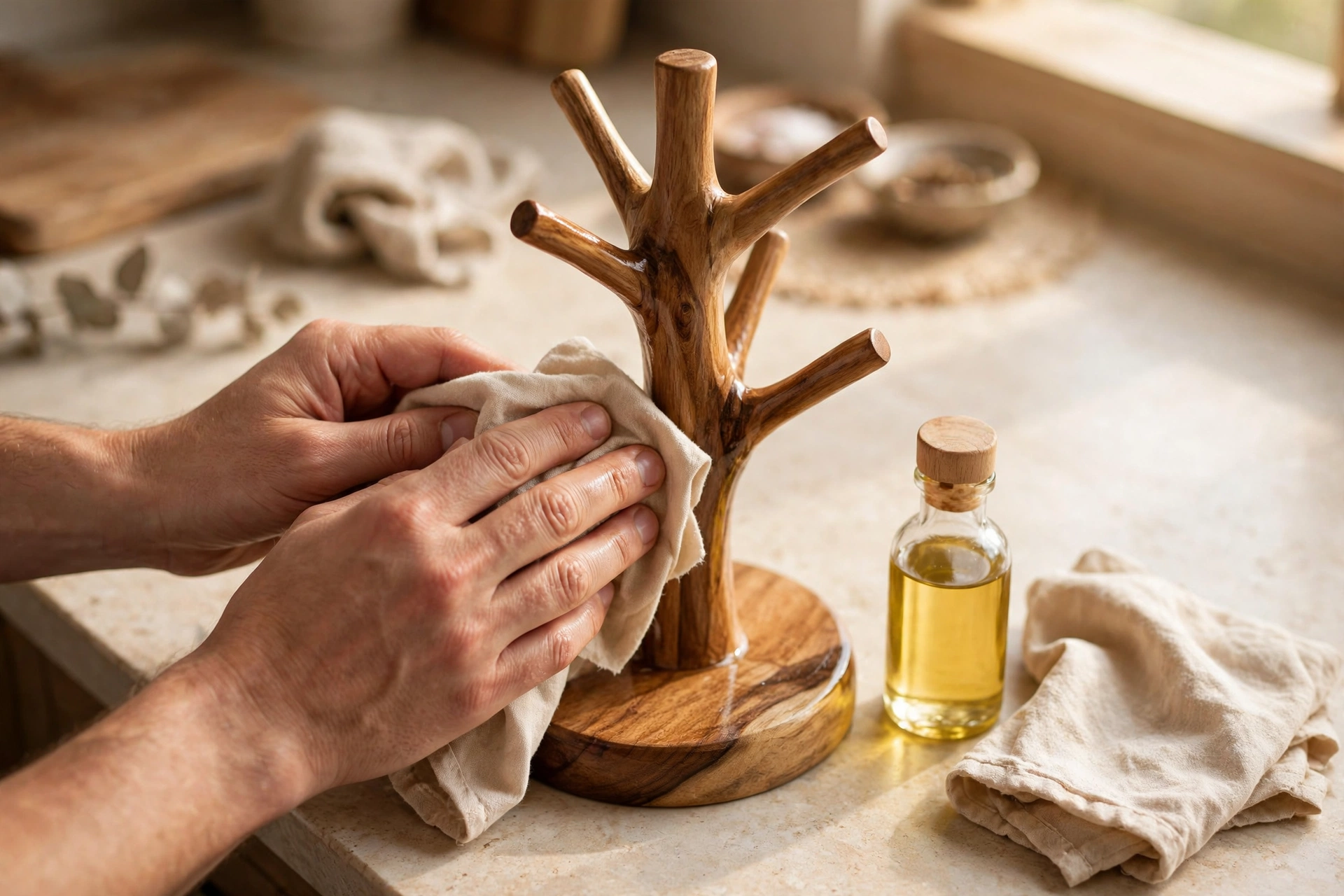
Keep it away from constant direct sunlight if you can. A sunny windowsill will fade one side over time. A spot a foot or two back from the window is perfect.
The Gift Angle (Because Someone You Know Needs This)
Here is a thought: a wooden mug tree is one of the best housewarming gifts nobody thinks to buy. It is useful, it is attractive, it costs under $25, and it is the kind of thing people never buy for themselves but love once they have it.
Pair it with two nice mugs and a small bag of good coffee beans, and you have a complete gift that looks like you spent far more than you did. It works for housewarmings, weddings, birthdays, and the coworker who is impossible to shop for. Add a kraft gift tag and some twine and it looks like it came from a boutique.
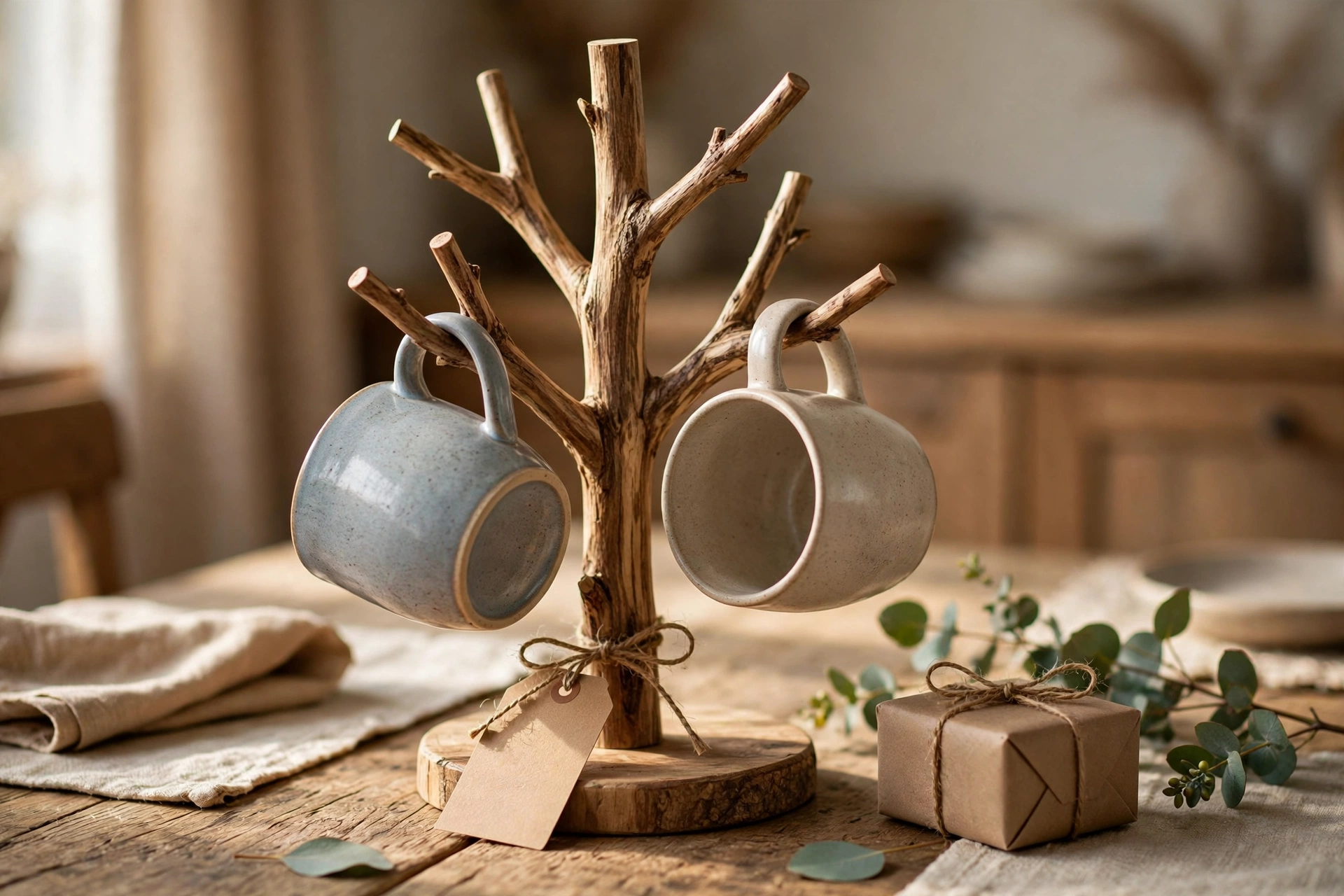
With the holidays coming up, this is also a genuinely good stocking stuffer alternative for the coffee lover who already owns every gadget. They do not own a mug tree. Almost nobody does, which is exactly why it lands so well as a gift.
Other Wooden Finds Worth a Look
While I was researching mug trees, I kept running into other handmade wooden pieces that solve similarly annoying little problems. A few that stood out, all verified live this week:
- Wooden K-Cup dispenser, $25.00 on Etsy (IronCedarWoodworks). Holds 24 coffee pods in a pine and poplar dispenser, so your pods stop living in a messy drawer. See it on Etsy.
- Hand-carved mahogany mortar and pestle, $39.99 (UNICEF Market). Hand-carved in Mexico, and it crushes whole spices the way a pre-ground jar never will. See it here.
- Hexagon rosewood watch box, from $26.25 on Etsy (TheWoodenWorldin). A honeycomb-shaped box for watches, on a 25 percent off sale that ends November 18. See it on Etsy.
- Wooden turkey napkin holder, $18.48 on Etsy (CSPDesigns7, Star Seller). Thanksgiving is two weeks away, and this little birch turkey holder is the kind of detail guests actually remember. See it on Etsy.
If you like the handmade wood idea in general, we have covered a lot of it here before, from handmade wood and epoxy resin coasters that save your coffee table, to the handmade wooden blanket ladder that tamed our throw blanket chaos, and the handmade bread board with a crumb tray that ended the morning crumb problem. Same idea every time: one well-made wooden thing, doing one job properly.
Quick Answers Before You Buy
Will a mug tree fit on a small counter? Yes. Most are about 6 to 7 inches across at the base, which is roughly the footprint of a large mug. If you have room for a coffee maker, you have room for a mug tree.
Can it hold big mugs? Standard 11-ounce mugs fit easily. Oversized 15-ounce mugs fit on most six-hook trees, but check the hook spacing in the listing photos. If the hooks look crowded, go for a tree with a slightly taller post.
Does the wood stain from coffee? Not with normal use. Wipe splashes when you see them and oil the wood every month or two, and it will stay clean. Acacia is naturally resistant to staining, which is one more reason it is the best choice for this.
Is $24.99 a good price? Yes. Handmade wooden mug trees on Etsy typically run $35 to $60, and the mass-market ones at big box stores run $15 to $20 but are usually made from softer wood with worse balance. The $24.99 acacia tree sits in the sweet spot: real hardwood, proven reviews, impulse-buy price.
What if I have more than six mugs I love? Then you have two options. Buy a second tree, which looks surprisingly good as a pair, or be honest with yourself about which six you actually use. Most of us can name our six in about ten seconds. The rest are souvenirs, and souvenirs belong on a shelf somewhere else.
The Bottom Line
My cabinet used to be a hazard. Now six mugs hang on a wooden tree by the coffee maker, the cabinet has breathing room, and I have not been attacked by falling ceramics in weeks. It is a small change, and that is the point. The best home fixes are usually small, cheap, and slightly embarrassing in how long you waited to try them.
If your mornings start with a mug excavation, give the tree a shot. For $24.99, the worst outcome is a nicer-looking counter. The likely outcome is a calmer kitchen and a favorite mug that stays chip-free.
Want more ideas like this? We collect our favorite handmade wood finds on Pinterest, and every one of them is something we would actually put in our own kitchen. Follow along and steal the ideas freely. And if you try the mug tree, come back and tell us how many mugs you ended up donating. My guess: at least ten.
Found this useful? Pin it for later, and check out our other handmade wood guides on thecavee.com. Your kitchen will thank you.