From Marrakech to the Sahara: Your 2026 Guide to the Desert Trip Everyone Gets Wrong
Here is the honest truth about Morocco. Most people land in Marrakech, spend two days getting lost in the souks, take a day trip to a patch of sand that barely counts as desert, and fly home thinking they have seen the Sahara. They have not. They have seen a warm car park with camels.
The real Sahara, the one with dunes so tall they change the color of the light, sits about 560 kilometers from Marrakech, near a small town called Merzouga. Getting there takes a proper road trip, not a day trip. And that road trip, done right, is one of the best three days you can spend anywhere. Done wrong, it is nine hours in a minibus staring at the back of someone else’s headrest.
This guide fixes that. It is the route I would hand to a friend who asked me, plainly, “Is the Marrakech to Sahara trip actually worth it, and how do I not mess it up?” Short answer: yes, it is worth it, especially in November. Longer answer: keep reading, because the details are where this trip is won or lost.
Why November is the sweet spot
Marrakech in November averages a daytime high of about 23 degrees Celsius, with nights dropping to around 11 degrees. Compare that with July, when the average high is close to 38 degrees, and you start to see why autumn is the season locals quietly recommend.
In the desert itself, November days sit in the low twenties, nights are cold and clear, and that is exactly what you want. Cold, clear nights mean stars. On a cloudy, hazy summer night you might see a handful of constellations. On a still November night at Erg Chebbi, the sky looks like someone spilled glitter across black velvet. Bring a warm jacket, though. The temperature drop after sunset catches almost everyone out, and desert camps are not heated the way hotels are.
November also sits in the comfortable window that Moroccan tour operators list again and again: March to May and September to November. Summer is too hot at midday. Deep winter brings desert nights that can approach freezing. November gives you warm days, cool nights, and far fewer crowds than the Christmas rush.
The mistake almost everyone makes: Zagora versus Merzouga
If you only remember one thing from this article, make it this: do not book a trip to Zagora thinking you are going to the Sahara.
Zagora is closer to Marrakech, so plenty of cheap tours go there. Its dunes are small, brownish, and honestly a bit underwhelming after a long drive. Merzouga, on the other hand, is home to Erg Chebbi, a sea of orange dunes that rise up to 150 meters high in places, with some sources putting the tallest at 160 meters. That is a proper dune, the kind you climb breathless and sweaty and then sandboard or simply slide down like a kid.
The trade off is distance. Merzouga is a long way. A two day express trip means about nine hours of driving each way, which is brutal. The classic three day tour exists for a reason. It breaks the journey, gives you a night in the Dades Valley, and gets you to the dunes in time for sunset instead of in the dark. If you only have two days, be honest with yourself about whether you enjoy long drives. If you do not, spend those two days in Marrakech and the Atlas foothills instead, and save the Sahara for a trip when you have three.
The route at a glance
Day one: Marrakech over the High Atlas to the Dades Valley, stopping at Ait Ben Haddou. Day two: through Todra Gorge to Merzouga, camel ride at sunset, night in a desert camp. Day three: sunrise over the dunes, then the long, scenic drive back to Marrakech through the Roses Valley and the Draa Valley.
That is the skeleton. The flesh, the stops that make it memorable, is where the next sections come in.
Day one: over the Atlas and into another world
You leave Marrakech early, usually around 7:30 in the morning, and the first big moment comes fast. The Tizi n’Tichka Pass climbs to 2,260 meters on a road full of switchbacks. Stop at the viewpoints. The Atlas looks different from every angle, and the light in the morning is the best you will get all day.
Then comes Ait Ben Haddou, a fortified mud brick village, a ksar, that is a UNESCO World Heritage site and has doubled as a film set for dozens of productions. Walk up to the top of the old granary if your knees allow it. The view across the valley, all ochre walls and palm groves, is the Morocco you pictured before you arrived. Go early if you can, before the tour buses stack up.
From there the road runs through Ouarzazate, sometimes called the door of the desert, and into the Dades Valley. This is your overnight stop. It is quieter, cooler, and greener than you expect after a day of rock and dust. Eat well here, sleep well here, because day two starts early and ends in sand.
Day two: Todra Gorge, then the dunes at last
Morning in the Dades Valley is worth slowing down for. Rose fields, almond orchards, and canyon walls line the road. Then Todra Gorge arrives, and it is genuinely dramatic: limestone cliffs up to 300 meters high split by a cold river. Walk a little way into the gorge on foot if your driver stops. Photos from the car window do not do the scale justice. Standing at the bottom, looking up at rock that seems to lean over you, does.
By late afternoon you reach Merzouga. This is the moment the whole trip has been building toward. You leave the vehicle, meet the camels, and ride out into Erg Chebbi as the sun drops. Camel riding is not comfortable, and nobody honest will tell you otherwise. It sways, it creaks, and after an hour your legs will know about it. It is also, somehow, perfect. The dunes turn gold, then orange, then a deep rust color, and the silence out there is total. No traffic, no music, just wind on sand.
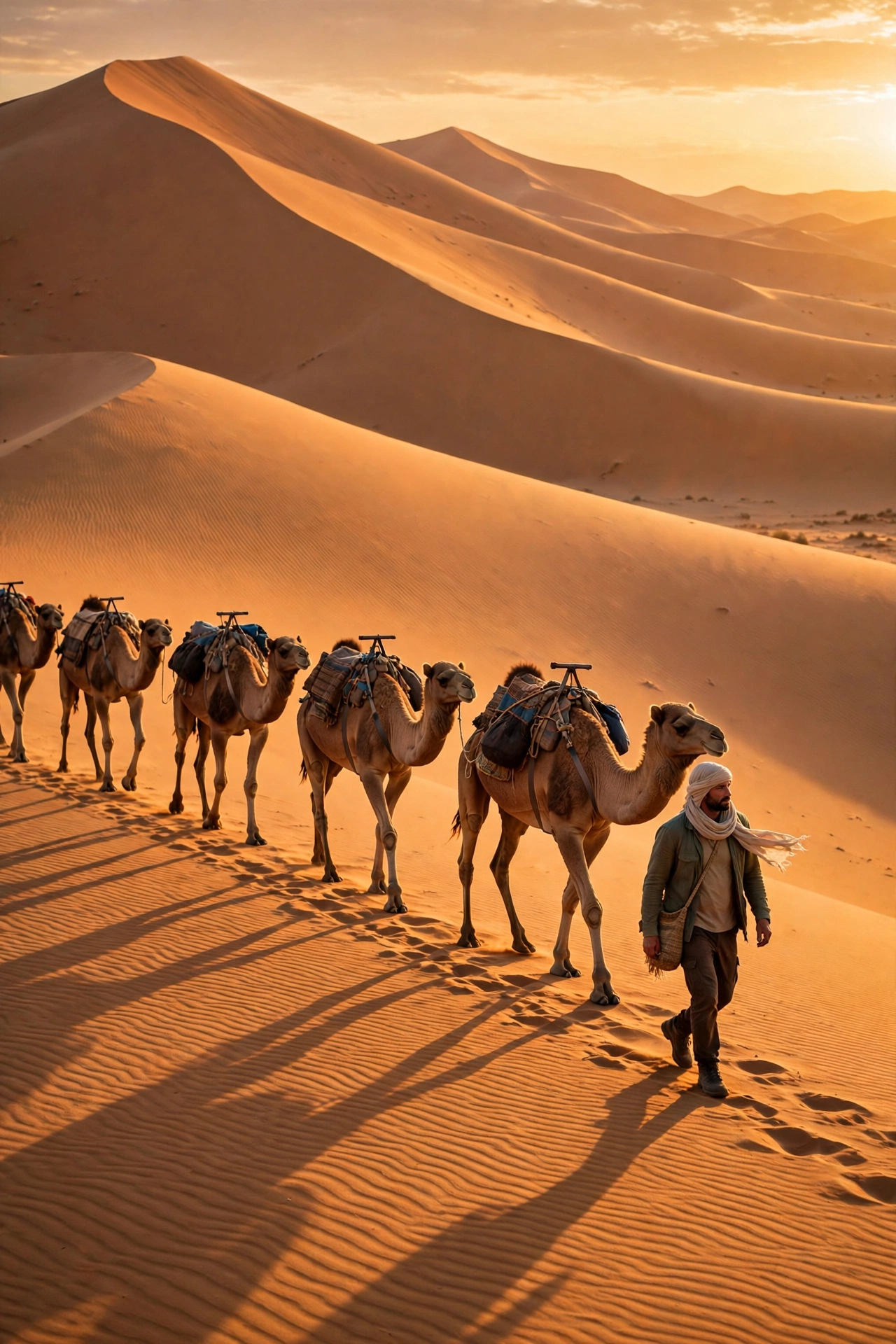
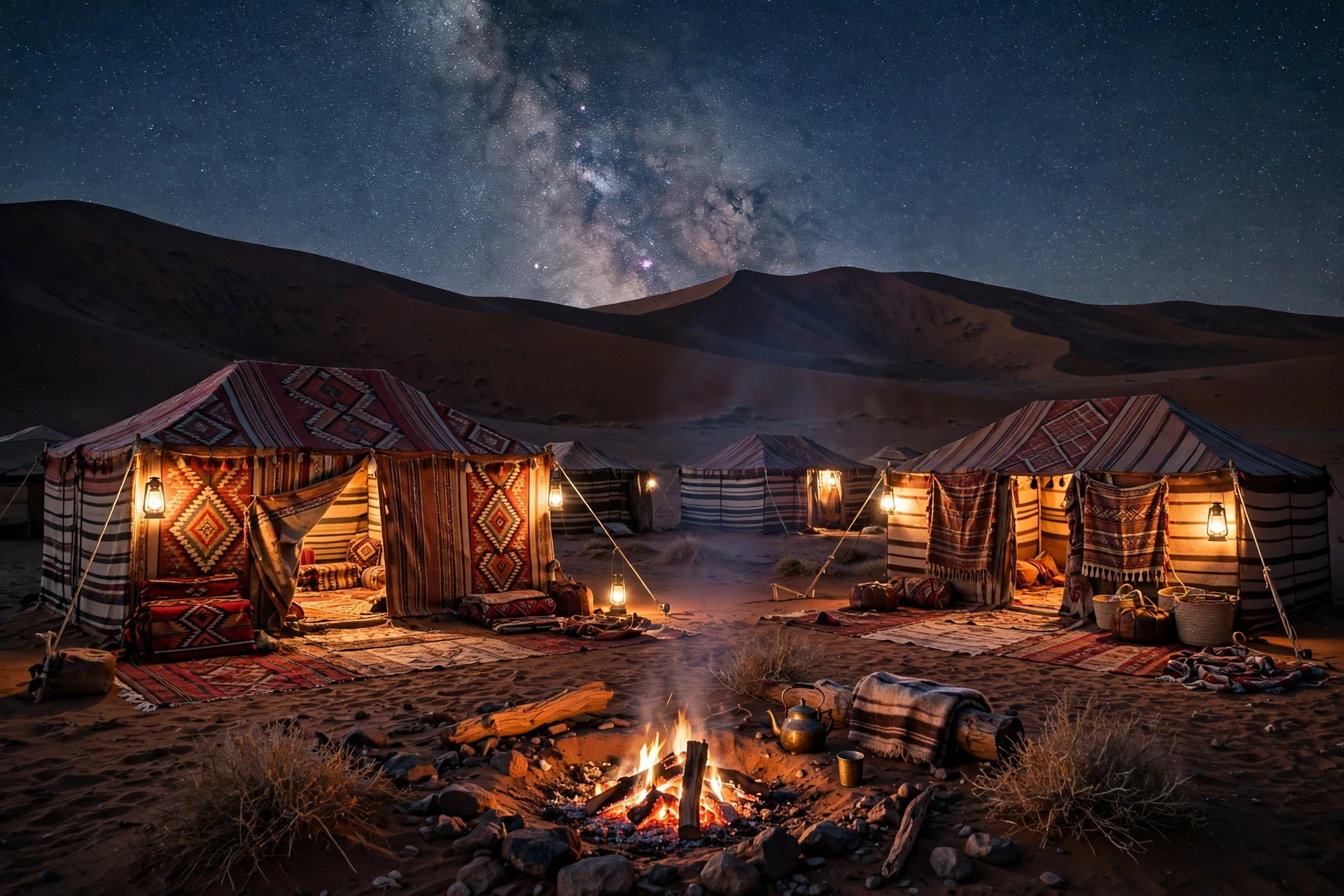
Your camp waits among the dunes. Standard camps have tents, dinner, and Berber music around a fire. Luxury camps add proper beds, en suite tents, and heating, which in November is worth real money. Eat tagine, listen to drums, and then step away from the fire and look up. If you have never seen the Milky Way properly, this is where you will.
Day three: sunrise, then the long way home
Set an alarm. Sunrise over Erg Chebbi is not a nice extra, it is half the point. Climb a dune in the dark, sit still, and watch the light creep across the ridges. The sand goes from grey to pink to gold in about twenty minutes. Then ride the camels back, or walk if you prefer, have breakfast, and start the drive home.
The return route runs through the Roses Valley around El Kelaa M’Gouna, then back over the Atlas. It is a long day, and there is no honest way to pretend otherwise. Break it up with stops, buy snacks, download music or podcasts before you leave Marrakech, and treat the drive as part of the trip rather than dead time. The landscapes keep changing, from dunes to valleys to mountains, and that variety is actually the secret pleasure of this route.
Want more mountains? Add Toubkal
If three days in the desert leaves you hungry for a bigger physical challenge, Mount Toubkal is the obvious next step. At 4,167 meters, it is the highest peak in North Africa, and it sits only about 63 kilometers south of Marrakech in Toubkal National Park.
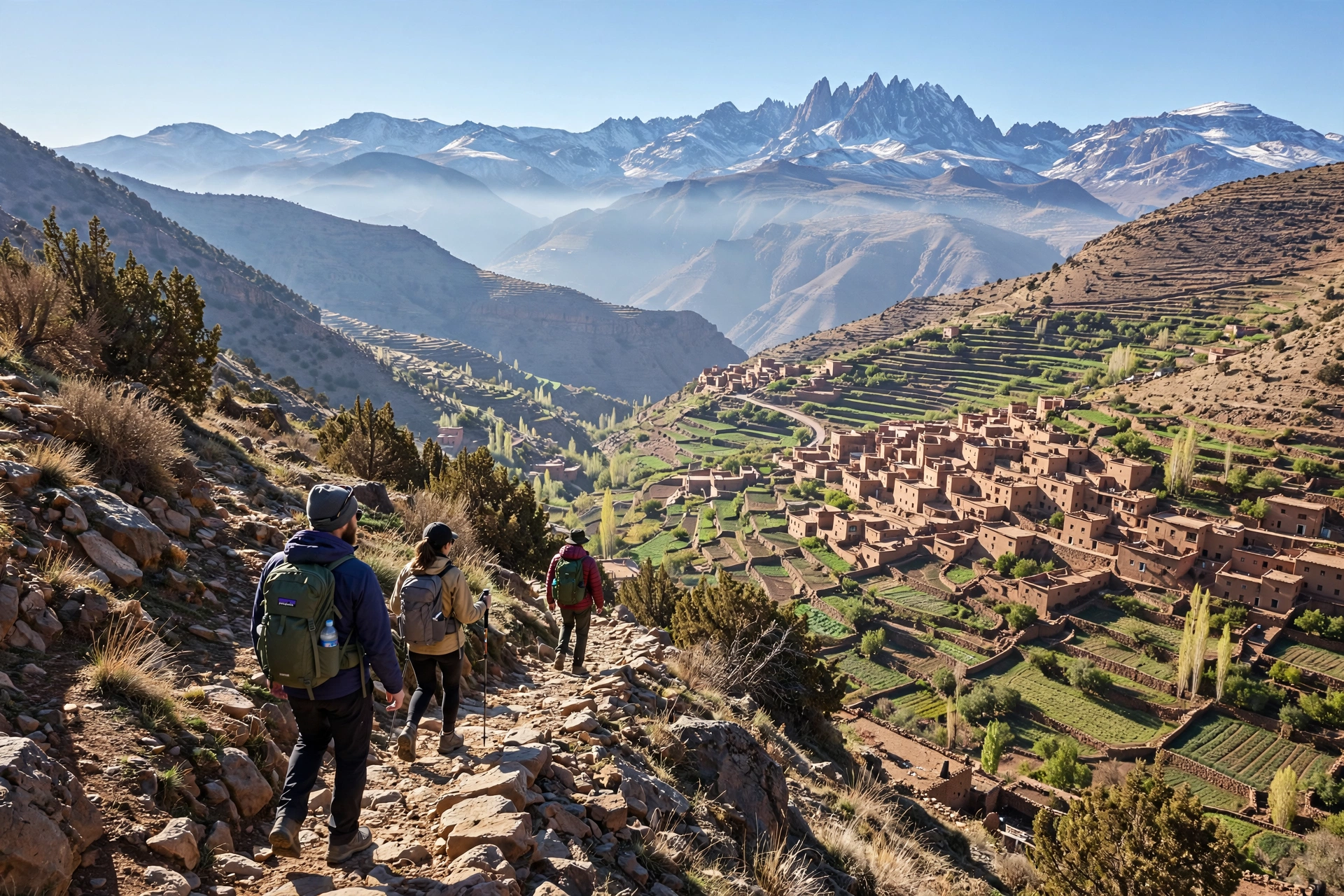
Most treks start in Imlil village at 1,740 meters, climb to the Toubkal Refuge at about 3,207 meters, and push for the summit early the next morning. It is a two to four day trek depending on how much acclimatization time you build in, and it needs a licensed local guide. The honest difficulty rating is moderate to challenging. You do not need technical climbing skills in normal seasons, but you do need fitness, and altitude does not care how fit you think you are. Go slow, drink water, and do not be proud about turning back if a headache gets worse.
Pairing Toubkal with the Sahara trip makes a superb five to seven day Morocco itinerary: city, mountains, desert, in that order. Your legs will complain. Your photo album will not.
What it actually costs
Prices vary a lot, so here are real ranges from operators running these tours in 2026, not guesses. A shared three day tour from Marrakech to Merzouga starts from about 85 euros per person, with private three day tours from about 195 euros. One operator lists private three day tours at 450 to 680 euros per person depending on group size, with smaller groups paying more per head. That spread tells you something important: the cheapest tour and the most expensive tour are not the same product, even when the itinerary looks identical on paper.
What changes the price? Private driver versus shared minibus, standard camp versus luxury camp, hotel standard on the Dades Valley night, and how many people are splitting the vehicle cost. Read what is included before you book. Lunches, entrance fees to places like Ait Ben Haddou, drinks, and tips for guides and camel handlers are often excluded, so budget for them separately.
My practical take: if you can afford it, go private with a small group and upgrade the desert camp. The shared tours are fine and social, and plenty of travelers love them, but a private driver stops when you want to stop, and in November, a warm tent with a real bed is not a luxury, it is common sense.
What to pack, and what to leave behind
Pack layers, not bulk. A warm jacket and a fleece for desert nights, light clothes for Marrakech afternoons, closed walking shoes with grip for dunes and gorges, sunscreen, a scarf for wind and dust, and a headlamp for the camp. A power bank matters too, because desert camps have limited charging, and you will take more photos than you expect.
Leave the wheeled suitcase in Marrakech if you can. Most riads and tour operators will store luggage. Take a soft duffel or backpack for the desert nights. You will be climbing onto a camel and into a tent, and a hard suitcase is nobody’s friend in either situation.
Also, bring cash in small notes. Tips, snacks, and small purchases along the route are much easier in cash, and card machines are not guaranteed in villages and camps.
Who should skip this trip?
Honesty matters here, because this trip is not for everyone. Skip the camel ride if you have a bad back, bad knees, or you are pregnant, and ask your camp about a 4×4 transfer into the dunes instead. Many camps offer it, and you still get the sunset and the stars without the swaying. Skip the two day express version if long car journeys make you miserable. And if you hate early mornings, know that both the desert sunrise and the Atlas viewpoints reward early risers, and sleeping in means missing the best light of the day.
For everyone else, especially first time visitors to Morocco who want one trip that delivers mountains, film set villages, gorges, and a real desert night, this is the trip. It solves the exact problem most Morocco itineraries have: too much time in the city, not enough time in the landscapes that make the country unforgettable.
The bottom line
Marrakech will charm you, haggle with you, and exhaust you in equal measure. The Sahara will quiet you down. There is something about standing on a dune at dawn, with nothing but sand in every direction, that resets a person. It is not a luxury experience, and it is not a polished resort holiday. It is better than that. It is a real journey, with dust in your shoes and stars overhead, and it is the story you will still be telling years after the souk souvenirs have broken or been forgotten.
Go in November if you can. Book Merzouga, not Zagora. Take three days, not two. Upgrade the camp. Set the alarm for sunrise. And when you get home, tell someone else, because a trip this good deserves to be passed on.
Want more adventures like this? Follow The Cavee on Pinterest for weekly travel ideas, and read the full story here on thecavee.com. If you loved the desert, you will also enjoy our guide to the Ha Giang Loop in Vietnam, our look at where the Serengeti herds are right now, and our Mount Huashan plank walk guide. For desert specifics, check the best things to do in Merzouga and the Mount Toubkal trekking guide for the mountain add on.